Category Archives: Estate Planning

Estate Planning Lawyer Erda Utah

Estate Planning Lawyer Erda Utah

Estate Planning Lawyer Erda Utah

I am attorney Jeremy Eveland. This is abaout Estate Planning Lawyer Erda Utah. Call me at (801) 613-1472 when you need help with estate planning in Erda Utah.

Understanding Estate Planning Lawyer Erda Utah

This guide covers Estate Planning Lawyer Erda Utah and what you need to know. If you are searching for a trusted estate planning lawyer in Erda, Utah, you have come to the right place. Erda is a small community in Tooele County, located just west of Salt Lake County along the I-80 corridor. Residents of Erda often face the same estate planning challenges as families throughout Utah — protecting hard-earned assets, providing for minor children, avoiding probate, and making sure their wishes are honored when they can no longer speak for themselves. Attorney Jeremy Eveland has helped families across Tooele County and the greater Salt Lake area create clear, legally sound estate plans. Call our office at (801) 613-1472 to schedule a free consultation with an experienced estate planning lawyer serving Erda, Utah.


Learn More About Avoiding Probate

Why Estate Planning is Important for Erda, Utah Residents

Protecting Your Assets

Estate planning is crucial for protecting your hard-earned assets and ensuring they are distributed according to your wishes after your passing. Erda families who own property, farm land, or small businesses face unique considerations — without a solid plan, those assets can be tied up in Utah’s probate courts for months or even years. By creating a comprehensive estate plan with an experienced estate planning lawyer in Erda, Utah, you can establish legal safeguards to prevent disputes or confusion regarding the distribution of your assets. This provides peace of mind, knowing that your belongings and wealth will end up in the hands of the individuals or organizations you desire. If you want to explore your options for estate planning for real estate and holding companies, our office can walk you through every available strategy.

Ensuring the Well-Being of Your Loved Ones

Another significant aspect of estate planning is ensuring the well-being of your loved ones, especially if they depend on your financial support. Through a well-designed estate plan, you can create trust funds or establish guardianship for minor children, guaranteeing that their future needs will be taken care of in the event of your absence. Learn more about estate planning for children and how to protect your family’s financial future. By planning ahead, you can provide financial stability and security for your family and ensure their future prosperity. If you are unsure when to begin, read our guide on when you should start estate planning — the answer is almost always sooner than you think.

Minimizing Estate Taxes

Estate planning also provides opportunities to minimize the tax burden on your estate. Through strategic tax planning, a knowledgeable estate planning lawyer can help you take advantage of various legal tools and exemptions to reduce the amount of estate taxes your heirs will have to pay. For example, understanding the tax basis step-up rules can help your beneficiaries avoid significant capital gains taxes. This helps preserve the value of your assets and ensures that more of your wealth is passed on to your loved ones, rather than being depleted by taxes. Under Utah Code Ann. § 75-2-101 et seq. (the Utah Uniform Probate Code), careful estate planning can substantially reduce your estate’s exposure to both federal and state-level obligations.

Understanding the Role of an Estate Planning Lawyer in Erda Utah

Legal Expertise and Knowledge

An estate planning lawyer in Erda, Utah is a legal professional who specializes in assisting individuals in creating and implementing their estate plans. They possess a deep understanding of estate planning laws and regulations — including Utah’s specific probate statutes — and keep up-to-date with any changes that might affect their clients’ plans. With their expertise, they can guide you through the complex legalities involved in estate planning and ensure that your wishes are carried out in a legally sound manner. You can find a useful overview of estate planning fundamentals at Cornell Law School’s Legal Information Institute.

Tailored Estate Plans

Every individual’s circumstances and goals are unique, and an estate planning lawyer takes this into account when designing an estate plan. They carefully assess your financial situation, family dynamics, and personal priorities to create a customized plan that aligns with your specific needs. Whether you are planning at any income level or dealing with a blended family situation, our firm designs solutions that protect your interests. By tailoring the estate plan to your requirements, an estate planning lawyer can address any potential complexities and provide solutions that work for your specific situation.

Assistance with Complex Legal Processes

The legal processes involved in estate planning can be intricate and time-consuming. An estate planning lawyer can simplify these processes for you and guide you through each step. Whether it’s drafting wills and trusts, creating powers of attorney, or navigating probate and estate administration, an experienced lawyer will ensure that all legal requirements are met and that your estate plan is implemented effectively.

Estate Planning Lawyer Erda Utah

Click Here For More Information About the Probate Process

Services Offered by an Estate Planning Lawyer Serving Erda Utah

Wills and Trusts

Drafting a will is a fundamental aspect of estate planning. An estate planning lawyer in Erda, Utah can help you articulate your final wishes, appoint an executor, and designate beneficiaries for your assets. Your will must meet all legal requirements under Utah law, and your instructions must be clear and unambiguous to hold up in probate court.

Trusts are another valuable tool utilized in estate planning. They allow you to transfer assets to a trustee, who holds and manages them on behalf of your beneficiaries, often without the delay and expense of probate. Working with an estate planning lawyer, you can explore various types of trusts — such as revocable living trusts, irrevocable trusts, and testamentary trusts — and determine which best suits your objectives. For a deeper look at protecting your assets through trust structures, read our guide on asset protection trusts in Utah.

Power of Attorney

Granting a power of attorney is an important part of estate planning, as it allows a trusted individual to make financial or legal decisions on your behalf if you become incapacitated. Our firm can help you understand the different types of power of attorney — including durable power of attorney and limited power of attorney — and ensure that the document is properly executed under Utah law. You can also learn more about the general framework of power of attorney in Utah on our website.

Healthcare Directives

Healthcare directives, including living wills and healthcare power of attorney, allow you to express your medical wishes and appoint a healthcare agent to make medical decisions for you if you are unable to do so. An estate planning lawyer can guide you through the process of creating these directives, ensuring that your healthcare choices are respected and your loved ones have the authority to act on your behalf in a medical crisis.

Probate and Estate Administration

In the unfortunate event of your passing, an estate planning lawyer can assist your loved ones with the probate and estate administration process. They will help your designated executor fulfill their duties, including asset distribution, paying off debts, and resolving any claims against the estate. If you want to understand what to expect, read our complete guide on the 10 steps to start probate in Utah. You should also be aware of the 13 hidden costs of probate in Utah that most families never anticipate. By working with an experienced lawyer, you can ensure that this process is handled smoothly, minimizing any potential issues or conflicts.

Estate Planning for Second Marriages and Blended Families in Erda

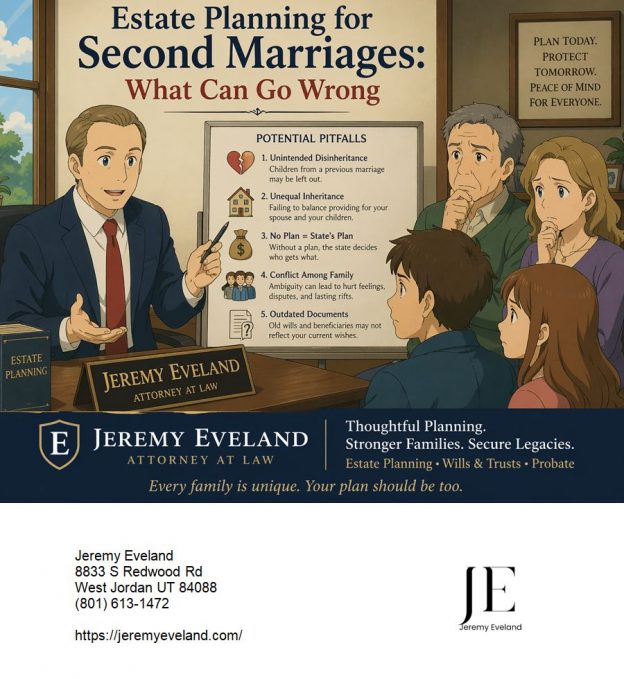
Second marriages and blended families create unique estate planning challenges. Without careful planning, assets intended for your children from a prior relationship may pass unintentionally to a new spouse — or vice versa. Our firm has guided many Erda-area families through these sensitive situations. Learn about the most common pitfalls in our article on estate planning for second marriages. If you are entering or have recently entered a second marriage, you may also want to review prenuptial agreement advice to protect both parties from the start.

Charitable Giving and Advanced Estate Planning Strategies

Estate planning is not only about passing assets to family members. Many Erda residents also want to make meaningful charitable contributions as part of their legacy. Strategies such as charitable gift annuities allow you to support causes you care about while also providing income and potential tax benefits. Our office can help you explore these advanced strategies and determine what fits your goals and values.

Choosing an Estate Planning Lawyer in Erda Utah

Experience and Expertise

When selecting an estate planning lawyer in Erda, Utah, it is essential to consider their experience and expertise in this specific area of law. Look for a lawyer who has a proven track record in estate planning and has dealt with cases similar to yours. Attorney Jeremy Eveland has served clients throughout Tooele County, Salt Lake County, and the entire Wasatch Front for years. His knowledge and experience are invaluable in designing a comprehensive estate plan that meets your unique needs.

Client Reviews and Testimonials

Reading client reviews and testimonials can give you valuable insight into the reputation and quality of service provided by an estate planning lawyer. Look for positive feedback from past clients who have entrusted their estate planning needs to the lawyer you are considering. This can provide reassurance and confidence in their ability to handle your case effectively.

Fee Structure and Payment Options

Estate planning is a long-term process, and you want to ensure that you can afford the services of an estate planning lawyer in the long run. Before engaging an attorney, discuss their fee structure and payment options. Some lawyers may charge an hourly rate, while others may offer a flat fee for certain services. Clarify any questions you have regarding fees and make sure you are comfortable with the financial arrangements before proceeding. Call (801) 613-1472 to discuss our fee structure.

Estate Planning Lawyer Erda Utah

Estate Planning Process in Erda Utah

Initial Consultation

The estate planning process typically begins with an initial consultation with an estate planning lawyer. During this meeting, you can discuss your goals, concerns, and specific needs for your estate plan. The lawyer will ask you detailed questions about your assets, family dynamics, and any other relevant information to gain a comprehensive understanding of your situation. For Erda residents, we offer consultations at our office in Lindon, Utah — conveniently accessible via I-15 from Tooele County.

Asset Evaluation

To design an effective estate plan, your lawyer will conduct a thorough evaluation of your assets. This evaluation includes identifying all your properties, bank accounts, investments, and other valuables. It will help determine the best strategies for asset protection, tax planning, and the distribution of your wealth to your intended beneficiaries.

Designing the Estate Plan

Based on the information gathered during the initial consultation and asset evaluation, your estate planning lawyer serving Erda, Utah will develop a tailored estate plan that meets your unique requirements. They will draft legal documents, such as wills, trusts, and healthcare directives, ensuring that they accurately reflect your wishes while complying with relevant Utah laws and regulations.

Review and Finalization

Once the initial draft of your estate plan is prepared, you will have the opportunity to review and provide feedback. Your estate planning lawyer will carefully consider your input and make any necessary revisions to ensure the plan aligns with your wishes. This collaborative process continues until you are fully satisfied with the final version of your estate plan.

Execution and Implementation

After the finalization of your estate plan, your lawyer will guide you through the process of executing the legal documents. They will ensure that all necessary signatures and formalities are met to make your estate plan legally binding under Utah law. By implementing your estate plan correctly, you can rest assured that your wishes will be carried out as intended.

Common Estate Planning Mistakes to Avoid

Understanding what not to do is just as important as knowing what to do. Read our in-depth article on the #1 estate planning mistake that destroys generational wealth for a comprehensive look at what trips up even well-intentioned families.

Failure to Update Documents

One common mistake in estate planning is neglecting to update important documents regularly. Life circumstances, such as marriage, divorce, births, or deaths in the family, can significantly impact your estate plan. Failing to update your estate plan to reflect these changes can lead to unintended outcomes and potentially lengthy and costly legal battles. It is important to review your estate plan regularly, ideally with the guidance of an estate planning lawyer, to ensure its continued relevance and effectiveness.

Lack of Beneficiary Designations

Failing to designate beneficiaries for your assets, such as life insurance policies, retirement accounts, or bank accounts, can create unnecessary complications for your loved ones down the line. Without clear beneficiary designations, the distribution of these assets may be subject to the probate process, causing delays and potential disputes. Properly designating beneficiaries ensures a smoother transfer of assets and helps avoid unnecessary legal complications.

Not Planning for Incapacity

Many individuals focus solely on creating an estate plan for after their passing but overlook the importance of planning for potential incapacity. By including power of attorney and healthcare directives in your estate plan, you can prepare for unexpected circumstances where you may be unable to make financial or medical decisions for yourself. Planning for incapacity helps ensure that your affairs are managed according to your wishes and reduces the burden on your loved ones during challenging times. To understand when you may need professional legal guidance, see our article on 9 signs you need a probate lawyer in Utah right now.


Understanding Power of Attorney

Types of Power of Attorney

Power of attorney is a legal document that grants an individual, known as the agent or attorney-in-fact, the authority to act on behalf of another person, known as the principal. There are different types of power of attorney, including general power of attorney, limited power of attorney, and durable power of attorney. Each type has its own scope and restrictions, depending on the rights and responsibilities the principal wishes to delegate. Utah’s statutes governing powers of attorney are found at Utah Code Title 75, Chapter 9 (Utah Uniform Power of Attorney Act).

Duties and Responsibilities

The duties and responsibilities of a power of attorney agent vary depending on the powers granted in the document. They may include managing financial affairs, paying bills, making investments, and handling legal matters on behalf of the principal. It is crucial to choose a trustworthy agent who will act in your best interests and follow your instructions diligently.

Revoking a Power of Attorney

There may come a time when you wish to revoke a power of attorney due to changes in circumstances or a loss of trust in the agent. To revoke a power of attorney, you must follow specific legal procedures, such as drafting a revocation document and notifying the agent of the revocation. An estate planning lawyer in Erda, Utah can guide you through the process and ensure that the revocation is properly executed to protect your interests.

Importance of Healthcare Directives

Living Will

A living will is a legal document that allows you to specify your wishes regarding medical treatment in the event that you are unable to communicate or make decisions for yourself. It outlines your preferences regarding life-sustaining treatments, resuscitation, and end-of-life care. Having a living will ensures that your healthcare providers and loved ones are aware of your desires and can respect them when making medical decisions on your behalf.

Healthcare Power of Attorney

A healthcare power of attorney, also known as a healthcare proxy, designates an individual to make healthcare decisions for you if you are incapable of doing so. This person, referred to as the healthcare agent, should be someone you trust to make medical choices in line with your beliefs and values. By appointing a healthcare power of attorney, you can have peace of mind knowing that your healthcare decisions will be made by someone who understands your wishes.

Discussing End-of-Life Care with Loved Ones

While it may be uncomfortable to discuss end-of-life care, it is essential to have these conversations with your loved ones. Communicating your wishes regarding medical treatment, resuscitation, and other important decisions can prevent confusion and potential conflicts among family members during stressful times. By discussing these matters openly and honestly, you can ensure that your desires are known and respected.

Estate Planning Lawyer Erda Utah

The Probate and Estate Administration Process in Utah

Executor’s Duties and Responsibilities

The executor of an estate is responsible for overseeing the administration and distribution of assets according to the terms of the will. Their duties include gathering and managing assets, paying off debts and taxes, and distributing the remaining property to beneficiaries. Our article on 7 things you must do immediately after someone dies in Utah is an essential resource for executors and surviving family members. An estate planning lawyer can assist the executor in understanding their responsibilities and ensure that the probate process is carried out efficiently.

Asset Distribution

During the probate process, the assets of the deceased individual are distributed to the intended beneficiaries. This distribution is governed by the terms of the will or, in cases where there is no will, by Utah’s intestacy laws under Utah Code Ann. § 75-2-101. An estate planning lawyer can help ensure that the asset distribution is carried out properly, addressing any legal considerations and minimizing the risk of disputes among beneficiaries.

Resolving Estate Debts and Claims

As part of the probate process, estate debts and claims must be addressed and resolved. This includes paying off outstanding debts, notifying creditors, and handling any legal claims that may arise. An experienced estate planning lawyer can guide the executor through these processes, ensuring that all debts and claims are appropriately handled and that the estate’s assets are protected. For families navigating this process without prior planning, the costs can be significant — read about the 11 probate mistakes that cost Utah families thousands to avoid the most common pitfalls.

Serving Erda and Surrounding Tooele County Communities

Our firm proudly serves clients throughout Erda and all of Tooele County, including Tooele City, Stansbury Park, Grantsville, Stockton, and the surrounding areas. Erda, Utah sits along the I-80 corridor between Tooele and Salt Lake City, making it easily accessible for our team. Whether you own property in Tooele County, run a family business near Erda, or simply want to ensure your loved ones are protected, our office is ready to help. We also serve clients in the Salt Lake City, Utah area and nearby communities like Mapleton.

Tips for a Smooth Estate Planning Process

Organize Your Documents

To streamline the estate planning process, it is crucial to organize your important documents and financial records. Compile documents such as wills, trusts, insurance policies, bank statements, and property titles into a central location. This will not only make it easier for your estate planning lawyer but also provide a comprehensive overview of your assets and liabilities.

Communicate with Your Loved Ones

Open and transparent communication with your loved ones about your estate plan is essential. Discussing your intentions and expectations can help eliminate surprises and potential conflicts among family members. By involving your loved ones in the estate planning process, you can ensure that everyone is aware of your wishes and understands their roles and responsibilities.

Update Your Estate Plan Regularly

Life is constantly changing, and your estate plan should reflect these changes. Regularly review and update your estate planning documents to account for any significant life events, such as marriage, divorce, births, deaths, or changes in financial circumstances. By keeping your estate plan up to date, you can ensure that it accurately reflects your current wishes and provides maximum protection for your loved ones and assets.

Estate planning plays a crucial role in protecting your assets, ensuring the well-being of your loved ones, and minimizing estate taxes. By working with an experienced estate planning lawyer in Erda, Utah, you can benefit from their legal expertise and knowledge, receive tailored estate plans, and receive assistance with complex legal processes. The services provided by an estate planning lawyer include drafting wills and trusts, establishing powers of attorney and healthcare directives, as well as guiding you through the probate and estate administration process. When choosing an estate planning lawyer, consider their experience and expertise, client reviews and testimonials, as well as their fee structure and payment options. The estate planning process involves an initial consultation, asset evaluation, designing the estate plan, review and finalization, and execution and implementation. It is important to avoid common estate planning mistakes such as failure to update documents, lack of beneficiary designations, and not planning for incapacity. Understanding the different types of power of attorney and the importance of healthcare directives is crucial for ensuring that your interests are protected in various situations. Finally, follow helpful tips for a smooth estate planning process, including organizing your documents, communicating with your loved ones, and updating your estate plan regularly. By taking these steps and seeking guidance from an estate planning lawyer serving Erda, Utah, you can have peace of mind knowing that your assets and loved ones will be taken care of according to your wishes. Call attorney Jeremy Eveland at (801) 613-1472 today to schedule your free consultation.

More Information Here

Jeremy Eveland
17 North State Street
Lindon UT 84042
(801) 613-1472

Home

For legal assistance, contact Jeremy Eveland, Attorney at Law — 8833 S Redwood Rd #A, West Jordan, UT 84088 · (801) 613-1472.

The #1 Mistake That Destroys Generational Wealth

The #1 Estate Planning Mistake That Destroys Generational Wealth

The #1 Estate Planning Mistake That Destroys Generational Wealth

This guide covers Estate Planning Mistake That Destroys and what you need to know. Most families do not lose their wealth because of one catastrophic event; they lose it because their estate plan stops at a simple will and never becomes a real wealth preservation strategy. In practice, that is the #1 estate planning mistake: treating estate planning as a one-time, document-driven event instead of a living, multi-generational plan designed to protect assets, reduce taxes, prevent probate, prepare heirs, and preserve control. Research is often summarized this way: about 70% of family wealth is gone by the second generation and 90% by the third, and while the exact figures vary by study, the pattern is consistent—wealth rarely survives without structure and education.^1

This article explains how that mistake shows up in real life: tax exposure, asset vulnerability, business failure, probate delays, family conflict, and heirs who are unprepared to manage inherited wealth. It also shows how a Utah family can break that cycle with a coordinated plan built around trusts, entity structuring, incapacity planning, beneficiary audits, business succession, and family governance. If you want generational wealth to last, the right move is not just signing documents; it is working with an experienced Utah estate planning attorney who understands wealth preservation, tax efficiency, and family dynamics.^3^5

Why wealth disappears

The statistic that most family wealth disappears by the second or third generation is widely cited in estate planning and wealth management circles, and the practical meaning is simple: money alone does not preserve wealth. Families often assume their children will “figure it out,” but inheritance without structure, education, and clear rules often leads to spending, conflict, poor investments, or forced liquidation of valuable assets. The Williams Group statistic is commonly used to describe this pattern, and the larger lesson is that the transfer of wealth is not just a legal event—it is a financial, emotional, and cultural transition.^2

The difference between transferring money and transferring wealth is huge. Money is a number; wealth includes knowledge, discipline, governance, tax strategy, asset protection, and a plan for how assets should support future generations. Without those pieces, even a large estate can evaporate through taxes, lawsuits, divorce, bad business decisions, family fighting, or simple lack of preparation. In real life, families lose wealth when a ranch, business, rental portfolio, or investment account is inherited with no rules, no training, and no structure to preserve it.^6

The core mistake

The core mistake is believing that a will is the same thing as an estate plan. A will is important, but by itself it only says who should receive property after death and how probate should begin; it does not automatically avoid court, protect assets from creditors, reduce tax exposure, prepare heirs, or keep a business running. In Utah, a will generally still must go through probate to prove the transfer of property, which is why relying on a will alone can create delay, expense, and public disclosure.^4

A true estate plan is designed to preserve, protect, and grow wealth across generations. That means using the right mix of revocable trusts, irrevocable trusts, entity planning, beneficiary designations, incapacity documents, tax planning, and family education. Even sophisticated people make this mistake because they feel “done” once documents are signed, but wealth preservation is an ongoing process, not a binder on a shelf. When the plan is only a will, everything important is left to chance: taxes, creditors, business continuity, family harmony, and whether heirs are ready.^7

Eight ways wealth is destroyed

No tax strategy

A simple will often leaves families with missed tax opportunities. For larger estates, that can mean unnecessary exposure to federal estate tax, and for many families it also means losing planning opportunities during life such as annual exclusion gifts, insurance planning, and trust-based transfer strategies. Tools like irrevocable life insurance trusts, grantor retained annuity trusts, charitable remainder trusts, and other advanced techniques are designed to move wealth more efficiently, but they are frequently ignored when planning stops at a will.^9

The result is that heirs receive less because tax costs consumed more of the estate. A coordinated plan built with an attorney and CPA can reduce transfer taxes and preserve more of the estate for children and grandchildren. The earlier these strategies are implemented, the more flexibility the family has.^9

No asset protection

A will passes property, but it does not shield inherited assets from lawsuits, divorce, bankruptcy, or poor decisions. Once inherited wealth is distributed outright, it can become the most exposed wealth a person owns, especially if the heir is in a risky profession, a troubled marriage, or financial distress. A simple inheritance can be vulnerable the same day it is received.^10

To reduce that risk, families often use dynasty trusts, spendthrift provisions, asset protection trusts, and LLC structures to create barriers around inherited wealth. Utah law specifically recognizes asset protection trust structures that, if properly formed and funded, can limit creditor access under the statute. The key is to build protection before a problem appears.^5

No business succession plan

Family businesses are often the biggest source of generational wealth and one of the easiest assets to lose. Without a succession plan, heirs may disagree about control, a surviving spouse may lack authority, key employees may leave, and the business may be sold at a discount just to end the conflict. In many families, the operating business is worth more than the liquid assets, which makes a lack of succession planning especially dangerous.^6

The solution is to integrate buy-sell agreements, management succession planning, insurance funding, and entity structuring into the estate plan. That way, ownership transfer, control transfer, and cash flow planning happen in an orderly way. A business that is planned for can survive the founder’s death; a business that is not planned for often becomes a family dispute.^6

Unprepared heirs

One of the most overlooked causes of generational wealth destruction is that the heirs are not prepared to manage what they inherit. If a child receives a large lump sum with no training, no guardrails, and no accountability, the money can disappear through spending, bad investing, or outside pressure. Wealth is not preserved by inheritance alone; it is preserved by stewardship.^1

Avoid this by using incentive trusts, staged distributions, family meetings, and financial education during life. A structure that allows a trustee to release assets over time can protect an heir from their own inexperience. The goal is not control for its own sake; it is to create maturity before full access.^1

Outdated documents

Estate plans go stale. A trust drafted 15 years ago may not reflect today’s tax laws, your current marriage status, your blended family, your business sale, your new home, or the fact that you now own digital assets or crypto. Old plans also often fail because the beneficiary forms on retirement accounts and life insurance were never updated, and those designations usually control regardless of what the will says.^8

The fix is simple but often neglected: review the whole plan every 3 to 5 years, and after major life events such as marriage, divorce, birth, death, business sale, relocation, or a major liquidity event. Every account should be coordinated with the trust and the estate documents. A stale plan is worse than no plan only when it creates a false sense of security.

Family conflict

Inheritance disputes destroy wealth fast. Ambiguous language, unequal distributions, second marriages, resentment, and silence about the plan create a perfect environment for litigation. Even families that love each other can fight hard when money, expectations, and grief mix together.^11

To reduce conflict, use clear documents, a letter of intent, a communication plan, and mediation or dispute-resolution provisions where appropriate. Utah probate and trust law provide procedures for administering estates and trusts, but court involvement is expensive and public. The best dispute is the one that never starts.^4

No incapacity plan

Estate planning is not just about death. If you become incapacitated without durable powers of attorney, healthcare directives, or trust provisions for incapacity, your family may need a court proceeding to manage your affairs. That can freeze accounts, stall business operations, and create conflict among family members while you are still alive.^12

A complete plan includes financial powers of attorney, healthcare directives, and trust provisions that name who can step in and how decisions should be made. Utah provides statutory forms and legal structures for these documents. Incapacity planning is what keeps a family from having to go to court in a crisis.^13

Probate dependency

A will often means probate, and probate is slow, public, and expensive. Utah law states that a will generally must be declared valid by probate before it proves transfer of property, which makes probate the default path for will-based plans. During that process, assets may be delayed, legal fees accumulate, and family financial details become part of the court record.^4

To avoid probate, families often use revocable living trusts, beneficiary designations, and transfer-on-death or payable-on-death tools where appropriate. Proper titling and funding are essential because a trust that is not funded does not do the job. Probate is not always avoidable for every asset, but it should rarely be the main plan.^5

What a real plan includes

A real multi-generational estate plan starts with a revocable living trust and a pour-over will, then adds the right layers based on the family’s assets and goals. For tax planning and asset protection, that may include irrevocable trusts such as dynasty trusts, ILITs, SLATs, GRATs, or QPRTs. For business owners, it should include succession planning, buy-sell agreements, and ownership structuring.^7

It also includes an asset protection layer, beneficiary designation audits, incapacity documents, and family governance tools. Charitable strategies like donor-advised funds, charitable remainder trusts, or private foundations can fit into the plan when philanthropy is part of the legacy. The point is coordination: each tool should support the others instead of operating in isolation.^5

Real cost of failure

The cost of failing to plan is not just taxes. It includes legal fees, probate costs, business disruption, creditor claims, and the loss of value that happens when assets are sold under pressure. It also includes time, because families can spend years in court or in conflict while the estate sits unfinished.^4

The emotional cost can be even worse. Parents often spend a lifetime building not just money but identity, values, and stability for their children, and a bad plan can destroy all three. Compared with that, the cost of comprehensive planning is modest, especially when measured against the assets and peace of mind it protects.

How an attorney helps

An experienced Utah estate planning attorney does much more than draft forms. The right lawyer designs a plan around your assets, your family structure, your business, your tax exposure, and your long-term goals. That means coordinating with your CPA, financial advisor, and insurance professionals so the legal plan supports the whole wealth picture.^7

A strong attorney also helps with trust creation and funding, business succession, asset protection, incapacity planning, and family communication. They should review the plan over time as your life and the law change. For Utah families who want to preserve wealth across generations, that coordinated approach matters far more than isolated documents.^3^4

Planning tools that matter

Revocable living trusts

A revocable living trust is often the foundation of a modern estate plan. It can help avoid probate, keep affairs private, and provide continuity if the settlor becomes incapacitated. It is flexible during life, but it is not, by itself, an asset protection or tax elimination tool.^5

Irrevocable trusts

Irrevocable trusts can move assets outside the taxable estate and create stronger creditor protection. Dynasty trusts, ILITs, SLATs, GRATs, and QPRTs are all examples of tools that may be used for tax efficiency and long-term control, depending on the family’s goals and circumstances. These must be drafted carefully because the wrong structure can fail to achieve the intended result.^5

LLCs and FLPs

Family limited partnerships and LLCs are often used to organize investment real estate, operating businesses, and concentrated family assets. They can support liability management, succession planning, and valuation strategies when used correctly. They are not substitutes for a trust, but they are powerful companions to one.

Beneficiary designations

Retirement accounts, life insurance, and annuities pass by beneficiary form, not by will. That means a stale form can undo a carefully written estate plan. Every beneficiary designation should be reviewed regularly and aligned with the trust and tax plan.^8

Charitable tools

Charitable remainder trusts, charitable lead trusts, donor-advised funds, and private foundations can reduce tax pressure while supporting the family’s philanthropic goals. These tools work best when giving is part of the family mission, not an afterthought. They can also help balance income, legacy, and tax planning in the right cases.

Buy-sell and insurance

A business succession plan often needs both legal documents and funding. Buy-sell agreements define what happens to ownership, and life insurance can provide liquidity so heirs or co-owners can execute the plan. Without funding, a buy-sell agreement can be more theory than solution.

TOD and POD

Transfer-on-death and payable-on-death designations can simplify transfer of some assets outside probate. They are useful for certain accounts, but they should not be the backbone of a large or complex estate. They work best as part of a coordinated plan, not as a substitute for one.

Incentive trusts

Incentive trusts can reward education, work, sobriety, entrepreneurship, or other family values. They are useful when heirs need guidance, not just cash. The limitation is that they must be drafted carefully so they motivate rather than create resentment.

Family governance

Family mission statements, education plans, and regular family meetings can preserve the purpose behind the money. Wealth without governance often becomes entitlement; wealth with governance can become stewardship. That is one of the biggest differences between money that lasts and money that disappears.^1

What to do now

If your plan is thin or outdated, start by gathering every existing document: wills, trusts, powers of attorney, healthcare directives, deeds, business records, and insurance policies. Then audit all beneficiary designations and inventory every asset, including real estate, businesses, retirement accounts, digital assets, and intellectual property. After that, identify the gaps in tax planning, asset protection, incapacity planning, and succession planning.^12

Next, meet with an experienced Utah estate planning attorney and coordinate with your CPA and financial advisor. Talk with your family enough to reduce confusion and conflict, but keep the plan coordinated and intentional. Then set a review schedule every 3 to 5 years or after major life events.^7

Utah laws to know

Utah follows the Utah Uniform Probate Code and Utah trust law, which govern wills, probate, and trust administration. Utah law also recognizes trusts with governing-law provisions and provides rules for trust administration and nonjudicial settlement agreements. For incapacity, Utah has statutory frameworks for powers of attorney and advance healthcare directives.^14^12^5

Utah also has a specific asset protection trust statute that, if properly used, can restrict creditor access under the statute’s requirements. Federal estate and gift tax rules still matter for Utah residents, so state planning must be coordinated with federal tax planning. Property ownership, homestead, creditor claims, and joint ownership issues should also be reviewed carefully because they affect how wealth transfers in practice.^9^5

Probate Attorney Herriman Utah

Probate Attorney Draper Utah

Probate Attorney Sandy Utah

Common mistakes to avoid

The biggest mistake is assuming a will is enough. Other major errors include failing to fund a trust, ignoring beneficiary forms, forgetting incapacity planning, skipping business succession, avoiding family communication, and waiting until a crisis to plan. Another common problem is assuming heirs will manage money responsibly without education or structure.^8

Digital assets, crypto, and intellectual property are also frequently overlooked. So are personal-and-business asset separations, which can create liability problems if co-mingled. Good planning is not just about documents; it is about building a system that works when life changes.

FAQ

What is the #1 estate planning mistake that destroys generational wealth?

It is treating estate planning as a one-time will package instead of a complete, multi-generational wealth preservation strategy.^4

Why do most wealthy families lose wealth by the third generation?

Because the money is inherited without enough structure, education, tax planning, or governance to preserve it.^2

Is a will enough to protect generational wealth?

No. A will alone usually does not avoid probate, protect assets, or provide tax-efficient long-term planning.^4

What is the difference between a will and a trust?

A will speaks at death and usually goes through probate; a trust can help manage assets during life, at incapacity, and after death without the same court process.^5

What is a dynasty trust?

A dynasty trust is an irrevocable trust designed to hold assets for multiple generations, often with tax and asset protection benefits.^5

How do estate taxes affect wealth transfer?

Estate taxes can reduce what heirs receive, especially when assets are illiquid or not planned for efficiently.^9

What is the federal estate tax exemption in 2026?

The federal exemption is described in current 2026 guidance as \$15 million per individual and \$30 million for married couples, with annual gift exclusion guidance at \$19,000 per recipient.^9

How do I protect an inheritance from divorce or creditors?

Use trusts with spendthrift protections, proper entity structuring, and distributions controlled by a trustee rather than outright ownership.^5

What is an ILIT?

An irrevocable life insurance trust can keep life insurance proceeds outside the taxable estate and provide liquidity for heirs or business needs.^7

How do I create a business succession plan?

Integrate ownership transfer, management transfer, buy-sell agreements, and insurance funding into the estate plan.^6

What happens if I become incapacitated without a plan?

Your family may need court involvement to manage your affairs, which can freeze assets and disrupt decisions.^13

What is the difference between a revocable and irrevocable trust?

A revocable trust can usually be changed by the settlor; an irrevocable trust generally cannot be changed easily and is often used for stronger tax or asset protection planning.^5

How often should I update my estate plan?

Every 3 to 5 years, and after major life events or major asset changes.^7

Can I disinherit a family member in Utah?

Sometimes, but it should be done carefully and with advice because the method and consequences depend on the facts and the documents used.^4

What are incentive trusts?

They are trusts designed to encourage certain behaviors or milestones, such as education or employment.^1

How do beneficiary designations affect planning?

They can override the will, which is why they must be reviewed carefully and kept consistent with the estate plan.^8

What is a family limited partnership?

It is an entity used to centralize and manage family assets, often for business, tax, or control purposes.^7

How do charitable strategies reduce taxes?

They can shift assets to charity in ways that may reduce estate or income tax pressure while supporting legacy goals.^5

What role does life insurance play?

Life insurance can create liquidity for taxes, buyouts, or family support when assets are not easily converted to cash.^7

What are the biggest mistakes people make?

Relying on a will, failing to fund a trust, skipping beneficiary audits, ignoring incapacity, and not planning for business succession.^8

Do I need an attorney or can I use online documents?

For simple situations, online documents may cover basics, but complex estates, businesses, tax planning, and wealth preservation usually require an experienced attorney.^7

How do I prepare heirs?

Teach them financial literacy, involve them in family conversations, and use structured distributions and governance.^1

What is asset protection planning?

It is the legal structuring of assets to reduce exposure to creditors, lawsuits, divorce, and similar risks.^5

What should I do first if my plan is inadequate?

Gather documents, review beneficiaries, inventory assets, and meet with a Utah estate planning attorney promptly.^12

How much does comprehensive estate planning cost in Utah?

It varies widely based on complexity, but the cost is usually far less than the expense of probate, litigation, tax inefficiency, or a failed transfer strategy.^4

This article provides general legal information, not legal advice. Estate planning, tax planning, trust design, and asset protection depend on your specific facts, family dynamics, and goals.

For Utah families who want to preserve wealth across generations, consult an experienced Utah estate planning and wealth preservation attorney such as Jeremy Eveland for comprehensive estate planning, trust creation, asset protection, business succession planning, and probate services.
^15^17^19^21^23^25^27^29

Jeremy Eveland
17 North State Street
Lindon UT 84042
(801) 613-1472

Business Lawyer in West Jordan, Utah

For legal assistance, contact Jeremy Eveland, Attorney at Law — 8833 S Redwood Rd #A, West Jordan, UT 84088 · (801) 613-1472.

13 Hidden Costs of Probate in Utah (Most Families Miss These)

13 Hidden Costs of Probate in Utah (Most Families Miss These)

13 Hidden Costs of Probate in Utah (Most Families Miss These)

This guide covers 13 Hidden Costs and what you need to know. Most families assume probate costs are just a filing fee and maybe an attorney bill. In reality, probate costs Utah families face often include a long list of hidden expenses that can quietly drain thousands of dollars — and in some estates, tens of thousands — from what heirs expected to inherit.^1

These hidden costs can include court filings, attorney work, executor compensation, appraisals, tax preparation, bond premiums, property carrying costs, creditor notice expenses, dispute-related litigation, and the real financial drag caused by delay. Many of those expenses are reduced, and some are eliminated, by careful estate planning such as a revocable living trust, beneficiary designations, and properly titled assets. If you are trying to understand the true hidden costs of probate in Utah, the most important thing to know is that planning ahead is almost always cheaper than cleaning up after death. An experienced Utah estate planning attorney can help families reduce or avoid probate costs before they ever arise.^3^5^1

What probate is

Probate is the court-supervised process for settling a deceased person’s estate: proving the will if there is one, appointing a personal representative, paying valid debts, and distributing remaining assets. Utah probate is governed by the Utah Uniform Probate Code, which sets the rules for appointment, notice, creditor claims, compensation, and distribution.^7^8

Utah uses both informal and formal probate. Informal probate is usually used when there is agreement and no major dispute, while formal probate is used when the court needs to resolve disagreements or supervise the process more closely. Even “simple” estates can become expensive once real property, creditor claims, tax work, family conflict, or title issues enter the picture.^8^7

Probate generally applies to assets titled only in the decedent’s name, while jointly owned property with survivorship rights, accounts with beneficiary designations, POD/TOD assets, and assets in a properly funded trust usually avoid probate. That distinction is the foundation for reducing probate court costs Utah families otherwise end up paying.^5^6

13 hidden costs

1. Court filing and administrative costs

The first cost most people notice is the court filing fee, but that is only the beginning. Utah probate filing fees are commonly reported at about \$375 to open a case, and there can be additional fees for certified copies, recordings, objections, and other filings over the life of the estate.^2^12

In a straightforward estate, these costs may stay relatively modest, but multiple filings can stack up if the estate needs inventory updates, formal accountings, or additional court orders. A family that thought probate would cost “a few hundred dollars” can easily end up paying several hundred more just for paperwork and copies. The estate usually pays these costs, not the heirs personally.^4^2

2. Attorney fees

Attorney fees are usually the biggest visible expense in probate. Utah probate attorneys commonly charge hourly or flat fees, with reported hourly ranges around \$200 to \$500 and flat-fee matters often starting in the low thousands for simpler cases.^1

The bill rises fast when there are disputes, out-of-state assets, business interests, tax issues, or multiple pieces of real estate. Families often assume the attorney “just handles everything,” but every extra hearing, phone call, document review, and negotiation adds time and cost. For a contested or complicated probate, attorney fees can become one of the estate’s largest drains.^13^4

3. Personal representative compensation

Utah law allows a personal representative to receive reasonable compensation for services. That means an executor who is also a family member may still be paid from the estate, which can surprise heirs who assumed the work was “just part of being family”.^9^15

There is no single fixed formula in Utah law; instead, compensation depends on the effort, complexity, and results of the administration. In practice, compensation often grows when the PR has to manage property, collect records, deal with creditors, or oversee a lengthy estate. In some estates, this can mean thousands of dollars that reduce what beneficiaries receive.^14^1

4. Appraisal and valuation costs

If the estate includes real estate, a closely held business, valuable personal property, or unique assets, valuation costs can be substantial. Appraisals may be needed to establish fair market value, support tax filings, divide assets fairly, or satisfy the court and heirs.^16

A home appraisal might be a few hundred to a few thousand dollars, while business or specialized asset valuations can cost much more. Families often overlook the fact that probate may require more than a simple Zestimate or tax assessment. When the estate contains a family business or valuable collectibles, valuation can become a major expense.^13^16

Estate Planning Lawyer West Jordan Utah

Testamentary Trust Lawyer Riverton Utah

Estate Planning in Utah: The Documents, and What Changed for 2026

5. Tax preparation and accounting fees

A deceased person’s final income tax return still has to be filed, and the estate itself may also need its own tax return if it earns income during administration. That means a CPA, tax preparer, or accountant may need to be hired to prepare final 1040s, fiduciary returns, and any other required filings.^4

If the estate is large enough, a federal estate tax return may also be required, even though Utah has no state estate tax or inheritance tax. The cost of bookkeeping can also rise if probate lasts many months and the personal representative has to track income, bills, rents, or investment activity. These are not usually the “headline” costs families expect, but they can materially reduce the inheritance.^17^19^1

6. Bond premiums

In some Utah probate matters, the personal representative may be required to post a surety bond. The bond is effectively an insurance policy protecting the estate and beneficiaries if the PR mishandles funds or fails to meet fiduciary duties.^20

The estate typically pays the premium, not the personal representative personally. Bond cost depends on the amount of coverage required and the risk profile of the estate, so it can range from relatively modest to several hundred dollars or more. A will can sometimes waive the bond requirement, which is one reason well-drafted estate planning documents matter.^22^20

7. Real estate carrying costs

If the estate owns a house, probate does not stop the bills from coming. Mortgage payments, property taxes, insurance, HOA dues, utilities, landscaping, security, and routine maintenance can continue throughout administration.^3

This becomes expensive when a home sits vacant for months, especially if there are repairs, weather damage, or a slow sale. Deferred maintenance and market changes can shrink the estate’s value before heirs ever receive the property. A home that should have been a major inheritance can quietly become a source of loss.^17^3

8. Title and transfer costs

Real property often needs a title search, deed preparation, and recording before it can be transferred out of the estate. If title defects are discovered — such as an old lien, missing deed, or unclear ownership history — extra legal and title work may be required to clear them.^12

Those costs can be small in a clean estate, but they rise quickly when the property has been in the family for years or when prior transfers were never completed correctly. Recording fees and title insurance expenses are easy to overlook, yet they are often unavoidable when real estate changes hands. This is one more reason probate vs trust Utah planning can make such a difference.^6^16^13

9. Creditor claim and notice costs

Utah law allows a personal representative to publish notice to creditors, and creditors then generally have three months after the first publication to present claims. Publishing that notice in a newspaper costs money, and the notice process also adds administrative time and legal work.^23

The real cost, however, is not just publication — it is the time spent reviewing claims, investigating whether they are valid, negotiating reductions, or disputing them. A disputed debt can add months to probate and increase attorney fees substantially. Families are often surprised that probate can reopen old financial problems they believed were already gone.^25^4

10. Lost investment opportunity and depreciation

When assets are frozen or managed conservatively during probate, they may miss out on growth opportunities. Real estate may sit unsold, investment accounts may stay in cash, and business interests may stall while the personal representative waits for approvals or resolves uncertainty.^9^17

The cost here is subtle but real: market appreciation that never happens, inflation that erodes purchasing power, or business value that declines while the estate is tied up. A family might not see a line-item bill for this loss, but it still reduces inheritance value. Time is money in probate, and delays make that painfully clear.^3^17

11. Family conflict and dispute costs

One of the largest hidden expenses is conflict. Will contests, fights over who should serve as personal representative, objections to accountings, or disputes over personal property can all trigger hearings, settlement talks, and litigation.^15^13

Those costs may include mediator fees, extra attorney billing, and even separate lawyers for different heirs. In a contentious estate, the legal fees can snowball until a meaningful portion of the inheritance is gone. Emotion often makes the financial damage worse, because grieving people make rushed decisions they would never make during calm planning.^15^4

12. Privacy costs

Probate filings are public, and Utah probate records are generally accessible through the court system and archives. That means assets, debts, heirs, and sometimes family disputes can become visible to outsiders.^26^28

Public access can invite scams, solicitations, or unwanted attention at a time when families are already vulnerable. It can also create embarrassment when family finances, creditor issues, or distribution disputes become visible. Trusts are one of the best tools for keeping this information private because the property passes outside probate.^5^26

13. Delay costs

In Utah, probate often takes months and can stretch much longer when estates are complex or contested. During that time, beneficiaries may need help with rent, mortgage payments, tuition, or basic living expenses while the estate remains tied up.^7^4

Delay makes every other cost worse: more attorney time, more carrying costs, more bookkeeping, more frustration, and more risk of asset decline. A probate that should have been resolved in under a year can become a multi-year drain if the family fights or the estate is complicated. This is one of the most overlooked probate fees Utah families end up paying indirectly.^8^9^3

A real-world example

Imagine a Utah estate with a \$650,000 home, \$120,000 in bank and brokerage accounts, and \$30,000 in personal property, for a total of \$800,000. The family expects the house and accounts to pass smoothly, but the estate goes through probate because the house and most accounts were titled only in the deceased spouse’s name.^6^5

Now the estate incurs a \$375 court filing fee, \$4,000 in attorney fees for a simple matter, \$6,500 in PR compensation, \$1,200 for appraisals, \$900 in tax prep, \$700 in bond premium, \$4,800 in two months of mortgage/insurance/utilities, \$600 in title work, \$300 in creditor publication, and \$2,000 in extra costs caused by delays and family disagreements. That is already about \$21,375 before any serious litigation or market loss.^2^12^13

If the dispute becomes contested, those numbers can climb dramatically, especially once separate counsel, mediation, and additional hearings enter the picture. On an \$800,000 estate, a family may expect everything to transfer intact, yet actual inheritance can shrink by 3% to 5% or more even in a fairly routine probate. In a worse case, the loss is much higher.^1^15

Probate and nonprobate assets

Assets that typically go through probate in Utah include solely owned real estate, bank accounts with no payable-on-death designation, investment accounts with no beneficiary, business interests without transfer planning, and personal property titled only in the decedent’s name. These are the assets most likely to trigger the probate process and its associated costs.^5

Assets that usually avoid probate include jointly owned property with right of survivorship, life insurance and retirement accounts with beneficiary designations, payable-on-death accounts, transfer-on-death securities, and assets held in a properly funded revocable living trust. Understanding this difference is one of the fastest ways to reduce how much does probate cost in Utah for your family.^10^5

How to reduce costs

The most effective way to avoid probate costs is to plan before death, not after. A revocable living trust can keep key assets out of probate if it is properly funded, meaning the trust actually owns the property before death.^6

Beneficiary designations and POD/TOD accounts are also powerful tools, especially for bank accounts, retirement accounts, and life insurance. Joint ownership with right of survivorship can help, but it must be used carefully because it can create unintended tax, divorce, creditor, or family conflict issues. Utah’s small estate affidavit process may help smaller estates under the current threshold of \$100,000 in personal property with no real estate, if the other statutory conditions are met.^10^6

You can also reduce probate friction by including bond-waiver language in a will, choosing a responsible and neutral personal representative, and making sure property titles are clean and up to date. The most practical step is to work with an experienced Utah estate planning attorney, such as Jeremy Eveland, to create a plan that minimizes or eliminates probate where possible.^21^6

Utah rules to know

Utah probate is governed by the Utah Uniform Probate Code, which controls notice, appointments, bond, compensation, claims, and administration duties. Informal probate is generally faster and less expensive, while formal probate is used when disputes or court supervision are needed.^7^8

Utah’s small estate affidavit process can be used when the estate meets the statutory requirements, including the \$100,000 limit for personal property, no real estate, and at least 30 days since death. Utah also has a creditor notice system, and publication can shorten the claims window, which is why creditor handling matters so much in probate administration. Utah has no state estate tax or inheritance tax, though federal estate tax can still apply to large estates.^24^19^5

Common misconceptions

A common myth is that probate only costs a few hundred dollars. Filing fees may be modest, but the real cost includes attorney work, notices, valuation, tax prep, and delay.^2

Another myth is that having a will avoids probate. A will helps direct probate, but it does not eliminate probate for probate assets. Families also sometimes think they can simply divide everything privately, but title, creditor, tax, and court issues can still block that approach.^9^5

It is also false that the attorney handles everything for free or that only wealthy people need to worry about probate costs. Even middle-class estates with a home and ordinary bank accounts can face serious expenses. Finally, beneficiary designations do not “cover everything” unless every major asset is correctly titled or assigned outside probate.^13^1^6

FAQs

How much does probate cost in Utah?

Most Utah probates cost more than the initial court filing fee because attorney fees, appraisal costs, tax work, publication, and administration expenses are usually added. A simple case may cost a few thousand dollars, while a contested or complex estate can cost far more.^1^13

Who pays for probate — the estate or the heirs?

Probate expenses are generally paid from estate assets before beneficiaries receive their inheritance. In other words, the estate usually pays first, and heirs receive what remains.^4

How long does probate take in Utah?

A straightforward probate may take several months, but many cases last 6 to 18 months or longer if disputes or complications arise. Real estate, tax issues, and creditor claims often extend the timeline.^23^17

Can I avoid probate in Utah?

Yes, in many cases you can avoid probate entirely or reduce it significantly by using a trust, beneficiary designations, POD/TOD accounts, and clean asset titling. The best strategy depends on what you own and how it is titled.^10^6

Does having a will avoid probate?

No. A will does not avoid probate; it usually directs how probate assets should be distributed.^7

What is the cheapest way to avoid probate in Utah?

For some small estates, the Utah small estate affidavit may be the cheapest option if the statutory requirements are met. For larger estates, a properly funded revocable living trust is often the best long-term solution.^5

How much do probate attorneys charge in Utah?

Reported Utah probate attorney fees often range from about \$200 to \$500 per hour, or they may be offered as a flat fee for simpler matters. Complex or contested cases can cost much more.^2^1

What does a personal representative get paid in Utah?

A personal representative is entitled to reasonable compensation under Utah law. The amount depends on the work required and the complexity of the estate.^14^9

Is probate required for every estate in Utah?

No. Probate is not required for every estate, especially when assets pass by beneficiary designation, joint ownership, trust, or small estate procedures.^6

What is Utah's small estate affidavit threshold?

Utah’s small estate affidavit procedure generally applies when the estate is under \$100,000 in value, there is no real property, at least 30 days have passed since death, and no personal representative has been appointed.^5

Do all assets go through probate?

No. Many assets pass outside probate, including trust assets, POD/TOD accounts, and jointly owned property with survivorship rights.^10

What happens if someone dies without a will in Utah?

The estate is distributed under Utah intestacy law, and the court still appoints a personal representative to administer the estate. That process can still involve many of the same probate costs.^9

Can probate be done without an attorney in Utah?

Sometimes, yes, especially in an informal, low-conflict estate. But families often hire counsel because mistakes can create delays, title problems, or disputes that cost more later.^8^4

What is the difference between formal and informal probate in Utah?

Informal probate is usually handled without a hearing and is used when the parties agree and the issues are straightforward. Formal probate involves court hearings and is more common when there are disputes or uncertainty.^8

Are probate records public in Utah?

Yes, probate records are generally public, and Utah court records can be searched through public systems. That is one reason trusts offer privacy advantages.^27^26

How does a revocable living trust avoid probate?

A trust avoids probate because the trust, not the individual, owns the assets that have been properly transferred into it during life. At death, the successor trustee can distribute those assets without court-supervised probate.^6

What are the biggest mistakes families make during probate?

The biggest mistakes are waiting too long, failing to identify all probate assets, ignoring creditor and tax issues, fighting over decisions, and assuming the process will be fast and cheap.^23^9

Can probate costs be deducted from the estate?

Yes, many probate administration costs are paid from estate assets as part of administration. That means the inheritance is reduced before beneficiaries receive distributions.^4

What triggers a contested probate in Utah?

Contests usually arise when someone challenges the will, disputes the personal representative, objects to asset values, or believes the distribution is unfair.^15

What is the first step if a family member dies and probate is needed?

The first step is usually to identify the assets, locate the will if there is one, and determine whether probate, informal administration, or a small estate process applies.^7^5

Next Steps For Probate or Estate Planning

Probate costs in Utah go far beyond court filing fees, and the 13 hidden costs covered here can significantly reduce what your family actually inherits. Most of those expenses can be reduced or avoided with the right estate plan, especially when assets are properly titled and trust funding is done correctly. The best time to address probate costs is before they arise, through a comprehensive estate plan tailored to your family and property. For help protecting your family from unnecessary probate costs, consult with Utah attorney Jeremy Eveland about wills, trusts, powers of attorney, and a probate-avoidance strategy built for your situation.^13^10^6
^29^31^33^35^37^39^41^43^45^47^49^51^53^55

Jeremy Eveland
17 North State Street
Lindon UT 84042
(801) 613-1472

Business Lawyer in West Jordan, Utah

For legal assistance, contact Jeremy Eveland, Attorney at Law — 8833 S Redwood Rd #A, West Jordan, UT 84088 · (801) 613-1472.

When Should You Start Estate Planning

When Should You Start Estate Planning?

When Should You Start Estate Planning?

When Should You Start Estate Planning

When should you start estate planning? The short answer is simple: most people should start estate planning as soon as they become adults, and they should update the plan whenever life changes in a meaningful way. Estate planning is not just about dying; it is about controlling who receives your property, who can act for you if you are incapacitated, and who will care for your children if something happens to you.

In Utah, the rules that apply when someone dies without a plan can send property to the wrong people, create probate delays, and force your family into decisions a court makes for them. An experienced estate planning attorney can help at every stage of life, whether you need a simple will and powers of attorney or a more comprehensive plan with trusts, tax planning, and business succession documents.^1^3

What estate planning includes

Before answering when should you start estate planning, it helps to understand what it involves. At its core, estate planning is the process of putting legal instructions in place so your wishes are followed during life, at incapacity, and after death. A basic plan usually includes a will, a financial power of attorney, a healthcare directive, and beneficiary review, while a more complete plan may also include a revocable living trust, guardianship nominations, and asset protection planning. The right documents depend on your age, family situation, assets, and goals, but the purpose is always the same: reduce uncertainty and keep control in your hands.

Last Will and Testament

A will says who receives your probate property after death and who should serve as personal representative. Without a will, Utah’s intestacy laws decide who inherits, which can produce results that do not match your wishes. For example, if you have children from a prior relationship and never update your plan, the law may divide property in a way that creates conflict or unfairness. This is one reason when should you start estate planning is such an important question.^4

Revocable Living Trust

When should you start estate planning with a trust? A revocable living trust can help manage property during life and after death, often with more privacy and flexibility than a will alone. If trust assets are properly funded, they generally avoid probate, which can save time and reduce court involvement. In practice, a trust is often used by people who own real estate, have blended families, want smoother administration, or want stronger incapacity planning.

Durable Power of Attorney

A durable financial power of attorney authorizes someone you trust to handle money, banking, property, and other financial matters if you cannot act for yourself. Without it, your family may need a court proceeding to get authority over your finances. That can delay bill payments, business operations, and property management at the worst possible time.

Healthcare Directive and Living Will

A healthcare directive lets you name someone to make medical decisions and state your treatment preferences if you cannot communicate. Utah law recognizes advance healthcare directives, and practical hospital forms are commonly used so loved ones and doctors know who has authority. Without this document, family members may disagree, doctors may not know who should decide, and courts may need to step in. This alone shows why when should you start estate planning is so urgent.^5

Beneficiary Designations

Life insurance, retirement accounts, and many financial accounts pass by beneficiary designation, not by will. That means an outdated beneficiary form can override everything else in your estate plan. A common example is an ex-spouse still listed on a retirement account because the owner forgot to update the paperwork after divorce.

Guardianship designations for children

If you have minor children, estate planning lets you nominate guardians in case both parents die or become incapacitated. This is one of the most important reasons to start early, because the court otherwise chooses who raises your children. Parents can also use trusts to control how and when children receive inherited assets. For more on this topic, see our guide on estate planning for children.

Asset protection and tax planning

Some plans include strategies to help protect assets from avoidable claims, long-term care costs, or unnecessary transfer costs. Tax planning may also matter for larger estates, retirement accounts, family businesses, or appreciated property. Even in Utah, where there is no state estate tax, federal tax and income tax planning can still matter depending on the size and structure of the estate. Learn more about asset protection trusts in Utah.^7

Why timing matters

Understanding when should you start estate planning begins with recognizing why timing matters. Timing matters because estate planning is as much about preparing for incapacity as it is about death. If you wait until a crisis, you may lose the chance to choose who acts for you, who manages your money, or who cares for your children. Waiting also increases the odds that your assets, beneficiary designations, and family circumstances will fall out of sync.

Utah intestacy law fills in the blanks when there is no valid will, but the statute does not know your values, family dynamics, or promises you made privately. Probate can also take time, and even a small estate may need an affidavit only if it meets Utah’s specific conditions, including a value under \$100,000, no real property, and at least 30 days after death. In other words, a plan made early is usually easier, cheaper, and more effective than one made in a rush.^9^1

When to start by life stage

Young adults 18–25

Turning 18 is a major legal milestone because parents no longer automatically have authority over medical or financial decisions. A young adult should strongly consider a healthcare directive and financial power of attorney, especially before college, military service, travel, or a first job with benefits. Beneficiary designations on a bank account, life insurance policy, or retirement plan should also be reviewed immediately.

Newlyweds and newly partnered couples

Marriage changes property rights, inheritance expectations, and decision-making authority. Newly married couples should create or update wills, beneficiary forms, and account titling so the plan reflects the new relationship. In Utah, married couples may also benefit from reviewing how property is titled and whether joint ownership actually matches their long-term goals.^3

New parents

The birth or adoption of a child is one of the clearest triggers, and for new parents wondering when should you start estate planning, this is the moment. Parents should name guardians, create a plan for financial support, and consider trust planning so a minor child does not receive a large inheritance outright at age 18. Life insurance often becomes part of the plan at this stage because it can fund a trust and protect dependents if a parent dies unexpectedly.

Adults with growing assets

In your 30s, 40s, and 50s, the need for a more detailed plan often increases as you buy real estate, build retirement savings, start a business, or accumulate investments. A revocable trust may become useful when probate avoidance, privacy, or incapacity planning becomes more important. This is also the stage when tax planning and business succession documents can add real value.

Nearing retirement

If you are nearing retirement and still wondering when should you start estate planning, ages 55 to 65 are often the best time to review an existing plan in detail. Retirement brings new risks, including long-term care needs, beneficiary mistakes on retirement accounts, and changing tax consequences. It is also the time to coordinate estate planning with Medicaid planning, distribution planning, and updated powers of attorney.

Retirees and seniors

Even seniors asking when should you start estate planning will find it is never too late to start or update an estate plan. Many retirees focus on incapacity planning, legacy gifts, charitable planning, and making sure their plan is easy for family members to carry out. If health concerns are increasing, an updated estate plan becomes even more important because waiting can make it harder to sign valid documents or explain your wishes clearly.

Related resources: Estate Planning for Estate Distribution Disputes | Estate Planning Lawyer West Jordan Utah | Estate Planning Lawyer Salt Lake City

Events that should trigger an update

Some life events should prompt an immediate estate plan review, even if you already have documents in place. These include marriage, divorce, birth or adoption, death of a spouse or beneficiary, inheritance, serious illness, buying property, starting a business, moving to Utah, large changes in net worth, retirement, and children reaching adulthood. A plan that was perfect five years ago may be outdated today because your family, finances, and legal needs have changed. Knowing when should you start estate planning also means knowing when to revisit it.

What an attorney prepares

A comprehensive Utah estate planning attorney typically prepares more than just a will. Depending on your circumstances, the plan may include a revocable living trust, a pour-over will, a durable financial power of attorney, a healthcare power of attorney, an advance healthcare directive, a HIPAA authorization, beneficiary review documents, minor trust provisions, asset transfer documents, and business succession provisions. If the estate includes larger tax issues or a business, the attorney may also prepare a tax planning memorandum or related coordination documents.

Risks of waiting

When should you start estate planning? Certainly before a crisis occurs. Waiting to begin estate planning creates real risks. If you die without a valid will, Utah’s intestacy statutes decide who inherits, which may not match what you would have chosen. If you become incapacitated without powers of attorney and healthcare directives, the court and medical system may need to fill the gap instead of someone you trust.^6^1

Waiting also raises the likelihood of probate disputes, family conflict, and avoidable delays. If minor children are involved, the court may have to appoint guardians and administrators without the benefit of your written guidance. You also lose opportunities for tax planning, beneficiary coordination, and trust funding that can become impossible to fix after death.

Common misconceptions

People often delay because they think they are too young, do not own enough, or can “just handle it later.” Those assumptions are usually wrong.

  • “I’m too young.” Adults can become incapacitated or die at any age, and 18 is often the first age when legal documents become essential.
  • “I don’t have enough assets.” Estate planning is also about children, healthcare, and decision-making authority, not just wealth.
  • “My spouse gets everything automatically.” That is not always true, especially with separate property, prior children, or outdated beneficiary forms.
  • “My beneficiaries already cover everything.” Beneficiary forms do not handle guardianship, incapacity, or all property.
  • “Online is enough.” Online forms often miss Utah-specific issues, funding steps, and family complications.
  • “I’ll do it later.” Life rarely gets less complicated on its own.
  • “My family knows what I want.” Verbal wishes are not a substitute for legally enforceable documents.

Choosing a Utah attorney

When selecting an estate planning attorney in Utah, look for someone who handles wills, trusts, powers of attorney, probate, and comprehensive planning. The attorney should understand Utah probate and intestacy rules, explain options in plain English, and build a plan around your family, property, and goals. A good provider also offers a clear fee structure and updates your plan as life changes. They can also help you answer when should you start estate planning based on your unique situation.

For many Utah residents, an experienced Utah estate planning attorney such as Jeremy Eveland is a practical place to start when they want a comprehensive plan built around their specific circumstances. The most helpful attorneys do not just draft documents; they help clients coordinate titles, beneficiaries, and funding so the plan actually works when needed.

Utah-specific issues

Utah follows the Utah Uniform Probate Code, which governs intestacy, wills, probate, and related estate administration issues. If someone dies without a will, Utah’s intestacy rules decide who inherits probate property, and probate may be required when property must be transferred by court process. Utah also allows a small estate affidavit in limited cases, but that shortcut applies only if the estate is under \$100,000, has no real property, and meets the other statutory requirements.^2^10^9

Utah does not have a state estate tax or inheritance tax, which is good news for most families, but federal tax planning may still matter in larger or more complex estates. Utah property and trust law also make ownership structure important, especially for married couples and real estate owners. Because these rules are specific, Utah residents wondering when should you start estate planning benefit from legal advice tailored to state law rather than generic templates.^8^3

What a complete plan covers

Once you have decided when should you start estate planning, the next step is building a complete plan. A complete estate plan usually starts with core documents, then moves to asset coordination. That means the attorney drafts the will or trust, prepares powers of attorney and healthcare directives, checks beneficiary designations, reviews title to real estate and accounts, and makes sure funding steps are completed. For business owners, the plan should also align with operating agreements, buy-sell provisions, or succession documents.

Most clients should also build in a review schedule. A common practice is to review the plan every few years or after a major life event. That keeps the plan aligned with the real world rather than a past version of your life.

FAQ schema ready

When should you start estate planning?

You should start estate planning as soon as you become an adult, and you should update it after major life changes.

Is estate planning only for wealthy people?

No. Estate planning is also about healthcare decisions, guardianship, incapacity, and avoiding family disputes.

What happens if I die without a will in Utah?

Utah intestacy law decides who inherits your probate property.^10

Do I need a will or a trust, or both?

Many people need a will, and some also need a trust depending on assets, privacy goals, children, or probate concerns.

Can I do estate planning online without a lawyer?

You can, but online forms often miss Utah-specific issues and do not replace personalized legal advice.

How much does estate planning cost in Utah?

It varies widely based on complexity, but a simple plan is usually far less expensive than the cost of fixing mistakes later.

How long does it take to complete an estate plan?

Simple plans can be completed quickly, while more complex trust-based plans take longer because they require coordination and funding.

What is the difference between a will and a living trust?

A will takes effect at death and usually goes through probate, while a trust can manage assets during life and often avoid probate.

Does marriage automatically update my estate plan?

No. Marriage changes your circumstances, but you should still review and update the documents and beneficiary forms.

Does divorce automatically revoke my will in Utah?

Divorce may affect some provisions, but you should not rely on automatic rules alone. Update the plan immediately after divorce.

Who should I name as executor?

Choose a trustworthy, organized person who can communicate well and handle financial responsibilities.

Who should I name as guardian for my children?

Choose someone who shares your values, can care for the children, and is willing to serve.

What is a power of attorney and why do I need one?

It gives someone authority to handle finances if you cannot do so yourself.

What is a healthcare directive and when does it apply?

It lets someone make medical decisions for you if you cannot communicate.

Does estate planning help avoid probate?

A trust-based plan can reduce or avoid probate for assets properly funded into the trust.

How often should I update my estate plan?

Review it every few years and after any major life event.

What life events should trigger an update to my estate plan?

Marriage, divorce, children, inheritance, business ownership, illness, relocation, and retirement are common triggers.

Can estate planning reduce taxes?

Yes, in some cases it can reduce federal estate tax exposure or improve income tax planning.

What is a revocable living trust and do I need one?

It is a flexible trust you can change during life, often used to avoid probate and manage incapacity.

Are beneficiary designations part of my estate plan?

Yes. They are often one of the most important parts of the plan.

What happens to my business if I die without a succession plan?

The business may face delays, disputes, or operational problems while ownership and authority are sorted out.

Can I leave assets to a minor child directly?

You can, but it is usually better to use a trust or custodial arrangement rather than giving assets outright.

What is a pour-over will?

It is a will that sends leftover assets into your trust after death.

Does Utah have an estate tax?

No. Utah does not have a state estate tax.^7

What is the first step in starting an estate plan?

The first step is to identify your family, assets, beneficiaries, and decision-makers, then meet with an attorney to design the right documents.

Conclusion

If you are still asking when should you start estate planning, the right time is now, whether you are 18 or 80, married or single, wealthy or just getting started. A thoughtful plan protects your family, gives you control, and reduces the risk that a court or default law will decide what happens instead. Avoid the #1 estate planning mistake that destroys generational wealth. For Utah residents who want clear guidance, working with an experienced estate planning attorney is the most reliable way to put the right plan in place.^1

Take the first step today by consulting with Utah Attorney Jeremy Eveland to start or update your estate plan.
^12^14^16^18^20^22^24

Jeremy Eveland
17 North State Street
Lindon UT 84042
(801) 613-1472

Business Lawyer in West Jordan, Utah

For legal assistance, contact Jeremy Eveland, Attorney at Law — 8833 S Redwood Rd #A, West Jordan, UT 84088 · (801) 613-1472.

Estate Planning Lawyer West Jordan UT

Estate Planning Lawyer West Jordan UT

Estate Planning Lawyer West Jordan UT

Understanding Estate Planning Lawyer West Jordan

This guide covers Estate Planning Lawyer West Jordan and what you need to know. If you are searching for a trusted estate planning lawyer in West Jordan, UT, attorney Jeremy Eveland provides comprehensive legal services to help Utah families protect their assets, plan for the future, and ensure their wishes are honored. With deep knowledge of Utah estate planning law, Jeremy guides clients through wills, trusts, powers of attorney, healthcare directives, and probate — giving you peace of mind that your family is protected no matter what the future holds.

Estate Planning Lawyer West Jordan Utah

Learn More About Avoiding Probate

What is Estate Planning?

Definition of Estate Planning

Estate planning is the process of arranging for the management and distribution of your assets during your lifetime and after your death. A solid estate plan addresses who will receive your property, who will manage your affairs if you are incapacitated, and how your healthcare decisions will be made when you cannot make them yourself. Under Utah’s Uniform Probate Code (Title 75), individuals have broad flexibility to structure their estates in ways that reflect their personal values and family circumstances. Estate planning is not only for the wealthy — every adult in West Jordan, Utah benefits from having a documented plan in place.

Importance of Estate Planning

Without an estate plan, Utah’s intestacy laws decide how your assets are distributed — which may not match your intentions. A properly drafted estate plan allows you to name beneficiaries, designate guardians for minor children, appoint trusted agents to manage your finances, and minimize the delay and expense of probate court. It also protects your business, reduces potential estate tax liability, and ensures that your healthcare preferences are honored. Understanding when you should start estate planning is one of the most important steps toward protecting your family’s financial future.

Why You Need an Estate Planning Lawyer in West Jordan, UT

Understanding the Complexities of Estate Planning

Estate planning involves multiple intersecting areas of law: property law, tax law, family law, and probate law. An experienced estate planning lawyer in West Jordan, UT navigates these complexities on your behalf, ensuring your documents comply with Utah’s legal requirements and withstand scrutiny. For example, a will must be signed before two witnesses under Utah Code § 75-2-502, and certain trusts must be properly funded and administered to achieve their intended purpose.

Avoiding Common Mistakes

DIY estate plans frequently fail because of technical errors, outdated beneficiary designations, or assets that are never transferred into a trust. One of the most costly estate planning mistakes families make is failing to update their plan after major life events such as marriage, divorce, the birth of a child, or the acquisition of significant assets. An estate planning attorney ensures your plan stays current and legally enforceable.

Addressing Specific Needs and Concerns

Every family’s situation is unique. Whether you have a blended family, own a business, have a child with special needs, or wish to leave a charitable legacy, your estate plan must be tailored to your specific circumstances. Working with a dedicated estate planning lawyer ensures nothing is overlooked and that your plan reflects the full picture of your life, your relationships, and your goals. Learn more about estate planning for second marriages and the unique challenges it presents.

Ensuring Compliance with Legal Requirements

Utah law sets specific requirements for how estate planning documents must be executed, witnessed, notarized, and recorded. An estate planning lawyer in West Jordan ensures every document is properly prepared and legally binding. They also monitor changes in state and federal law — including tax exemption thresholds and probate code updates — so your plan remains compliant over time. Understanding estate planning for estate tax exemptions is one key area where professional legal guidance can save families significant money.

Click Here For More Information About Probate

Choosing the Right Estate Planning Lawyer in West Jordan

Consideration Factors

When selecting an estate planning lawyer in West Jordan, UT, consider their focus area, years of experience, and familiarity with Utah’s specific laws. A lawyer who concentrates on estate planning will stay current with developments in Utah probate code, tax law, and trust administration — unlike a general practice attorney who handles estate planning only occasionally. Also consider whether the attorney offers in-person consultations and how accessible they are when you have questions.

Experience and Expertise

Jeremy Eveland has years of experience helping West Jordan and greater Salt Lake County residents create comprehensive estate plans. He has guided families through straightforward wills, complex multi-trust structures, business succession plans, and estate administration. His deep familiarity with Utah law means your documents are drafted correctly the first time, reducing the risk of costly disputes or court proceedings.

Client Testimonials

Clients consistently rate Jeremy Eveland’s office highly for professionalism, thoroughness, and responsiveness. With a 4.9-star aggregate rating, families trust that their estate plans are in capable hands. Positive reviews highlight clear communication, attention to detail, and genuine care for each client’s unique situation.

Communication and Accessibility

Open communication is essential when crafting an estate plan that truly reflects your wishes. At Jeremy Eveland’s office, clients receive direct access to their attorney throughout the process. You should never feel uncertain about where your estate plan stands or what documents you need to sign. If you have questions at any stage, a straightforward answer is always available.

Key Services Provided by an Estate Planning Lawyer

Creating an Individualized Estate Plan

Every estate plan begins with a thorough intake process — gathering information about your family structure, assets, liabilities, business interests, and long-term goals. Based on this, your lawyer drafts a coordinated set of documents that work together to protect your estate. A well-designed plan also addresses the tax basis step-up rules that can significantly reduce capital gains taxes for your heirs.

Drafting Wills and Trusts

A Last Will and Testament and a Revocable Living Trust are the cornerstones of most estate plans. Your will governs assets that pass through probate; your trust manages assets transferred into it without probate. Together, they ensure a seamless transfer of wealth to your beneficiaries. Wills can also designate guardians for your children and establish testamentary trusts for minor beneficiaries. According to Cornell Law School’s Legal Information Institute, trusts are among the most flexible tools available in estate planning and can be tailored to virtually any family circumstance.

Minimizing Estate Taxes

Federal estate tax applies to estates above the federal exemption threshold (currently over $13 million per individual). However, careful planning can shield even larger estates from tax exposure through gifting strategies, irrevocable trusts, charitable planning, and valuation discounts. Understanding how estate tax exemptions work is critical for high-net-worth individuals and business owners in West Jordan, Utah.

Establishing Power of Attorney

A Durable Power of Attorney authorizes a person you trust — your agent — to manage your financial and legal affairs if you become incapacitated. Without this document, your family may be forced to go through an expensive and time-consuming guardianship proceeding in Utah courts. A properly drafted Durable Power of Attorney prevents this and ensures your affairs are managed according to your preferences.

Setting Up Healthcare Directives

A Living Will (also called an Advance Healthcare Directive in Utah) outlines the medical treatments you do or do not want if you are terminally ill or in a persistent vegetative state. A Healthcare Power of Attorney designates someone to make medical decisions on your behalf. These documents protect your dignity and spare your family from having to make painful decisions without guidance during an already difficult time.

Estate Planning and Probate Laws in West Jordan, Utah

Understanding the Legal Framework

Utah follows the Uniform Probate Code, which provides a relatively streamlined probate process compared to many other states. However, even in Utah, probate can take months and incur significant costs in attorney fees, court filing fees, and executor compensation. A well-crafted estate plan with a funded revocable trust can help your family avoid probate entirely, saving time, money, and the stress of court proceedings.

Probate Processes and Timelines

Utah offers both formal and informal probate procedures. Informal probate is available when there is a valid will and no disputes among beneficiaries; it can be completed in as little as three to six months. Formal probate is required when the will is contested or the estate is complex. Many families are surprised to learn about the 13 hidden costs of probate in Utah that erode an estate’s value before distribution. Understanding the full probate process in Utah helps families make informed decisions about whether to pursue probate or use trust-based planning to avoid it altogether.

Local Regulations and Requirements

West Jordan falls within Salt Lake County’s Third District Court for probate matters. Estate planning documents executed in Utah must comply with state-specific rules on witnessing, notarization, and recording. Jeremy Eveland’s office is familiar with the local court procedures, filing requirements, and timeline expectations — ensuring that estate administration proceeds as smoothly as possible when the time comes.

Common Estate Planning Documents

Last Will and Testament

A Last Will and Testament is the foundational estate planning document for most people. It designates who receives your property, who serves as executor, and — critically — who will care for your minor children. Without a will, Utah’s intestacy statutes control distribution, which can result in assets passing to unintended heirs. If you are unsure where to begin, review the 10 steps to start probate in Utah to understand what happens when someone dies with or without a will.

Living Will

A Living Will documents your preferences for end-of-life medical care, including decisions about life support, artificial nutrition, and resuscitation. In Utah, this document is also known as an Advance Healthcare Directive. It removes the burden from your loved ones of guessing what you would have wanted during a medical crisis and provides clear guidance to your healthcare providers.

Revocable Living Trust

A Revocable Living Trust holds title to your assets during your lifetime and transfers them to your beneficiaries at death without going through probate. You retain full control of trust assets during your lifetime and can amend or revoke the trust at any time. A funded revocable trust is one of the most powerful tools for avoiding probate, protecting privacy, and ensuring a smooth, efficient transfer of wealth. It also provides continuity of management if you become incapacitated.

Durable Power of Attorney

A Durable Power of Attorney remains effective even if you become mentally or physically incapacitated. It allows your chosen agent to pay bills, manage investments, file tax returns, and conduct real estate transactions on your behalf. Without a Durable Power of Attorney, your family may need to petition a Utah court for a conservatorship — a costly and time-consuming process that could have been avoided entirely with proper planning.

Estate Planning Lawyer West Jordan Utah

Estate Planning for Families with Minor Children in West Jordan

Appointing Legal Guardians

One of the most important reasons for parents of young children to have a will is the ability to designate a legal guardian. If both parents die without a will that names a guardian, a Utah court will decide who raises your children — and that decision may not align with your wishes. Naming a guardian in your will gives the court a clear directive and provides certainty for the people you trust most.

Creating a Trust for Minors

Minor children cannot legally own significant property directly. A testamentary trust (created within your will) or a standalone children’s trust holds assets for your minor beneficiaries until they reach a specified age. Your trustee manages the funds for education, healthcare, and living expenses on behalf of your children. You set the terms — including the age at which your children receive their full inheritance outright — giving you control even after you are gone.

Planning for Education Expenses

Estate plans for families with minor children often include provisions for funding education. This can be achieved through a trust, a 529 education savings account, or a combination of both. Planning ahead ensures that educational opportunities remain available to your children regardless of what happens to you, and that funds are used as you intended.

Estate Planning for Business Owners in West Jordan, Utah

Succession Planning

Business owners face unique estate planning challenges. Who will take over the business? How will the buyout be funded? Will the transition be tax-efficient? A comprehensive business succession plan addresses these questions and creates a clear roadmap for ownership transfer. Without a succession plan, the death or incapacity of a business owner can trigger disputes, liquidity crises, and even the forced sale of a profitable company.

Protecting Business Assets

Estate planning for business owners also involves structuring ownership to protect business assets from personal liability and vice versa. Tools such as family limited partnerships, LLCs, and irrevocable trusts can shield business assets from creditor claims and reduce estate tax exposure. The right structure depends on the nature of the business, the number of owners, and your long-term succession goals.

Minimizing Tax Implications

Business interests are often among the largest assets in an estate, and their valuation can generate significant estate tax liability. Strategic planning — including lifetime gifting of minority interests, installment sales to trusts, and buy-sell agreements funded with life insurance — can dramatically reduce the tax burden on your heirs while ensuring the business continues to operate effectively after your passing.

Estate Planning Lawyer West Jordan Utah

Charitable Planning and Estate Giving

Donating to Charity Through an Estate Plan

If charitable giving is part of your legacy, your estate plan can incorporate it in several tax-efficient ways. Options include charitable remainder trusts, donor-advised funds, charitable lead trusts, and direct bequests. Each approach has different income tax and estate tax implications. Learn more about estate planning for charitable gift annuities, a popular option that provides lifetime income while supporting causes you care about.

Tax Benefits of Charitable Giving

Charitable bequests reduce the taxable value of your estate, potentially eliminating or reducing estate tax owed. Charitable remainder trusts can also provide income to you during your lifetime while delivering a tax deduction in the year the trust is funded. An estate planning lawyer can model the financial impact of various charitable strategies and help you choose the approach that maximizes both your legacy and your tax savings.

Contact an Estate Planning Lawyer in West Jordan, Utah

Importance of Seeking Professional Assistance

Estate planning is one of the most important legal steps you can take for your family. A comprehensive, properly drafted estate plan — created with the guidance of an experienced estate planning lawyer in West Jordan, UT — protects your assets, names the people you trust to carry out your wishes, and spares your family the confusion and expense of unnecessary court proceedings. Don’t leave your family’s future to chance. If you are concerned about common pitfalls, review the 9 signs you need a probate lawyer in Utah right now and take action before a crisis occurs.

Schedule Your Consultation Today

For professional estate planning assistance in West Jordan, Utah, contact Jeremy Eveland at (801) 613-1472. Jeremy and his team are ready to help you create a comprehensive estate plan that protects your assets, cares for your loved ones, and reflects your wishes. Whether you need a simple will or a complex trust-based plan, the consultation process is straightforward, confidential, and focused on your goals. Call today to take the first step toward securing your family’s future.

More Information About Probate Attorney Services

Jeremy Eveland
8833 S Redwood Road
West Jordan UT 84088
(801) 613-1472

Home

For legal assistance, contact Jeremy Eveland, Attorney at Law — 8833 S Redwood Rd #A, West Jordan, UT 84088 · (801) 613-1472.
Transferring Vacation Home To Heirs

Transferring Vacation Home To Heirs

If you are transferring vacation home to heirs, this article is for you.

Have you ever wondered how to transfer your vacation home to your heirs smoothly and without any legal complications? In this article, we will explore the various aspects of transferring vacation homes to heirs, providing you with valuable information and guidance. From understanding the legal requirements to determining the best strategy for your specific situation, we will cover everything you need to know to ensure a seamless transfer of your beloved vacation property to your loved ones. So, sit back, relax, and let’s dive into the world of transferring vacation homes to heirs. Let’s get started!

Frequently Asked Questions:

  1. What is the process of transferring a vacation home to heirs? The process typically involves drafting a will or setting up a trust to specify how the property should be transferred upon your passing. Consulting with a knowledgeable estate planning attorney is crucial to ensuring a thorough and legally valid transfer.

  2. Can I transfer my vacation home to multiple heirs? Yes, you can transfer your vacation home to multiple heirs. This can be done by stipulating the percentage of ownership each heir will receive and specifying how the property’s expenses and maintenance will be divided among them.

  3. Are there any tax implications associated with transferring a vacation home to heirs? Yes, there can be tax implications when transferring a vacation home to heirs, including potential gift or estate taxes. Consulting with an experienced tax attorney or accountant is essential to understanding and minimizing these tax obligations.

  4. Can I transfer my vacation home during my lifetime? Yes, it is possible to transfer your vacation home during your lifetime. This can be done through various methods, such as gifting the property, establishing a life estate, or creating a trust. Each option has its own considerations and implications, so it’s advisable to consult with an attorney to determine the best approach for your situation.

  5. What if my vacation home is subject to a mortgage or other debts? If your vacation home has outstanding debts, such as a mortgage, those liabilities will typically become the responsibility of the heirs who receive the property. Careful planning and communication with your attorney can help ensure that the transfer process takes these financial obligations into account.

Transferring Vacation Home To Heirs

Click Here

Understanding the Importance of Transferring a Vacation Home to Heirs

1.1 Why is Transferring a Vacation Home to Heirs Important?

Transferring a vacation home to your heirs is an essential aspect of estate planning that allows you to ensure the smooth transition of your property to your loved ones for generations to come. Without proper planning, your vacation home could end up going through a lengthy and costly probate process, potentially leading to disputes between family members and unnecessary taxes. By planning ahead and transferring your vacation home to heirs, you can provide peace of mind and preserve the family legacy.

1.2 Legal Considerations for Transferring Vacation Homes to Heirs

When it comes to transferring vacation homes to heirs, there are several legal considerations to keep in mind. It’s crucial to familiarize yourself with the various methods available and understand the tax implications involved. Seeking legal guidance from an experienced attorney will ensure that you navigate this process smoothly and comply with all legal requirements.

Methods of Transferring Vacation Homes to Heirs

2.1 Transferring the Vacation Home through a Will

One common method of transferring a vacation home to heirs is through a last will and testament. In your will, you can designate who will inherit your vacation home and establish the conditions of the transfer. However, it’s important to note that transferring property through a will may require the property to go through probate, which can be a lengthy and expensive process.

2.2 Using a Living Trust for Transferring Vacation Homes to Heirs

Creating a living trust is another effective way to transfer a vacation home to heirs. By placing the vacation home in a trust, you can avoid probate and maintain control over the property during your lifetime. When you pass away, the named beneficiaries of the trust will receive the vacation home according to your instructions. Consulting with an attorney specializing in trust planning can help you determine if a living trust is the right option for you.

2.3 Transferring Vacation Homes through Joint Ownership

For those who wish to transfer their vacation home during their lifetime, joint ownership can be a viable option. By adding your heirs as joint owners, they will have immediate ownership rights and share in the responsibilities and expenses. However, it’s important to consider potential conflicts and issues that may arise from joint ownership, such as disagreements on usage and maintenance.

2.4 Considering Gifting the Vacation Home to Heirs

Gifting your vacation home to your heirs can be a generous and efficient way to transfer ownership. You can gift a certain percentage of the property each year using the annual gift tax exclusion, reducing your taxable estate while ensuring your loved ones benefit from the property. However, it’s crucial to consult with an attorney to understand the gift tax rules and exemptions to avoid any unexpected tax liabilities.

2.5 Selling the Vacation Home to Heirs

Selling your vacation home to heirs is another option to consider. By selling the property at fair market value, you not only transfer ownership but also potentially provide an opportunity for your heirs to invest in their future. A well-drafted sales agreement, along with proper legal advice, can help ensure a smooth transaction and provide a clear understanding of the terms and conditions of the sale.

Click Here to Learn More

Tax Implications and Planning for Transferring Vacation Homes to Heirs

3.1 Understanding Gift Tax Rules and Exemptions

When transferring a vacation home to heirs, it’s essential to understand the gift tax rules and exemptions. The Internal Revenue Service (IRS) allows for an annual gift tax exclusion, which allows you to gift a certain amount per recipient without incurring any taxes. Keeping abreast of the current gift tax exclusion limits and seeking professional advice can help you efficiently plan your transfers and minimize potential tax burdens.

3.2 Capital Gains Tax Considerations for Transferring Vacation Homes

Transferring a vacation home to heirs may have capital gains tax implications. If the property has appreciated in value since its purchase, there may be capital gains tax obligations upon transfer. Consulting with a tax professional can help you understand the potential tax liabilities and explore strategies to minimize these taxes, such as utilizing the stepped-up basis or considering a 1031 exchange.

3.3 Estate Tax Planning for Vacation Home Transfers

Estate tax planning plays a crucial role when transferring a vacation home to heirs. It’s important to assess the value of your estate, including the vacation home, and determine if it exceeds the current estate tax exemption threshold. Proper estate planning, such as utilizing trusts or gifting strategies, can help minimize estate taxes and ensure that your heirs receive the maximum benefit from your vacation home.

3.4 Seeking Professional Advice on Tax Planning

Navigating the complex landscape of tax implications when transferring a vacation home to heirs requires expertise and knowledge. Seeking professional advice from a tax attorney or certified public accountant specializing in estate and gift taxation can provide invaluable guidance. They can help you develop a comprehensive tax planning strategy that aligns with your goals and ensures the best possible outcome for your heirs.

Avoiding Probate for Transferring Vacation Homes to Heirs

4.1 Understanding the Probate Process for Vacation Homes

Probate is the legal process of administering a deceased person’s estate. When a vacation home is not properly transferred to heirs, it may be subject to probate, which can be time-consuming, costly, and open to potential disputes. Understanding the probate process and the impacts it may have on your vacation home is crucial in formulating an effective transfer plan.

4.2 Utilizing Transfer-on-Death (TOD) Designations for Vacation Homes

One way to avoid probate for your vacation home is to utilize transfer-on-death (TOD) designations. By naming specific beneficiaries on the property’s title, the vacation home can be transferred directly to them upon your passing, bypassing the probate process altogether. TOD designations offer a simple and efficient way to ensure your vacation home smoothly transitions to your chosen heirs.

4.3 Using a Revocable Living Trust to Bypass Probate

Establishing a revocable living trust is another effective method to bypass probate and transfer your vacation home. By placing the property in the trust, you retain control during your lifetime, while ensuring a seamless transition to your beneficiaries upon your passing. A properly drafted trust, along with diligent estate planning, can help you avoid probate and provide your heirs with a streamlined transfer process.

Considerations for Transferring Vacation Homes to Multiple Heirs

5.1 Ensuring Fairness among Heirs

When transferring a vacation home to multiple heirs, it’s crucial to establish a fair and equitable plan. Considerations such as each individual’s financial capabilities, contributions, and personal needs should be taken into account. Open and transparent communication with your heirs and seeking legal advice can help navigate potential conflicts and ensure a harmonious transfer process.

5.2 Dealing with Potential Conflicts or Disputes

Transferring a vacation home to multiple heirs can lead to conflicts and disputes if not properly addressed. It’s important to establish clear expectations, rules, and guidelines for the vacation home’s ownership and usage. Consulting with an attorney experienced in family law and estate planning can help identify potential conflicts and implement strategies to prevent or address them effectively.

5.3 Structuring Co-Ownership Arrangements for a Vacation Home

Co-ownership arrangements for a vacation home can be an effective solution when transferring the property to multiple heirs. Options such as establishing an LLC or creating a legal agreement outlining each co-owner’s rights and responsibilities can help mitigate potential conflicts and ensure a smooth operation. Seeking legal guidance can assist in structuring co-ownership arrangements that align with your specific goals and protect the interests of all parties involved.

Maintaining and Managing the Vacation Home after Transfer

6.1 Establishing Clear Rules and Expectations for Heirs

After the transfer of your vacation home to heirs, it’s important to establish clear rules and expectations for its ongoing management. Setting guidelines on usage, responsibilities, and maintenance can help prevent misunderstandings and potential conflicts among the heirs. Regular communication and open dialogue are vital in ensuring all parties are on the same page and preserving the harmony of the vacation home for future generations.

6.2 Considering the Option of a Vacation Home LLC

Forming a vacation home limited liability company (LLC) can provide a structured framework for managing the property after transfer. An LLC offers liability protection for the owners while facilitating decision-making, property maintenance, and financial management. Consulting with an attorney experienced in real estate and business law can assist in determining if an LLC is a suitable option for your specific circumstances.

6.3 Addressing the Financial Responsibilities of Heirs

The financial responsibilities associated with a vacation home must be taken into account when transferring it to heirs. Expenses such as property taxes, insurance, maintenance, and repairs should be discussed and agreed upon by all parties involved. Establishing a financial plan that outlines the contributions and expectations of each heir will help ensure the sustainable management of the vacation home.

6.4 Planning for Repairs, Upkeep, and Maintenance

Maintaining the condition of a vacation home requires proactive planning for repairs, upkeep, and maintenance. Creating a reserve fund or setting up a system for sharing these costs among the heirs is crucial for the long-term preservation of the property. Additionally, establishing a clear plan for routine maintenance and inspections can help prevent significant issues and costly repairs down the line.

Transferring Vacation Home To Heirs

Seeking Legal Assistance for Transferring a Vacation Home to Heirs

7.1 The Importance of Consulting with an Experienced Attorney

When transferring a vacation home to heirs, it is highly recommended to seek the expertise of an experienced attorney specializing in estate planning and real estate law. An attorney can guide you through the legal complexities and nuances of the transfer process, ensuring that your wishes are properly documented and executed. Their knowledge and expertise will provide you with peace of mind, knowing that your vacation home is transferred smoothly and in accordance with your desires.

7.2 Tasks an Attorney Can Help with in the Transfer Process

An attorney can assist you with various tasks throughout the transfer process, including:

  • Reviewing and updating legal documents such as wills, trusts, and deeds
  • Explaining the tax implications and strategies for minimizing tax liabilities
  • Assisting with the creation and administration of trusts
  • Ensuring compliance with state-specific laws and regulations
  • Resolving potential disputes or conflicts among heirs
  • Providing guidance on asset protection and preservation
  • Advising on the most suitable transfer method based on your unique circumstances

7.3 Hiring an Attorney to Assist with Estate Planning

Estate planning is a complex and multifaceted process that requires careful consideration and attention to detail. By hiring an attorney to assist with your estate planning, you can ensure that all legal requirements are met, potential risks are mitigated, and your goals are effectively achieved. An attorney will work closely with you to understand your specific needs and design a customized plan that protects your assets and provides for the future of your loved ones.

7.4 Reviewing and Updating Documents Regularly

Once you have established an estate plan and transferred your vacation home to heirs, it is crucial to review and update your legal documents regularly. Life circumstances, tax laws, and personal preferences may change over time, necessitating updates to your estate plan. By conducting periodic reviews with your attorney, you can ensure that your documents remain current and reflect your evolving needs and objectives.

Frequently Asked Questions (FAQs)

  1. What are the benefits of transferring a vacation home to heirs? Transferring a vacation home to heirs allows you to preserve the family legacy, avoid lengthy probate processes, and potentially minimize tax liabilities. It ensures that your loved ones can enjoy the property for generations to come.

  2. How can I minimize tax implications when transferring a vacation home to heirs? Consult with a tax professional to understand the gift tax rules and exemptions, consider strategies such as utilizing the stepped-up basis or 1031 exchange, and explore estate tax planning options to minimize tax burdens.

  3. What is the role of an attorney in transferring a vacation home to heirs? An attorney specializing in estate planning and real estate law can provide invaluable guidance, ensure compliance with legal requirements, review and update legal documents, resolve disputes, and provide advice on tax planning and asset protection.

  4. Is joint ownership a good option for transferring a vacation home to heirs? Joint ownership can be a suitable option when you wish to transfer the vacation home during your lifetime. However, it’s important to consider potential conflicts and issues that may arise from joint ownership, such as disagreements on usage and maintenance.

  5. How can I ensure fairness among multiple heirs when transferring a vacation home? To ensure fairness, establish open communication, set clear rules and expectations, consider each heir’s financial capabilities and personal needs, and seek legal advice to structure co-ownership arrangements that protect the interests of all parties involved.

Remember, each individual’s circumstances are unique, and consulting with an experienced attorney will provide personalized guidance tailored to your specific situation and goals.

Learn More

For legal assistance, contact Jeremy Eveland, Attorney at Law — 8833 S Redwood Rd #A, West Jordan, UT 84088 · (801) 613-1472.

Estate Planning Lawyer Mapleton Utah

Estate Planning Lawyer Mapleton Utah

Hi! I’m Jeremy Eveland. Are you looking for an Estate Planning Lawyer Mapleton Utah? If so, give me a call at (801) 613-1472 to see if we’d be a good fit to work together.

Understanding Estate Planning Lawyer Mapleton Utah

This guide covers Estate Planning Lawyer Mapleton Utah and what you need to know. Are you in need of an estate planning lawyer in Mapleton, Utah? Look no further, because we have the perfect solution for you. Our experienced attorney is ready to assist you with all your estate planning needs. From wills and trusts to probate and asset protection, our lawyer is well-versed in the complexities of estate planning. Whether you’re an individual or a couple, we understand the importance of securing your assets and ensuring your wishes are carried out. Don’t wait any longer – take the next step and give us a call today for a consultation. Your peace of mind is just a phone call away.

Estate Planning Lawyer Mapleton Utah

Learn More

What is Estate Planning?

Definition of Estate Planning

Estate planning is a process that involves making arrangements and decisions regarding the management and distribution of your assets and property during your lifetime and after your death. It is a proactive approach to ensuring that your loved ones are taken care of and that your wishes are honored.

Importance of Estate Planning

Estate planning is not just for the wealthy or elderly. It is essential for everyone, regardless of their age or financial situation. By engaging in estate planning, you can:

  • Ensure that your assets go to the right beneficiaries
  • Minimize conflicts and disputes among family members
  • Protect your family’s financial security
  • Minimize estate taxes
  • Plan for incapacity or disability
  • Express your healthcare and end-of-life wishes
  • Provide for the care of minor children or dependents

When Do You Need an Estate Planning Lawyer?

Life Events that Trigger Estate Planning

Certain life events can prompt the need for estate planning. These events include:

  • Marriage or divorce
  • Birth or adoption of a child
  • Acquisition of substantial assets
  • Retirement or reaching a certain age
  • Serious illness or disability
  • Inheritance or receipt of a large sum of money
  • Change in family dynamics or relationships

Complex Family Situations

If you have a blended family, LGBTQ+ relationship, or have children from previous marriages or relationships, estate planning becomes even more crucial. An estate planning lawyer can help navigate the complexities of these situations and ensure that everyone’s interests are protected.

If you are also considering estate planning options in nearby areas, our firm serves clients across Utah County, including those looking for an estate planning lawyer in Orem and an estate planning lawyer in Sandy.

High Net Worth Individuals

If you have significant wealth or own a business, estate planning becomes vital. An estate planning lawyer can assist in minimizing estate taxes, protecting your assets, and developing a comprehensive plan for the management and distribution of your wealth.

Click Here For More Information

Benefits of Hiring an Estate Planning Lawyer

Expertise and Knowledge

An estate planning lawyer specializes in this field of law and possesses the knowledge and experience necessary to guide you through the complexities of the process. They stay up-to-date with ever-changing laws and regulations, ensuring that your plan is legally sound and effective.

Customized Estate Plans

Every individual has unique circumstances and desires. An estate planning lawyer can tailor your estate plan to meet your specific needs and goals. They will consider factors such as your family dynamics, financial situation, and personal values to create a comprehensive plan that reflects your wishes.

Avoiding Legal Pitfalls and Challenges

Estate planning involves complex legal documents and requirements. By consulting with an estate planning lawyer, you can avoid common mistakes and ensure that your plan adheres to all legal formalities. An experienced lawyer can anticipate potential challenges and provide solutions to protect your interests.

Finding the Right Estate Planning Lawyer in Mapleton, Utah

Experience and Specialization

When searching for an estate planning lawyer, it is essential to consider their experience and specialization. Look for a lawyer who has a track record of successfully handling estate planning cases and who focuses primarily on this area of law. This expertise ensures that they have a deep understanding of the intricacies involved in estate planning.

Credentials and Certifications

Check for the lawyer’s credentials and certifications. Look for memberships in professional organizations such as the American Bar Association‘s Section of Real Property, Trust and Estate Law, or the National Association of Estate Planners & Councils. These affiliations demonstrate a commitment to staying updated on the latest developments in estate planning.

Client Testimonials

Reviewing testimonials and feedback from past clients can provide valuable insights into the lawyer’s professionalism, communication skills, and overall satisfaction. You can also request referrals from friends, family, or trusted advisors who have previously engaged an estate planning lawyer.

Affordability

Estate planning is an investment in your family’s future. It is essential to discuss fees and costs upfront with potential lawyers. While affordability is crucial, it is equally important to ensure that the lawyer you choose provides high-quality service and expertise.

Estate Planning Lawyer Mapleton Utah

Understanding the Estate Planning Process

Initial Consultation

The first step in the estate planning process is an initial consultation with your chosen lawyer. During this meeting, you will discuss your goals, concerns, and financial situation. The lawyer will explain the estate planning process, the various documents involved, and answer any questions you may have.

Gathering and Reviewing Information

To create an effective estate plan, your lawyer will need detailed information about your assets, liabilities, and personal circumstances. You will need to provide financial statements, property deeds, insurance policies, and any existing estate planning documents. The lawyer will review and analyze this information to develop a comprehensive strategy.

Drafting the Estate Plan

Based on the information gathered, your lawyer will draft the necessary estate planning documents. These may include a Last Will and Testament, trust agreements, powers of attorney, and healthcare directives. The lawyer will ensure that these documents accurately reflect your wishes and comply with all legal requirements.

Revision and Finalization

Once the initial draft of the estate plan is prepared, there will be a review process. You will have the opportunity to suggest revisions or modifications to ensure that the plan accurately reflects your wishes. Your lawyer will work closely with you to make any necessary changes and finalize the documents.

Key Components of an Estate Plan

Last Will and Testament

A Last Will and Testament is a legal document that dictates how your assets will be distributed upon your death. It allows you to designate beneficiaries, name an executor to administer your estate, and appoint guardians for minor children. A well-drafted Will ensures that your assets are distributed according to your wishes.

Trusts

Trusts are legal entities that hold and manage assets for the benefit of designated beneficiaries. They can be used to accomplish various goals such as avoiding probate, protecting assets from creditors, and providing for the ongoing care of individuals with special needs. Trusts offer flexibility and control over the distribution of your assets.

Power of Attorney

A Power of Attorney authorizes someone to act on your behalf in legal and financial matters if you become incapacitated. It allows a trusted individual, known as your agent or attorney-in-fact, to make decisions regarding your finances, property, and legal affairs. A Power of Attorney ensures that your interests are protected in case of incapacity.

Healthcare Directives

Healthcare directives, which consist of a living will and a healthcare power of attorney, allow you to express your wishes regarding medical treatment and end-of-life care. They designate a trusted individual, known as your healthcare proxy, to make medical decisions on your behalf in case you are unable to do so. Healthcare directives ensure that your healthcare preferences are respected.

Asset Protection Strategies

Minimizing Estate Taxes

One of the primary concerns in estate planning is minimizing estate taxes. An estate planning lawyer can employ various strategies, such as gifting, charitable giving, and the creation of trusts, to reduce your potential estate tax liability. These strategies can help preserve your wealth and ensure that more of it goes to your desired beneficiaries.

Protecting Assets from Creditors

Asset protection is a critical aspect of estate planning, especially for high net worth individuals. An estate planning lawyer can implement strategies to shield your assets from potential creditors. These strategies may involve the use of trusts, family limited partnerships, or other legal tools to protect your assets and preserve your financial security.

Charitable Giving

Many individuals have charitable inclinations and wish to support causes and organizations dear to their hearts. An estate planning lawyer can help structure charitable giving in a way that maximizes the benefit to both the donor and the charitable organization. This may involve creating a charitable trust or including charitable provisions in your estate plan.

Updating Your Estate Plan

Reevaluating Your Plan

Estate planning is not a one-time event; it is an ongoing process. It is essential to review and update your estate plan periodically. Changes in personal circumstances, such as marriage, divorce, birth, death, or a significant change in financial status, may necessitate revisions to your plan. Regular evaluation ensures that your planning remains current and effective.

Making Changes to Beneficiaries and Executors

As your personal circumstances change, you may need to make changes to the individuals named as beneficiaries or executors in your estate plan. It is crucial to keep these designations up to date and reflective of your current preferences. By regularly reviewing and updating beneficiary designations, you can ensure that your assets are distributed as intended.

Updating for Life Events

Life events such as the birth or adoption of a child, the acquisition or sale of significant assets, or a change in marital status often require updates to your estate plan. It is essential to consult with your estate planning lawyer whenever these types of life events occur to ensure that your plan remains relevant and legally enforceable.

Estate Planning Lawyer Mapleton Utah

Common Estate Planning Mistakes

Failure to Create an Estate Plan

One of the most significant mistakes individuals make is failing to create an estate plan altogether. Without an estate plan, your assets may be distributed according to state laws, which may not align with your wishes. By engaging an estate planning lawyer and establishing a comprehensive plan, you can ensure that your assets are protected and distributed as you desire.

Improper Beneficiary Designations

Another common mistake is the improper designation of beneficiaries on financial accounts, retirement plans, or life insurance policies. Failing to update beneficiary designations can lead to unintended consequences, such as assets passing to ex-spouses or deceased individuals. Regularly reviewing and updating these designations can prevent such errors and ensure your assets are allocated correctly.

Not Updating the Plan

Even if you have established an estate plan, failing to update it when necessary can render it ineffective. As mentioned earlier, life events, changes in financial circumstances, or modifications to tax laws may require revisions to your plan. By neglecting to update your estate plan, you risk missing vital changes that could significantly impact your desired outcomes.

Importance of Estate Planning for Business Owners

Succession Planning

For business owners, estate planning is crucial to ensure a smooth transition of the business upon their death or retirement. Succession planning involves creating a comprehensive strategy for passing the business to the next generation or a chosen successor. An estate planning lawyer can help draft documents such as shareholder agreements, buy-sell agreements, and business trusts to facilitate this process.

Asset Protection for Business Assets

Business owners often have significant assets tied up in their businesses. Estate planning can help protect these assets from creditors and potential lawsuits. By incorporating asset protection strategies into their estate plan, business owners can safeguard their business and personal wealth.

Business Continuity

Estate planning also focuses on ensuring the continuity of the business after the owner’s death or incapacity. By appointing a trusted individual to manage the business or providing clear instructions for its operation, business owners can ensure that the company continues to thrive. An estate planning lawyer can assist in developing a detailed plan for the seamless continuation of your business.

Whether you live in Mapleton or elsewhere in Utah, our team is ready to help. You can also explore our services as an estate planning lawyer in Ogden for northern Utah clients.

In conclusion, estate planning is a critical step in protecting your assets, ensuring your loved ones’ financial security, and upholding your wishes. By consulting with an experienced and specialized estate planning lawyer, you can navigate the complexities of the process and create a comprehensive plan tailored to your specific needs. Remember, estate planning is an ongoing process, and regular updates are essential to keep your plan current and effective. Take the necessary steps today to secure your future and provide peace of mind for yourself and your loved ones.

More Information Here

Jeremy Eveland
17 North State Street
Lindon UT 84042
(801) 613-1472

Home

For legal assistance, contact Jeremy Eveland, Attorney at Law — 8833 S Redwood Rd #A, West Jordan, UT 84088 · (801) 613-1472.

Estate Planning Lawyer Sunset Utah

Estate Planning Lawyer Sunset Utah

Estate Planning Lawyer Sunset Utah

This is about Estate Planning Lawyer Sunset Utah.

Understanding Estate Planning Lawyer Sunset Utah

This guide covers Estate Planning Lawyer Sunset Utah and what you need to know. If you need an estate planning lawyer in Sunset, Utah, attorney Jeremy Eveland is ready to help. Sunset is a growing community in Davis County, Utah, where families and individuals face the same critical need to protect their assets, care for their loved ones, and ensure their wishes are honored. Whether you are a first-time homeowner, a business owner, a new parent, or a retiree, working with an experienced estate planning lawyer in Sunset, Utah can give you lasting peace of mind. Call today to schedule your consultation.

Learn More

What is Estate Planning?

Estate planning is the process of making important legal and financial decisions about the management and distribution of your assets in the event of your incapacitation or death. A well-crafted estate plan includes legal documents that outline your wishes regarding asset transfer, guardianship of minor children, healthcare decisions, and charitable donations. For residents of Sunset, Utah, having a complete estate plan is one of the most responsible actions you can take for yourself and your family.

Importance of Estate Planning in Sunset, Utah

Estate planning is not just for the wealthy or the elderly. Every adult in Sunset, Utah, regardless of the size of their estate, benefits from having a plan in place. A proper estate plan lets you provide for your family, avoid unnecessary financial burdens, and ensure a smooth distribution of your assets. Estate planning allows you to control the future of your estate, prevent family disputes, minimize taxes, and protect your beneficiaries. It is a responsible way to plan for the unexpected.

Goals of Estate Planning

The primary goals of estate planning are to protect your assets, provide for your loved ones, and ensure that your wishes are carried out. These goals are achieved through strategies such as creating a will or trust, designating beneficiaries, establishing power of attorney, and making healthcare directives. Whether your focus is to provide for your children, minimize estate taxes, or support charitable causes, a skilled estate planning lawyer in Sunset, Utah can customize a plan aligned with your specific goals. For more on this topic, see our guide on when you should start estate planning.

Why Do You Need an Estate Planning Lawyer in Sunset, Utah?

Navigating the complexities of Utah estate laws and ensuring that your estate plan is both effective and legally enforceable requires professional guidance. Here are the key reasons why hiring an estate planning lawyer in Sunset, Utah is essential:

Complexity of Utah Estate Laws

Utah has its own specific rules governing wills, trusts, powers of attorney, and probate. A knowledgeable estate planning lawyer stays updated with changes in Utah law and guides you through the process in full compliance. The Utah Uniform Probate Code governs much of how estates are administered in our state, and an attorney familiar with its provisions can help you plan accordingly.

Avoiding Costly Mistakes

Without proper legal guidance, there is a higher risk of making costly errors in your estate planning documents. An estate planning lawyer can help you avoid common mistakes such as incorrect beneficiary designations, inadequate asset protection strategies, or improperly drafted trusts. To understand some of the most damaging errors families make, read our article on the #1 estate planning mistake that destroys generational wealth.

Minimizing Taxes

One of the key benefits of estate planning is minimizing taxes such as estate taxes and inheritance taxes. An estate planning lawyer can analyze your financial situation and develop strategies to reduce the tax burden on your estate. Learn how specific strategies work in our articles on estate planning for estate tax exemptions and estate planning for capital gains taxes.

Updating Your Estate Plan

Life is ever-changing, and your estate plan must reflect those changes. An estate planning lawyer can help you review and update your plan regularly to ensure it remains relevant and aligned with your current wishes. They can assist in modifying beneficiary designations, updating wills and trusts, and addressing any other changes prompted by major life events.

Estate Planning Lawyer Sunset Utah

Click Here For More Information

Estate Planning Specific to Sunset, Utah Residents

Sunset is located in Davis County, just north of Layton and west of Syracuse. As a mid-sized Utah community, Sunset residents typically own homes, have retirement accounts, and have minor children or aging parents to care for. These are exactly the circumstances where estate planning makes the biggest difference. An estate planning lawyer familiar with Utah law and local courts can help you draft documents that work in Davis County’s probate court and protect your family under Utah’s specific statutory framework.

Common estate planning needs for Sunset, Utah families include:

  • Creating a revocable living trust to avoid probate in Davis County
  • Drafting a will that complies with Utah’s execution requirements
  • Establishing powers of attorney for finances and healthcare
  • Planning for minor children’s guardianship and inheritance
  • Coordinating beneficiary designations on life insurance and retirement accounts
  • Planning for the transfer of family-owned businesses or real estate

If your estate involves a family business, also review our article on business succession planning to understand how to coordinate your business interests with your overall estate plan.

When to Hire an Estate Planning Lawyer in Sunset, Utah

While it is possible to download template forms online, certain life events and circumstances make working with an estate planning lawyer in Sunset, Utah absolutely essential:

Starting a Family

When you become a parent, your responsibilities shift dramatically. It is critical to create an estate plan that appoints guardians for your children and provides financial security for their future. An estate planning lawyer can ensure your children are protected no matter what happens.

Changes in Marital Status

Marriage, divorce, or remarriage all require updates to your estate plan. An estate planning lawyer can navigate the legal complexities to ensure your assets are protected and distributed according to your current wishes. If you are planning for a blended family, see our guide on estate planning for second marriages.

Changes in Financial Situation

Acquiring substantial assets, selling a business, or receiving a significant inheritance may require adjustments to your estate plan. An estate planning lawyer can help you evaluate the impact of these changes and modify your plan accordingly.

Approaching Retirement

As you near retirement age, it is essential to review and update your estate plan to align with your retirement goals. An estate planning lawyer can help ensure a smooth transition, proper asset distribution, and financial security during your retirement years.

Serious Illness or Disability

If you or a loved one are facing a serious illness or disability, having safeguards in place is critical. An estate planning lawyer can help you establish powers of attorney and advance healthcare directives to ensure your wishes are respected and your financial affairs are handled properly.

Choosing the Right Estate Planning Lawyer in Sunset, Utah

Selecting the right estate planning lawyer is a crucial step. Here are the factors to consider:

Experience and Expertise

Look for an estate planning lawyer with significant experience in Utah estate law. An attorney who specializes in estate planning is more likely to have the knowledge to handle complex matters, including tax planning, trust administration, and multi-generational wealth transfer.

Reputation and References

Research the reputation of the estate planning lawyer and their firm. Seek client testimonials or referrals from trusted sources. A reputable lawyer should have a track record of successfully assisting Utah clients with their estate planning needs.

Clear Communication

Effective communication is essential when working with an estate planning lawyer. They should explain complex legal concepts in plain language, actively listen to your concerns, and address your questions thoroughly.

Accessibility

Ensure the estate planning lawyer you choose is accessible and responsive. Estate planning is an ongoing process that may require periodic updates. Work with a lawyer who is available to assist you promptly.

Cost and Fees

Discuss the fees and cost structure with the estate planning lawyer upfront. Fee structures can include hourly rates, flat fees, or a percentage of the estate value. Understand the billing process before proceeding.

Estate Planning Lawyer Sunset Utah

Estate Planning Services Provided in Sunset, Utah

An estate planning lawyer in Sunset, Utah offers a range of services to help clients create and implement comprehensive estate plans:

Will and Trust Creation

An estate planning lawyer can draft a last will and testament specifying how your assets should be distributed after your death. They can also create trusts — such as revocable living trusts or irrevocable trusts — to protect assets, minimize taxes, and ensure a smooth transfer of wealth. Learn more about how trust law works in our trust law overview.

Asset Protection

Protecting your assets from potential creditors, lawsuits, or excessive taxation is a crucial aspect of estate planning. An estate planning lawyer can help you implement strategies such as family limited partnerships, limited liability companies, or irrevocable trusts to shield your assets and preserve their value for future generations.

Probate Administration

Probate is the legal process of validating a will, settling debts, and distributing assets. An estate planning lawyer can guide your family through probate, ensuring that all legal requirements are met and minimizing delays or conflicts. To understand what probate costs, read our guide on the 13 hidden costs of probate in Utah. You can also review the 10 steps to start probate in Utah for a complete checklist.

Charitable Planning

If you have philanthropic goals, an estate planning lawyer can incorporate charitable giving into your estate plan. They can assist in setting up charitable trusts, foundations, or donor-advised funds. For details on this strategy, see our guide on estate planning for charitable gift annuities.

Power of Attorney and Advance Health Care Directives

An estate planning lawyer can help you establish powers of attorney, granting trusted individuals the authority to make financial and healthcare decisions on your behalf in the event of incapacity. They can also assist in creating advance healthcare directives outlining your wishes regarding medical treatment and end-of-life care.

Common Estate Planning Documents

Estate planning involves creating various legal documents to protect your interests and ensure the proper management of your estate. Here are the key documents you should have:

Last Will and Testament

A last will and testament outlines your wishes regarding the distribution of your assets after your death. It designates beneficiaries, appoints guardians for minor children, and may include other instructions such as funeral arrangements. In Utah, a will must be signed by the testator and two witnesses to be valid under the Utah Uniform Probate Code.

Living Trust

A living trust allows you to transfer assets into a trust during your lifetime. As the grantor, you retain control over assets while alive. Upon your death, the trust becomes irrevocable, allowing assets to transfer to beneficiaries without going through probate court in Davis County.

Durable Power of Attorney

A durable power of attorney grants someone you trust the authority to make financial decisions on your behalf if you become incapacitated. This ensures your finances and assets are managed properly even when you are unable to act for yourself.

Health Care Proxy

A health care proxy (also called a medical power of attorney) appoints an individual to make medical decisions on your behalf if you are unable to do so. This document ensures your healthcare preferences are communicated and followed.

Living Will

A living will, also known as an advance directive, expresses your wishes regarding medical treatment and end-of-life care. It provides guidance to healthcare providers and loved ones about your preferences for life-sustaining treatments. According to Cornell Law School’s Legal Information Institute, advance directives are legally recognized in all 50 states including Utah.

Understanding the Estate Planning Process in Sunset, Utah

The estate planning process with a Sunset, Utah attorney typically follows these steps:

Initial Consultation

During the initial consultation, you will meet with the estate planning lawyer to discuss your goals, concerns, and current financial and family situation. The attorney will explain the estate planning process, gather information, and identify areas that need attention.

Gathering Information

The estate planning lawyer will collect detailed information about your assets, liabilities, income, and family dynamics. They will consider your financial goals, tax planning strategies, and any special circumstances that need to be addressed.

Creating and Reviewing Documents

Based on the information gathered, the attorney will draft the necessary legal documents — wills, trusts, and powers of attorney. They will review the drafts with you to ensure they accurately reflect your wishes. Any changes or revisions are made during this stage.

Execution and Signing

Once finalized, you will meet with the estate planning lawyer to sign the documents in the presence of witnesses or a notary public, as required by Utah law. Proper execution is essential to ensure validity and enforceability.

Periodic Review and Updates

Estate planning is not a one-time event. Utah law and your personal circumstances change over time. An estate planning lawyer can guide you on when and how often to review your plan to ensure its continued effectiveness.

Benefits of Estate Planning for Sunset, Utah Families

Creating a well-crafted estate plan offers numerous benefits for Sunset, Utah residents and their families:

Ensure Distribution of Assets According to Your Wishes

By creating a comprehensive estate plan, you can be confident your assets will be distributed according to your specific wishes. Without an estate plan, Utah’s intestacy laws determine how your assets are divided, which may not align with your intentions.

Minimize Estate Taxes

Proper estate planning can help minimize the impact of estate taxes. Through strategies such as creating trusts, lifetime giving, or charitable donations, you can reduce the tax liability and preserve more wealth for future generations. Review how to maximize your estate tax exemptions and how to handle tax basis step-up planning.

Avoid Family Disputes

Clear instructions provided in your estate plan can help prevent family conflicts. By clearly outlining your intentions and appointing responsible individuals to manage your estate, you minimize the likelihood of disagreements among your loved ones.

Protect Beneficiaries

An estate plan allows you to protect and provide for your beneficiaries — whether they are minor children, disabled family members, or financially vulnerable individuals. Through trusts, you can ensure your assets are managed and distributed in a way that safeguards your beneficiaries’ best interests.

Plan for Incapacity

Estate planning goes beyond addressing the distribution of your assets after death. It also allows you to plan for incapacity by appointing trusted individuals to make financial and healthcare decisions on your behalf, providing peace of mind for you and your family.

Estate Planning Lawyer Sunset Utah

Common Estate Planning Mistakes to Avoid

When creating an estate plan, be aware of pitfalls that can undermine its effectiveness:

Failing to Create or Update Your Estate Plan

One of the biggest mistakes is not having an estate plan in place, or neglecting to update it regularly. Failing to create a plan can result in your assets being distributed contrary to your wishes or being subjected to unnecessary taxes and legal complications.

Not Considering All Assets

It is crucial to consider all of your assets when creating an estate plan. Many people focus only on real estate or financial accounts and overlook other valuable possessions such as heirlooms, collectibles, or digital assets. Ensure that all your assets are explicitly addressed in your plan.

Failure to Regularly Review

Life events such as births, deaths, marriages, or divorces can significantly impact your estate plan. Failing to review and update your plan when significant changes occur can lead to unintended consequences.

Ignoring Tax Implications

Taxes play a significant role in estate planning. Failing to consider the tax implications of gifting strategies, charitable donations, or asset transfers can result in unnecessary tax burdens or missed opportunities for savings.

Neglecting Beneficiaries

When creating an estate plan, carefully consider your beneficiaries and their individual needs. Failure to address specific concerns — such as special needs trusts for disabled beneficiaries or spendthrift provisions for financially irresponsible individuals — can lead to unintended consequences.

Cost of Hiring an Estate Planning Lawyer in Sunset, Utah

The cost of hiring an estate planning lawyer in Sunset, Utah varies depending on the complexity of your estate and the services required:

Hourly Rates

Some estate planning lawyers charge an hourly rate. This fee structure may be suitable for individuals with straightforward estate planning needs or those who require limited assistance.

Flat Fee

Many estate planning lawyers offer flat fee arrangements for their services, which include the initial consultation, document drafting, and necessary revisions. This structure provides transparency and better cost control.

Percentage of Estate Value

In certain cases involving larger estates, an estate planning lawyer may charge a percentage of the total estate value. Always discuss the fee structure upfront to ensure you have a clear understanding of the costs involved before proceeding.

Frequently Asked Questions About Estate Planning in Sunset, Utah

Do I need an estate planning lawyer if I don’t have a large estate?

Yes. Estate planning is not just for wealthy individuals. Even a modest estate benefits from a will, powers of attorney, and healthcare directives. Without these documents, Utah law — not you — controls what happens to your assets and who makes decisions for you if you are incapacitated.

How long does estate planning take in Utah?

For most individuals and families, the estate planning process takes one to three weeks from the initial consultation to the signing of documents. Complex estates involving businesses, significant assets, or special needs beneficiaries may take longer.

Can I update my estate plan after it is created?

Absolutely. Estate plans should be reviewed and updated after major life events — marriage, divorce, the birth of a child, the death of a beneficiary, or a significant change in assets. Your estate planning lawyer in Sunset, Utah can help you make amendments or create a new plan as needed.

What happens if I die without a will in Utah?

If you die without a will in Utah, the state’s intestacy laws govern how your assets are distributed. This may not align with your wishes and can create delays, added costs, and family conflict. A will or trust ensures your assets go to the people you choose.

How does probate work in Utah?

Probate is the court-supervised process of distributing a deceased person’s estate. In Utah, probate is handled through the district court in the county where the deceased lived — for Sunset residents, that would be Davis County. The process can take months and involves fees and public records. A living trust can help your family avoid probate entirely. See our detailed guide on how to start probate in Utah for a step-by-step overview.

What is the difference between a will and a living trust?

A will takes effect only after you die and must go through probate. A living trust takes effect immediately upon creation, allows you to manage assets during your lifetime, and transfers assets to beneficiaries without probate at your death. For many Sunset, Utah residents, a living trust provides greater efficiency and privacy than a will alone.

In conclusion, estate planning is a vital component of financial planning that every Sunset, Utah resident should prioritize. Hiring an experienced estate planning lawyer gives you the guidance you need to navigate Utah estate laws, avoid costly mistakes, minimize taxes, and ensure your plan remains current. Whether you need a simple will, a comprehensive living trust, or advanced tax planning, attorney Jeremy Eveland is here to help. Contact us today to schedule your consultation and take the first step toward securing your legacy.

More Information Here

Jeremy Eveland
8833 S Redwood Road
West Jordan UT 84088
(801) 613-1472

Home

For legal assistance, contact Jeremy Eveland, Attorney at Law — 8833 S Redwood Rd #A, West Jordan, UT 84088 · (801) 613-1472.
Asset Protection Trusts in Utah

Asset Protection Trust in Utah: The 2025 Statute Rewrote the Rules

Utah rewrote the asset protection trust in Utah statute in 2025, and the new requirements are specific enough that a general irrevocable trust will not qualify. Under Section 75B-1-303 the instrument must be governed by Utah law, must keep at least one Utah trustee at all times, must restrict the settlor’s ability to transfer their interest, and must require 30 days written notice to anyone holding a domestic support obligation before any distribution to the settlor. Miss the structural requirements and no property in the trust is protected at all.

Last updated: September 2026

Key Takeaways

  • The governing statute is Title 75B, Chapter 1, Part 3, enacted by Chapter 338 of the 2025 General Session.
  • At least one trustee must be a Utah resident or a Utah trust company, at all times.
  • The settlor cannot revoke, amend, or withdraw without consent of an adversely affected beneficiary, though a substitution power is allowed.
  • No mandatory distributions to the settlor are permitted.
  • Saying you want protection from future creditors is expressly not evidence of fraudulent intent.
  • A creditor challenging a transfer bears the burden by clear and convincing evidence.
  • Failing a structural requirement kills protection for everything; failing a transfer condition kills it only for that transfer.
  • Jeremy Eveland builds Utah estate plans for $1,500 (will-based) or $3,500 (trust-based), quoted before work begins.

What an Asset Protection Trust in Utah Is

An asset protection trust in Utah does something ordinary trust law forbids. Ordinarily a settlor cannot protect assets from their own creditors by putting them in a trust for their own benefit. Utah is one of a minority of states that permits it by statute, through what the Code calls an asset protection trust.

The structure is a self-settled irrevocable trust: you transfer property to a trustee, you remain a discretionary beneficiary, and if the statutory conditions are satisfied, your creditors generally cannot reach the trust property or force a distribution.

The current statute is new. Title 75B, Chapter 1, Part 3 was enacted by Chapter 338 of the 2025 General Session, and Section 75B-1-302 provides the governing law rule and describes the protections that apply when the requirements are met.

This is a different instrument from an ordinary revocable living trust, which protects nothing from the settlor’s creditors because the settlor can take the assets back at any time. The comparison is worked through in the revocable and irrevocable trust guide.

The Four Structural Requirements

Every asset protection trust in Utah must satisfy Section 75B-1-303(2)(a), which requires the trust instrument to do four things. All four are mandatory, and Section 75B-1-303(2)(d) helpfully provides that no particular language is required so long as the meaning complies.

The trust instrument shall: (i) provide that the trust is governed by Utah law and is established in accordance with this part; (ii) require that at all times at least one trustee be a Utah resident or Utah trust company; (iii) provide that the settlor, as a beneficiary, may not voluntarily or involuntarily transfer the income or principal of the asset protection trust or any other beneficial interest of the settlor; and (iv) require that the trustee notify in writing every person who has a domestic support obligation against the settlor at least 30 days before paying and delivering any distribution to the settlor as a beneficiary.

Utah Code Section 75B-1-303(2)(a)

Subsection (2)(a)(v) adds that the notice must state the date the distribution will be paid and the amount.

The Utah trustee requirement is the one out-of-state settlors underestimate. It is continuous, not a condition satisfied once at signing. A trust that loses its only Utah trustee has stopped complying.

The transfer restriction in clause (iii) does more work than it appears to. Section 75B-1-303(2)(b) provides that it “is considered a restriction on the transfer of the settlor’s beneficial interest … that is enforceable under applicable nonbankruptcy law within the meaning of 11 U.S.C. Sec. 541(c)(2),” which is the provision that keeps such an interest out of a bankruptcy estate.

The domestic support notice has its own consequence rather than voiding the trust. Under Section 75B-1-303(2)(c), if the trustee fails to send it, the court may authorize an unnotified support obligation holder to attach that distribution or future distributions. But even then, that person may not satisfy a claim out of the settlor’s transfer to the trust or the settlor’s beneficial interest, and may not force the trustee to distribute.

What the Settlor Must Give Up

Two further requirements for an asset protection trust in Utah govern the settlor’s retained powers, and they are where most attempted asset protection trust in Utah structures fail.

Section 75B-1-303(3) prohibits the settlor from having the ability, without the consent of a person with a substantial beneficial interest who would be adversely affected, to revoke, amend, or terminate all or part of the trust, or to withdraw property. One power survives: the settlor may be given the power, without anyone’s approval, to substitute assets of substantially equivalent value.

Section 75B-1-303(4) prohibits the instrument from providing for any mandatory distributions of income or principal to the settlor, subject to narrow exceptions in Sections 75B-1-304(5)(c) and (6).

Read together, those mean the settlor is a discretionary beneficiary at the trustee’s mercy. You can hope for distributions. You cannot demand them, and neither can a creditor standing in your shoes. That is precisely why the protection works, and it is the part clients most often want to negotiate away.

The Transfer Conditions

Structure alone does not make an asset protection trust in Utah work. Each transfer into the trust must also satisfy Section 75B-1-303(5) and (6).

At the time of transfer the settlor may not be in default of making a payment due under a domestic support obligation, and may not intend to hinder, delay, or defraud a known creditor. The transfer may not render the settlor insolvent, and may not be derived from unlawful activities.

Then the provision that distinguishes Utah’s statute from ordinary fraudulent transfer analysis:

Section 75B-1-303(5)(b): “A settlor’s expressed intention to protect assets in the asset protection trust from the settlor’s potential future creditors is not evidence of an intent to hinder, delay, or defraud a known creditor.”

Saying out loud that you want protection from creditors who do not yet exist is not held against you. That distinction, between known creditors at the time of transfer and potential future ones, is the whole architecture of legitimate asset protection planning.

Section 75B-1-303(7) then places the burden where it matters: a creditor “has the burden of proving that the requirement in Subsection (5)(a)(ii) or (6)(a) is not satisfied by clear and convincing evidence.” Not a preponderance. Clear and convincing.

Section 75B-1-307 adds that a cause of action under this part is generally not a claim under Utah’s Uniform Voidable Transactions Act at Title 25, Chapter 6, with an exception for the intent and insolvency conditions.

What Happens When It Fails

An asset protection trust in Utah can fail in two very different ways. Section 75B-1-303(8) grades the consequences, and the distinction is worth understanding before signing anything.

What went wrong Consequence Provision
No Utah governing law clause, no Utah trustee, or no transfer restriction; or the settlor kept revocation or withdrawal powers; or mandatory distributions were required No property in the trust is ever protected 75B-1-303(8)(a)
Settlor was in default on a domestic support obligation at the time of transfer That transferred property is unprotected as to the person holding that obligation 75B-1-303(8)(b)
Intent to hinder, delay, or defraud a known creditor, or the transfer rendered the settlor insolvent, or the property came from unlawful activity That transferred property is unprotected 75B-1-303(8)(c)

The first row is the severe one. A structural defect is not a partial failure. It means none of the property in the trust “will at any time have the benefit of the protections,” including property transferred years earlier when everything was clean.

The second and third rows are asset-by-asset. A single tainted transfer does not destroy protection for everything else.

Who It Fits

An asset protection trust in Utah is a planning tool for people with genuine future exposure and time to plan.

  • Physicians, surgeons, and other high-liability professionals, planning years before any claim exists.
  • Business owners with personal guarantees or industry exposure.
  • Real estate investors whose entities do not cover every risk.
  • Anyone with substantial assets and no current claims on the horizon.

An asset protection trust in Utah does not fit anyone reacting to a claim that already exists. A transfer made after a known creditor appears fails Section 75B-1-303(5)(a)(ii), and no jurisdiction cures that.

It also does not fit anyone unwilling to genuinely give up control. Section 75B-1-303(3) and (4) are not drafting preferences; they are conditions.

What It Does Not Do

  • It does not reduce income tax. Depending on structure the income may still be reported by the settlor.
  • It does not shield you from your own negligence claims retroactively. Timing governs everything.
  • It does not defeat Utah’s Medicaid estate recovery in the ordinary case. Section 26B-3-1001(12) defines the recovery estate broadly, and Section 26B-3-1013(5) voids any trust provision denying recovery at the time it is made. Recovery reaches property conveyed through joint tenancy, life estate, or a living trust, and the lien is of indefinite duration.
  • It does not protect against domestic support obligations in the way it protects against ordinary creditors, as the notice requirement and Section 75B-1-303(8)(b) make plain.
  • It does not avoid the need for the rest of a plan. A will, incapacity documents, and correct beneficiary designations are still required.

Section 75B-1-308 addresses claims against beneficiaries of an asset protection trust, Section 75B-1-309 the liability of a participant, and Section 75B-1-310 distributions. Section 75B-1-306 provides for an affidavit of solvency, which is a practical step at each funding.

The Offshore Comparison

People weighing an asset protection trust in Utah often compare it against a foreign structure. The trade-off is straightforward.

An offshore trust adds jurisdictional friction, since a foreign trustee in a jurisdiction that does not recognize US judgments cannot simply be served. It also adds annual information reporting with penalties that attach to the failure to file rather than to any tax owed, plus foreign trustee fees and local counsel. And a US court retains jurisdiction over a Utah settlor, and can order repatriation and hold the settlor in contempt for refusing.

The domestic version has less friction and vastly less compliance. For a Utah resident with Utah assets and Utah creditors it usually delivers most of the benefit at a fraction of the cost. A US person also remains taxed on worldwide income regardless of where a trust sits, so the offshore version changes reporting rather than tax.

Two ordinary Utah protections are worth knowing before building anything. A spendthrift provision protects a beneficiary’s interest from that beneficiary’s creditors, which handles the next generation without any self-settled structure at all. And Sections 78B-5-505(1)(n) and (2) exempt inherited individual retirement accounts in Utah, the opposite of the general federal bankruptcy result.

The wider planning framework is in the Utah estate planning overview.

Frequently Asked Questions

Does Utah allow self-settled asset protection trusts?

Yes. Title 75B, Chapter 1, Part 3, enacted by Chapter 338 of the 2025 General Session, permits a trust protecting the settlor’s own assets if the statutory requirements are met.

Do I need a Utah trustee?

Yes, continuously. Section 75B-1-303(2)(a)(ii) requires that at all times at least one trustee be a Utah resident or a Utah trust company.

Can I still control the trust?

No. Section 75B-1-303(3) bars the settlor from revoking, amending, terminating, or withdrawing without consent of an adversely affected beneficiary, though the settlor may retain a power to substitute assets of substantially equivalent value.

Can I require the trustee to pay me?

No. Section 75B-1-303(4) prohibits mandatory distributions of income or principal to the settlor, subject to narrow exceptions. The settlor is a discretionary beneficiary.

Does saying I want creditor protection hurt me?

No. Section 75B-1-303(5)(b) provides that an expressed intention to protect assets from potential future creditors is not evidence of intent to hinder, delay, or defraud a known creditor.

What must a creditor prove?

Under Section 75B-1-303(7), a creditor bears the burden of proving by clear and convincing evidence that a transfer was made with intent to hinder, delay, or defraud a known creditor, or that it rendered the settlor insolvent.

What happens if the trust is drafted wrong?

Section 75B-1-303(8)(a) provides that failing certain structural requirements means no property in the trust is ever protected. Failing a transfer condition affects only the property transferred in violation.

Will it protect my home from Medicaid recovery?

Generally not. Section 26B-3-1001(12) defines Utah’s recovery estate broadly, and Section 26B-3-1013(5) voids any trust provision purporting to deny recovery at the time it is made.

Considering an asset protection trust, or holding one drafted before the 2025 statute? The structural requirements changed, and a defect in them costs the protection entirely.

Schedule a consultation or call (801) 613-1472. Offices in Lindon and West Jordan, Utah.

Written by Jeremy Eveland, an estate planning and business attorney licensed in Utah, Nevada, California, and Texas. He advises Utah families and professionals from offices in Lindon and West Jordan.

This article is general information about Utah law, not legal advice for your situation. Reading it does not create an attorney-client relationship. Asset protection planning is timing sensitive and should not be attempted in response to an existing claim.

Estate Planning For Real Estate Holding Companies

Estate Planning For Real Estate Holding Companies

Estate Planning For Real Estate Holding Companies

This article is about Estate Planning For Real Estate Holding Companies.

For legal help with a Real Estate Holding Company relative to Estate Planning, contact attorney Jeremy Eveland (801) 613-1472. He may be able to help you.

If you are a real estate holding company owner or someone interested in estate planning for such companies, this article provides valuable insights into the topic. It discusses the importance of estate planning for real estate holding companies and how the process works. By reading this article, you will gain a better understanding of the steps involved in estate formation and the benefits it can bring to your company. Make sure to take advantage of the call to action included in the article and reach out to the listed estate planning lawyer for a consultation to discuss your specific needs and requirements.

Estate Planning For Real Estate Holding Companies

This image is property of images.unsplash.com.

See the Estate Planning For Real Estate Holding Companies in detail.

1. Introduction to Estate Planning for Real Estate Holding Companies

1.1 What is Estate Planning?

Estate planning is the process of arranging for the management and disposal of an individual’s assets and properties upon their death or incapacity. It involves creating a comprehensive plan to ensure the smooth transfer of wealth, minimize taxes, protect assets, and address various legal and financial considerations. Estate planning allows individuals to have control over the distribution of their estate, protect their loved ones, and make provisions for charitable giving.

1.2 What are Real Estate Holding Companies?

Real estate holding companies are entities that exist for the purpose of owning, managing, and developing real estate properties. These companies are commonly used by real estate investors and developers to hold and manage multiple properties under a single legal entity. By consolidating their real estate assets into a holding company, investors can benefit from centralized management, limited liability protection, and potential tax advantages.

2. Importance of Estate Planning for Real Estate Holding Companies

2.1 Protecting Assets and Minimizing Taxes

Estate planning is crucial for real estate holding companies to protect their assets and minimize tax liabilities. Through strategic estate planning, owners can utilize various tools and strategies to structure their holdings in a way that maximizes tax benefits, reduces estate taxes, and ensures a smooth transfer of ownership to future generations. By taking advantage of tax-saving techniques such as gifting, trusts, and other estate planning tools, real estate holding companies can optimize their tax position and preserve more wealth for their beneficiaries.

2.2 Ensuring Smooth Transition and Continuity

One of the key objectives of estate planning for real estate holding companies is to ensure a smooth transition of ownership and continuity of operations. Without a proper estate plan in place, the transfer of ownership can be complex, time-consuming, and subject to potential disputes among family members or business partners. Through estate planning, owners can establish clear instructions on how the business should be managed and who should take over the reins after their passing or incapacity. This ensures that the real estate holding company can continue its operations seamlessly, minimizing disruption and protecting the value of the assets.

2.3 Managing Estate Liquidity

Real estate holdings are often illiquid assets, meaning they cannot be easily converted into cash. This liquidity challenge poses a unique consideration for estate planning involving real estate holding companies. By employing effective estate planning strategies, owners can prepare for estate liquidity needs, such as taxes, debts, and administrative expenses, without having to liquidate valuable real estate assets at unfavorable terms. Estate planning tools like life insurance policies and trusts can provide the necessary liquidity to meet the financial obligations of the estate, allowing for a smooth transition without compromising the integrity of the real estate holdings.

Estate Planning For Real Estate Holding Companies

Estate Planning For Real Estate Holding Companies

2.4 Avoiding Family Disputes and Probate

Family disputes and probate can be a significant risk when it comes to estate planning for real estate holding companies. Without a clear and well-documented estate plan, disagreements among family members regarding the division and management of the estate can arise, leading to costly and time-consuming legal battles. Estate planning allows owners to establish clear guidelines and instructions, minimizing the potential for conflicts and providing a framework for resolving any disputes that may arise. By avoiding probate, real estate holding companies can also maintain privacy, reduce administrative expenses, and expedite the distribution of assets to beneficiaries.

2.5 Facilitating Charitable Giving

For many real estate owners, philanthropy and charitable giving are important aspects of their legacy. Estate planning for real estate holding companies can provide a structured approach to charitable giving, allowing owners to support causes they care about and leave a lasting impact on their communities. By incorporating charitable trusts or other philanthropic vehicles into their estate plan, owners can maximize the impact of their giving while potentially benefiting from tax advantages. This enables real estate holding companies to create a positive and enduring legacy beyond their own lifetime.

See the Estate Planning For Real Estate Holding Companies in detail.

3. Key Considerations in Estate Planning for Real Estate Holding Companies

3.1 Understanding the Company Structure

Before diving into estate planning for real estate holding companies, it is essential to have a clear understanding of the company’s structure. This includes reviewing the legal entity’s formation documents, operating agreements, partnership agreements, or any other governing documents that govern the company’s operations. Understanding the company structure ensures that the estate planning strategies effectively align with the specific requirements and limitations imposed by the legal framework of the real estate holding company.

3.2 Identifying and Valuing Assets

A critical step in estate planning for real estate holding companies is identifying and valuing the assets. This includes taking stock of all real estate properties owned by the company, as well as any other tangible or intangible assets, such as mortgages, leases, intellectual property rights, or investment portfolios. Proper valuation of these assets is essential for determining the overall net worth of the estate and establishing a basis for various estate planning decisions.

3.3 Determining Estate Division and Beneficiaries

Determining how the estate should be divided and who the beneficiaries will be is a fundamental consideration in estate planning for real estate holding companies. The owner must consider their personal and family circumstances, assess the needs and capabilities of potential beneficiaries, and define their desired distribution of assets. This may involve making decisions about whether to provide equal or proportional distributions, establishing specific provisions for certain properties or assets, or considering long-term goals and preferences for the real estate holdings.

3.4 Choosing the Right Estate Planning Tools

To achieve the desired outcomes, real estate holding companies need to select the most appropriate estate planning tools. These tools can include wills, trusts, limited liability companies (LLCs), family limited partnerships (FLPs), buy-sell agreements, and life insurance policies. Each instrument serves different purposes and offers unique benefits, such as asset protection, tax efficiency, privacy, and control. It is crucial to carefully assess the objectives and circumstances of the real estate holding company to determine which estate planning tools will best align with their needs and goals.

3.5 Planning for Contingencies

To effectively address uncertainties and potential challenges, estate planning for real estate holding companies must consider contingencies. Contingency planning involves identifying potential events or circumstances that may impact the estate and developing strategies to mitigate risks or respond to changes. This can include planning for unexpected events such as incapacity, the death of a key stakeholder, changes in tax laws, economic downturns, or shifts in family dynamics. By incorporating contingency planning into the estate plan, real estate holding companies can ensure their readiness to adapt and navigate unforeseeable circumstances.

4. Estate Planning Tools for Real Estate Holding Companies

4.1 Trusts

Trusts are commonly used estate planning tools for real estate holding companies due to their flexibility, privacy, and asset protection benefits. Trusts allow owners to transfer assets to a separate legal entity managed by a trustee, who holds and administers the assets for the benefit of the trust’s beneficiaries. There are various types of trusts that can be utilized in estate planning for real estate holding companies, including revocable living trusts, irrevocable trusts, qualified personal residence trusts, and charitable trusts.

4.1.1 Revocable Living Trusts

Revocable living trusts are popular estate planning tools for real estate holding companies as they provide flexibility and control during the owner’s lifetime while allowing for a smooth transition of assets upon death or incapacity. With a revocable living trust, the owner retains control over the assets held within the trust and can modify or revoke the trust provisions as desired. This type of trust avoids the need for probate, offers privacy, and allows for the seamless management and distribution of the real estate holdings according to the owner’s instructions.

4.1.2 Irrevocable Trusts

Irrevocable trusts serve as powerful estate planning tools for real estate holding companies seeking asset protection, tax planning, and charitable giving benefits. Once assets are transferred into an irrevocable trust, the owner relinquishes control over those assets. This relinquishment may provide protection against potential creditors and estate taxes. Irrevocable trusts can be designed to hold the real estate holdings and provide for the controlled distribution of income and principal to beneficiaries, while also potentially reducing estate tax exposure.

4.1.3 Qualified Personal Residence Trusts

Qualified personal residence trusts (QPRTs) are specialized trusts designed for real estate holding companies owning residential properties. By transferring ownership of a primary or vacation residence into a QPRT, owners can retain the right to use and live in the property for a predetermined term, while ultimately transferring the property to designated beneficiaries. QPRTs offer potential estate tax savings by discounting the property’s value for gift tax purposes, especially if the owner expects the property’s value to appreciate significantly over time.

4.1.4 Charitable Trusts

Charitable trusts provide a means for real estate holding companies to align their philanthropic goals with their estate planning strategies. Charitable remainder trusts (CRTs) and charitable lead trusts (CLTs) are two commonly used charitable trusts. CRTs allow the transfer of assets to a trust, with the income generated from the trust distributed to the owner or other beneficiaries during their lifetime. After the specified period or upon the death of the beneficiaries, the remaining trust assets are then directed to charitable organizations. CLTs, on the other hand, provide income to charitable organizations for a specific term, with the remaining assets eventually passing to non-charitable beneficiaries.

4.2 Limited Liability Companies (LLCs)

Limited Liability Companies (LLCs), widely used in real estate holding companies, offer a combination of liability protection, management flexibility, and potential tax advantages. By structuring the real estate holdings as an LLC, owners can shield their personal assets from potential liabilities associated with the real estate business. LLCs also provide a valuable tool for estate planning as they can be structured to allow for seamless transfer of ownership through the use of operating agreements and the assignment or transfer of membership interests. This ensures the continuity of the real estate holding company and facilitates the management and transition of ownership according to the owner’s wishes.

4.3 Family Limited Partnerships (FLPs)

Family Limited Partnerships (FLPs) are estate planning tools that can provide a mechanism for real estate holding companies to transfer assets to succeeding generations while retaining control and facilitating tax planning opportunities. By forming an FLP, the owner can retain control of the real estate holdings through the general partnership interest while gifting limited partnership interests to family members. This allows for the gradual transfer of assets while minimizing estate and gift taxes. FLPs also provide asset protection benefits, as the limited partners’ liability is generally limited to their investment in the partnership.

4.4 Buy-Sell Agreements

Buy-sell agreements can be essential estate planning tools for real estate holding companies with multiple owners or shareholders. These agreements define how ownership interests should be transferred or sold in the event of specific triggering events, such as the death, disability, retirement, or divorce of an owner. With a properly structured buy-sell agreement, real estate holding companies can ensure the orderly, efficient, and fair transfer of ownership interests while minimizing potential disputes and maximizing liquidity for the departing or deceased owner’s estate.

4.5 Life Insurance Policies

Life insurance can play a crucial role in estate planning for real estate holding companies. By obtaining life insurance policies, owners can ensure that sufficient funds will be available to cover estate taxes, debts, and other financial obligations upon their death. Life insurance policies provide a source of immediate liquidity, allowing beneficiaries to meet the necessary estate settlement expenses without having to dispose of valuable real estate holdings at unfavorable terms. Properly structured and funded life insurance policies can provide peace of mind and financial security for families and ensure the preservation of the real estate holding company’s value.

5. Steps in Estate Planning for Real Estate Holding Companies

5.1 Identifying Goals and Objectives

The first step in estate planning for real estate holding companies is to identify and define clear goals and objectives. This involves understanding the owner’s personal and financial aspirations, considering their family dynamics, and evaluating the long-term vision for the real estate holdings. By establishing specific goals and objectives, real estate holding companies can tailor their estate plan to address their unique circumstances and ensure their legacy is protected and preserved according to their wishes.

5.2 Gathering and Reviewing Documents

To facilitate the estate planning process, real estate holding companies must gather and review all relevant documents and records. This includes company formation documents, legal agreements, property deeds, financial statements, insurance policies, and any previous estate planning documents. Reviewing these documents helps establish a comprehensive understanding of the company’s structure, assets, liabilities, and existing estate planning provisions. It also ensures that the estate planning process is conducted in alignment with the existing legal and financial framework.

5.3 Consulting with Professionals

Estate planning for real estate holding companies is a complex and specialized area that often requires the assistance of experienced professionals. Consulting with an estate planning lawyer, tax advisor, and other relevant professionals is essential to ensure all legal, financial, and tax considerations are properly addressed. These professionals can provide expert guidance, analyze the unique circumstances of the real estate holding company, and recommend the most suitable estate planning strategies and tools to achieve the owner’s goals.

5.4 Analyzing Tax Implications

Analyzing the tax implications is a critical step in estate planning for real estate holding companies. Tax considerations include estate taxes, gift taxes, income taxes, and potential capital gains taxes. By working closely with tax advisors or estate planning lawyers familiar with real estate taxation, owners can identify tax-saving opportunities, employ tax-efficient strategies, and develop plans that minimize the tax burden on the estate and its beneficiaries. Such analysis ensures that the estate plan is structured to maximize the preservation of wealth and minimize the impact of taxes on the real estate holdings.

5.5 Designing the Estate Plan

Designing the estate plan involves integrating the goals, objectives, and recommendations into a comprehensive plan that addresses all aspects of the real estate holding company’s estate planning needs. This includes selecting and implementing the appropriate estate planning tools, defining the desired distribution of assets, establishing necessary trusts or entities, and considering contingencies. The estate plan should be carefully crafted to align with the specific circumstances and objectives of each real estate holding company and ensure the seamless transition of assets for future generations.

5.6 Implementing and Updating the Plan

Implementing the estate plan is a crucial step that involves executing the necessary legal documents, funding trusts, retitling assets, and making any required revisions to agreements or contracts. It is essential to work closely with professionals to ensure that the estate plan is properly implemented according to the legal requirements and guidelines. Additionally, as circumstances or laws change over time, it is essential to review and update the estate plan regularly to ensure continued relevance and effectiveness.

5.7 Communicating the Plan to Family Members

Open and transparent communication with family members is vital in estate planning for real estate holding companies. Once the estate plan is in place, it is important to communicate its details, intentions, and provisions to family members and other parties involved. This helps prevent misunderstandings, align expectations, and promote harmony within the family regarding the future of the real estate holdings. Clear communication ensures that family members are aware of their roles and responsibilities and are prepared for their involvement in the management or ownership of the real estate holding company.

6. Working with an Estate Planning Lawyer

6.1 When to Seek Professional Assistance

Estate planning for real estate holding companies can be a complex and nuanced process, requiring a deep understanding of legal, financial, and tax considerations. It is advisable to seek professional assistance when embarking on the estate planning journey to ensure that all aspects are properly addressed. Professional guidance can be particularly valuable when dealing with complex business structures, substantial assets, or unique family dynamics. Engaging the services of an experienced estate planning lawyer can provide the expertise needed to navigate the complexities of estate planning for real estate holding companies.

6.2 Finding a Qualified Estate Planning Lawyer

Finding a qualified estate planning lawyer who specializes in real estate holding companies is paramount. It is essential to seek out professionals with extensive experience in estate planning, tax law, and real estate to ensure the best outcome for the real estate holding company. Trusted referrals from other professionals, colleagues, or friends who have undergone estate planning for their real estate holdings can be a valuable starting point in finding a qualified estate planning lawyer.

6.3 Initial Consultation and Evaluation

The initial consultation with an estate planning lawyer is an opportunity to discuss the specifics of the real estate holding company, its objectives, and the owner’s estate planning needs. During this consultation, the lawyer will usually ask detailed questions to gain a comprehensive understanding of the real estate holdings, family dynamics, and the owner’s goals. The consultation also allows the owner to ask questions, seek clarifications, and evaluate if the estate planning lawyer is the right fit in terms of expertise and compatibility.

6.4 Collaborating on the Estate Plan

Once engaged, the estate planning lawyer will work closely with the owner to design and implement the estate plan for the real estate holding company. Collaborative efforts involve analyzing the legal and financial aspects, addressing tax implications, discussing available estate planning tools and options, and tailoring the plan to meet the owner’s specific objectives. Throughout the process, the estate planning lawyer will guide the owner, provide advice, and ensure that all legal requirements are met.

6.5 Reviewing and Updating the Plan

Estate planning is an ongoing process, and it is essential to review and update the plan periodically, especially when significant life events or changes in circumstances occur. This can include the birth or death of family members, changes in tax laws, acquisitions or disposals of real estate assets, or shifts in the owner’s goals and priorities. The estate planning lawyer will provide guidance on when and how often the estate plan should be reviewed, ensuring that it remains current and aligned with the real estate holding company’s evolving needs.

6.6 Addressing Changes and Life Events

Throughout the estate planning process, changes and life events may require adjustments to the estate plan. The estate planning lawyer plays a crucial role in helping real estate holding companies address these changes and make the necessary modifications to their plans. Whether it is incorporating new legal considerations, updating trust provisions, modifying beneficiaries, or reassessing the need for specific estate planning tools, the estate planning lawyer will guide the real estate holding company in adapting the estate plan to suit changing circumstances.

Estate Planning For Real Estate Holding Companies

This image is property of images.unsplash.com.

7. Common Challenges and Solutions in Estate Planning for Real Estate Holding Companies

7.1 Dealing with Complex Ownership Structures

Real estate holding companies often have complex ownership structures involving multiple shareholders or partners. This complexity can pose challenges in estate planning, as it may be necessary to balance the desires and interests of different stakeholders, ensure the smooth transition of ownership, and address potential conflicts. Solutions can include utilizing buy-sell agreements, establishing family limited partnerships, or creating customized trusts that address the unique ownership dynamics of the real estate holding company.

7.2 Navigating Tax and Legal Requirements

The tax and legal landscape surrounding real estate holdings can be intricate, and it is crucial to navigate these requirements effectively. Estate planning for real estate holding companies must consider potential estate taxes, gift taxes, income taxes, and property transfer taxes. Experienced estate planning lawyers can provide guidance on tax-efficient strategies, leverage available deductions and exemptions, and ensure compliance with the ever-evolving tax and legal provisions.

7.3 Balancing Flexibility and Control

Real estate holding companies often face the challenge of balancing flexibility and control when it comes to estate planning. While flexibility is essential to adapt to changing circumstances and accommodate future generations, maintaining control over the real estate holdings is also crucial. Estate planning tools such as family limited partnerships, trusts, and carefully crafted operating agreements can strike a balance between flexibility and control, allowing for the preservation of the real estate business while addressing the interests of all stakeholders.

7.4 Planning for Multiple Generations

For real estate holding companies with assets that are intended to be passed down multiple generations, planning for the long term is paramount. Estate planning must consider the implications of generational wealth transfer, potential changes in family dynamics, and the preservation of the real estate holdings for future generations. By incorporating flexible and adaptable provisions within the estate plan, real estate holding companies can ensure that their assets are protected and managed in a manner consistent with the owner’s values and intentions for successive generations.

7.5 Handling Business Succession

Business succession planning is a key consideration in the estate planning process for real estate holding companies. Decisions must be made regarding who will assume leadership and operational responsibilities, whether that involves passing the real estate holdings to family members, partners, or third parties. Properly structuring the estate plan and identifying suitable successors is critical to ensure the seamless continuation of the real estate holding company’s operations and the preservation of its value.

8. Case Studies and Success Stories

8.1 Estate Planning for Multi-Property Holding Company

In this case study, a real estate holding company owned several residential and commercial properties across multiple states. The owner wanted to ensure a smooth transition of the business to their children while minimizing estate taxes. Working with an estate planning lawyer, the real estate holding company established a family limited partnership (FLP) and utilized gifting strategies to gradually transfer ownership to the next generation. By carefully structuring the FLP and incorporating a well-designed estate plan, the real estate holding company successfully reduced estate taxes, preserved the value of the properties, and maintained the flexibility to adapt to changing dynamics within the family.

8.2 Smooth Transition of Family-Owned Real Estate Business

In this success story, a family-owned real estate holding company wanted to ensure a seamless transition of the business to the next generation. The company’s founder sought professional assistance from an estate planning lawyer to craft an estate plan that addressed both the succession planning and tax planning objectives. With the guidance of the estate planning lawyer, the family-owned real estate holding company implemented a combination of trusts and buy-sell agreements to facilitate the transfer of ownership, provide liquidity for estate settlement expenses, and minimize estate taxes. The estate plan ensured a smooth and orderly transition while safeguarding the family’s legacy and financial security.

8.3 Maximizing Tax Benefits through Strategic Planning

This case study highlights the importance of strategic planning and tax optimization for real estate holding companies. The owner of a real estate holding company reached out to an estate planning lawyer seeking guidance on minimizing estate taxes and maximizing tax benefits for charitable giving. The estate planning lawyer recommended a combination of charitable trusts and gifting strategies to provide immediate tax deductions, reduce the taxable estate, and align the owner’s philanthropic goals with their estate planning objectives. By implementing the recommended strategies, the real estate holding company achieved significant tax savings, increased its charitable impact, and preserved more wealth for the next generation.

Estate Planning For Real Estate Holding Companies

This image is property of images.unsplash.com.

9. Risks of Inadequate Estate Planning for Real Estate Holding Companies

9.1 Loss of Control and Mismanagement

Without proper estate planning, real estate holding companies face the risk of losing control over the management and distribution of their assets. Failure to designate clear instructions, successors, or the establishment of appropriate legal entities can lead to mismanagement or unwanted control over the real estate holdings. Adequate estate planning ensures that the owner’s intentions are documented, understood, and respected, protecting the real estate holding company from mismanagement or a loss of control.

9.2 Inefficient Distribution of Assets

Inadequate estate planning can result in an inefficient distribution of assets, leading to potential delays, disputes, and additional expenses. Real estate holding companies that do not have a comprehensive estate plan in place may face challenges in identifying beneficiaries, resolving conflicting claims, and administering the distribution of assets. Efficient estate planning ensures that the assets of the real estate holding company are distributed according to the owner’s wishes, minimizing delays, and unnecessary costs in the probate process.

9.3 Excessive Estate Taxes

A lack of proper estate planning can result in excessive estate taxes, diminishing the value of the real estate holdings and compromising the financial security of the heirs or beneficiaries. Real estate holding companies without an optimized estate plan may fail to take advantage of available deductions, exemptions, or tax-saving strategies, resulting in a higher estate tax liability. By implementing effective estate planning techniques that consider tax implications, real estate holding companies can reduce the overall estate tax burden and preserve more wealth for future generations.

9.4 Burden on Heirs and Beneficiaries

Inadequate estate planning can place a significant burden on heirs and beneficiaries of a real estate holding company. Without clear instructions or proper management provisions, the transfer of assets may be complex, time-consuming, and emotionally challenging for the loved ones left behind. Adequate estate planning ensures that the transition of ownership and management is streamlined, minimizing the emotional and administrative burden on heirs and beneficiaries during an already difficult time.

9.5 Lengthy and Costly Probate Process

Real estate holding companies without a well-designed estate plan may be subject to a lengthy and expensive probate process. Probate involves the court-supervised administration of the estate, which can be time-consuming and costly, and often involves public disclosure of personal and financial information. A comprehensive estate plan can bypass or minimize the need for probate, allowing for the efficient transfer of assets, maintaining privacy, and reducing administrative expenses.

10. Next Steps: Contact an Estate Planning Lawyer

10.1 Schedule a Consultation

If you are a real estate holding company owner seeking to protect your assets and ensure a smooth transition of your estate, the next step is to schedule a consultation with an experienced estate planning lawyer. During the consultation, you will have the opportunity to discuss your specific goals, challenges, and circumstances related to estate planning for your real estate holdings. This consultation will help you gain clarity on the best strategies and tools to implement for your estate planning needs.

10.2 Discuss Your Company and Goals

During the consultation, be prepared to discuss the details of your real estate holding company, including its structure, assets, liabilities, and any specific concerns or objectives you may have. This information will enable the estate planning lawyer to provide tailored advice and recommendations that are aligned with your company’s unique circumstances and aspirations.

10.3 Seek Professional Guidance

Estate planning is a complex and specialized field that requires expertise in legal, financial, and tax matters. Seeking professional guidance from an experienced estate planning lawyer ensures that you receive accurate and up-to-date advice throughout the estate planning process. A skilled estate planning lawyer will help you navigate the intricacies of estate planning for real estate holding companies, address potential risks and challenges, and provide customized solutions that align with your goals.

10.4 Plan Your Estate with Confidence

By engaging the services of an estate planning lawyer, you can plan your estate for your real estate holding company with confidence. With their expertise and guidance, you can design and implement a comprehensive estate plan that protects your assets, minimizes taxes, ensures a smooth transition, and leaves a lasting legacy. Take the next step and reach out to an estate planning lawyer today to begin the process of securing the future of your real estate holding company.

Estate Planning For Real Estate Holding Companies

Areas We Serve in Nevada

We serve individuals and businesses in the following Nevada locations:

Alamo Nevada
Amargosa Valley Nevada
Austin Nevada
Baker Nevada
Battle Mountain Nevada
Beatty Nevada
Beaverdam Nevada
Bennett Springs Nevada
Blue Diamond Nevada
Boulder City Nevada
Bunkerville Nevada
Cal-Nev-Ari Nevada
Caliente Nevada
Carlin Nevada
Carson City Nevada
Carter Springs Nevada
Cold Springs Nevada
Crescent Valley Nevada
Crystal Bay Nevada
Dayton Nevada
Denio Nevada
Double Spring Nevada
Dry Valley Nevada
Dyer Nevada
East Valley Nevada
Elko City Nevada
Ely City Nevada
Empire Nevada
Enterprise Nevada
Eureka Nevada
Fallon Station Nevada
Fallon Nevada
Fernley Nevada
Fish Springs Nevada
Fort McDermitt Nevada
Gabbs Nevada
Gardnerville Nevada
Gardnerville Ranchos Nevada
Genoa Nevada
Gerlach Nevada
Glenbrook Nevada
Golconda Nevada
Golden Valley Nevada
Goldfield Nevada
Goodsprings Nevada
Grass Valley Nevada
Hawthorne Nevada
Henderson Nevada
Hiko Nevada
Humboldt River Ranch Nevada
Imlay Nevada
Incline Village Nevada
Indian Hills Nevada
Indian Springs Nevada
Jackpot Nevada
Johnson Lane Nevada
Kingsbury Nevada
Kingston Nevada
Lakeridge Nevada
Lamoille Nevada
Las Vegas Nevada
Laughlin Nevada
Lemmon Valley Nevada
Logan Creek Nevada
Lovelock Nevada
Lund Nevada
McDermitt Nevada
McGill Nevada
Mesquite Nevada
Mina Nevada
Minden Nevada
Moapa Town Nevada
Moapa Valley Nevada
Mogul Nevada
Montello Nevada
Mount Charleston Nevada
Mount Wilson Nevada
Mountain City Nevada
Nellis AFB Nevada
Nelson Nevada
Nixon Nevada
North Las Vegas Nevada
Oasis Nevada
Orovada Nevada
Osino Nevada
Owyhee Nevada
Pahrump Nevada
Panaca Nevada
Paradise Nevada
Paradise Valley Nevada
Pioche Nevada
Preston Nevada
Rachel Nevada
Reno Nevada
Round Hill Village Nevada
Ruhenstroth Nevada
Ruth Nevada
Sandy Valley Nevada
Schurz Nevada
Searchlight Nevada
Silver City Nevada
Silver Peak Nevada
Silver Springs Nevada
Skyland Nevada
Smith Valley Nevada
Spanish Springs Nevada
Sparks Nevada
Spring Creek Nevada
Spring Valley Nevada
Stagecoach Nevada
Stateline Nevada
Summerlin South Nevada
Sun Valley Nevada
Sunrise Manor Nevada
Sutcliffe Nevada
Tonopah Nevada
Topaz Lake Nevada
Topaz Ranch Estates Nevada
Unionville Nevada
Ursine Nevada
Valmy Nevada
Verdi Nevada
Virginia City Nevada
Wadsworth Nevada
Walker Lake Nevada
Washoe Valley Nevada
Wells Nevada
West Wendover Nevada
Whitney Nevada
Winchester Nevada
Winnemucca Nevada
Yerington Nevada
Zephyr Cove Nevada

Areas We Serve in Utah

We serve individuals and businesses in the following Utah locations:

Salt Lake City Utah
West Valley City Utah
Provo Utah
West Jordan Utah
Orem Utah
Sandy Utah
Ogden Utah
St. George Utah
Layton Utah
South Jordan Utah
Lehi Utah
Millcreek Utah
Taylorsville Utah
Logan Utah
Murray Utah
Draper Utah
Bountiful Utah
Riverton Utah
Herriman Utah
Spanish Fork Utah
Roy Utah
Pleasant Grove Utah
Kearns Utah
Tooele Utah
Cottonwood Heights Utah
Midvale Utah
Springville Utah
Eagle Mountain Utah
Cedar City Utah
Kaysville Utah
Clearfield Utah
Holladay Utah
American Fork Utah
Syracuse Utah
Saratoga Springs Utah
Magna Utah
Washington Utah
South Salt Lake Utah
Farmington Utah
Clinton Utah
North Salt Lake Utah
Payson Utah
North Ogden Utah
Brigham City Utah
Highland Utah
Centerville Utah
Hurricane Utah
South Ogden Utah
Heber Utah
West Haven Utah
Bluffdale Utah
Santaquin Utah
Smithfield Utah
Woods Cross Utah
Grantsville Utah
Lindon Utah
North Logan Utah
West Point Utah
Vernal Utah
Alpine Utah
Cedar Hills Utah
Pleasant View Utah
Mapleton Utah
Stansbury Par Utah
Washington Terrace Utah
Riverdale Utah
Hooper Utah
Tremonton Utah
Ivins Utah
Park City Utah
Price Utah
Hyrum Utah
Summit Park Utah
Salem Utah
Richfield Utah
Santa Clara Utah
Providence Utah
South Weber Utah
Vineyard Utah
Ephraim Utah
Roosevelt Utah
Farr West Utah
Plain City Utah
Nibley Utah
Enoch Utah
Harrisville Utah
Snyderville Utah
Fruit Heights Utah
Nephi Utah
White City Utah
West Bountiful Utah
Sunset Utah
Moab Utah
Midway Utah
Perry Utah
Kanab Utah
Hyde Park Utah
Silver Summit Utah
La Verkin Utah
Morgan Utah

Estate Planning Attorney Consultation

When you need help from an estate planning lawyer, call Jeremy D. Eveland, MBA, JD (801) 613-1472 for a consultation.

Jeremy Eveland
17 North State Street
Lindon UT 84042
(801) 613-1472

Home

Related Posts

What Are The 4 Different Types of Business Law?

Business Lawyer Washington Utah

Title Lawyers in Utah

Business Lawyer South Salt Lake Utah

Legal Requirements for Utah Technology Startups

Business Lawyer Farmington Utah

Due Diligence For Buying A Utah Business

Business Lawyer Clinton Utah

Understanding Utah’s Labor Laws

Business Lawyer North Salt Lake Utah

Product Liability Laws in Utah

Business Lawyer Payson Utah

Preventing Cybersecurity Breaches

Business Lawyer North Ogden Utah

Piercing the Corporate Veil

Business Lawyer Brigham City Utah

Franchise Disclosure Laws

Business Lawyer Highland Utah

Mastering Business Law: Key Essentials For Success

Business Lawyer Centerville Utah

Shareholder Agreements in Utah

Business Lawyer Hurricane Utah

Tax Status and LLC Types

Corporate Attorney West Jordan UT

Estate Planning For Survivorship Considerations

Estate Plan Update

Construction Lawyer West Bountiful Utah

Utah Estate Finalization

Truck Accident Lawyer North Logan Utah

Trucking Accidents

Estate Planning for Business Asset Protection

Estate Planning for Children

Are Small Business Loans Worth It?

Can A DUI Be Expunged?

Estate Planning For Real Estate Holding Companies

For legal assistance, contact Jeremy Eveland, Attorney at Law — 8833 S Redwood Rd #A, West Jordan, UT 84088 · (801) 613-1472.