Tag Archives: business name

Do I Need A Permit To Start A Business In Utah

Do I Need A Permit To Start A Business In Utah?

Do I Need A Permit To Start A Business In Utah?

TLDR: The truth is you should always speak with a business lawyer in your area to be sure you have all the required licenses and permits prior to starting a business.

“Start Your Utah Business Right – Get the Permit You Need!”

Introduction

Starting a business in Utah can be an exciting and rewarding experience. However, it is important to understand the legal requirements for doing so. Depending on the type of business you are starting, you may need to obtain a permit from the state of Utah. This article will provide an overview of the types of permits that may be required to start a business in Utah, as well as the process for obtaining them.

What Are the Benefits of Obtaining a Business Permit in Utah?

Obtaining a business permit in Utah is an important step for any business owner. A business permit is required for any business that operates within the state of Utah. It is important to understand the benefits of obtaining a business permit in Utah in order to ensure that your business is compliant with all applicable laws and regulations.

The primary benefit of obtaining a business permit in Utah is that it allows your business to operate legally. A business permit is required for any business that operates within the state of Utah, and it is important to ensure that your business is compliant with all applicable laws and regulations. By obtaining a business permit, you are ensuring that your business is operating in accordance with the laws and regulations of the state.

Another benefit of obtaining a business permit in Utah is that it allows you to access certain resources and services. For example, businesses that obtain a business permit in Utah are eligible for certain tax incentives and grants. Additionally, businesses that obtain a business permit in Utah are eligible for certain business loans and other financing options.

Finally, obtaining a business permit in Utah can help to protect your business from potential legal issues. By obtaining a business permit, you are ensuring that your business is operating in accordance with the laws and regulations of the state. This can help to protect your business from potential legal issues that may arise in the future.

Do I Need A Permit To Start A Business In Utah, Jeremy Eveland, Jeremy Eveland Lawyer, Utah Attorney Jeremy Eveland, Attorney Jeremy Eveland, business, state, license, tax, name, businesses, utah, licenses, insurance, registration, llc, corporations, city, sales, number, services, step, process, service, permits, division, department, requirements, system, dba, online, licensing, employees, employer, unemployment, companies, types, names, llcs, agencies, idea, fee, form, ein, proprietorship, business license, utah department, sole proprietorship, business name, business licenses, commercial code, internal revenue service, small businesses, sole proprietorships, professional licensing, workforce services, utah business, employer identification number, business plan, fictitious business names, utah state tax, sales tax, utah division, registered agent, online registration process, fifteen minutes, business organization, state sales tax, comprehensive state registry, public reference, legal system, file records, utah business license, business idea, business ideas, utah, llc, business license, licenses, tax, ein, licensing, registered agent, sales tax, sole proprietorship, taxes, fee, permits, registration, business entity, employees, regulations, irs, state of utah, entrepreneurs, insurance, start-up, social security number, partner, limited liability company, llcs, venture capitalist, general partner, tax identification number, federal employer identification number, fein, vc, pass-through entity, trade name, s corporation, limited liability partnership, sole proprietorship, llp, social security number, federal tax id, vcs, partnership, payroll withholding

In conclusion, obtaining a business permit in Utah is an important step for any business owner. It is important to understand the benefits of obtaining a business permit in Utah in order to ensure that your business is compliant with all applicable laws and regulations. By obtaining a business permit, you are ensuring that your business is operating in accordance with the laws and regulations of the state, accessing certain resources and services, and protecting your business from potential legal issues.

What Are the Fees Associated with Obtaining a Business Permit in Utah?

Obtaining a business permit in Utah requires payment of various fees. The exact fees depend on the type of business and the location of the business.

For businesses located in unincorporated areas of Utah, the fees are as follows:

• Business License Fee: $25
• Business License Renewal Fee: $25
• Business License Transfer Fee: $25
• Business License Late Fee: $25
• Business License Reinstatement Fee: $25

For businesses located in incorporated areas of Utah, the fees are as follows:

• Business License Fee: $50
• Business License Renewal Fee: $50
• Business License Transfer Fee: $50
• Business License Late Fee: $50
• Business License Reinstatement Fee: $50

In addition to the above fees, businesses may also be required to pay additional fees for special permits or licenses. These fees vary depending on the type of business and the location of the business. Also, when you read this article, the prices may have changed. Prices always seem to change due to inflation or something, right?

You can register yourself if you want to by clicking this link here or going to the Utah Department of Commerce Directly.

It is important to note that all fees are subject to change without notice. It is recommended that businesses contact their local government office to confirm the exact fees associated with obtaining a business permit in Utah.

Understanding the Different Types of Business Licenses in Utah

Utah businesses must obtain the appropriate licenses and permits to operate legally. Depending on the type of business, the requirements for obtaining a license may vary. This article will provide an overview of the different types of business licenses available in Utah.

Sales Tax License: All businesses that sell tangible goods in Utah must obtain a sales tax license. This license allows businesses to collect and remit sales tax to the Utah State Tax Commission. Businesses must register for a sales tax license within 20 days of beginning operations.

Employer Identification Number (EIN): All businesses that have employees must obtain an EIN from the Internal Revenue Service (IRS). An EIN is a unique nine-digit number that identifies a business for tax purposes.

Business License: All businesses operating in Utah must obtain a business license from the Utah Department of Commerce. This license is required for businesses that are not required to obtain a sales tax license.

Professional License: Certain professions, such as doctors, lawyers, dentists, and accountants, must obtain a professional license from the Utah Division of Occupational and Professional Licensing. This license is required for any business that provides professional services.

Alcoholic Beverage License: Businesses that sell alcoholic beverages must obtain an alcoholic beverage license from the Utah Department of Alcoholic Beverage Control. This license is required for businesses that sell beer, wine, and spirits.

Food Service License: Businesses that prepare and serve food must obtain a food service license from the Utah Department of Health. This license is required for restaurants, catering businesses, and other food service establishments.

These are the most common types of business licenses available in Utah. Depending on the type of business, additional licenses may be required. It is important to research the specific requirements for your business to ensure that you are in compliance with all applicable laws and regulations.

How to Obtain a Business Permit in Utah

Obtaining a business permit in Utah is a straightforward process that requires the completion of a few simple steps.

First, you must determine the type of business you are operating. This will determine the type of permit you need to obtain. For example, if you are operating a restaurant, you will need to obtain a food service permit.

Second, you must register your business with the Utah Department of Commerce. This can be done online or in person. You will need to provide information about your business, such as its name, address, and type of business.

Third, you must obtain the necessary permits and licenses from the appropriate state and local agencies. Depending on the type of business you are operating, you may need to obtain a sales tax license, a business license, or a zoning permit.

Fourth, you must pay the applicable fees. These fees vary depending on the type of business you are operating.

Finally, you must submit your application to the Utah Department of Commerce. Once your application is approved, you will receive your business permit.

By following these steps, you can easily obtain a business permit in Utah.

What Types of Businesses Require a Permit to Operate in Utah?

In Utah, businesses must obtain a permit to operate in certain industries. These industries include food service, alcohol sales, tobacco sales, firearms sales, and certain types of construction.

Food service businesses, such as restaurants, must obtain a permit from the Utah Department of Health. This permit is required for any business that serves food to the public, including catering services.

Alcohol sales businesses, such as bars and liquor stores, must obtain a permit from the Utah Department of Alcoholic Beverage Control. This permit is required for any business that sells alcoholic beverages to the public.

Tobacco sales businesses, such as smoke shops and convenience stores, must obtain a permit from the Utah Department of Health. This permit is required for any business that sells tobacco products to the public.

Firearms sales businesses, such as gun stores and pawn shops, must obtain a permit from the Utah Department of Public Safety. This permit is required for any business that sells firearms to the public.

Certain types of construction businesses, such as electrical contractors and plumbers, must obtain a permit from the Utah Division of Occupational and Professional Licensing. This permit is required for any business that performs construction work for the public.

In addition to these industries, businesses may also need to obtain other permits or licenses depending on their specific type of business. It is important for business owners to research the requirements for their particular business before beginning operations.

Q&A

1. Do I need a permit to start a business in Utah?
Yes, you will need to obtain a business license from the Utah Department of Commerce. Depending on the type of business you are starting, you may also need to obtain additional permits or licenses from other state or local agencies.

2. What type of business license do I need?
The type of business license you need depends on the type of business you are starting. For example, if you are starting a restaurant, you will need to obtain a food service license. If you are starting a retail business, you will need to obtain a retail license.

3. How much does a business license cost?
The cost of a business license varies depending on the type of business you are starting. Generally, the cost ranges from $25 to $100.

4. How long does it take to get a business license?
It typically takes about two weeks to obtain a business license. However, the process may take longer if additional permits or licenses are required.

5. What other permits or licenses may I need?
Depending on the type of business you are starting, you may need to obtain additional permits or licenses from other state or local agencies. For example, if you are starting a restaurant, you may need to obtain a food service license from the Utah Department of Health.

New Business Consultation

When you need legal help with a New Business, call Jeremy D. Eveland, MBA, JD (801) 613-1472 for a consultation.

Jeremy Eveland
17 North State Street
Lindon UT 84042
(801) 613-1472

Home

Related Posts

Advertising Law

Business Succession Lawyer Taylorsville Utah

Business Succession Lawyer South Jordan Utah

Purchase and Sale Agreement

Business Succession Lawyer Lehi Utah

Business Succession Lawyer Millcreek Utah

Business Succession Lawyer Murray Utah

Business Transaction Lawyer

Construction Law

Business Lawyer Salt Lake City Utah

What Is An Express Contract?

Antitrust Law

Salt Lake City Business Transaction Attorney

Business Succession Lawyer Herriman Utah

What Are The Advantages Of Hiring A Business Lawyer?

Business Succession Lawyer Logan Utah

Buy Sell Agreement

What Is The Relationship Between Business Law And Economies?
Litigation

Commercial Law

Business Transaction Lawyer West Valley City Utah

Registered Trade Marks

Due Diligence

Do I Need A Permit To Start A Business In Utah?

Registered Trade Marks

Registered Trade Marks

Registered Trade Marks

“Protecting Your Brand with Registered Trade Marks – Your Brand, Your Reputation, Your Future.”

Introduction

A registered trade mark is a sign that is used to distinguish the goods and services of one trader from those of another. It is a form of intellectual property that is protected by law and can be registered with the relevant government authority. Registered trade marks provide exclusive rights to the owner to use the mark in relation to the goods and services for which it is registered. They also provide a legal basis for taking action against anyone who uses the mark without permission.

The Impact of Trade Mark Infringement on Your Business

Trade mark infringement can have a significant impact on businesses, both large and small. It can damage a company’s reputation, lead to financial losses, and create legal complications.

Reputation Damage

When a company’s trade mark is infringed upon, it can damage the company’s reputation. Consumers may become confused and think that the infringing product or service is associated with the original company. This can lead to a loss of trust in the company and a decrease in sales.

Financial Losses

Trade mark infringement can also lead to financial losses. The infringing company may be selling a product or service at a lower price than the original company, which can lead to a decrease in sales for the original company. Additionally, the original company may have to spend money on legal fees to protect their trade mark.

Legal Complications

Finally, trade mark infringement can lead to legal complications. The original company may have to take legal action against the infringing company in order to protect their trade mark. This can be a lengthy and expensive process, and the outcome is not always guaranteed.

In conclusion, trade mark infringement can have a significant impact on businesses. It can damage a company’s reputation, lead to financial losses, and create legal complications. Companies should take steps to protect their trade marks in order to avoid these negative impacts.

The Process of Registering a Trade Mark

Registering a trade mark is a complex process that requires careful consideration and planning. It is important to understand the process and the steps involved in order to ensure that your trade mark is properly registered and protected.

Registered Trade Marks, Jeremy Eveland, Jeremy, Eveland, Trade Mark, Trade, Mark, Trademark Lawyer Jeremy Eveland, Eveland Attorney Trademark, trademark, mark, services, symbol, registration, trademarks, application, business, protection, goods, name, rights, products, law, marks, brand, patent, service, owner, office, domain, word, documents, product, system, process, trade, fees, logo, search, property, years, uspto, states, year, design, classes, infringement, example, time, trademark office, trademark application, registered trademark, trademark protection, united states, trademark owner, registered trademark symbol, trade mark, u.s. patent, intellectual property, trademark registration, domain name, service mark, registered symbol, business name, trademark rights, free lawyer, trademark symbol, similar mark, simple steps, trademark infringement, trademark classes, last year, federal register, free verification, trademark attorneys, trademark owners, trademark law, domain names, trademark start, trademark, symbol, uspto, logo, registered trademark, patent, ™, trademark protection, brand, upcounsel, phrase, copyright, windows, intellectual property, mac, service mark, attorney, fee, lawyers, u.s. patent and trademark office, trademark registration, risk, trademark electronic search system, registered mark, world intellectual property organization, alt code, trade mark, patent and trademark office, generic name, united states patent, trademark symbols, copyrighted, copyright act, intellectual property, copyrighted material, shortcuts

Step 1: Conduct a Trade Mark Search

The first step in registering a trade mark is to conduct a trade mark search. This is an important step as it will help you to determine whether your proposed trade mark is available for registration. The search should include a search of the trade mark register, as well as a search of other sources such as the internet, newspapers, and trade publications.

Step 2: Prepare the Trade Mark Application

Once you have determined that your proposed trade mark is available for registration, you will need to prepare a trade mark application. This application must include all of the necessary information about the trade mark, including the name, logo, and description of the goods or services associated with the trade mark.

Step 3: Submit the Trade Mark Application

Once the application is complete, it must be submitted to the relevant trade mark office. Depending on the jurisdiction, this may be the national trade mark office or a regional office. The application must be accompanied by the appropriate fee.

Step 4: Examination of the Trade Mark Application

Once the application has been submitted, it will be examined by the trade mark office. During this process, the office will determine whether the trade mark meets the requirements for registration. If the application is approved, the trade mark will be registered.

Step 5: Publication of the Trade Mark

Once the trade mark has been registered, it will be published in the trade mark register. This will allow other parties to become aware of the trade mark and to take steps to protect their own rights.

Step 6: Renewal of the Trade Mark

Finally, it is important to remember that trade marks must be renewed periodically in order to remain valid. The renewal process will vary depending on the jurisdiction, but typically involves submitting a renewal application and paying the appropriate fee.

By following these steps, you can ensure that your trade mark is properly registered and protected. It is important to remember that the process can be complex and time-consuming, so it is important to seek professional advice if you are unsure of any aspect of the process.

How to Choose the Right Trade Mark for Your Business

Choosing the right trade mark for your business is an important decision that can have a lasting impact on the success of your company. A trade mark is a unique identifier that distinguishes your business from others in the marketplace. It is a symbol, phrase, or word that is legally registered and used to identify and promote your products or services.

When selecting a trade mark, it is important to consider the following factors:

1. Uniqueness: Your trade mark should be unique and distinguishable from other marks in the marketplace. It should be memorable and easily recognizable.

2. Relevance: Your trade mark should be relevant to your business and its products or services. It should be reflective of your brand and its values.

3. Protection: Your trade mark should be legally protected. It is important to research existing trade marks and register your own to ensure that it is not already in use.

4. Simplicity: Your trade mark should be simple and easy to remember. It should be easy to pronounce and spell.

5. Versatility: Your trade mark should be versatile and able to be used in a variety of mediums, such as print, television, and online.

By considering these factors, you can ensure that you select the right trade mark for your business. A well-chosen trade mark can help to build brand recognition and loyalty, and can be a powerful tool for marketing and promotion.

Understanding the Different Types of Trade Mark Protection

A trade mark is a sign that is used to distinguish the goods and services of one trader from those of another. It can be a word, phrase, logo, symbol, design, or a combination of these elements. Trade marks are an important form of intellectual property protection, and can be used to protect a business’s brand and reputation. Trademarks and Intellectual Property Law are a part of Business Law.

There are several different types of trade mark protection available, each with its own advantages and disadvantages. Understanding the different types of trade mark protection can help businesses make informed decisions about how to protect their brand.

The first type of trade mark protection is a registered trade mark. A registered trade mark is a trade mark that has been registered with a national or regional trade mark office. This type of protection gives the owner exclusive rights to use the trade mark in the country or region where it is registered. It also gives the owner the right to take legal action against anyone who uses the trade mark without permission.

The second type of trade mark protection is an unregistered trade mark. An unregistered trade mark is a trade mark that has not been registered with a trade mark office. This type of protection is based on common law, and gives the owner the right to take legal action against anyone who uses the trade mark without permission. However, it does not give the owner exclusive rights to use the trade mark.

The third type of trade mark protection is a certification mark. A certification mark is a trade mark that is used to certify that goods or services meet certain standards. This type of protection is usually used by industry associations or government bodies to certify that goods or services meet certain standards.

The fourth type of trade mark protection is a collective mark. A collective mark is a trade mark that is used by members of a particular group or organization. This type of protection is usually used by professional associations or trade unions to identify members of the group or organization.

Finally, the fifth type of trade mark protection is a defensive mark. A defensive mark is a trade mark that is used to prevent others from using a similar trade mark. This type of protection is usually used by businesses to prevent competitors from using a similar trade mark.

Understanding the different types of trade mark protection can help businesses make informed decisions about how to protect their brand. Each type of protection has its own advantages and disadvantages, and businesses should consider all of their options before deciding which type of protection is best for their needs.

The Benefits of Registering a Trade Mark

Registering a trade mark is an important step for businesses to protect their brand and reputation. A trade mark is a sign that distinguishes the goods and services of one business from another. It can be a word, phrase, logo, symbol, design, sound, smell, or a combination of these elements.

Registering a trade mark provides a number of benefits to businesses. Firstly, it gives the owner exclusive rights to use the trade mark in relation to the goods and services for which it is registered. This means that no other business can use the same or a similar trade mark for the same or similar goods and services. This helps to protect the business’s brand and reputation, as well as preventing confusion among customers.

Secondly, registering a trade mark gives the owner the right to take legal action against anyone who uses the trade mark without permission. This helps to protect the business’s intellectual property and can be an effective deterrent against infringement.

Thirdly, registering a trade mark can add value to a business. It can be used as a form of collateral for loans and investments, and can be sold or licensed to other businesses.

Finally, registering a trade mark can help to build trust and credibility with customers. It shows that the business takes its brand and reputation seriously, and is willing to invest in protecting it.

In our view, registering a trade mark is an important step for businesses to protect their brand and reputation. It provides exclusive rights to use the trade mark, the right to take legal action against infringement, adds value to the business, and helps to build trust and credibility with customers.

Q&A

Q1: What is a Registered Trade Mark?
A1: A Registered Trade Mark is a sign or symbol used to identify a product or service and distinguish it from other products or services. It is a form of intellectual property that is registered with a government agency to protect the owner’s exclusive rights to use the mark.

Q2: How do I register a Trade Mark?
A2: To register a Trade Mark, you must file an application with the relevant government agency in the country where you wish to register the mark. In the US you have to file your application with the United States Patent and Trademark Office or USPTO for short. For a Utah State Filing of a Trademark, you file it with the Trademark Division of Corporations and Commercial Code located in Salt Lake City Utah. The application must include a description of the mark, the goods or services it will be used for, and the owner’s contact information. There is a fee for doing so and if you don’t complete the application correctly, it may be rejected.

Q3: What are the benefits of registering a Trade Mark?
A3: Registering a Trade Mark provides the owner with exclusive rights to use the mark in connection with the goods or services it is registered for. It also provides legal protection against infringement and allows the owner to take legal action against anyone who uses the mark without permission.

Q4: How long does a Trade Mark registration last?
A4: Under current US law, a trademark does not expire after a certain period of time, rather it will continue so long as the owner of the mark continues to use it. You still have to renew and pay the fees for a Trade Mark registration every 10 years, but can be renewed indefinitely. In the State of Utah, a trademark must be renewed every 5 years or it will expire.

Q5: What happens if someone infringes on my Trade Mark?
A5: If someone infringes on your Trade Mark, you can take legal action against them. This may include seeking an injunction to stop them from using the mark, or seeking damages for any losses you have suffered as a result of the infringement.

Registered Trade Marks Consultation

When you need legal help with Registered Trade Marks, call Jeremy D. Eveland, MBA, JD (801) 613-1472 for a consultation.

Jeremy Eveland
17 North State Street
Lindon UT 84042
(801) 613-1472

Home

Related Posts

Business Lawyer

Mergers and Acquisitions

Advertising Law

Business Succession Lawyer Taylorsville Utah

Business Succession Lawyer South Jordan Utah

Purchase and Sale Agreement

Business Succession Lawyer Lehi Utah

Business Succession Lawyer Millcreek Utah

Business Succession Lawyer Murray Utah

Business Transaction Lawyer

Construction Law

Business Lawyer Salt Lake City Utah

What Is An Express Contract?

Antitrust Law

Salt Lake City Business Transaction Attorney

Business Succession Lawyer Herriman Utah

What Are The Advantages Of Hiring A Business Lawyer?

Business Succession Lawyer Logan Utah

Buy Sell Agreement

What Is The Relationship Between Business Law And Economies?
Litigation

Commercial Law

Business Transaction Lawyer West Valley City Utah

Registered Trade Marks

What Is A DBA

What Is A DBA?

What Is A DBA?

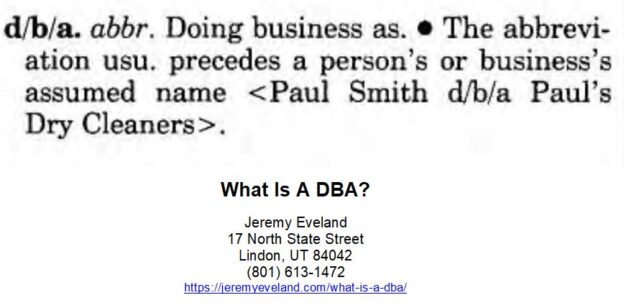
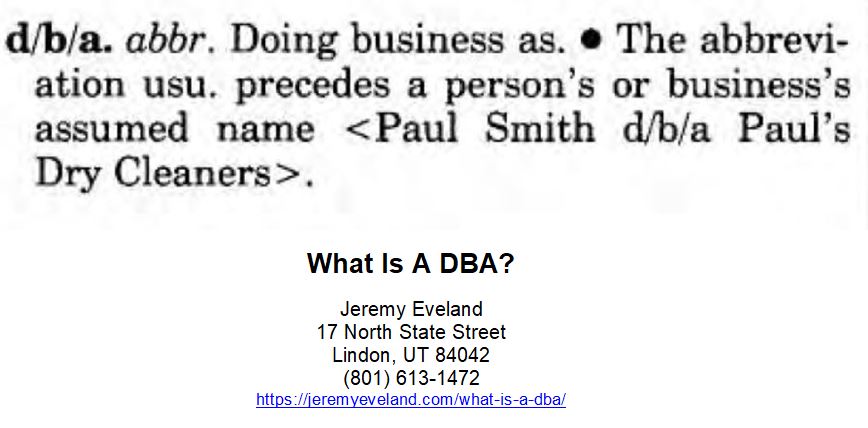
A DBA, or Doing Business As, is a type of business structure that allows an individual or company to operate under a name that is different from their legal name. A DBA is also sometimes referred to as an alias, assumed name, fictitious business name, or trade name. For example, a business owner operating under their own name might file a DBA to do business as “ABC Widgets,” rather than their own name.

When registering a DBA, the business owner is usually required to submit a form to the county or state in which they are doing business. This form typically includes the name of the business, the address of the business, and the name and address of the business owner. Depending on the state, the owner may also be required to publish a notice in a local newspaper or other periodical, alerting the public of the DBA registration.

What Is A DBA, Jeremy Eveland, Lawyer Jeremy Eveland, Jeremy Eveland Utah Attorney, dba name, sole proprietorship, legal name, business name, legal entity, fictitious name, different name, business structure, business owners, dba registration, business owner, own name, sole proprietorships, business bank account, business administration, business entity, personal name, sole proprietor, noise levels, personal assets, legal protections, fictitious business name, general partnership, many states, state fees varies, limited liability company, dba degree, general partnerships, county clerk, trade name, business, dba, name, state, llc, states, database, entity, noise, dbas, corporation, proprietorship, businesses, bank, owners, owner, example, air, filing, account, protection, liability, registration, products, county, tax, exposure, services, level, names, degree, administration, time, management, way, structure, fees, partnership, llcs, corporations, dba, llc, sole proprietorship, doing business as, taxes, legal entity, assets, fees, tax, ein, partnerships, trademark, degree, business entity, secretary of state, tax returns, legal name, credit score, company, liability, db, franchise, credit, trade names, d/b/a, fictitious business name, db(c), db(a), db(b), limited liability companies, assumed business name, limited liability, employer identification number, do business as, ph.d. in business, bofa, s corporation, loudness, education, sounds, l3c, bank of america corporation, legal liabilities

In most cases, a DBA does not provide the same legal protections as a corporation or limited liability company (LLC). Without registering as a separate business entity, the business owner remains personally liable for any debts and obligations associated with the business. A DBA also does not offer the same tax advantages, as the business is still taxed as a sole proprietorship or partnership

Business Structures in Utah

Business structure is a vital component of any successful organization. It is the way in which the business is set up and maintained, and it can have a significant effect on the company’s ability to operate effectively. In Utah, there are a variety of different business structures available, including sole proprietorships, limited liability companies (LLCs), corporations, and partnerships. Each of these structures offer different levels of protection and exposure to the owners and their businesses.

For example, a sole proprietorship is the simplest type of business structure. This is when one individual owns the business and is solely responsible for its operations. The owner may operate the business under their own name, or they may register a “doing business as” (DBA) name with the state. This DBA name must be unique and should be registered in the state’s database of business names. This will provide a degree of protection for the owner and their business from liability and taxation.

A limited liability company (LLC) is a more complex type of business structure. LLCs are popular in Utah due to their high degree of protection and flexibility when it comes to business operations. LLCs have a number of advantages, including limited liability protection for the owners, reduced filing fees, and the ability to manage the business in a way that suits the owners’ needs. In addition, LLCs provide tax and accounting benefits, such as the ability to pass tax credits onto their owners.

Partnerships are another popular business structure in Utah. This type of business structure is similar to a sole proprietorship in that two or more individuals own the business. However, partnerships offer the advantage of having two or more owners to share the risk of running the business. Partnerships also offer tax advantages, such as the ability to pass profits and losses onto the partners.

Finally, corporations are the most complex type of business structure. Corporations are owned by shareholders and managed by a board of directors. Corporations offer a number of advantages, including limited liability protection for the owners and the ability to raise capital through the sale of stock. However, corporations are subject to a number of regulations and taxes, so it is important to consider all of the options before making a decision.

No matter which type of business structure you choose, it is important to have a clear understanding of the regulations and laws that apply to your business. In Utah, the Division of Corporations and Commercial Code Administration is responsible for registering and managing businesses. It is also important to consider the fees associated with each type of business structure, as well as the time and energy it will take to set up the business. With careful thought and planning, however, the right business structure can provide a strong foundation for success.

Business Formation

Business formation is a critical step for entrepreneurs seeking to establish a business and start generating revenue. In Utah, business formation is typically accomplished by registering a dba name, sole proprietorship, legal name, business name, legal entity, or fictitious name. A dba name is a different name used by an individual or business to identify itself to the public, while a sole proprietorship is a business structure that is owned and operated by a single business owner. For a dba registration, business owners must file an application with their county clerk. Additionally, many states require a business owner to register a fictitious business name with the state.

When forming a sole proprietorship, a business owner typically uses his or her own name as the business name. In some cases, business owners may register a “trade name” which is a name other than their own personal name. This allows them to use a different name for the business that is more descriptive or easier to remember. In addition, many states require business owners to register a dba degree, which is an additional designation that they can use to identify the business.

When forming a legal entity, such as a general partnership or limited liability company, business owners must appoint a business administration to handle business affairs. This includes opening a business bank account, obtaining necessary permits and licenses, and filing all required paperwork with the state. Depending on the business structure, the business owners may be personally liable for any debts or obligations of the business. Therefore, it is important for business owners to understand the legal protections of the particular business structure they choose.

Noise levels and personal assets are two important considerations when selecting a business structure. For example, a sole proprietorship provides the greatest amount of legal protection for the business owner’s personal assets, but there is no limit on the amount of noise associated with the business. On the other hand, a limited liability company offers more legal protections for the business owner’s personal assets, but it also limits the amount of noise generated by the business.

The cost of business formation also varies depending on the type of business structure chosen. For example, the cost of filing a fictitious business name is typically lower than the cost of registering a dba or forming a legal entity such as a general partnership or limited liability company. Additionally, the state fees associated with forming a business may vary from state to state.

In conclusion, business formation is a critical step for entrepreneurs looking to launch a business. There are a variety of factors to consider, including the type of business structure selected, the cost associated with filing a fictitious business name or dba degree, and the legal protections of the particular business structure chosen. Additionally, many states require business owners to register a fictitious business name with the state. It is important for entrepreneurs to understand all of the options available to them when forming a business in order to ensure the most successful business formation.

DBA Lawyer Consultation

When you need legal help from a Business Lawyer about a DBA, call Jeremy D. Eveland, MBA, JD (801) 613-1472 for a consultation.

Jeremy Eveland
17 North State Street
Lindon UT 84042
(801) 613-1472

Home

Recent Posts

Business Succession Lawyer Salt Lake City Utah

The Utah Uniform Partnership Act

The 10 Essential Elements of Business Succession Planning

Utah Business Law

Mergers and Acquisitions

Advertising Law

Business Succession Lawyer Taylorsville Utah

Business Succession Lawyer South Jordan Utah

Business Succession Lawyer Lehi Utah

Business Succession Lawyer Millcreek Utah

Business Transaction Lawyer

Construction Law

Business Lawyer Salt Lake City Utah

What Is An Express Contract?

Antitrust Law

Business Transaction Lawyer Salt Lake City Utah

Business Succession Lawyer Herriman Utah

What Are The Advantages Of Hiring A Business Lawyer?