How long does probate take in Utah? A straightforward, uncontested informal probate usually runs about five to eight months from filing to closing. Utah law sets a hard floor underneath that: a personal representative cannot file a closing statement until four months after appointment, and creditors who receive published notice get three months to present claims.
Last updated: September 19, 2026. Written by Jeremy D. Eveland, MBA, JD, a Utah attorney who handles probate and estate administration from offices in West Jordan and Lindon. Every deadline below was checked against the current text of the Utah Code on that date.
Key Takeaways
- The fastest realistic informal probate in Utah is about four to five months, because Utah Code § 75-3-1003 bars a personal representative from filing the closing statement earlier than four months after appointment.
- Creditors who receive published notice have three months from the first publication to present claims. That window runs in parallel with the four month floor, not after it.
- Most uncontested Utah estates close in five to eight months. Estates with real property to sell, a business interest, or a federal estate tax return commonly run twelve to eighteen months.
- A will contest, an unlocatable heir, or a disputed creditor claim converts the case to formal probate and can push it past two years.
- Estates of $100,000 or less in personal property can often skip probate entirely with a small estate affidavit, available 30 days after death.
- A very small estate can close even faster inside probate. If the estate does not exceed the family protections, funeral costs, last illness expenses, and administration costs, Utah Code § 75-3-1203 lets the personal representative distribute immediately without notice to creditors.
- Utah imposes an absolute three year deadline to commence probate at all, and Utah courts enforce it strictly.
How Long Does Probate Take in Utah? The Realistic Ranges
There is no single answer, because “probate” covers everything from a bank account transfer to a two year fight over a family ranch. What there is, though, is a set of statutory waiting periods that no estate can compress. Once you know those, the honest ranges become clear.
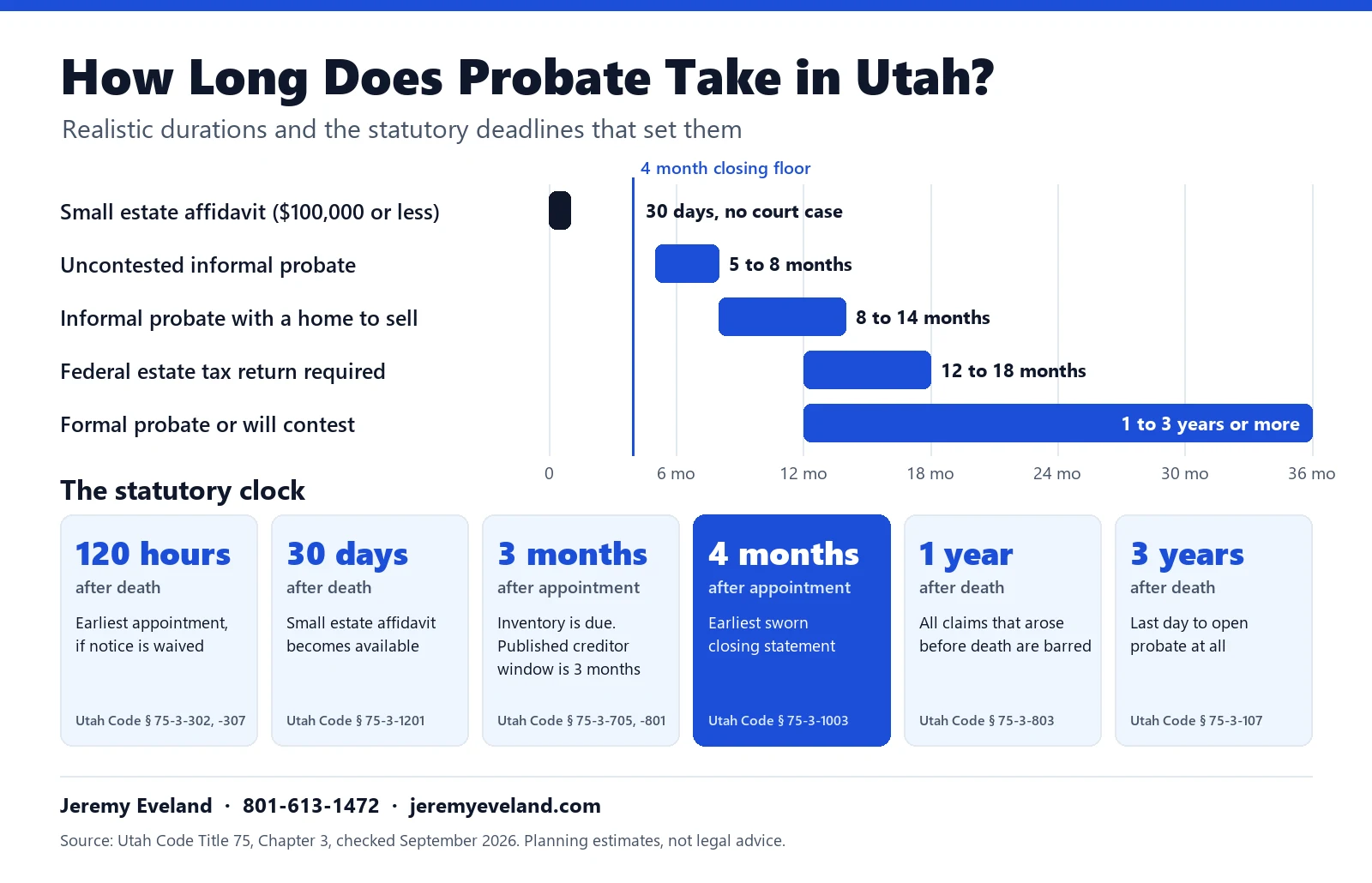
The table below reflects how these cases actually run in Utah practice. Treat the figures as planning estimates rather than guarantees, since court calendars, asset complexity, and family cooperation all move the number.
| Situation | Realistic duration | What drives the timing |
|---|---|---|
| Small estate affidavit (personal property of $100,000 or less) | 30 days plus institution processing time | No court filing at all. The 30 day wait after death is the only statutory delay. |
| Uncontested informal probate, simple assets | About 5 to 8 months | The four month closing floor and the three month creditor window, running together. |
| Informal probate with real property to sell | About 8 to 14 months | Listing, marketing, and closing the sale is usually the long pole, not the court. |
| Estate large enough to require a federal estate tax return | About 12 to 18 months | Form 706 is due nine months after death, and the estate normally stays open until it is resolved. |
| Formal probate, will contest, or disputed heirs | 1 to 3 years, sometimes longer | Litigation scheduling, discovery, and hearings replace the administrative track. |
What Is Probate in Utah, and When Is It Required?
Probate is the court process that gives one person, called the personal representative, legal authority to collect a deceased person’s property, pay the final debts and taxes, and transfer what remains to the people entitled to it. In Utah it is filed in the district court of the county where the person lived, under Utah Code § 75-3-201, and the filing fee is $375 under Utah Code § 78A-2-301.
A death does not automatically start a probate. Someone has to open one, and it is only needed when the person died owning property in their own name alone with no beneficiary attached. In practice, three situations trigger probate in Utah:
- Real estate titled in the decedent’s name alone. A home, land, or a mineral interest cannot be transferred with a small estate affidavit, no matter how little it is worth.
- More than $100,000 in probate assets. Once the estate subject to administration, less liens and encumbrances, passes the $100,000 limit in Utah Code § 75-3-1201, the affidavit is no longer available.
- A legal reason to need court authority. Examples include a lawsuit the estate needs to bring, a dispute among heirs, or an institution that will not release funds without letters from the court.
Property with a named beneficiary, jointly owned property with survivorship rights, and assets inside a funded trust pass outside of probate entirely. Under Utah Code § 75-3-101, ownership technically passes to the heirs or devisees at the moment of death, subject to administration. That is why the family owns the house during probate even though nobody can sell or refinance it until a personal representative has been appointed and holds letters testamentary.
The Statutory Clock: Deadlines Built Into Utah Law
Most articles on this question give you a vague range and stop. The more useful exercise is to look at the actual deadlines in the Utah Uniform Probate Code, because those are the constraints your attorney is working around.
| When | What happens | Authority |
|---|---|---|
| 120 hours after death | Earliest the registrar may issue informal probate or appoint a personal representative, and only if everyone entitled to notice has waived it in writing. | Utah Code § 75-3-302, § 75-3-307 |
| 10 days after notice | The alternative path, used when notice is given rather than waived. | Utah Code § 75-3-302, § 75-3-307 |
| 30 days after death | Appointment is delayed at least this long when the decedent was a nonresident, subject to exceptions. | Utah Code § 75-3-307(1) |
| 45 days after death | A creditor becomes eligible to ask for appointment as personal representative if the family has not opened the estate. | Utah Code § 75-3-203(1)(f) |
| 3 months after appointment | The personal representative must prepare an inventory and appraisement of estate property. | Utah Code § 75-3-705 |
| 3 months after first publication | Claims of creditors notified by publication are barred if not presented. | Utah Code § 75-3-801(1) |
| 90 or 60 days | Creditors given actual written notice get 90 days from the published notice or 60 days from mailing, whichever is later. | Utah Code § 75-3-801(2) |
| 4 months after appointment | Earliest the personal representative may file a sworn closing statement. | Utah Code § 75-3-1003 |
| 9 months after death | Federal estate tax return due, if the estate is large enough to require one. | IRS Form 706 instructions |
| 1 year after death | Outer bar for claims that arose before death, regardless of notice. | Utah Code § 75-3-803(1)(a) |
| 6 months after closing statement | Breach of fiduciary duty claims against the personal representative are barred, with exceptions for fraud. | Utah Code § 75-3-1005 |
| 12 months after informal probate | Window to contest an informally probated will. The deadline is the later of 12 months from the informal probate or three years from death. | Utah Code § 75-3-107(1)(c) |
| 1 year after closing statement | The personal representative’s appointment terminates, if no proceedings are pending. | Utah Code § 75-3-1003(2) |
| 3 years after death | Absolute deadline to commence a probate or formal testacy proceeding. | Utah Code § 75-3-107 |
Why Four Months Is the Real Floor
If you read national articles about probate timelines, you will often see six months quoted as the minimum. That figure comes from the model Uniform Probate Code and from states that adopted it without change. Utah did not. Utah shortened it.
“A personal representative may close an estate by filing with the court no earlier than four months after the date of original appointment of a general personal representative for the estate, a verified statement…”
That single sentence explains most of what people find frustrating about the process. Even if the decedent left one bank account, one beneficiary, and no debts, the estate cannot be formally wrapped up before that four month mark. Families often assume a simple estate means a fast estate. In Utah, a simple estate mostly means a predictable one.
The three month creditor window under Utah Code § 75-3-801 runs alongside that four month period rather than after it, which is why the two do not stack into seven months. Publication typically begins shortly after appointment, so by the time the four month floor arrives, the creditor period has usually already closed.
Step by Step Through a Utah Informal Probate
Here is how the months actually get spent in a typical uncontested case. Informal probate is the administrative track handled by a court registrar without hearings, and it is how the large majority of Utah estates are handled.
Weeks 1 to 4: Gathering and filing
Someone locates the original will, collects the death certificate, and identifies the heirs and devisees. The application for informal probate and appointment goes to the district court in the county where the decedent lived. Under Utah Code § 75-3-302, the registrar cannot act until at least 120 hours have passed since death, and then only if everyone entitled to notice has waived it in writing. Otherwise the wait is ten days from the date notice was given.
Month 1 to 2: Appointment and notice
The registrar reviews the application and, if it is complete, issues letters appointing the personal representative. That appointment is the starting gun for nearly every other deadline. The personal representative then publishes notice to creditors once a week for three successive weeks in a newspaper of general circulation in the county, and separately mails notice to any creditor already known.
Months 2 to 4: Inventory, claims, and administration
Within three months of appointment, the personal representative must prepare an inventory and appraisement listing each asset and its fair market value as of the date of death. Meanwhile the creditor window runs. Real property gets listed if it is being sold, accounts are consolidated, and the final income tax return is prepared. If you are serving in this role, the duties of an executor or personal representative are worth understanding before you start making distributions.
Months 4 to 6: Paying claims and distributing
Once the earliest claim limitation has expired, Utah Code § 75-3-807 directs the personal representative to pay allowed claims in the statutory order of priority. Only after debts, taxes, and administration expenses are handled can the remaining property be distributed to the people entitled to it. Distributing early is one of the fastest ways for a personal representative to end up personally liable.
Month 4 and later: Closing
With everything paid and distributed, the personal representative files the sworn closing statement under Utah Code § 75-3-1003 and sends a copy to all distributees and known claimants. For most families that is the end of it. This whole sequence is what estate administration refers to in practice.
How Long Does Probate Take in Utah on Each Track?
The single biggest predictor of duration is which of Utah’s three procedural tracks the estate is on. Choosing the right one at the outset does more for the timeline than anything a family can do afterward.
| Track | Typical duration | Why it takes that long |
|---|---|---|
| Small estate affidavit | 30 days, no court case | No filing, no appointment, no creditor period. Personal property only, capped at $100,000 |
| Informal probate | 5 to 8 months typical, 12 or more with real estate | Handled by a registrar without hearings. The four month closing floor controls |
| Formal probate | 12 to 24 months | Noticed hearings before a judge on contested questions, plus discovery |
| Supervised administration | 18 months and up | Continuing court authority, with approval required before distribution |
Note the gap between the first two rows. If an estate qualifies for the affidavit, the answer to how long does probate take in Utah is essentially thirty days, because there is no probate. That is worth checking before anyone pays a filing fee, and it is the first thing a Utah probate attorney should confirm.
How Long Does Probate Take in Utah Without a Will?
Probate without a will takes about the same five to eight months in an uncontested Utah case, because every statutory waiting period is identical. The four month closing floor, the three month creditor window, and the three month inventory deadline apply whether or not there is a will.
What changes is the front end. With no will, nobody has been nominated, so Utah Code § 75-3-203 decides who has priority to serve: the surviving spouse first, then the other heirs. When several people share the same priority, such as three adult children, they must agree on one applicant or sign renunciations before the registrar can appoint anyone informally. Collecting those signatures is the step that most often adds a few weeks. The heirs themselves are fixed by Utah intestate succession rather than by anyone’s wishes. There is a fuller walk through in how long probate takes if there is no will.
How Do You Close Probate in Utah, and How Long Does Closing Take?
Most Utah estates close with a one page sworn statement rather than a hearing. Closing itself takes a day to file. What takes time is reaching the point where the statement is true. Utah gives a personal representative three ways to finish.
| Closing method | Earliest timing | What it requires |
|---|---|---|
| Sworn closing statement, Utah Code § 75-3-1003 | Four months after the original appointment | A verified statement that the creditor period has expired, claims and taxes are paid, assets are distributed, and every distributee received a copy and a written account |
| Summary closing for very small estates, Utah Code § 75-3-1203 and § 75-3-1204 | Any time after distribution, with no four month wait and no notice to creditors | The estate, less liens, does not exceed the homestead allowance, exempt property, family allowance, administration costs, reasonable funeral expenses, and last illness medical expenses |
| Formal closing by court order, Utah Code § 75-3-1001 | After the creditor claim period expires. An heir or other interested person can force the issue one year after appointment | A petition, notice to all interested persons, a hearing, and an order that approves the accounting and discharges the personal representative |
Filing the closing statement also starts a protective clock. Under Utah Code § 75-3-1005, claims against the personal representative for breach of fiduciary duty are barred six months after the closing statement is filed, except for fraud, misrepresentation, or inadequate disclosure. An informal estate that is never formally closed does not expire on its own, so that protection never begins. It is one of the most common loose ends I see in Utah estates that families handled without help.
When Do Heirs Actually Receive Their Inheritance?
In a typical uncontested Utah probate, heirs receive most of their inheritance between the fourth and sixth month, after the creditor window has closed and the debts and taxes have been paid. Nothing in the code forbids an earlier distribution, but the person making it carries the risk.
Under Utah Code § 75-3-807, a personal representative who pays out before the claim period expires can be personally liable to a creditor who is hurt by it. Heirs carry risk too. Utah Code § 75-3-909 requires a distributee who was paid improperly to return the property or its value. For that reason, careful personal representatives make small partial distributions early, such as personal effects and a vehicle, and hold the cash until the claims picture is clear.
Utah law does not leave a surviving family without support in the meantime. These protections come ahead of creditor claims and can be paid during administration:
- Homestead allowance of $22,500 for the surviving spouse, or divided among minor and dependent children, under Utah Code § 75-2-402.
- Exempt property of up to $15,000 in household furniture, automobiles, furnishings, appliances, and personal effects, under Utah Code § 75-2-403.
- Family allowance, a reasonable amount for the support of the surviving spouse and dependent children while the estate is open. If the estate cannot pay all claims, the allowance may not run longer than one year, under Utah Code § 75-2-404.
What the Timeline Costs
Duration and cost move together, though not as tightly as people assume. The $375 filing fee set by Utah Code § 78A-2-301 is the same whether the case closes in five months or twenty five. What grows with time is attorney work: more creditor correspondence, more accountings, more hearings. A straightforward informal administration handled on a flat fee is insulated from that, which is one practical reason to ask about fee structure early. The detail is in the guides to Utah probate filing fees and the hidden costs of probate in Utah.
What Makes a Utah Probate Take Longer
The statutory minimums rarely control how long probate actually takes in Utah. These factors do.
- Real estate. If a house has to be cleaned out, listed, and sold before the estate can be divided, the market sets the schedule. This is the single most common reason a six month estate becomes a twelve month estate.
- A closely held business. Valuing and transferring an interest in a company takes appraisals and often negotiation among the owners. Succession terms in an operating agreement can help or complicate matters considerably.
- A will contest. A challenge based on capacity, undue influence, or execution formalities moves the case into formal probate with hearings and discovery. Years, not months.
- Heirs who cannot be located. The personal representative has to make a diligent search, and the court will not approve distribution until the issue is resolved.
- Disputed or unexpected creditor claims. A disallowed claim gives the claimant 60 days to petition the court under Utah Code § 75-3-806, which adds its own litigation track.
- A federal estate tax return. Form 706 is due nine months after death and can be extended six months. Estates rarely close before that is resolved.
- A personal representative who is also grieving. This is underrated and entirely human. The role is administrative work performed by someone who just lost a family member, and the pace reflects that.
Common Mistakes That Add Months to a Utah Probate
Most slow probates in Utah are slow because of avoidable choices in the first sixty days, not because of the court. These are the ones that cost families the most time.
- Waiting to publish notice to creditors. Publication is optional under Utah Code § 75-3-801, and skipping it feels like a savings. Without it, claims that arose before death stay alive until one year after death under Utah Code § 75-3-803, and the estate cannot be safely closed at month four. The Utah notice to creditors is what buys the short three month window.
- Opening a probate the estate did not need. If everything qualifies for the small estate affidavit, a court case converts a 30 day task into a five month one.
- Filing an incomplete application. A missing original will, a missing heir address, or an unsigned waiver sends the file back. Each round trip with the clerk costs one to three weeks.
- Distributing too early, then clawing it back. Undoing a distribution after a late claim appears takes far longer than waiting would have.
- Assuming the creditor deadline stops everyone. The current version of Utah Code § 75-3-803, effective May 7, 2025, states that the claim deadlines do not prevent Medicaid medical assistance recovery or the collection of criminal restitution. An estate with either exposure needs a plan before it distributes.
- Forgetting the out of state property. A cabin in Idaho or a timeshare in Nevada needs its own ancillary probate, and it is often discovered at month five.
- Never filing the closing statement. The money is distributed, everyone moves on, and the estate stays open for years with the personal representative still exposed.
There is a longer list in 11 probate mistakes that cost Utah families thousands.
What the Timeline Looks Like for Your Situation
If you are the personal representative
Plan for about six months of part time work, heaviest in the first ninety days. You must be at least 21 to serve under Utah Code § 75-3-203. Your three fixed dates are the inventory at three months, the end of the creditor window three months after first publication, and the closing statement at four months or later. Put all three on a calendar the day your letters are issued. The full list of Utah personal representative duties is worth reading before you sign anything.
If you are an heir or beneficiary
Expect little visible progress for the first three to four months. That quiet period is the creditor window, not a sign of trouble. You are entitled to a copy of the inventory if you ask for it under Utah Code § 75-3-705, and you will receive the closing statement and a written account at the end. If a year has passed since the appointment with no distribution and no explanation, Utah Code § 75-3-1001 lets any interested person petition the court to settle the estate.
If the decedent lived outside Utah but owned Utah property
Add at least a month. When the decedent was not a Utah resident, Utah Code § 75-3-307 delays the Utah appointment until 30 days after death, unless the applicant is the personal representative already appointed in the home state or the will directs that Utah law govern the estate. The Utah case normally follows the home state case, and the fee for filing another state’s probate documents with a Utah court is $35 under Utah Code § 78A-2-301.
If the estate includes a business
Expect twelve months or more. A company interest has to be valued as of the date of death, and the operating agreement or buy-sell agreement usually controls who may buy it and on what schedule. Someone also needs clear authority to sign payroll and contracts in the first weeks, which is a reason to ask for appointment as soon as the 120 hour period has passed. For owners reading this in advance, a funded trust and a current buy-sell agreement remove most of this delay.
If someone is contesting the will
The case moves to formal probate and the realistic range becomes one to three years. A person who wants to challenge an informally probated will has until the later of 12 months after the informal probate or three years after death under Utah Code § 75-3-107. Many contested probate cases resolve through mediation well before trial, which is usually the fastest honest path to an ending.
Faster Paths That Skip Probate Entirely
Sometimes the honest answer to how long does probate take in Utah is that it does not, because probate only governs assets that pass through the estate. A large share of a typical Utah estate never enters the process at all, and that property moves in weeks rather than months.
| Transfer method | Typical timing | Best for |
|---|---|---|
| Small estate affidavit under Utah Code § 75-3-1201 | Available 30 days after death | Personal property of $100,000 or less, with no real property and no pending appointment of a personal representative |
| Beneficiary designation (life insurance, retirement accounts) | Weeks, once the claim is submitted | Accounts where the decedent named a living beneficiary |
| Payable on death and transfer on death accounts | Weeks | Bank and brokerage accounts set up in advance |
| Joint tenancy with right of survivorship | Immediate by operation of law | Property intentionally titled jointly, with the tax consequences understood |
| Assets held in a funded revocable trust | No court process | Families who planned ahead and actually retitled the assets |
The last row is the one worth dwelling on. A revocable living trust avoids probate only for property that was actually transferred into it. An unfunded trust is a document that describes a plan nobody executed, and the estate goes through probate anyway. There is a complete list of options in how to avoid probate in Utah. If avoiding this timeline matters to your family, that is a Utah estate planning decision to make now rather than a probate decision to make later.
The Three Year Deadline You Cannot Miss
Utah sets an outer limit on the entire question of how long probate can take in Utah, and on whether it can happen at all. Under Utah Code § 75-3-107, an informal probate or formal testacy proceeding generally may not be commenced more than three years after the decedent’s death. There are narrow exceptions, including cases where an earlier proceeding was dismissed because of genuine doubt about whether the person had died.
Families sometimes let an estate sit because the house is occupied, or because nobody wants to be the one to start. Three years passes faster than it sounds. Once that window closes, the presumption of intestacy attaches and the options narrow sharply. If a last will and testament exists and has not been probated, the clock is a reason to act rather than wait.
Local venue affects the pace too, mainly through how quickly a particular district processes informal applications. For Salt Lake County families, see the probate attorney in Salt Lake City page, and for the statewide overview of the process see the Utah probate attorney guide. Related reading: 10 steps to start probate in Utah, 13 hidden costs of probate in Utah, how long probate takes with no will, real estate in Utah probate, and the probate law library.
How to Move a Utah Probate Along Faster
You cannot shorten the statutory periods that set how long probate takes in Utah, but you can stop losing time around them.
- Get written waivers of notice early. If every person entitled to notice signs a waiver, the registrar can act once 120 hours have passed after death instead of waiting the ten days.
- Publish notice to creditors immediately after appointment. The three month window does not start until the first publication. Delaying publication by a month simply adds a month.
- Do the inventory properly the first time. A supplementary inventory under Utah Code § 75-3-707 is not fatal, but hunting down missed assets late is where months disappear.
- Order the death certificates in quantity. Every institution wants its own certified copy. Requesting more later costs weeks.
- List real property early if it is being sold. The sale usually determines the closing date of the entire estate, so start it in parallel rather than after the creditor period.
- Communicate with beneficiaries before they ask. Most probate disputes that turn into formal proceedings begin as an information vacuum rather than a real disagreement.
How to Choose a Utah Probate Attorney Who Will Keep the Estate Moving
You are not required to hire a lawyer for an informal probate in Utah, and the Utah courts publish self-help forms for simple estates. Where a home, a business, a blended family, or a creditor problem is involved, the right attorney usually shortens the process. These questions separate the ones who will from the ones who will not.
- Do they check first whether probate is needed at all? The first conversation should cover the small estate affidavit and non-probate transfers before anyone mentions a filing fee.
- Do they know the Utah numbers without looking them up? Four months to close, three months for published creditors, 120 hours, $100,000, three years. An attorney who quotes six months is reciting the national model code, not Utah law.
- Will they give you a written calendar? You should leave the first meeting with dates for publication, the inventory, the end of the claim period, and the target closing.
- Is the fee structure clear? A flat fee for an uncontested informal administration keeps the cost from growing with the calendar.
- Do they plan the closing on day one? The estate is not finished when the checks go out. It is finished when the closing statement is filed.
- Can they handle the surrounding issues? Estates regularly include a business interest, a real estate sale, or a contract dispute, and it helps when one office can handle all of it.
Jeremy Eveland is a Utah attorney with offices in West Jordan and Lindon who handles probate and estate administration alongside business and real estate matters. If you would like a realistic timeline for a specific estate, call (801) 613-1472.
How This Article Was Researched
Every deadline and dollar figure in this article was checked on September 19, 2026 against the current version of the statute published by the Utah Legislature at le.utah.gov, including the versions of Utah Code § 75-3-803, § 75-3-1201, and § 75-3-101 that took effect May 7, 2025 and the court fee schedule in Utah Code § 78A-2-301 that took effect May 6, 2026. Court procedure was checked against the Utah State Courts informal probate guide. Federal figures come from the IRS Instructions for Form 706, and the Utah tax position comes from the Utah State Tax Commission.
The duration ranges, such as five to eight months, are planning estimates drawn from how uncontested Utah estates move through the statutory periods. They are not court statistics, and the Utah courts do not publish average probate durations. Because this is a legal topic, no anonymous forum posts or unsourced anecdotes were used.
Frequently Asked Questions About How Long Probate Takes in Utah
What is the shortest a probate can take in Utah?
About four months, and only in an ideal case. Utah Code § 75-3-1003 prohibits the personal representative from filing a closing statement earlier than four months after appointment. Add the time to locate the will and file the application, and roughly five months is the practical minimum.
Can you avoid probate in Utah?
Often, yes. Property with a named beneficiary, payable on death accounts, jointly titled property, and assets held in a funded revocable trust all pass outside probate. Personal property estates of $100,000 or less can also use a small estate affidavit 30 days after death.
How long do creditors have to make a claim against a Utah estate?
Three months from the date of first publication of the notice to creditors. Creditors given actual written notice get 90 days from that published notice or 60 days from mailing, whichever is later. All pre-death claims are barred one year after death regardless of notice.
Is informal probate faster than formal probate in Utah?
Substantially. Informal probate is handled administratively by a court registrar without hearings, which is why most Utah estates use it. Formal probate involves petitions, notice to all interested persons, and court hearings, and typically adds many months or years.
Does a will speed up probate in Utah?
It helps, but it does not eliminate the process. A valid will names the personal representative and directs distribution, which prevents disputes over both. The statutory waiting periods for creditors and closing apply either way.
How long does the personal representative have to file the inventory?
Three months after appointment, under Utah Code § 75-3-705. The inventory lists each asset owned at death with its fair market value as of the date of death and any encumbrances against it.
Does Utah have an estate or inheritance tax that delays closing?
No. Utah’s inheritance tax was eliminated after December 31, 2004 and Utah inheritance tax returns do not need to be filed. Only estates large enough to require a federal return face the nine month Form 706 deadline.
What happens if nobody opens probate within three years?
Under Utah Code § 75-3-107, probate and formal testacy proceedings generally cannot be commenced more than three years after death, subject to narrow exceptions. Utah courts have enforced this limit strictly, so waiting can permanently foreclose options.
What triggers probate in Utah?
Probate is triggered when someone dies owning property in their own name alone with no beneficiary attached, and that property either includes real estate or is worth more than $100,000 after liens. Assets with a beneficiary designation, survivorship ownership, or a funded trust do not count toward that figure and do not need probate.
Does every death in Utah go through probate?
No. Probate never starts automatically. Someone must file an application, and many Utah families never need to. If everything passes by beneficiary designation, joint ownership, or trust, or if the remaining personal property is $100,000 or less, the estate can be settled without a court case under Utah Code § 75-3-1201.
How long does probate take in Utah without a will?
About the same as with a will, usually five to eight months when nobody objects. The statutory waiting periods are identical. The difference is at the start: Utah Code § 75-3-203 sets who has priority to serve, and heirs with equal priority must agree on one applicant or sign renunciations before an informal appointment.
How long does probate take in Utah when there is a house to sell?
Plan on eight to fourteen months. The court side still takes about five months, but the home must be cleared, prepared, listed, put under contract, and closed. The estate cannot be fully distributed or closed until the sale proceeds are in hand, so the real estate market usually sets the finish date.
Who owns the home during probate in Utah?
Under Utah Code § 75-3-101, title passes to the heirs or devisees at the moment of death, subject to administration, creditor rights, and the family allowances. In practice the personal representative controls the property during probate and is the only person who can sign a deed to sell it once letters are issued.
When do beneficiaries get paid in a Utah probate?
Usually between month four and month six in an uncontested estate. The personal representative normally waits until the creditor claim period has ended and debts and taxes are paid. Earlier distributions are legal, but Utah Code § 75-3-807 makes the personal representative personally liable if an early payment harms a creditor.
Can a personal representative distribute assets before four months have passed?
Yes. The four month rule in Utah Code § 75-3-1003 limits when the closing statement can be filed, not when property can be distributed. Distributing before the creditor period expires is a risk the personal representative carries personally, so most wait or make only small partial distributions.
How much does it cost to file probate in Utah?
The court filing fee to open a probate in a Utah district court is $375 under Utah Code § 78A-2-301. Other common costs are certified copies of the letters, newspaper publication of the notice to creditors, appraisals, and attorney fees. Filing another state’s probate documents in Utah for an ancillary matter costs $35.
How soon after a death can you file probate in Utah?
An informal probate cannot be granted until 120 hours, which is five days, have passed since the death, and then only if everyone entitled to notice has waived it in writing. Otherwise the registrar waits ten days after notice is given. The outer limit is three years after death under Utah Code § 75-3-107.
How long does it take to get letters testamentary in Utah?
Once a complete application is filed, letters are usually issued within a few weeks, depending on the district court’s workload and whether waivers of notice were filed with the application. Incomplete applications are the main cause of delay. This is a practical estimate rather than a statutory deadline.
How do you close probate in Utah?
Most estates close when the personal representative files a sworn closing statement under Utah Code § 75-3-1003, no earlier than four months after appointment, and sends a copy to every distributee and known unpaid claimant. Contested or complicated estates close by court order under Utah Code § 75-3-1001 after notice and a hearing.
What happens if a Utah probate is never closed?
The estate simply stays open. The personal representative’s authority and duties continue, and the six month limit on breach of fiduciary duty claims in Utah Code § 75-3-1005 never begins to run, because it is measured from the filing of the closing statement. Filing the statement is what ends the exposure.
How long do you have to contest a will in Utah?
For a will admitted through informal probate, a contest must be started within the later of 12 months after the informal probate or three years after the death, under Utah Code § 75-3-107. An order entered after formal testacy proceedings is far harder to reopen, so anyone considering a contest should get advice promptly.
Can a creditor open a probate in Utah?
Yes. Under Utah Code § 75-3-203, any creditor has priority to seek appointment as personal representative once 45 days have passed since the death, behind the persons named in the will, the surviving spouse, and the heirs. Creditors use this when a family delays opening an estate that owes them money.
Can Medicaid still collect from a Utah estate after the creditor deadline?
Yes. The current version of Utah Code § 75-3-803, effective May 7, 2025, states that the claim deadlines do not affect medical assistance recovery under Utah’s Medical Benefits Recovery law, or the collection of criminal restitution. An estate with Medicaid exposure should address it before making final distributions.
What if the person lived in another state but owned property in Utah?
A second, ancillary probate is usually opened in the Utah county where the property sits. Utah Code § 75-3-307 delays a nonresident’s Utah appointment until 30 days after death unless the home state personal representative is the applicant. Filing the home state probate documents in Utah costs $35.
Do all Utah counties take the same amount of time?
The statutory deadlines are identical statewide, because every county applies the same Utah Uniform Probate Code. What varies is how quickly each district court’s registrar processes an informal application, which can differ by days or a few weeks. Venue is the county where the decedent lived under Utah Code § 75-3-201.
Do I need a lawyer for probate in Utah?
Not always. Utah does not require an attorney for informal probate, and the Utah State Courts publish self-help forms. A lawyer is worth the cost when the estate includes real estate, a business, debts that may exceed assets, heirs who disagree, or property in another state, because mistakes there are what turn months into years.
Wondering how long your specific estate will take, or whether it needs probate at all? That question usually takes one conversation to answer.
Call (801) 613-1472 or read more about working with a Utah probate lawyer.
This article is general information about Utah law, not legal advice, and timelines vary with the facts of each estate. Reading it does not create an attorney-client relationship.
Jeremy Eveland
17 North State Street
Lindon UT 84042
(801) 613-1472
Jeremy Eveland
8833 S Redwood Road
West Jordan UT 84088
(801) 613-1472