Category Archives: Probate Law

10 Steps To Start Probate in Utah

10 Steps to Start Probate in Utah (Complete Checklist) A Utah Attorney Explains

10 Steps to Start Probate in Utah (Complete Checklist) A Utah Attorney Explains

Opening Summary

The short answer is this: probate in Utah usually starts by filing a petition or application with the Utah district court in the county where the deceased person lived at death. Probate is the court-supervised process of validating a will if there is one, appointing a personal representative, identifying and protecting estate assets, paying debts and taxes, and distributing what remains to heirs or beneficiaries. Utah follows the Uniform Probate Code, which is why the state offers both informal probate and formal probate depending on whether the estate is uncontested or requires court oversight.^3^5^1

For families, having a clear step-by-step roadmap matters because probate mistakes can cause delay, extra cost, creditor problems, and avoidable conflict among relatives. If you are grieving, overwhelmed, or simply trying to do things correctly, an experienced Utah probate attorney can help you move through each requirement with less stress and fewer mistakes.^2^7^3

What Probate Is and When It Is Required in Utah

Probate is the legal process used to transfer a deceased person’s property when assets do not pass automatically by title, beneficiary designation, or trust. In plain English, probate exists so the court can confirm who has authority to act for the estate and who is entitled to receive property. Utah probate law is part of the Utah Uniform Probate Code, which provides the rules for probate of wills, intestate succession, creditor claims, and personal representative duties.^5^9^11^13^1^3

Probate is often required when the deceased person owned assets in their sole name and those assets cannot be transferred by a surviving co-owner or beneficiary designation. Probate may not be required when property is jointly owned with rights of survivorship, when an account has a TOD or POD beneficiary, when the asset is held in trust, or when the estate qualifies for Utah’s small estate affidavit process. Utah’s small estate procedure is especially important for families handling modest estates because it can avoid a full court probate if the estate fits the statutory limits.^6^12^1

A person who dies with a valid will leaves a testate estate, while a person who dies without a valid will leaves an intestate estate. In testate probate, the court looks to the will for distribution instructions, while in intestate probate the Utah Code supplies the distribution rules. That difference matters because intestate succession can produce results the decedent never intended, especially where there is a surviving spouse, children from more than one relationship, or no closely related heirs.^9

Utah’s small estate affidavit process is a common shortcut for certain estates, but it is not available in every situation. If the estate includes real estate, disputes, creditor problems, or assets over the threshold, a formal probate filing may still be necessary. Real-world example: a decedent with only a bank account payable-on-death to a spouse may avoid probate, while a decedent who owned a house in sole name usually cannot.^10^12^6

Informal vs. Formal Probate in Utah

Utah offers informal probate for estates that are generally uncontested and suitable for streamlined administration. Utah Courts explain that informal probate is the process for asking the court to appoint a personal representative without a hearing, and it is typically used when the interested parties agree about the appointment and estate distribution. Informal probate is usually faster and less expensive because the court’s role is more administrative than adversarial.^4

Formal probate is used when there is disagreement, uncertainty, or a need for judicial supervision. Utah Courts describe formal probate as the process for asking the court to appoint a personal representative with a hearing, often because there is disagreement over who should serve or how the estate should be handled. Formal probate is more common when a will is contested, heirs are fighting, the will may be invalid, or the estate is complicated enough that the court needs to resolve issues directly.^1

The Utah district court is involved in both paths, but it plays a lighter role in informal probate and a more active role in formal probate. The practical question is not just whether there is a will, but whether the estate is cooperative, clear, and administratively simple enough for an informal process. If not, formal probate may be the safer path because it creates a clearer record and allows the court to decide contested issues.^17^1

10 Steps to Start Probate in Utah

Step 1: Locate the Original Will and Key Documents

The first priority is finding the original will, because Utah probate proceedings generally rely on the original document rather than a copy. You should also gather the death certificate, deeds, account statements, insurance policies, tax returns, business records, vehicle titles, and any trust documents that may affect the estate. If there is no will, the estate proceeds under Utah’s intestacy laws, so the absence of a will does not stop probate; it simply changes the distribution rules.^18^16^4^9

Wills are commonly stored in a lawyer’s office, a home safe, a safe deposit box, or with estate planning documents kept by the decedent. If the original will cannot be found, the situation may require extra review because the court and heirs may need to determine whether the will was revoked, lost, or preserved elsewhere. In practice, missing documents are one of the biggest causes of delay at the start of probate.^19^4

Probate Attorney Bluffdale Utah

Probate Lawyer

Probate Attorney West Jordan Utah

Step 2: Determine Whether Probate Is Necessary

Before filing anything, identify which assets are actually part of the probate estate. Probate is usually necessary for assets titled only in the decedent’s name, while jointly held property, TOD/POD accounts, beneficiary-designated assets, and trust assets often pass outside probate. Utah’s small estate affidavit process may be available for certain personal property estates that fall within the statutory limit, which is one reason it is so important to review the asset list carefully before opening a case.^11^15^1

If the estate includes a home, business interest, unclear title, or creditor issues, a probate attorney should review whether a petition is required. The right answer depends on the title of each asset, not just the total value of the estate. A family can often avoid unnecessary probate work by separating probate assets from nonprobate assets at the very beginning.^12^4^11

Step 3: Identify the Correct Court and Jurisdiction

Utah probate is filed in the district court in the county where the decedent was domiciled at death. This is the proper starting point even if some of the estate property is located elsewhere. If the decedent owned real estate in another state, an ancillary probate or separate transfer procedure may be needed in that jurisdiction.^13^4^12

Knowing the correct county matters because a filing in the wrong court can delay the appointment of the personal representative and the issuance of letters. Utah Courts provide the probate self-help materials and forms through the district court system, which is where the application or petition is filed. When a decedent lived in Utah but owned property elsewhere, the Utah probate may be only one part of the larger administration picture.^18^4^12

Step 4: Choose Between Informal and Formal Probate

If the estate is cooperative and the will is clear, informal probate is often the best fit. Utah Courts state that informal probate is generally used when all interested parties agree about the appointment and distribution issues. That said, if there are objections, missing heirs, a disputed will, or a need for judicial instructions, formal probate may be necessary from the start.^4

This decision is strategic because it affects cost, timeline, and how much court supervision you will have. A formal case can provide clarity where family conflict exists, while an informal case can save time when everyone is on the same page. In a closely held family business or contested estate, choosing formal probate early can reduce later procedural problems.^17^1

Step 5: Prepare and File the Probate Petition

The filing begins with the correct Utah probate application or petition, along with supporting documents such as the original will and death certificate. Utah’s informal probate forms include an application and a cover sheet for probate actions, and the court will review whether the application is complete before appointment. The filing fee must be paid at the time of filing, and the amount depends on the court fee schedule in effect.^20^1

The petition generally needs to identify the decedent, the date of death, the county of residence, the heirs and beneficiaries, and the proposed personal representative. Common mistakes include omitting required information, submitting the wrong form, or failing to attach the documents the court needs to act. Those mistakes can force the filing to be corrected and refiled, which delays the appointment.^19^18

Step 6: Get Appointed as Personal Representative

The personal representative is the person appointed to manage the estate; many people still call this role the executor. Once appointed, the personal representative receives authority through the court’s issuance of Letters Testamentary or Letters of Administration, depending on whether the estate is testate or intestate. Utah law treats the personal representative as a fiduciary who must settle and distribute the estate according to the will and the Utah Code.^3^1^19

The Utah Probate Code sets out priority rules for appointment, which usually favor the surviving spouse, named nominees, and then heirs with an interest in the estate. The court may require a bond unless the will waives it or the circumstances justify waiving it. Once the letters are issued, the personal representative has the practical authority needed to gather property, pay expenses, and begin administration.^16^9^3

Step 7: Notify Heirs, Beneficiaries, and Creditors

After appointment, notice must be given to interested persons, including heirs and beneficiaries, and creditor notice must be handled according to Utah law. Utah Code § 75-3-801 governs notice to creditors, and the Utah Court materials and statutes show why notice is a major step in protecting the estate and limiting future claims. Utah law generally allows a shortened creditor claim period after proper notice, while also preserving the general outside deadline under the Probate Code.^21^7^19

This step matters because improper notice can leave the estate vulnerable to later claims and can create personal risk for the representative. Known creditors should be addressed directly, while unknown creditors are typically handled by publication under the statutory process. In a well-run probate, notice is not an afterthought; it is part of the claim-management strategy.^7^21

Step 8: Inventory and Appraise Estate Assets

A personal representative must prepare an inventory of the decedent’s property within the time required by the Probate Code. Utah Code § 75-3-705 requires an inventory listing the property with reasonable detail and fair market value as of the date of death. The inventory helps the personal representative track what is actually in the estate, identify missing assets, and support later accounting and distribution.^2

Some assets, such as real estate, business interests, or unique personal property, may need a professional appraisal. The personal representative also has authority and responsibility to take possession or control of estate property and preserve it during administration. If additional assets are discovered later, they must be added and handled properly rather than ignored.^5^3

Step 9: Pay Debts, Taxes, and Administrative Expenses

The personal representative must pay valid estate obligations before distribution. That includes creditor claims, final income taxes, administrative expenses, and other statutory obligations. Utah law and the Probate Code also recognize that the representative must manage and preserve the estate responsibly while administration is ongoing.^7^5

Utah does not impose a state estate tax, but federal tax issues may still matter for larger estates. Administrative costs can include attorney fees, court costs, bond premiums, publication costs, appraisal fees, and accountant fees. A careful representative does not distribute assets too early, because doing so before debts and claims are resolved can create avoidable problems.^23^25^20^7

Step 10: Distribute Assets and Close the Estate

Once debts, taxes, and creditor claims are handled, the personal representative can distribute the remaining assets to the rightful beneficiaries or heirs. If the estate is testate, the will controls the distribution; if it is intestate, Utah’s intestacy rules control. A proper closing usually includes a final accounting, beneficiary receipts, and a formal or informal discharge process depending on the type of probate.^9^1^5

This is the point where the estate moves from administration to closure. Distributions should only happen after the representative is confident that the estate has satisfied its obligations and that any required notice periods have expired. A clean close protects everyone involved and reduces the chance of later disputes.^22^3^7

Utah Probate Timeline

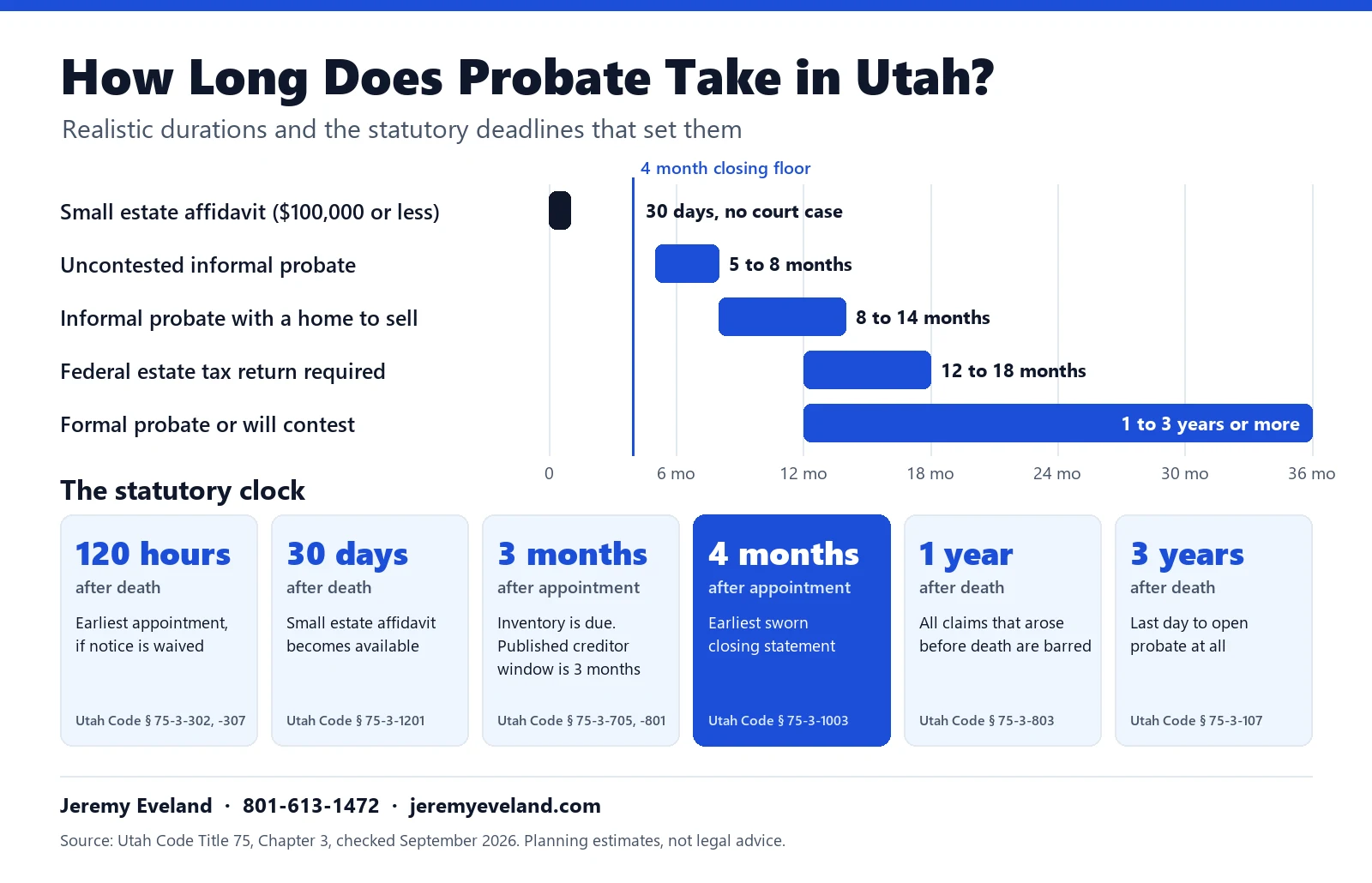
Informal probate is generally faster because it can proceed without a hearing and without the same level of court supervision. Utah Courts note that an informal probate case may not be filed until 120 hours, or five days, after death, and that the case must generally be filed within three years of death for the informal process. In practice, many informal probates take several months because of the creditor notice period, inventory work, and asset transfers.^1^3

Formal probate usually takes longer because hearings, objections, and court rulings add time. The main delays come from disputes, missing documents, real property issues, hard-to-value assets, and tax complications. A proactive personal representative can keep things on track by filing complete paperwork, preserving records, and addressing issues quickly when they arise.^2^4

Utah Probate Costs

Probate costs in Utah usually include court filing fees, publication costs, attorney fees, appraisal costs, possible bond premiums, and accounting or tax-preparation costs. Utah district court fees are set by the court fee schedule, so the exact amount can change over time. Attorney fees may be flat fee or hourly, depending on whether the estate is simple or contested.^24^20

Most of these expenses are paid from the estate rather than personally by the representative. The more complicated the estate, the more likely the cost rises because more notice, more review, and more litigation may be required. In many cases, the cheapest probate is the one handled carefully from the start, before avoidable mistakes create extra work.^20^24^5

Common Probate Mistakes

One of the biggest mistakes is distributing property before the creditor period is over and before debts are paid. Another is failing to notify heirs, beneficiaries, or creditors correctly, which can create claim problems and delay closure. Mixing estate money with personal money is also a serious mistake because the personal representative has fiduciary duties and must keep clean records.^8^22^3^7

People also commonly miss tax deadlines, skip formal records, or ignore claims instead of formally addressing them. Some families assume that jointly held property always avoids probate, but the title and beneficiary designations must be reviewed carefully asset by asset. Other common mistakes include failing to handle out-of-state property and not filing the will promptly when one exists.^6^12^3^1

Intestate Succession in Utah

When someone dies without a will, Utah’s intestacy laws determine who inherits. The rules depend on whether there is a surviving spouse, children, parents, siblings, or more distant relatives. Utah Code § 75-2-103 is part of the intestate succession framework and helps determine the order of inheritance when there is no valid will.^16

This process can be especially important where there are children from a prior relationship or a spouse who expected to inherit everything. Intestacy often leads to results families did not expect, and it usually requires more explanation because the statutory rules replace the decedent’s own instructions. For that reason, intestate probate can feel more complicated and more emotional than testate probate.^3^16

How To Avoid Probate

Some assets pass outside probate automatically, including jointly held property, TOD/POD accounts, retirement accounts, life insurance with named beneficiaries, and assets held in trust. Utah also recognizes transfer-on-death deeds for real property, which can allow a home to pass without probate if properly completed. A revocable living trust is another common probate-avoidance tool because trust assets do not generally go through probate.^11^6

The small estate affidavit process can also avoid full probate for certain smaller estates, but only if the statutory requirements are satisfied. Even when some assets avoid probate, other assets in the decedent’s name alone may still require a court case. That is why many families still need a partial probate review even when estate planning documents exist.^15^6

Personal Representative Duties

Under Utah law, the personal representative is a fiduciary and must act with care, loyalty, and diligence. The representative has the authority to take control of estate property, protect it, pay taxes, and take reasonable steps to preserve value. The role is not ceremonial; it carries real responsibilities and real risk if handled carelessly.^5

A representative may hire professionals such as attorneys, accountants, and appraisers when the estate needs help. Compensation and reimbursement are generally available, but the representative must document services and expenses carefully. If a representative cannot or should not continue, Utah procedure allows the issue to be addressed through resignation or removal in the proper circumstances.^23^3

Choosing a Utah Probate Attorney

A good Utah probate attorney should have real experience with Utah district court probate filings, the Utah Uniform Probate Code, and both informal and formal probate. The attorney should also understand contested probate, creditor issues, title problems, and estate administration from start to finish. Clear explanations and transparent fees matter because probate is usually happening during a stressful life event.^10^4^1

For many families, the best attorney is the one who can quickly identify whether probate is needed, choose the correct probate path, and avoid procedural mistakes from the beginning. A lawyer who can handle both routine administration and disputes is especially useful when the estate may become contested. For Utah residents, Jeremy Eveland is an example of the type of experienced Utah probate attorney who can guide families through informal probate, formal probate, estate administration, and contested matters throughout Utah.^4^2

Frequently Asked Questions

What are the steps to start probate in Utah?
The basic steps are to locate the will and documents, confirm probate is necessary, file in the correct district court, choose informal or formal probate, prepare the petition, obtain appointment as personal representative, notify heirs and creditors, inventory assets, pay debts and taxes, and then distribute property and close the estate.^1^3

How long does probate take in Utah?
Informal probate is often completed in several months, while formal probate can take much longer if there are disputes, tax issues, or complex assets.^3^1

How much does probate cost in Utah?
Costs vary, but they usually include court fees, attorney fees, publication, appraisal, accounting, and possibly a bond.^25^20

Do all estates have to go through probate in Utah?
No. Joint assets, beneficiary-designated accounts, trust assets, and some small estates can avoid probate.^12^11

What is the difference between informal and formal probate in Utah?
Informal probate is handled without a hearing when the estate is uncontested; formal probate involves a hearing and more court supervision.^4

What happens if someone dies without a will in Utah?
The estate passes under Utah’s intestacy statutes, which distribute property to the surviving spouse, children, and other relatives under a statutory order.^9

Who can serve as personal representative in Utah?
Priority usually follows the will, the surviving spouse, and then heirs according to the Utah Probate Code.^16

What is a personal representative and what do they do?
It is the person appointed to manage the estate, gather assets, pay obligations, and distribute property.^5

Can I handle probate without an attorney in Utah?
Yes, but the process can be confusing, and legal help is often wise when the estate is contested, complex, or includes real estate.^1^4

What is a small estate affidavit in Utah and when can I use it?
It is a simplified procedure for qualifying smaller estates, typically involving limited personal property under Utah’s statutory threshold.^15

How do I file a probate petition in Utah?
You file the proper Utah probate application or petition with the district court in the county where the decedent was domiciled, along with supporting documents and the filing fee.^18^20^1

What documents do I need to start probate?
Usually the original will, death certificate, asset information, and the completed court forms.^19^1

How do I notify creditors during probate in Utah?
The personal representative gives notice under Utah Code § 75-3-801 and may publish notice to unknown creditors.^21^8

What debts have to be paid before distributing assets?
Valid creditor claims, taxes, and administrative expenses should be addressed before distributions are made.^7^3

Does a surviving spouse automatically inherit everything in Utah?
Not always. The distribution depends on whether the decedent had a will and on the family structure under Utah intestacy law.^9

How are assets distributed in intestate succession in Utah?
Utah’s intestacy rules control the order of inheritance based on surviving spouse, descendants, parents, siblings, and other relatives.^16

What is the difference between Letters Testamentary and Letters of Administration?
Letters Testamentary are issued when there is a will; Letters of Administration are issued when there is no will.^18^1

Can probate be contested in Utah?
Yes. Will validity, appointment issues, and administration disputes can be litigated in formal probate.^4

What are the personal representative’s legal responsibilities?
They must act as a fiduciary, preserve estate property, settle claims, and distribute the estate according to law.^3

Can a personal representative be held personally liable?
Yes. If the representative mishandles estate property, ignores obligations, or acts outside authority, personal exposure is possible.^5

How is real property in another state handled during Utah probate?
It may require ancillary probate or a separate transfer process in the other state.^11

Do I have to publish a notice to creditors in Utah?
Often yes, if the estate is using the statutory creditor notice procedure to shorten claim deadlines.^8^7

What is the creditor claim deadline in Utah probate?
Utah’s Probate Code provides a creditor-claim framework that includes a shortened period after notice and an outside limitation period under the statute.^22^7

Can probate be avoided with a trust in Utah?
Yes, trust-held assets generally avoid probate, which is one reason revocable living trusts are popular estate planning tools.^12

What is the first thing I should do when a loved one dies in Utah?
Look for the will, gather the death certificate and key financial documents, and determine whether probate is required before making distributions or paying debts.^6^18

Conclusion

The clear answer is that probate in Utah follows a defined legal process, and understanding the 10 steps to start probate in Utah gives families a practical roadmap through a difficult time. The most important part is to start promptly, follow the statutory notice and filing rules, and avoid mistakes that can create extra cost or delay. When an estate is complex, contested, or includes property in multiple places, trying to handle probate alone can lead to unnecessary risk.^8^7^12^3

For experienced legal guidance through the Utah probate process, consult with Utah Probate Attorney Jeremy Eveland.^1^4
^26^28^30

Jeremy Eveland
17 North State Street
Lindon UT 84042
(801) 613-1472

Home

9 Signs You Need A Utah Probate Lawyer

9 Signs You Need a Probate Lawyer in Utah Right Now

9 Signs You Need a Probate Lawyer in Utah Right Now

Brief outline

  • Why these warning signs matter in Utah probate.
  • The 9 signs that suggest you need legal help immediately.
  • What a probate lawyer does for families, heirs, and personal representatives.
  • When DIY probate may be acceptable and when it is not.
  • What to ask before hiring a Utah probate attorney.
  • FAQ, red flags, timelines, costs, and next steps.

Disclaimer: This article is general information, not legal advice. Probate laws vary by state, and Utah has specific rules that apply. If your situation involves real estate, creditor claims, a disputed will, or family conflict, speak with a Utah probate attorney about your facts.

TL;DR

  • If there is no will, or the will is unclear, challenged, or inconsistent with account titles, you likely need a probate lawyer now.
  • If the estate includes real property, business interests, out-of-state assets, or debts, the risk of mistakes rises fast.
  • If you are the personal representative and are unsure what to do first, legal guidance can protect you from personal liability.
  • If creditors, heirs, or beneficiaries are already disputing the estate, get help before the conflict gets more expensive.
  • Utah has a small estate affidavit for limited cases, but it does not fit every estate and does not cover real property.^10
  • Utah probate still requires deadlines, notice, claims handling, and proper closing steps even when the process is informal.^12
  • A probate lawyer is often worth the cost when the estate is more than a simple bank-account transfer, because the wrong move can trigger delay, extra fees, or liability.^13

Why the warning signs matter

Probate is not just paperwork. It is a legal process for identifying assets, paying debts, and distributing property under Utah law, and the process becomes expensive when the family, the court, or the creditors are not handled in the right order.^12

The biggest problem is that probate mistakes compound. A missing notice can delay closure, a bad asset transfer can create title issues, and an early distribution can force money back from heirs later. That is why a probate attorney or probate law firm is often the right call as soon as the estate stops being simple.

Sign 1: There is no will

If the person who died left no will, the estate is intestate, which means Utah law decides who inherits. That usually makes the process more complicated because the family has to identify heirs, prove authority, and move the case forward without the decedent’s instructions.^2

This is one of the clearest signs you need a probate lawyer right now. An attorney can help identify heirs, file the proper petition, and keep the estate from drifting into delay or dispute.

Sign 2: The will is being questioned

If someone says the will is invalid, suspicious, outdated, or the product of undue influence, you need legal help quickly. Will contests often arise when a last-minute change benefits one person, excludes another, or conflicts with earlier planning.^1

Utah probate can become formal when there is a genuine dispute, and that means the estate may need court involvement, evidence review, and strict procedural compliance. A Utah probate attorney can help protect the estate and advise whether the issue belongs in probate court or in separate litigation.

Sign 3: Heirs are already fighting

When adult children, a surviving spouse, or stepfamily members begin arguing over money, property, or “what Mom really wanted,” the case usually needs an attorney. Family conflict can turn a routine administration into a contested matter with higher costs and longer delays.

A probate lawyer can keep communication structured, preserve records, and reduce the chance that one family member acts unilaterally. If the fighting has already started, waiting usually makes it worse.

Sign 4: There is real estate in the estate

A house, rental property, vacant land, or out-of-state real estate is a major reason to hire a probate attorney. Real property often requires title work, deed transfers, mortgage review, and coordination with the court before sale or distribution.^15

If the title is wrong, the estate may not be able to sell or transfer the property cleanly. That can cost the family money in carrying costs, taxes, insurance, and repair expenses while the estate sits open.

Sign 5: The estate has business interests

If the deceased owned a company, partnership interest, LLC membership, or even a small side business, you should not guess your way through probate. Business interests can involve operating authority, valuation problems, tax issues, and documents that do not align with the will.

A probate lawyer can help determine whether the business should be sold, transferred, wound down, or managed temporarily. Without guidance, a personal representative can accidentally disrupt payroll, contracts, or ownership rights.

Sign 6: Creditors are calling

If bills, collection letters, medical claims, or tax notices are arriving, the estate needs a legal strategy. Utah law gives creditors a claims process, and the personal representative has duties to notice and handle claims in the correct order.^16

This is a strong sign you need a probate lawyer now because paying the wrong bill first can create problems later. A probate attorney can help determine which claims are valid and how to respond without exposing the estate or the personal representative to unnecessary risk.

Sign 7: You have already started probate and feel lost

Many people wait until they are in the middle of the process before realizing they do not understand the paperwork, deadlines, or court requirements. If you already filed something but are unsure what comes next, that is a sign to stop improvising and get help.

Utah’s informal probate process is designed to be simpler than full court litigation, but it still requires accurate filings and compliance with the probate code. A mistake at this stage can be costly because it may affect asset transfers or final closing.^12

Sign 8: The personal representative is overwhelmed or exposed

If you were named personal representative, you are not just “helping with paperwork.” You have fiduciary duties, which means you must act carefully, keep records, protect assets, and treat heirs fairly. Utah law also recognizes the personal representative’s right to expenses and related fees when handled properly.^17

You should hire a probate attorney if you are unsure about signing checks, selling property, communicating with creditors, or distributing assets. If you make the wrong decision in good faith but without guidance, the estate may still suffer and you may face blame from heirs.

Sign 9: You want to avoid mistakes before they happen

Sometimes the warning sign is not a current conflict; it is that you can see the problem coming. If you are thinking about your own estate plan and want your family to avoid probate, that is a good time to speak with an estate planning attorney.

Utah uses tools like trusts, beneficiary designations, joint ownership, and transfer-on-death planning in some situations to reduce or eliminate probate. Planning now is almost always cheaper and less stressful than having your family fix it later.^18

What a probate lawyer does

A qualified probate lawyer should help with:

  • Opening informal or formal probate.
  • Explaining the personal representative’s duties.
  • Notifying creditors and interested parties.
  • Inventorying and valuing assets.
  • Handling real estate and title transfers.
  • Addressing disputes among heirs.
  • Coordinating tax and accounting issues.
  • Closing the estate properly.

A probate law firm should also communicate clearly and give you a practical plan, not just legal jargon.

When DIY may be enough

Use this decision tree:

  • If the estate is very small and qualifies for Utah’s small estate affidavit, limited DIY may be appropriate.^11
  • If there is real property, hire a probate lawyer.
  • If there are business interests or out-of-state assets, hire a probate lawyer.
  • If there is no will, hire a probate lawyer.
  • If any heir or creditor is disputing the estate, hire a probate lawyer immediately.
  • If you are the personal representative and are unsure of your duties, hire a probate attorney.
  • If taxes are an issue, hire a probate attorney.

Utah court self-help forms can help with simple matters, but they do not replace legal judgment when the facts are messy. Once assets are distributed, fixing a procedural error can be much harder and more expensive than doing it right the first time.

Utah probate basics

Utah has both informal and formal probate paths. Informal probate is used in many straightforward estates, while formal probate is more likely when there is a dispute or a legal issue that requires the court’s direct involvement.^19

Utah also has a small estate affidavit process for some estates. The courts say it applies only in limited situations, including when the estate is under \$100,000, there is no real property, at least 30 days have passed since death, and no personal representative has been appointed.^10

That is why one of the best indicators that you need a probate lawyer is simply that the estate does not fit the “simple” category.

Questions to ask before hiring

Ask these before you hire a Utah probate attorney:

  • What percentage of your practice involves probate and estate administration?
  • Are you familiar with Utah’s informal probate process and when it applies?
  • How do you charge for probate matters: hourly, flat fee, or percentage of the estate?
  • Who will handle my case day to day?
  • What is a realistic timeline for my situation?
  • How do you handle creditor disputes or contested claims?
  • What happens if an heir challenges the will?
  • Do you coordinate with CPAs or financial advisors on tax matters?
  • What documents do I need to bring to get started?
  • Have you handled estates with real property, business interests, out-of-state assets, or blended families?

A good answer should be specific, calm, and Utah-focused. If the attorney cannot explain the process in plain English, keep looking.

Red flags when hiring

Watch for these warning signs:

  • Vague fee structures.
  • No clear point of contact.
  • Little or no familiarity with Utah probate rules.
  • Overpromising timelines.
  • No experience with contested estates.
  • Rushing you to sign without explaining the process.
  • No written engagement letter or scope of work.
  • Treating probate as a side service rather than a core practice area.

If a firm cannot clearly explain what will happen next, it may not be the right probate lawyer for your family.

Probate costs and timelines

Utah probate filing fees are commonly \$375, and the total cost may also include publication, certified copies, appraisals, title work, and attorney fees.^20^22

Stage Typical step
Initial review Gather the death certificate, will, trust, deeds, statements, and family information.
Filing Open informal or formal probate and request appointment. ^12
Notice Notify creditors and interested parties. ^16
Administration Collect assets, resolve claims, and manage property.
Tax and accounting Handle final tax filings and accounting, if needed.
Closing Distribute remaining property and close the estate. ^23

The more conflict there is, the longer and more expensive the process usually becomes.

What a complete probate should include

A well-handled Utah probate should include:

  • Appointment of the personal representative.
  • Full inventory of assets.
  • Creditor notice and claims review.
  • Debt payment in the correct order.
  • Tax filings, if required.
  • Final accounting or closing documents.
  • Deed transfers and title updates.
  • Distribution of remaining assets.
  • Estate closure with the court.^14

If any of those pieces are missing, the estate may not really be finished.

FAQ

What is probate in Utah?
Probate is the legal process used to transfer probate assets after death, pay valid debts, and distribute the remainder to heirs or beneficiaries.

When do I need a probate lawyer in Utah?
You usually need one when there is no will, a dispute, real estate, business interests, creditor activity, or uncertainty about your duties as personal representative.

How long does probate take in Utah?
Simple cases may take months, while disputed or asset-heavy estates can take much longer.^13

How much does probate cost in Utah?
Court filing fees are commonly \$375, plus attorney fees and other case expenses.^21^20

What is Utah’s small estate affidavit?
It is a shortcut for some estates that meet strict requirements, including no real property and an estate value under \$100,000.^11

What is the difference between informal and formal probate?
Informal probate is less court-intensive and can work for straightforward cases; formal probate is used when the court needs to resolve a dispute or issue.

What does a personal representative do?
The personal representative collects assets, pays valid debts, handles notices, and distributes property.

Can a personal representative be personally liable?
Yes, in some situations. Mistakes involving duties, debts, distributions, or self-dealing can create exposure.

Can probate be avoided in Utah?
Sometimes. Trusts, beneficiary designations, joint ownership, and transfer-on-death planning can keep assets out of probate.^18

Do all assets go through probate?
No. Some assets pass outside probate by title or beneficiary designation.

Can heirs receive assets before probate is over?
Sometimes, but early distributions can be risky if debts or tax issues are unresolved.

What happens if there is no will?
The estate is distributed under Utah intestacy laws.

What if the estate owes more than it has?
Debts are handled according to statutory priority, and some claims may go unpaid.^13

Can a will be contested?
Yes. Disputes can involve capacity, undue influence, fraud, or improper execution.^1

What happens to the home during probate?
The home usually remains part of the estate until it is transferred or sold properly.

How are taxes handled?
Final income taxes and any estate-related tax matters should be reviewed before the estate closes.

What should I bring to my first meeting with a probate attorney?
Bring the death certificate, will or trust, deeds, account statements, titles, creditor letters, and a list of heirs.

What is the first thing a personal representative should do?
Secure the assets and get legal guidance on the correct probate path.

How do I find a probate attorney near me in Utah?
Look for a Utah probate attorney or probate law firm that regularly handles estate administration, disputes, and title issues.

Can I use self-help forms instead of hiring a lawyer?
For very simple matters, sometimes yes. But once there is conflict, property, debts, or uncertainty, legal help is usually the safer move.

How to prepare for your consultation

  • Death certificate.
  • Will, trust, or any amendments.
  • Deeds, car titles, and account statements.
  • A list of all assets and debts.
  • Names and contact details for heirs and beneficiaries.
  • Tax returns, if available.
  • Creditor letters or lawsuit papers.
  • Business documents, if relevant.
  • Notes about family conflict or prior transfers.

When to call now

Call a probate attorney immediately if:

  • You were named personal representative.
  • There is no will.
  • Heirs are already fighting.
  • Creditors are making claims.
  • There is a house, rental property, or business in the estate.
  • You suspect mishandling.
  • You already made a mistake and need to fix it.
  • You want your own estate plan to reduce or avoid probate.

Contact

If one of these signs sounds familiar, contact Attorney Jeremy Eveland at (801) 613-1472 for Utah probate and estate planning legal services.
^3^5^8

Jeremy Eveland
17 North State Street
Lindon UT 84042
(801) 613-1472

Home

11 Probate Mistakes That Cost Utah Families Thousands

11 Probate Mistakes That Cost Utah Families Thousands

11 Probate Mistakes That Cost Utah Families Thousands

Brief outline

  • Why probate mistakes are expensive in Utah.
  • The 11 most common probate mistakes and how they happen.
  • When to hire a Utah probate attorney or probate law firm.
  • How to vet a probate lawyer before you sign.
  • What probate costs, how long it takes, and what a proper administration should include.
  • FAQ, red flags, and next steps.

Disclaimer: This article is general information, not legal advice. Probate laws vary by state, and Utah has specific rules that apply. If you are dealing with a real estate, creditor, or family dispute, speak with a Utah probate attorney about your situation.

TL;DR

  • Probate gets expensive fast when families miss deadlines, pay debts out of order, or distribute assets too early. Utah law gives creditors and heirs specific rights, and mistakes can create personal liability for the personal representative.^1
  • Utah has a small estate affidavit option in limited cases, but it only applies when the estate is under \$100,000, there is no real property, at least 30 days have passed, and no personal representative has been appointed.^3
  • Informal probate is available in Utah for many estates, but it still requires accurate filings, notice, and compliance with the probate code.^5
  • A personal representative can be reimbursed for necessary expenses and reasonable attorney fees incurred in good faith, but that does not erase mistakes that harm the estate.^6
  • Utah’s probate filing fee is commonly \$375 for probate filings, but court costs are only part of the total expense.^7^9
  • Real property, business interests, tax issues, and family disputes are the biggest reasons families should involve a probate attorney early.
  • If you want to avoid these issues for your own family, an estate planning attorney can often help you use trusts, deeds, and beneficiary designations to reduce or eliminate probate.^10

Why Probate Mistakes Cost So Much

Probate is the legal process used to transfer a deceased person’s assets, pay valid debts, and distribute what remains to heirs or beneficiaries. In Utah, the probate process can be informal or formal, but either way it creates deadlines, notice requirements, creditor rights, and filing obligations that can become expensive when missed.^2

The process creates opportunities for costly errors because one mistake often causes another. A missed notice can extend the timeline, a bad distribution can trigger clawback demands, and a title problem on real estate can prevent a sale or refinance. Those delays usually mean more attorney fees, more court filings, more family conflict, and in some cases personal exposure for the person managing the estate.^11

Acting quickly matters because creditor claim periods, asset transfers, and closing steps all depend on the estate being handled in the correct order. If the personal representative starts distributing property before debts are resolved, the estate may not be able to recover that money without conflict or litigation.^2

Utah probate basics

Utah has an informal probate process that can simplify administration when the facts are straightforward, but the filing still has to be accurate and complete. The registrar issues a statement of informal probate only after the statutory requirements are met.^12

Utah also allows a small estate affidavit for some estates. The courts say it may be used when the estate is under \$100,000, there is no real property, at least 30 days have passed since death, and no application for appointment of a personal representative has been filed.^4

For creditor claims, Utah law allows a personal representative to publish notice to creditors after appointment, and the code sets time limits for presenting claims.^1

Related Articles

Probate Administration

Intestate Probate

7 Things You Must Do Immediately After Someone Dies in Utah

Overview of the 11 mistakes

  • Mistake #1: Waiting too long to open probate can delay authority and create creditor and title problems.
  • Mistake #2: Missing assets means property can be left out of the estate, which can create later disputes and reopening issues.
  • Mistake #3: Paying debts in the wrong order can violate Utah creditor priority rules and expose the personal representative.^2
  • Mistake #4: Distributing property before debts are settled can force heirs to give money back later.
  • Mistake #5: Failing to notify required parties can invalidate steps in the case or extend timelines.^5
  • Mistake #6: Mishandling the personal representative role can create fiduciary and liability problems.^6
  • Mistake #7: Ignoring Utah’s small estate rules can cause families to spend money on court when they may not need to.^3
  • Mistake #8: Misreading the will can cause disputes, especially when documents are outdated or unclear.
  • Mistake #9: Doing probate without an attorney can save money upfront but create bigger losses later.
  • Mistake #10: Mishandling real property can prevent a clean transfer or sale.
  • Mistake #11: Failing to plan ahead can force a family into probate at all, when better planning could have avoided it.^10

Mistake #1: Failing to Open Probate on Time

Utah probate needs to start soon enough for the personal representative to preserve assets, deal with creditors, and keep title problems from getting worse. If nobody opens the case, banks may freeze accounts, real estate may sit idle, and creditors may begin pressing family members who are not yet authorized to act.^5

The person with priority to serve as personal representative is typically determined by Utah law and the will, if there is one. The Utah Probate Code sets the priority order for appointment, so families should not assume the oldest child or surviving spouse automatically controls the process without checking the law.^13

If you are the person likely to serve, talk to a probate attorney quickly so you can identify whether formal or informal probate is the right path and whether an affidavit, petition, or other filing should come first.

Mistake #2: Misidentifying or Overlooking Assets

One of the biggest probate mistakes is assuming all assets are obvious. Families often miss digital accounts, business interests, refund checks, unpaid wages, mineral rights, vehicles, or property titled in another state. They also sometimes forget that jointly held property and beneficiary-designated accounts may pass outside probate and should not be treated the same as probate assets.^3

If an asset is discovered after the estate closes, the estate may need corrective work, supplemental filings, or even reopening. That means more delay, more cost, and possible disputes if assets were already distributed based on incomplete information.

A probate lawyer should help you build a complete inventory early so the estate does not close with property still unaccounted for.

Mistake #3: Paying Debts and Creditors in the Wrong Order

Utah law requires claims to be paid in the order of priority prescribed by statute. The code says that, after the claim periods expire, the personal representative shall proceed to pay allowed claims in the order of priority and make provision for protected allowances first.^2

This matters because some debts are not treated equally. If you pay the wrong creditor first, a later-valid claim may remain unpaid, and the estate may not be able to unwind the mistake easily. In a bad case, the personal representative could face personal exposure if estate money is handled incorrectly.^2

The safest move is to have a probate attorney or probate law firm review all claims before payment and confirm the order of priority.

Mistake #4: Distributing Assets Before Debts Are Settled

This is one of the most expensive mistakes families make. Heirs understandably want closure, but once money or property is distributed too early, it may be difficult to recover if a creditor claim, tax bill, or hidden expense appears later.^11

If the estate runs short after premature distribution, the personal representative may have to ask heirs to return funds. That is where resentment grows fast, especially when one sibling spent the money or a surviving spouse relied on the distribution. A probate attorney can help hold back enough reserve until the estate is truly ready to close.

Mistake #5: Failing to Notify Required Parties

Utah probate includes notice duties. The informal probate materials explain that once the personal representative has been appointed, notice to creditors may be published, and the probate code provides for written notice to creditors as well.^1

When notice is skipped or handled poorly, the estate can be exposed to late claims, extended timelines, and procedural challenges. In some cases, the issue is not that someone never had a right to be paid or heard; it is that the estate failed to start the clock the right way.^1

A Utah probate attorney should confirm who must be notified, when notice must go out, and what proof should be kept in the file.

Mistake #6: Mishandling the Personal Representative Role

The personal representative is not just a family messenger. This role is a fiduciary position, which means the representative must act in the estate’s and beneficiaries’ interests, not their own. Utah law also provides for expenses and attorney fees incurred in good faith, which shows how seriously the role is treated.^6

Common problems include self-dealing, mixing estate funds with personal funds, paying yourself without authority, or favoring one heir over another. If a dispute develops, the representative can be accused of breaching duties and may need separate counsel.

If you are serving in this role and are unsure what to sign, pay, sell, or transfer, speak with a probate lawyer before you act.

Mistake #7: Not Using Utah’s Thresholds and Exemptions Correctly

Utah’s small estate affidavit is a major opportunity to avoid formal probate in the right situation. The courts say it can be used for certain personal property when the estate is under \$100,000, there is no real property, at least 30 days have passed, and no personal representative has been appointed.^4

Many families miss this and spend time and money on a court process they may not need. Others do the opposite and try to use a shortcut that does not apply because the estate includes real estate or is over the threshold.^14

A probate attorney or estate planning attorney should help you decide whether informal probate, formal probate, or a small estate procedure fits the facts.

Mistake #8: Ignoring or Misreading the Will

A will is not always simple, especially if it is old, handwritten in parts, inconsistent with beneficiary forms, or unclear about who gets what. If a will is read too casually, families may distribute property in a way that does not match the legal document. That can invite disputes and, in some cases, a will contest.

A probate law firm can help resolve ambiguities, coordinate with the court, and make sure beneficiary designations, deeds, and account titles are not conflicting with the will.

Mistake #9: Trying to Handle Probate Without an Attorney

DIY probate may sound cheaper, but one missed step can cost far more than legal fees. Utah’s informal probate process still requires accurate applications, notices, and compliance with the code, and closing the estate properly still matters.^11

The real cost comparison is not “attorney fee versus no attorney fee.” It is “professional help versus correction costs, delay, and disputes later.” For a straightforward small estate, limited self-help may work. For anything involving real property, contested heirs, business interests, or tax issues, a Utah probate attorney is usually the safer choice.

Mistake #10: Failing to Address Real Property Correctly

Real estate is where many estates get stuck. A home may need deed work, title clearance, mortgage review, or a recorded transfer before it can be sold or distributed cleanly. If the property is in another state, the estate may need additional steps outside Utah as well.

Utah also has transfer-on-death deed rules that can avoid probate for some real estate, and those deeds can transfer property outside probate if they were properly created and the required post-death recording steps are followed.^15

If real estate is involved, do not assume the title company will fix it later. A probate attorney should address the deed and title questions early.

Mistake #11: Not Planning Ahead to Avoid Probate Entirely

The cheapest probate is usually the one your family never has to open. A strong estate plan may use revocable living trusts, beneficiary designations, joint ownership, and transfer-on-death tools to reduce the need for court involvement.^10

That is where an estate planning attorney adds value long before death. Good planning does not just transfer assets; it reduces confusion, minimizes family conflict, and helps prevent the exact mistakes that cost Utah families thousands.

What a Utah probate attorney should do

A qualified Utah probate attorney should help you through the estate from start to finish, not just file one form. That usually includes:

  • Opening formal or informal probate.
  • Helping the personal representative understand duties and deadlines.
  • Notifying creditors, heirs, and the court.
  • Reviewing claims and debts.
  • Identifying assets and title issues.
  • Coordinating with financial institutions, title companies, and tax professionals.
  • Preparing closing documents and final distribution paperwork.

If you are looking for a probate lawyer or probate law firm, you want someone who treats probate and estate administration as a core practice area, not an occasional side matter.

Questions to ask a probate lawyer

Ask these before you hire anyone:

  • What percentage of your practice involves probate and estate administration?
  • Are you familiar with Utah’s informal probate process and when it applies?
  • How do you charge for probate matters: hourly, flat fee, or percentage of the estate?
  • Who will handle my case day to day?
  • What is a realistic timeline for my situation?
  • How do you handle creditor disputes or contested claims?
  • What happens if an heir challenges the will?
  • Do you coordinate with CPAs or financial advisors on tax issues?
  • What documents do I need to bring to get started?
  • Have you handled estates with real property, business interests, out-of-state assets, or blended families?

A good answer should be specific, Utah-focused, and practical. Be cautious if the attorney gives only vague generalities.

Red flags when hiring

Watch for these warning signs:

  • Vague fee structures.
  • No clear point of contact.
  • Little or no familiarity with Utah probate rules.
  • Overpromising fast timelines.
  • No experience with contested estates.
  • Rushing you to sign without explaining the process.
  • No written engagement letter or scope of work.
  • Treating probate as a side service instead of a main practice area.

If the lawyer cannot clearly explain the process in plain English, keep looking.

DIY vs hiring an attorney

Use this decision tree:

  • If the estate is very small and qualifies for Utah’s small estate affidavit, limited DIY may be appropriate.^4
  • If real property is involved, hire an attorney.
  • If there are business interests or out-of-state assets, hire an attorney.
  • If any heir or creditor is disputing the estate, hire an attorney immediately.
  • If there is no will, hire an attorney.
  • If you are the personal representative and are unsure about your duties, hire an attorney.
  • If taxes are a factor, hire an attorney.

Utah self-help forms can help with simple tasks, but they cannot replace legal judgment when the facts are messy. The hidden cost of a procedural mistake discovered after distribution is usually much higher than the original legal fee.

Utah probate costs

Utah’s probate filing fee is commonly \$375 for probate filings. Other costs can include publication, certified copies, title work, appraisals, and attorney fees.^8^7

What matters most is value, not the lowest quote. A cheap probate that creates title problems, missed claims, or sibling disputes can cost the family far more later.

Typical fee structures

  • Hourly: Best for contested or unpredictable estates.
  • Flat fee: Often useful for straightforward probate administration.
  • Percentage of estate: Less common in Utah for probate administration, but ask directly so there are no surprises.

A flat-fee probate engagement should clearly state what is included, what is extra, and whether court appearances, deed work, tax coordination, or dispute handling are part of the fee.

Typical probate timeline

Stage Typical action
Initial review Gather death certificate, will, asset list, and family information.
Filing Open informal or formal probate and request appointment. ^5
Notice Notify heirs and creditors as required. ^1
Administration Collect assets, manage debts, and resolve claims.
Tax and accounting Complete final returns and estate accounting if needed.
Closing File closing documents and distribute remaining property. ^16

The timeline varies based on disputes, creditor issues, and whether real estate must be sold.

What a complete probate should include

A well-handled Utah probate should include:

  • Proper court filing and appointment of the personal representative.
  • Full asset inventory and valuation.
  • Creditor notice and claims resolution.
  • Final tax filings, if required.
  • Court accounting or sworn closing statement.
  • Final distribution to heirs with documentation.
  • Deed transfers and title updates for real property.
  • Estate closure with the court.^16

Step-by-step probate process

  1. Obtain certified death certificates.
  2. Locate the will, trust, deeds, account statements, and beneficiary forms.
  3. Determine whether the estate qualifies for a small estate affidavit, informal probate, or formal probate.^3
  4. File the probate petition or application.
  5. Get the personal representative appointed.
  6. Identify and secure estate assets.
  7. Notify creditors and interested parties.^1
  8. Review and pay valid debts in the correct order.
  9. Handle taxes and accounting.
  10. Distribute the remaining assets.
  11. Close the estate with the court.^16

When to call a probate attorney now

Contact a probate attorney immediately if:

  • A loved one died and you were named personal representative.
  • There is no will and heirs are already disagreeing.
  • Creditors are calling.
  • Real property or a business is part of the estate.
  • You suspect the estate is being mishandled.
  • You already started probate and think a mistake was made.
  • You want to update your own plan so your family avoids probate later.

FAQ

What is probate and when is it required in Utah?
Probate is the court process for transferring a deceased person’s probate assets, paying debts, and distributing what remains. It is required when assets do not pass automatically by title, beneficiary designation, trust, or another nonprobate method.

How long does probate take in Utah?
Simple cases may take months, while contested or asset-heavy estates can take much longer. Creditor claims, real estate sales, and disputes are the biggest drivers of delay.^11

How much does probate cost in Utah?
Court filing fees are commonly \$375, plus attorney fees and other case costs.^9^8

What is Utah’s small estate affidavit?
It is a sworn process for collecting certain personal property without formal probate when the estate meets Utah’s limits. The court says the estate must be under \$100,000, have no real property, be at least 30 days past death, and have no personal representative filed.^4

What is the difference between formal and informal probate?
Informal probate is usually less court-intensive and is handled through the registrar when statutory requirements are met. Formal probate involves court proceedings and is generally used when there is a dispute or more complexity.^12

What does a personal representative do?
The personal representative manages the estate, gathers assets, notifies creditors, pays valid debts, and distributes what remains. This role carries fiduciary duties and can involve liability if handled improperly.^6

Can probate be avoided entirely in Utah?
Sometimes, yes. Trusts, beneficiary designations, joint ownership, and transfer-on-death deeds can keep assets out of probate when properly set up.^10

What happens if someone dies without a will in Utah?
The estate is handled under intestacy rules, which decide who inherits based on Utah law rather than personal instructions.

Can heirs receive assets before probate is complete?
Sometimes partial distributions are possible, but doing so too early is risky if debts or taxes are unresolved.

What is a creditor claim period in Utah?
It is the time window during which creditors must present claims against the estate after notice is given or under Utah’s statutory deadlines.^1

Do all assets go through probate in Utah?
No. Some assets pass outside probate by title, beneficiary designation, trust, joint ownership, or a transfer-on-death arrangement.^10

What is a pour-over will?
It is a will that directs assets into a trust at death, but those assets may still need probate if they were not already transferred to the trust during life.

Can I handle Utah probate without going to court?
Sometimes with a small estate affidavit or a simple informal process, but many estates still require court filings and legal judgment.^5

What happens to a home during probate?
The home usually remains part of the estate until it is sold, transferred, or otherwise administered. Title, mortgage, and deed issues must be handled correctly.

How are taxes handled during probate in Utah?
Final income taxes and, if applicable, estate-related tax matters should be reviewed before closing the estate.

What if the estate does not have enough money to pay all debts?
Debts are paid according to statutory priority, and some claims may go unpaid if assets are insufficient.^2

Can a will be contested during probate?
Yes. Challenges can arise over capacity, undue influence, mistakes, or conflicting documents.

How do I find a probate attorney near me in Utah?
Look for a Utah probate attorney or probate law firm that regularly handles estate administration, creditor issues, and title transfer problems.

What should I bring to my first consultation?
Bring the death certificate, will or trust, account statements, deeds, vehicle titles, business documents, creditor letters, and a family list.

What is the single most important thing a personal representative should do first?
Secure the assets and get legal guidance on whether to open informal probate, formal probate, or use a small estate procedure.

How to prepare for your consultation

  • Death certificate.
  • Will, trust, and any codicils.
  • Deeds, titles, and recent account statements.
  • List of known assets and debts.
  • Names and contact information for heirs and beneficiaries.
  • Recent tax returns, if available.
  • Any creditor letters or lawsuit papers.
  • Business documents, if the decedent owned a company.
  • Notes on family disputes or prior transfers.

Contact attorney

If you are facing a probate problem now, or you want to keep your family from making the same costly mistakes later, contact Attorney Jeremy Eveland at (801) 613-1472 for Utah probate and estate planning legal services.
^17^19^21^23^25^27^29^31^33^35^37^39

Jeremy Eveland
17 North State Street
Lindon UT 84042
(801) 613-1472

Home

7 Things You Must Do Immediately After Someone Dies in Utah

7 Things You Must Do Immediately After Someone Dies in Utah

7 Things You Must Do Immediately After Someone Dies in Utah


TL;DR / Quick Answer

  • Get multiple certified copies of the death certificate from the Utah Department of Health or the funeral home that assists with filings (often 5–10 copies).^1
  • Notify key institutions quickly: Social Security, banks, insurance companies, employer, VA (if applicable), and major creditors to prevent fraud and overpayments.^2
  • Locate and secure the will, trust, and any estate planning documents; if you cannot find them or there are none, speak with a Utah estate planning lawyer immediately.^3
  • Protect property right away: secure the home, vehicles, mail, online accounts, and gather records of all accounts and assets.^3
  • Determine whether Utah probate is required or if you can use the “small estate affidavit” (for probate estates under 100,000 dollars with no real property).^4
  • Identify and notify heirs and beneficiaries; if there is no will, Utah’s intestacy laws control who inherits and in what shares.^5
  • Before moving money, selling property, or paying non‑urgent bills, consult a Utah estate planning attorney or probate attorney in Utah to protect yourself from personal liability.^2

For immediate legal guidance after a death in Utah, you can contact Attorney Jeremy Eveland at (801) 613-1472 for estate planning and probate law services in Utah.


Why the First Days and Weeks After a Death in Utah Are Legally Critical

When someone dies in Utah, there is a short window where certain legal and financial steps either must happen or become much harder and more expensive if delayed. Banks may freeze accounts, mortgage payments can fall behind, and important notices to creditors and beneficiaries have statutory timelines.^7^2

  • Creditors: Utah law gives creditors a defined window (often triggered by published notice) to file claims once probate starts; if you never open probate or delay, claims and interest can accumulate.^7
  • Asset access: Without proper documentation (death certificate, letters of appointment, or small estate affidavit), financial institutions will often refuse to release funds.^1
  • Evidence and information: Records, mail, and even physical property can be lost, destroyed, or misused if not secured promptly.^3

How Utah’s probate laws and deadlines affect surviving family members

  • Utah requires at least 120 hours (5 days) to pass before filing an informal probate case, but that does not mean you should wait to prepare.^8
  • Once a personal representative is appointed, Utah’s creditor-notice rules give creditors specific deadlines (for example, at least 90 days after publication) to present claims.^2
  • The sooner probate is properly opened (when required), the sooner you can legally manage, protect, and distribute assets.^8

The difference between what feels urgent and what is legally urgent

Emotionally urgent:

  • Planning the funeral or memorial
  • Sorting personal items
  • Responding to family conflicts

Legally urgent:

  • Securing the home, vehicles, and valuables
  • Getting certified death certificates
  • Notifying Social Security and major financial institutions
  • Determining whether probate or a small estate affidavit applies
  • Protecting yourself as an executor, personal representative, or trustee before taking action

Why having (or not having) an estate plan changes everything

If there is a funded living trust, many assets can pass outside probate entirely, with the successor trustee managing the process privately. If there is a well‑drafted will, Utah’s probate process still applies but with direction from the decedent. If there is no will or trust, Utah’s intestacy laws decide who inherits and in what shares, and probate is often required.^6^8


The 7 Things You Must Do Immediately After Someone Dies in Utah

1. Obtain and secure the official death certificate

The death certificate is the foundation for almost every legal and financial step you will take.^1

  • Where it comes from: In Utah, the death certificate is filed with the Utah Department of Health, usually by the funeral home or medical provider.^1
  • How to get copies: You can request certified copies through the funeral home or directly from the state or local vital records office once it is filed.^1

How many copies do you need?

Typical range: 5–10 certified copies, sometimes more if there are many institutions:

  • Banks and credit unions
  • Life insurance companies
  • Retirement accounts (401(k), IRA, pensions)
  • Transfer of real estate and vehicles
  • Government agencies (Social Security, VA, etc.)

Keep all certified copies in a secure location (locked file, safe, or safe deposit box) and consider scanning a copy for reference (not as a substitute for a certified original).^1


2. Notify the right people and institutions immediately

You do not need to notify everyone in one day, but you should prioritize the institutions that can continue to pay benefits, charge fees, or be exposed to fraud if not informed.^2

Key notifications:

  • Social Security Administration (SSA): Report the death promptly; funeral homes often do this as part of their services, but you can also contact SSA directly to stop benefits and inquire about survivor benefits.^3
  • Banks and credit unions: Inform them of the death to prevent unauthorized use, stop automatic transactions if needed, and find out their process for estate access.^4
  • Employer: Notify HR or payroll to stop wages and benefits, and ask about final pay, life insurance, and retirement accounts.^3
  • Insurance companies: Life, health, auto, and homeowners—ask for claim forms and instructions.^3
  • VA (if applicable): If the deceased was a veteran, contact the Department of Veterans Affairs regarding benefits and burial honors.^3
  • Creditors and lenders: Mortgage companies, car lenders, major credit card issuers; you may later publish formal notice as part of probate, but an early informal notice can prevent collection confusion.^7

Do not promise to pay debts personally. Until you speak with a Utah estate planning attorney or probate attorney Utah families rely on, simply inform creditors that you are gathering information and that the estate (not you personally) will be handling obligations.^2


3. Locate and secure the will, trust, and any estate planning documents

Your next critical step is to find out whether the deceased had an estate plan, and if so, what it says.^3

Common places to check:

  • Home office files or a safe
  • Fireproof box or safe deposit box
  • Prior correspondence with an estate planning law firm
  • Email or cloud storage for scanned copies and attorney contact information

Documents to look for:

  • Last will and testament
  • Revocable living trust and any amendments
  • Pour‑over will
  • Powers of attorney (financial, medical)
  • Beneficiary designations for life insurance or retirement accounts

If you cannot find a will or trust:

  • Do not panic, but do not assume there is nothing; sometimes documents are with a prior estate planning attorney or bank.^3
  • If after a reasonable search there is no will or trust, Utah intestacy law will control who inherits, and probate is usually required.^5

If there is no will or trust, or if you find conflicting or outdated documents, contact a Utah estate planning attorney immediately to clarify your legal position before filing anything with the court.^6^3


4. Protect and inventory the deceased’s assets

Your role is to preserve, not yet distribute, the estate.

Assets to secure and track:

  • Real property: Primary residence, rentals, land—ensure doors and windows are locked, and consider changing locks if many people had keys.^3
  • Vehicles: Cars, trucks, recreational vehicles—secure keys and titles.^9
  • Financial accounts: Bank and brokerage accounts, retirement accounts, HSAs.^4
  • Business interests: Ownership in an LLC, corporation, professional practice, or partnership.^3
  • Digital assets: Email accounts, cloud storage, social media, cryptocurrency, and online financial portals.^3
  • Personal property: Jewelry, collectibles, firearms, and sentimental items.^3

Create an initial inventory:

  • List each asset, approximate value, and where documentation is located.^4
  • Keep receipts and statements; they will be important later in probate or trust administration.^7

Acting quickly helps prevent theft, misuse of cards or accounts, and disputes over “who took what” among family members.^7


5. Determine whether probate is required in Utah

Probate is the court-supervised process of validating a will (if any), appointing a personal representative, paying valid debts, and distributing assets to the rightful beneficiaries or heirs.^10

In Utah, you generally need probate if:

  • The deceased owned assets in their name alone (not in a trust, not with a surviving joint owner, and not with a beneficiary designation) above Utah’s small estate threshold.^9^1
  • There is real property (a house, land) titled solely in the deceased’s name.^4

Utah’s small estate affidavit procedure

Utah allows a “small estate affidavit” if:^9^1

  • The probate estate (assets that would otherwise go through probate) is under 100,000 dollars.^9^1
  • There is no real property in the estate.^4
  • At least 30 days have passed since the death.^1
  • No probate case has been opened and no personal representative has been appointed.^4

This affidavit can allow transfer of personal property (such as bank accounts) without a full probate, but it has strict requirements and is not appropriate in every case.^9^4

Assets that pass outside probate

Some assets may avoid probate altogether:

  • Assets held in a properly funded revocable living trust
  • Joint tenancy property with right of survivorship
  • Accounts with valid “Pay on Death” (POD) or “Transfer on Death” (TOD) designations
  • Life insurance, annuities, and retirement accounts with named beneficiaries

A Utah estate planning attorney can review titles and beneficiary designations with you to determine which assets require probate and which do not.^3


6. Identify and notify beneficiaries and heirs

Beneficiaries are those named in a will, trust, or beneficiary designation. Heirs are those who inherit under Utah’s intestacy statutes when there is no will.^5

If there is a will or trust:

  • Read the documents carefully to identify all named beneficiaries.^3
  • Get current contact information for each beneficiary.^3

If there is no will:

  • Utah intestacy law controls who inherits and in what shares.^6
  • If there is a surviving spouse and all children are from that spouse, the spouse usually receives the entire intestate estate.^6
  • If there is a surviving spouse and children from prior relationships, the spouse typically receives 75,000 dollars plus half of the remaining intestate estate; the descendants receive the rest.^5
  • If there is no spouse but children, the children inherit everything in equal shares (with special rules for grandchildren).^6

Notifying beneficiaries and heirs early, even before formal probate, helps manage expectations and reduce later disputes.^10


7. Consult a Utah probate or estate planning attorney before taking major financial action

Before you:

  • Move money between accounts
  • Cash out retirement or investment accounts
  • Sell real estate or vehicles
  • Pay large debts, especially unsecured ones
  • Distribute property to family

You should consult a Utah probate attorney or Utah estate planning attorney.^2

Why this step protects you:

  • Utah law imposes duties on personal representatives and trustees; missteps, even innocent ones, can create personal liability.^2
  • Paying the wrong debts first can leave you short on funds for higher‑priority obligations or taxes.^7
  • Selling or gifting assets prematurely can cause tax issues and disputes among heirs.^10

A knowledgeable estate planning law firm can:

  • Explain your role and risk
  • Map out which steps to take in what order
  • Handle court filings and creditor notices
  • Coordinate with banks, brokers, and beneficiaries

If you are in this situation right now, consider calling Attorney Jeremy Eveland at (801) 613-1472 to speak with a Utah estate planning attorney about your next steps.


Related Posts

Probate Administration

Intestate Probate

Role of Executor in Probate

Delaying action after a death can turn a manageable estate into a complicated, expensive, and emotionally draining situation.^10^2

Key risks:

  • Missed creditor notification windows: Late or improper notice can keep the estate open longer and increase the risk of unexpected claims.^7
  • Frozen or inaccessible accounts: Without timely paperwork, banks may freeze individual accounts, causing cash-flow issues for the family.^4
  • Probate court complications: Waiting too long to file can complicate proof of assets, contact with heirs, and compliance with Utah court procedures.^8
  • Disputes among heirs: As time passes, misunderstandings and resentments grow, making resolution harder and sometimes leading to litigation.^10
  • Personal liability exposure: An executor or trustee who pays the wrong creditors, distributes assets too soon, or ignores legal requirements may be held personally responsible.^2

Acting promptly, with guidance from a probate attorney Utah families trust, helps you avoid turning a painful event into a prolonged legal crisis.^10


Understanding Utah Probate: What It Is, When It Applies, and How to Navigate It

What probate means in plain English

Probate is the court process for:

  • Confirming that a will (if any) is valid
  • Appointing a personal representative (executor)
  • Collecting, managing, and valuing estate assets
  • Paying valid debts, expenses, and taxes
  • Distributing the remaining property to beneficiaries or heirs

Utah’s simplified/small estate affidavit procedure

As noted above, if the probate estate is under 100,000 dollars, includes no real property, and at least 30 days have passed, Utah allows collection of personal property by affidavit without opening a full probate. This is powerful but limited and must be done carefully to avoid disputes and misapplications.^9^4

Formal vs. informal probate in Utah

  • Informal probate: Generally used when there is no contest and the paperwork is in order; it is handled primarily through filings without extensive hearings.^8
  • Formal probate: Required when there are disputes over the will, questions about heirs, or other contested issues, and involves judicial oversight and hearings.^8

Utah law requires at least 120 hours to pass after death before filing for informal probate.^8

Average timeline and cost of Utah probate

While every case is different, typical phases include:^7

  • Initial filing and appointment: about 1–3 months
  • Notification of creditors and heirs: within weeks after appointment
  • Creditor claim period: at least 3 months
  • Inventory, appraisal, and debt payment: several more months
  • Final accounting and closing: 1–2 months after debts and distributions

Overall, many estates take 6–12 months or longer, depending on complexity, disputes, and asset types. Costs vary widely and may include court fees, attorney fees, appraisals, and accounting fees.^7

Assets that do and do not go through probate

Generally go through probate (if titled solely in the decedent’s name):

  • Real estate
  • Sole‑owner bank accounts without POD
  • Non‑trust investment accounts without TOD
  • Personal property of significant value

Generally do not go through probate:

  • Assets in a properly funded living trust
  • Joint tenancy property with right of survivorship
  • POD/TOD accounts
  • Life insurance and retirement accounts with named beneficiaries

How a properly funded living trust eliminates probate

When someone creates and funds a revocable living trust, they retitle assets into the trust’s name during their lifetime. At death, the successor trustee steps in and distributes or manages those assets according to the trust, typically without court involvement. This can save time, reduce costs, preserve privacy, and greatly simplify matters for the family you leave behind.^3


The Role of a Utah Estate Planning or Probate Attorney After a Death

When you need an attorney immediately vs. when you can wait

You should seek immediate help from a Utah estate planning attorney or probate attorney if:^10

  • There is no will or the will is unclear
  • There is real property and multiple heirs
  • There are business interests, significant debt, or potential disputes
  • You are named executor, trustee, or agent and are unsure what to do

You may have a little more time if the estate is small, simple, and there is a funded living trust—but even then, a brief consultation is wise.^1^3

What a probate attorney actually does step by step

A probate attorney typically:

  • Reviews the will, trust, and key documents
  • Determines whether probate, small estate affidavit, or trust administration applies
  • Prepares and files court paperwork to appoint a personal representative
  • Guides you through notice to creditors and heirs
  • Helps inventory assets, value them, and address claims
  • Advises on tax and distribution issues
  • Prepares final accounting and closing filings

How an estate planning attorney can help surviving family members

Beyond administering the current estate, an estate planning lawyer can:

  • Help each family member update or create their own estate plans
  • Explain how beneficiary designations and titling should be coordinated with a will or trust
  • Prepare or revise powers of attorney and healthcare directives

What to bring to your first call or consultation

Helpful items include:

  • Death certificate (if available)
  • Any will, trust, or estate planning documents
  • List of family members and contact information
  • List of known assets and debts
  • Recent bank and investment statements
  • Any letters from creditors, the court, or government agencies

How attorney fees work in Utah probate matters

Fee structures may include:

  • Hourly rates (billed monthly)
  • Flat fees for specific tasks or uncomplicated estates
  • Hybrid arrangements (reduced hourly plus fixed components)

Utah does not require a percentage‑of‑estate fee like some states; ask the probate attorney or Utah estate planning attorney to explain their fee model clearly before you engage them.^3


What to Do If There Was No Will or Trust (Dying Intestate in Utah)

If your loved one died “intestate” (without a will), Utah law decides who inherits.^5

How Utah’s intestacy laws determine who inherits

  • Spouse and no descendants: spouse typically inherits everything.^6
  • Spouse and descendants all from that spouse: spouse typically inherits everything.^6
  • Spouse and descendants from prior relationships: spouse receives 75,000 dollars plus half of the remaining intestate estate; descendants receive the balance.^5
  • No spouse but descendants: children (or their descendants) inherit everything.^6

The court’s role when there are no instructions

Without a will, the court still appoints a personal representative, oversees payment of debts, and authorizes distribution to heirs under the intestacy statutes. This often requires formal probate, especially when there is real property or significant assets.^5^6

Impact on spouses, children, and unmarried partners

  • Surviving spouses generally have strong rights but may need probate to secure title to property or access accounts.^11
  • Children and stepchildren may have different rights depending on whether they are biological or adopted children of the deceased.^5
  • Unmarried partners usually have no automatic inheritance rights under Utah intestacy law, which can lead to harsh outcomes without planning.^5

Because intestacy cases are often complex and emotionally charged, they almost always require a probate attorney Utah families can rely on to navigate competing interests.^10


You should seek immediate help from a Utah estate planning attorney or probate attorney if any of the following are true:^10

  • The deceased owned a business or professional practice.
  • There are minor children or dependents with special needs.
  • It is a blended family with children from prior relationships.
  • The deceased owned real property in multiple states.
  • There are disputes among heirs, beneficiaries, or creditors.
  • The estate may be insolvent (more debts than assets).

These situations raise issues such as business succession, guardianship, special needs planning, multi‑state probate, and creditor priority—all of which are too complex to navigate safely without legal guidance.^10


Decision Tree: Do You Need a Probate Attorney Right Now?

Use this simple if/then guide to decide whether to call a probate attorney in Utah immediately:

  • If there is no will, then consult an attorney immediately.
  • If there is a will but no trust, then consult an attorney before filing anything with the court.
  • If there is a funded living trust, then review the trust with an attorney before distributing assets.
  • If you are named executor or personal representative, then consult an attorney before taking any financial action.
  • If the estate includes real property, then consult an attorney, because probate or trust work will be required for transfers.
  • If the estate’s probate assets are above Utah’s small estate threshold (100,000 dollars), then consult an attorney.^9^4
  • If you are unsure what documents exist, then consult an attorney to help locate and interpret them.

If any of these apply to you, consider calling Attorney Jeremy Eveland at (801) 613-1472 to speak with a Utah estate planning attorney about your options.


What a Good Utah Probate and Estate Planning Attorney Should Do for You

A capable estate planning law firm will:^10

  • Explain your role and responsibilities clearly, in plain English.
  • Identify which assets require probate and which pass outside of probate.
  • File necessary court documents and ensure compliance with Utah deadlines.^8
  • Protect you from personal liability as executor, personal representative, or trustee.^2
  • Coordinate with financial institutions, the IRS, and beneficiaries.^7
  • Help surviving family members understand and update their own estate planning needs.^3

Questions to Ask When Hiring a Utah Probate or Estate Planning Attorney

Here are practical questions to ask—and what you should listen for in the answer:

  1. Do you handle both probate administration and estate planning?
    • Look for: Regular experience in both, so they can manage the current case and help you plan for the future.^10
  2. What is your experience with Utah probate court specifically?
    • Look for: Familiarity with local courts, judges, and procedures.^8
  3. How do you charge for probate matters—hourly, flat fee, or a combination?
    • Look for: Clear explanation of fees, billing frequency, and what is included.^7
  4. What is your estimated timeline for a case like mine?
    • Look for: Realistic ranges (often many months), and acknowledgment that disputes can extend the process.^7
  5. Who will actually handle my case—you, a paralegal, or a team?
    • Look for: Clear description of who you will communicate with and how work is supervised.^3
  6. What are my responsibilities as executor or trustee, and how will you guide me?
    • Look for: Willingness to explain fiduciary duties, decision‑making boundaries, and documentation needs.^2
  7. What happens if an heir or beneficiary contests the will or raises objections?
    • Look for: Experience with disputes, potential need for formal probate, and strategies to reduce conflict.^8
  8. How do you communicate with clients—phone, email, client portal?
    • Look for: A communication plan that matches your needs and urgency.^10
  9. Can you also help me update my own estate plan after this process?
    • Look for: Ability to provide comprehensive estate planning, including wills, trusts, and powers of attorney.^3
  10. What should I absolutely not do before we speak?
    • Look for: Advice not to move or distribute assets, sign “quick fix” documents, or personally guarantee estate debts.^2

Red Flags When Hiring a Probate or Estate Planning Attorney in Utah

Be cautious if you encounter:

  • Vague or unavailable fee estimates.^3
  • No clear focus on probate or estate planning.^10
  • Pressure to act on major financial decisions before you are ready or before understanding the plan.^10
  • Poor communication or difficulty reaching the attorney during a time‑sensitive process.^10
  • Attorneys who discourage questions or fail to explain your responsibilities.^2
  • Firms that treat probate as a quick “loss leader” with little follow‑through.^10
  • A one‑size‑fits‑all, template‑only approach with no personalized strategy for your family.^3

Most Common Questions (FAQ) – Utah Deaths and Probate

Q1: What is the very first thing I should do when someone dies in Utah?
A1: Ensure immediate safety, contact appropriate medical and funeral personnel, and then begin the process of obtaining certified death certificates and securing property.^1

Q2: How long do I have to file for probate in Utah?
A2: Utah law allows probate to be opened for several years, but waiting increases risk and complexity; informal probate cannot be filed until at least 120 hours after death.^8

Q3: What is Utah’s small estate threshold and how does it work?
A3: Utah’s small estate affidavit can be used when the probate estate is under 100,000 dollars and includes no real property, at least 30 days have passed, and no probate is pending.^9^1

Q4: Do I need a lawyer to go through probate in Utah?
A4: While not always legally required, in practice most personal representatives benefit greatly from a Utah probate attorney due to complex duties and deadlines.^2^3

Q5: What happens if the deceased had no will in Utah?
A5: Utah intestacy laws determine who inherits, often requiring probate and distributing assets to the spouse and descendants under statutory rules.^6

Q6: Can I access the deceased’s bank account immediately?
A6: Not usually; banks may restrict access until they receive proper documents (such as letters of appointment or a small estate affidavit) unless there is a joint owner or POD designation.^4^1

Q7: What is a death certificate and how many copies do I need?
A7: A death certificate is an official record of the death; most families need 5–10 certified copies to handle financial, insurance, and property matters.^1

Q8: How do I notify Social Security of a death?
A8: The funeral home may report it, but you can also contact the Social Security Administration directly to stop benefits and inquire about survivor benefits.^3

Q9: What happens to a joint bank account when one owner dies in Utah?
A9: In many cases, the surviving joint owner becomes the sole owner automatically, and the account may not be part of the probate estate, though documentation may be required.^4

Q10: How does a living trust help the family after someone dies?
A10: A properly funded revocable living trust allows assets in the trust to be administered and distributed without formal probate, often more quickly and privately.^3

Q11: What is an executor and what are my responsibilities in Utah?
A11: The executor (personal representative) manages the estate: collecting assets, paying valid debts, and distributing the remainder according to the will or Utah law.^2

Q12: What is the difference between an executor and a trustee?
A12: An executor manages assets through probate under court authority; a trustee manages assets in a trust under the terms of the trust document, usually without court involvement.^3

Q13: How long does probate take in Utah?
A13: Many estates take 6–12 months or more, depending on complexity, creditor claims, and disputes.^7

Q14: What assets don’t go through probate in Utah?
A14: Assets in a funded trust, joint tenancy property with survivorship, POD/TOD accounts, and accounts or policies with named beneficiaries typically avoid probate.^1^3

Q15: What should I bring to my first meeting with a probate attorney?
A15: Death certificate, any will or trust, list of assets and debts, names and contact information for family members, and any letters from creditors or agencies.^10

Q16: Can I distribute assets to heirs before probate is complete?
A16: You should not; premature distributions can expose you to personal liability if later claims or taxes require funds you have already given away.^7

Q17: What happens to real estate owned by the deceased in Utah?
A17: Real property usually requires probate or trust administration to transfer title properly to heirs or beneficiaries.^4^3

Q18: Are there estate or inheritance taxes in Utah?
A18: Utah currently does not impose a separate state estate or inheritance tax, but federal estate tax may apply to very large estates; verify current thresholds with a professional.^3

Q19: What if heirs disagree on how to divide the estate?
A19: Disputes may push the case into formal probate and, in serious cases, litigation; early legal guidance can help manage and resolve disagreements.^8

Q20: How do I protect myself from personal liability as an executor?
A20: Follow Utah law, keep detailed records, avoid self‑dealing, and work closely with a probate attorney to prioritize debts and distributions correctly.^2


Cost, Timelines, and Typical Steps in Utah Probate

Typical Utah Probate Timeline and Milestones

Phase Approximate Timing (typical)
Initial filing and appointment 1–3 months after death (once ready) ^7
Notice to creditors and heirs Within weeks of appointment ^2
Creditor claim period At least 3 months ^2
Inventory and appraisal of assets 2–4 months ^7
Payment of debts and expenses 2–6 months after creditor period ^7
Final accounting and closing the estate 1–2 months ^7

Step-by-Step: How Utah Probate Works

  1. Death occurs.
  2. Obtain certified death certificates.^1
  3. Locate will, trust, and estate planning documents.^3
  4. Secure property and begin an inventory of assets and debts.^4
  5. Determine whether probate is required or whether a small estate affidavit or trust administration applies.^1^3
  6. File the appropriate petition with the Utah court (after at least 120 hours for informal probate).^8
  7. Court appoints a personal representative and issues letters of authority.^8
  8. Provide notice to creditors and heirs, including publication where required.^7
  9. Collect and manage assets, obtain appraisals, and keep records.^7
  10. Review and resolve creditor claims, pay valid debts and expenses in the correct order.^2
  11. Prepare an accounting and proposed distribution to beneficiaries or heirs.^7
  12. Distribute remaining assets as approved and file closing documents to terminate the estate.^7

How to Protect Your Own Family From Going Through This – Estate Planning Next Steps

For many people, the experience of settling a loved one’s estate is the moment they finally decide to complete their own planning.^3

A complete Utah estate plan typically includes:^3

  • Will (or pour‑over will if using a trust)
  • Revocable living trust (to avoid or minimize probate)
  • Durable financial power of attorney
  • Advance healthcare directive and HIPAA authorization
  • Clear beneficiary designations coordinated with the plan

The most commonly missed step is funding the trust—retitling assets into the trust, updating deeds, and revising account titles and designations. Without this, the trust may not actually avoid probate, even if it is perfectly drafted.^3

After you finish handling your loved one’s estate, it is wise to schedule a planning consultation for yourself and your spouse or partner with a Utah estate planning attorney. A professional can help you use what you have learned to build a plan that protects your own family from confusion and conflict.^3


How to Prepare for Your First Call With a Utah Probate Attorney (Checklist)

Before calling a probate attorney or estate planning law firm, gather:

  • Basic facts about the death: date, place, and cause if known
  • A copy of the death certificate (if available)
  • Any wills, trusts, or estate planning documents you can find
  • A list of immediate family members and their contact information
  • A list of known assets (real property, accounts, retirement savings, insurance)
  • A list of known debts (mortgage, credit cards, medical bills, loans)
  • Pending deadlines (foreclosures, lawsuits, notices from creditors)

Having this information ready will help a Utah estate planning attorney give you more precise guidance during your first conversation.^10


Next Steps

If you are reading this in the days or weeks after a death in Utah, you are carrying a heavy burden. The law expects you to protect the estate, follow Utah’s probate rules, and treat heirs and beneficiaries fairly—and it is normal to feel overwhelmed.

You do not need to do this alone. A knowledgeable Utah estate planning attorney or probate attorney Utah families trust can guide you step by step, protect you from mistakes, and help you move forward with confidence.^10

If you need immediate help after a death in Utah or want to prevent your own family from facing the same confusion, consider contacting Attorney Jeremy Eveland at (801) 613-1472 for Utah estate planning and probate law services.

What is the single biggest concern or question you have about your loved one’s estate right now?
^12^14

Probate Consultation

When you need help with an Estate Administration of Probate in Utah, call attorney Jeremy D. Eveland, MBA, JD (801) 613-1472 for a consultation.

Jeremy Eveland
17 North State Street
Lindon UT 84042
(801) 613-1472

Home

Lawyer Jeremy Eveland, Jeremy Eveland Utah Attorney, Jeremy, Eveland, Probate Lawyer Lindon Utah, probate, estate, law, decedent, court, lindon, attorney, property, planning, lawyer, lawyers, business, representative, practice, attorneys, death, mediator, administration, areas, firm, trusts, client, city, account, clients, creditors, wills, assets, provo, index, family, services, beneficiaries, state, claims, rating, heirs, return, person, mediation, personal representative, practice areas, estate planning, main index, estate administration lawyers, real estate, small estate affidavit, probate court, deceased person, client rating, utah probate, court hearing, united states, pleasant grove, legal advice, real property, family members, lump-sum death benefit, utah probate lawyer, probate law, legal services, probate law attorneys, probate client rating, mr. morrise, utah state bar, utah state courts, bank accounts, district court, joint tenant, mediation process, probate, lawyers, lindon, ut, mediator, attorneys, probate law, utah, trusts, lindon, estate planning, provo, real estate, estate, wills, law firm, law, mediate, mediation, probate, contract, domestic abuse, confidentiality, wills, legacy, conflicts of interest, law, wife, empathize, nonverbal cues, litigate, marriage, law firm, mediators, husband and wife, empathy, marital, violence

Probate Lawyer Lindon Utah

Probate Lawyer Lindon Utah

What Is Probate?

Probate is the legal process by which a deceased person’s estate is administered, debts are settled, and assets are distributed in accordance with a will or state law. In Utah, probate is required if the estate has real property of any value or assets over \$100,000 not otherwise excluded, such as personal property without a designated beneficiary. The process involves validating the will, appointing a personal representative (executor), notifying heirs and creditors, managing estate taxes and debts, and distributing remaining assets. If the estate is small and there’s no real property involved, Utah allows a “small estate affidavit” alternative.^1^3

Probate in Lindon, Utah

Lindon residents often seek probate lawyers when facing complex estate issues, disputes among heirs, or to ensure proper administration of a loved one’s estate. Probate attorneys provide guidance through local court procedures, help resolve conflicts, and ensure prompt, lawful distribution of assets.

Jeremy Eveland – Probate Lawyer in Lindon, Utah

Attorney Jeremy Eveland is a well-known probate lawyer in Lindon, providing compassionate and knowledgeable representation in probate matters. He offers help with:

  • Probate administration
  • Estate planning and drafting wills
  • Trust creation and administration
  • Probate litigation and dispute resolution

Jeremy Eveland leverages his deep understanding of Utah probate law to guide clients through the filing of required documents, meeting deadlines, and navigating family and financial complexities. His office is located at 17 N State St, Lindon, UT 84042, and he is available for consultations by phone[].^4^6

Overview of the Utah Probate Process

  1. File the Will \& Petition Court: The process starts by submitting the will for validation in probate court. If no will exists, intestate succession laws apply.
  2. Appoint Executor/Personal Representative: The court names a personal representative to manage the estate.
  3. Notify Creditors \& Beneficiaries: All creditors and heirs must be notified to make claims or prove their rights.
  4. Inventory \& Appraise Assets: The executor compiles a complete list of the decedent’s assets, which may include real estate, bank accounts, and personal property.
  5. Pay Debts \& Taxes: All outstanding debts, funeral expenses, and taxes must be settled.
  6. Distribute Assets: Once liabilities are paid, the remaining assets are distributed per the will or state law.
  7. Close Probate: After distributions and the final accounting are complete, the court closes the probate case.^2^1

Probate-Exempt vs. Probate-Required Assets

  • Probate-Exempt: Assets with designated beneficiaries (like retirement accounts, life insurance policies), jointly-owned property with survivorship rights.^5
  • Probate-Required: Individually-owned assets without beneficiaries, such as specific bank accounts, real estate, or personal property.^5

Benefits of Hiring a Probate Lawyer in Lindon

  • Efficiency: Experienced probate lawyers help ensure prompt, error-free processing.
  • Conflict Reduction: Legal guidance reduces family disputes and costly litigation.
  • Legal compliance: Attorneys handle paperwork and deadlines to prevent delays and legal issues.
  • Expert Advice: Professional advice for handling complex estates, trusts, and inheritance taxes.^6

Estate Planning Services

Many probate lawyers, including those in Lindon, also offer estate planning services:

  • Drafting wills and living wills
  • Creating trusts for asset protection and tax benefits
  • Powers of attorney and healthcare directives
  • Guardianship and conservatorship arrangements^9

Key Takeaways

A probate lawyer in Lindon, Utah guides families through the complexities of Utah probate law, ensuring estates are administered smoothly and legally. Whether you need estate planning or help administering a loved one’s estate, professional legal representation offers peace of mind and protects your interests at every step.^4^6


If you need probate help in Lindon, Utah, you can reach out for a consultation with Jeremy Eveland to discuss your unique situation and secure dedicated, compassionate legal support.^6
^10^12

Probate Lawyer Lindon Utah Consultation

When you need help with Probate Lawyer in Lindon Utah call Jeremy D. Eveland, MBA, JD (801) 613-1472 for a consultation.

Jeremy Eveland
17 North State Street
Lindon UT 84042
(801) 613-1472

Home

Related Posts

Business Succession Lawyer Pleasant Grove Utah

Trustee Powers and Duties

Probate Lawyer Murray Utah

Revocation of a Trust

Are Legal Expenses for Estate Planning Deductible?

How To Avoid Probate In Utah

[geocentric_weather id=”3367aa87-8e4d-4982-bd3f-853e5d006be7″]

[geocentric_about id=”3367aa87-8e4d-4982-bd3f-853e5d006be7″]

[geocentric_neighborhoods id=”3367aa87-8e4d-4982-bd3f-853e5d006be7″]

[geocentric_thingstodo id=”3367aa87-8e4d-4982-bd3f-853e5d006be7″]

[geocentric_busstops id=”3367aa87-8e4d-4982-bd3f-853e5d006be7″]

[geocentric_mapembed id=”3367aa87-8e4d-4982-bd3f-853e5d006be7″]

[geocentric_drivingdirections id=”3367aa87-8e4d-4982-bd3f-853e5d006be7″]

[geocentric_reviews id=”3367aa87-8e4d-4982-bd3f-853e5d006be7″]

Probate Attorney Richfield Utah

Hi, I’m Jeremy Eveland. I’m a Probate Attorney by Richfield UT. Call me at (801) 613-1472 when you need help with a probate matter in Richfield Utah.

When it comes to navigating the complex legal process of probate in Richfield, Utah, you deserve an attorney who is not only well-versed in the intricacies of the law, but also someone who can provide you with peace of mind during a challenging time. With years of experience and a deep understanding of the local legal landscape, our probate attorney in Richfield, Utah is dedicated to providing exceptional legal representation. From the moment you reach out to us, we will handle your case with professionalism, efficiency, and care, ensuring that your loved one’s estate is managed and distributed in accordance with their wishes. Trust in our expertise as we guide you through the probate process and work towards a fair and satisfactory resolution.

Probate Attorney Richfield Utah

Top Probate Attorneys In Richfield Utah

What is probate?

Probate is a legal process that occurs after someone passes away. It involves the court-supervised distribution of the person’s assets and payment of their debts. The purpose of probate is to ensure that the decedent’s property is transferred to the appropriate beneficiaries or heirs and that their debts are properly resolved. Probate also provides an opportunity for interested parties to contest the validity of a will or make claims against the estate.

Why hire a probate attorney?

Hiring a probate attorney is highly advisable when navigating the complex probate process. Here are some reasons why:

Expertise in probate law

Probate attorneys specialize in this area of law and have a deep understanding of the legal requirements and procedures involved. They can provide expert guidance and advice throughout the process, ensuring that all necessary steps are taken to successfully navigate probate.

Guidance through the probate process

Probate can be overwhelming, especially for those who are unfamiliar with the legal system. A probate attorney can provide invaluable guidance, explaining the steps involved, gathering the necessary documentation, and ensuring that all deadlines are met. This can help streamline the process and minimize stress for the executor or personal representative.

Avoiding costly mistakes

Probate involves numerous legal and financial aspects, and it’s crucial to avoid making costly mistakes that could potentially delay the distribution of assets or result in litigation. A probate attorney can help navigate these pitfalls, ensuring that all legal requirements are met and that the estate is properly administered.

Protection of assets

Probate attorneys can help protect the assets of the estate and ensure they are distributed according to the decedent’s wishes. They can assist in resolving creditor claims, negotiating with beneficiaries, and addressing any potential challenges to the estate.

Resolution of disputes

Disputes among beneficiaries or other interested parties can arise during probate. Hiring a probate attorney can help navigate these conflicts, whether through mediation or, if necessary, through probate litigation. They can advocate for their client’s interests and work towards a fair resolution.

Best Probate Lawyer Near Me

Benefits of hiring a probate attorney in Richfield, Utah

When it comes to probate matters in Richfield, Utah, hiring a local probate attorney offers several key benefits:

Local knowledge and experience

A probate attorney in Richfield, Utah, will have a deep understanding of local laws and procedures. This knowledge can be invaluable when navigating the specifics of the Utah probate system, as each state has its own unique laws and regulations.

Understanding of state-specific probate laws

Probate laws can vary significantly from state to state. By hiring a probate attorney in Richfield, Utah, you can ensure that your case is handled in accordance with the specific laws and regulations of the state. This can help prevent mistakes or complications that could arise from a lack of understanding of state-specific laws.

Efficient handling of paperwork and court procedures

The probate process involves extensive paperwork and adherence to specific court procedures. Hiring a probate attorney in Richfield, Utah, can ensure that all necessary documents are filed correctly and on time. They can also navigate court hearings and proceedings, ensuring that everything runs smoothly and efficiently.

Services provided by a probate attorney in Richfield, Utah

A probate attorney in Richfield, Utah, provides a range of services to assist clients with their probate and estate planning needs. Here are some of the services typically offered:

Probate administration

A probate attorney can handle all aspects of the probate process, from initiating probate proceedings to the final accounting and closing of the estate. They can assist in gathering and valuing assets, paying debts, filing tax returns, and distributing assets to beneficiaries.

Estate planning

An experienced probate attorney can help individuals create a comprehensive estate plan that includes wills, trusts, powers of attorney, and healthcare directives. They can tailor these documents to meet the individual’s specific needs and ensure that their wishes are carried out after their passing.

Will and trust creation

A probate attorney can assist with the creation of wills and trusts, ensuring that they meet all legal requirements and accurately reflect the individual’s wishes. They can provide guidance on the best strategies for asset distribution and minimizing estate taxes.

Probate Law

11 Probate Mistakes That Cost Utah Families Thousands

Probate Lawyer

Asset protection

Asset protection is a crucial aspect of estate planning. A probate attorney can help clients protect their assets from creditors, nursing home costs, and other potential threats. They can recommend strategies such as trusts or gifting to preserve and shelter assets.

Mediation and dispute resolution

Disputes can arise during the probate process, especially when there are multiple beneficiaries or complex family dynamics. A probate attorney can act as a mediator, helping parties reach a mutually satisfactory resolution. If mediation fails, they can represent their client’s interests in probate litigation.

Probate litigation

In cases where disputes cannot be resolved through negotiation or mediation, probate litigation may be necessary. A probate attorney has the experience and expertise to handle these complex legal battles and advocate for their client’s interests in court.

Probate Attorney Richfield Utah

Choosing the right probate attorney

When selecting a probate attorney, several factors should be considered to ensure the best possible representation:

Experience and specialization

It is important to choose a probate attorney with significant experience in handling probate cases. Look for someone who specializes in this area of law and has a proven track record of success.

Reputation and client testimonials

Research the probate attorney’s reputation within the legal community and among previous clients. Look for testimonials or reviews that speak to their professionalism, knowledge, and effectiveness.

Communication and accessibility

Effective communication is essential when working with a probate attorney. Choose someone who is responsive to your inquiries and keeps you informed throughout the process. Accessibility and availability are also important considerations.

Fee structure and affordability

Discuss the attorney’s fee structure upfront and ensure that it aligns with your budget and expectations. Some probate attorneys may charge an hourly rate, while others may work on a flat fee basis. Consider the value of the services provided in relation to the cost.

Understanding the probate process

The probate process typically involves several key steps:

Initiating probate proceedings

The process begins with the filing of a petition with the probate court in the county where the decedent resided. This petition typically includes the original will, if there is one, and identifies the executor or personal representative who will oversee the administration of the estate.

Inventory and appraisal of assets

The executor or personal representative must locate, inventory, and appraise the decedent’s assets. This includes both real estate and personal property. An accurate valuation is essential for determining the value of the estate and ensuring its proper distribution.

Notifying interested parties

Once probate proceedings are initiated, interested parties, including beneficiaries and creditors, must be notified. This typically involves sending formal notice by mail or publication in a local newspaper, depending on state requirements.

Resolving creditor claims

Creditors have a limited period to present claims against the estate. The executor or personal representative must review and evaluate these claims, paying valid debts from the assets of the estate.

Distribution of assets

Once all debts and expenses are paid, the remaining assets can be distributed to the beneficiaries named in the will or determined by state law. This distribution must be done in accordance with the probate court’s approval.

Final accounting and closing of the estate

The executor or personal representative is responsible for preparing a final accounting that details all transactions related to the estate. This accounting is submitted to the court for approval. Once approved, the estate can be closed, and the probate process concludes.

Common challenges in probate

Probate can present various challenges and complexities. Here are some common issues that may arise:

Disputes among beneficiaries

When multiple beneficiaries are involved, conflicts can arise over asset distribution, interpretations of the will or trust, or perceived unfairness. A probate attorney can help mediate or, if necessary, litigate these disputes to ensure a fair outcome.

Contesting the validity of a will

Interested parties may contest the validity of a will, claiming that it was executed under duress or that the decedent lacked the mental capacity to make a valid will. Probate attorneys have experience in navigating these challenges and can provide effective representation.

Complex estate planning situations

Some estates involve complex circumstances, such as blended families, business ownership, or charitable giving. A probate attorney with experience in complex estate planning can help ensure that these unique situations are appropriately addressed.

Tax issues

Probate can present various tax implications, including estate taxes and income taxes. A probate attorney can navigate these tax matters, ensuring compliance with all relevant laws and minimizing the tax burden on the estate.

Probate delays

Probate can be a lengthy process, particularly if there are complications or disputes. Hiring a probate attorney can help expedite the process by ensuring that all necessary steps are taken and deadlines are met.

Frequently asked questions about probate

Here are answers to some common questions about probate:

How long does probate take?

The duration of probate can vary depending on factors such as the complexity of the estate, the presence of disputes, and the efficiency of the probate court. Probate can take anywhere from several months to several years.

What happens if there is no will?

If someone passes away without a will, their assets will be distributed according to the laws of intestacy in their state. This typically means that assets are distributed to the closest living relatives.

Can I contest a will?

Yes, it is possible to contest a will if you believe there are grounds to do so. Common grounds for contesting a will include lack of testamentary capacity, undue influence, fraud, or improper execution. Consult with a probate attorney to determine the validity of your claim.

What are the costs associated with probate?

The costs associated with probate can vary depending on the complexity of the estate and the fees charged by the probate attorney. Costs may include filing fees, appraiser fees, attorney fees, and court costs.

When should I hire a probate attorney?

It is advisable to hire a probate attorney as soon as possible after the death of a loved one. The attorney can guide you through the process from the beginning and ensure that all necessary steps are taken to protect the estate and fulfill the decedent’s wishes.

Probate Attorney Richfield Utah

Testimonials from satisfied clients

Here are testimonials from clients who have benefited from the services of a probate attorney in Richfield, Utah:

Client A: ‘The probate attorney in Richfield, Utah helped me navigate a complex estate and provided excellent guidance. Their knowledge and expertise were invaluable, and they were always available to answer my questions and address any concerns. I highly recommend their services.’

Client B: ‘I highly recommend the probate attorney for their knowledge and efficient handling of the probate process. They took the time to explain the process to me in detail, and their communication was always prompt and clear. With their help, probate went smoothly, and I am grateful for their expertise.’

Client C: ‘The probate attorney resolved a dispute among beneficiaries and protected our interests. They were professional, proactive, and skilled in negotiating a fair resolution. We are grateful for their expertise and highly recommend their services in Richfield, Utah.’

Contact the probate attorney in Richfield, Utah

If you are in need of a probate attorney in Richfield, Utah, consider reaching out to discuss your specific needs and requirements.

Phone number: [phone number]

Email address: [email address]

Office address: [office address]

Online contact form: [link to online contact form]

By hiring a probate attorney, you can navigate the probate process with confidence and ensure that your loved one’s wishes are carried out. Contact a probate attorney in Richfield, Utah, today to discuss your specific needs and requirements.

Hire A Richfield Utah Probate Attorney

Jeremy Eveland
17 North State Street
Lindon UT 84042
(801) 613-1472

Home

Jeremy Eveland Utah Attorney

Probate Lawyer

In this article, you will learn about the role and importance of a probate lawyer when it comes to handling the legal affairs of a deceased person’s estate. A probate lawyer specializes in navigating the complex probate process, ensuring that the deceased person’s assets are distributed according to their wishes and the applicable laws. By understanding the responsibilities and expertise of a probate lawyer, you can make informed decisions regarding the management and distribution of your own estate or seek their assistance for the estate of a loved one.

A probate lawyer’s main role is to guide and assist the executor or personal representative of an estate through the probate process. They possess the legal knowledge and experience necessary to handle the various tasks involved, such as filing necessary documents, notifying creditors, valuing assets, and resolving any disputes that may arise. By hiring a probate lawyer, you can ensure that the estate administration is conducted in compliance with the law and that the rights and interests of all parties involved are protected. Additionally, a probate lawyer can help you navigate any complexities or legal challenges that may arise during the probate process, providing you with peace of mind knowing that your loved one’s estate is being handled professionally and effectively.

Probate Lawyer

Probate law encompasses the legal process of administering a deceased person’s estate. If you find yourself dealing with the complexities of probate, it is essential to seek the guidance of a knowledgeable probate lawyer. In this article, we will explore the definition, purpose, and applicability of probate law, as well as the roles and responsibilities of a probate lawyer. We will also discuss the importance of hiring a probate lawyer, common issues addressed by them, factors to consider when choosing one, and tips for a smooth probate administration. By the end, you will have a better understanding of how a probate lawyer can provide peace of mind in times of loss.

What is Probate Law?

Definition and Purpose of Probate Law

Probate law refers to the legal process that validates and administers the estate of a deceased person. It involves resolving any claims and distributing the deceased’s assets to the rightful beneficiaries. The purpose of probate law is to ensure a fair and efficient distribution of assets while protecting the rights of all parties involved.

When is Probate Law Applicable?

Probate law is applicable when an individual passes away, and their estate includes assets that require legal distribution. This typically occurs when the deceased person has not prepared a will or established a trust. Probate law ensures that the deceased’s assets are distributed according to their wishes or state laws if there is no will.

Roles and Responsibilities of a Probate Lawyer

Managing Probate Proceedings

One of the primary roles of a probate lawyer is to guide the executor or administrator through the probate process. They help with filing necessary documents with the court, ensuring compliance with deadlines, and representing their clients’ interests throughout the proceedings. A probate lawyer acts as a legal advisor, providing guidance and support during this often complex and emotionally challenging time.

Identifying and Valuing Assets

Another vital responsibility of a probate lawyer is helping to identify and value the deceased person’s assets. This includes real estate, bank accounts, investments, personal belongings, and any other property owned by the deceased. Accurate valuation of assets is crucial for determining the estate’s total value and ensuring proper distribution to beneficiaries.

Settling Outstanding Debts and Taxes

A probate lawyer plays a crucial role in settling the deceased individual’s outstanding debts and taxes. They assist in notifying creditors, evaluating creditor claims, and negotiating repayment or settlement agreements. Additionally, they help navigate the complex tax laws related to estate taxes, ensuring compliance and minimizing tax liability.

Distributing Assets to Beneficiaries

One of the key responsibilities of a probate lawyer is overseeing the fair distribution of assets to the deceased person’s beneficiaries. They work closely with the executor or administrator to ensure that the assets are transferred correctly and according to the provisions of the will or state laws. This involves preparing and filing the necessary paperwork with the court and addressing any disputes or challenges that may arise during the distribution process.

Importance of Hiring a Probate Lawyer

Expertise in Probate Law

Probate laws can be intricate and vary from state to state. Hiring a probate lawyer ensures that you have someone with the necessary expertise and knowledge by your side. They are familiar with the specific probate laws applicable in your jurisdiction, and they can guide you through the process, minimizing the chances of costly errors or delays.

Navigating Complex Legal Processes

Probate proceedings involve adhering to strict legal requirements and deadlines. Without proper guidance, it’s easy to get overwhelmed and make mistakes that could significantly impact the outcome. A probate lawyer understands these complex processes and can navigate them skillfully, ensuring that all legal obligations are met within the required timeframe.

Minimizing Disputes and Litigation

The distribution of assets during the probate process can often lead to disputes among beneficiaries or other interested parties. Hiring a probate lawyer can help minimize the potential for conflicts and litigation. They can act as mediators, working diligently to resolve any disputes amicably or representing their clients’ interests in court if necessary.

Ensuring Efficient Probate Administration

Probate proceedings can be time-consuming and emotionally draining. A probate lawyer can streamline the administration process, ensuring that it is as efficient and timely as possible. They will handle the procedural tasks, communicate with relevant parties, and keep the process moving forward, allowing you to focus on healing and moving forward.

Common Issues Addressed by Probate Lawyers

Jeremy Eveland Utah Attorney

Probate Lawyer

Contested Wills and Trusts

Contested wills and trusts occur when beneficiaries or interested parties raise objections or disputes regarding the validity or interpretation of the estate planning documents. A probate lawyer assists in resolving these disputes through negotiation, mediation, or, if necessary, litigation in court.

Will and Trust Disputes

A probate lawyer also handles disputes related to the distribution of assets and beneficiary rights outlined in wills and trusts. They work towards resolving conflicts, ensuring that the deceased person’s intentions are honored, and the assets are distributed according to the legal requirements.

Undue Influence Claims

Undue influence claims arise when beneficiaries or interested parties believe that a person exerted improper influence over the deceased, thereby affecting the contents of their will or trust. A probate lawyer investigates these claims, gathers evidence, and represents their client’s interests in court, if necessary.

Executor or Administrator Misconduct

In some cases, the executor or administrator of an estate may act negligently, improperly, or fraudulently. A probate lawyer helps protect the beneficiaries’ interests by addressing any allegations of misconduct, ensuring accountability, and seeking remedies to rectify the situation.

Factors to Consider When Choosing a Probate Lawyer

Experience and Specialization

When selecting a probate lawyer, consider their experience and specialization in probate law. Look for someone who has extensive experience handling probate cases similar to yours. Their expertise can significantly impact the smoothness and success of the probate process.

Reputation and Client Testimonials

Research the reputation of the probate lawyer you are considering. Read client testimonials and reviews to gain insight into their professionalism, communication skills, and success rate in handling probate cases. A probate lawyer with a solid reputation will likely provide the best guidance and representation.

Communication and Availability

Effective communication is crucial when working with a probate lawyer. Choose a lawyer who is responsive, accessible, and proactive in providing updates and answering your questions. They should be able to explain complex legal concepts in a way that you can understand, making you feel informed and supported throughout the process.

Fees and Billing Structure

Discuss the fees and billing structure with potential probate lawyers before making a decision. Some lawyers charge an hourly rate, while others use a flat fee or a combination of both. Consider your budget and find a lawyer whose pricing aligns with your expectations and the complexity of your case.

How to Prepare for a Meeting with a Probate Lawyer

Gathering Relevant Documents

Before your meeting with a probate lawyer, gather any relevant documents related to the deceased’s assets, debts, wills, trusts, and other legal documents. This will help the lawyer better understand your situation and provide appropriate advice.

Listing Questions and Concerns

Make a list of questions and concerns you want to discuss with the probate lawyer. This will ensure that you address all your doubts and obtain the necessary information during the meeting. Being prepared will make the most of your consultation time.

Understanding Personal Goals and Expectations

Take some time to reflect on your personal goals and expectations regarding the probate process. Think about what you hope to achieve and any concerns or fears you may have. Communicate these to the probate lawyer so that they can provide tailored guidance and address your specific needs.

The Probate Process: Step-by-Step Guide

Filing the Will and Initiation of Probate

The probate process begins with filing the deceased person’s will and initiating the probate proceedings in the appropriate court. The probate lawyer will assist with this process, ensuring that all necessary documents are correctly filed and submitted.

Inventory and Appraisal of Assets

After the probate proceedings are initiated, the executor or administrator, with the help of the probate lawyer, will gather and inventory the deceased person’s assets. This includes obtaining appraisals of real estate, valuing personal property, and identifying all financial accounts and investments.

Notifying Creditors and Beneficiaries

The next step involves notifying creditors and beneficiaries of the probate proceedings. The probate lawyer will assist in sending legal notices to all interested parties, providing them with the opportunity to make claims against the estate or express any concerns.

Payment of Debts and Taxes

During probate, the deceased person’s outstanding debts and taxes must be settled. The probate lawyer will work with the executor or administrator to address these financial obligations, negotiating with creditors and ensuring that all outstanding debts are paid on time.

Distribution of Estate to Heirs

Once all debts and taxes are settled, the probate lawyer will oversee the proper distribution of the deceased person’s assets to the beneficiaries. They will prepare the necessary documents, obtain court approval if required, and ensure that the distribution is carried out according to the terms of the will or state laws.

Alternative Options to Probate

Living Trusts

Creating a living trust can help avoid probate altogether. By transferring assets into a trust during a person’s lifetime, the assets are held by the trust and do not go through the probate process upon their death. A trust allows for the efficient transfer of assets to the beneficiaries without court involvement.

Joint Ownership with Right of Survivorship

Joint ownership with the right of survivorship is another option to avoid probate. When assets are held jointly, ownership automatically transfers to the surviving joint owner upon the other owner’s death. This applies to assets such as real estate, bank accounts, and investments.

Designation of Beneficiary

Certain assets, such as life insurance policies, retirement accounts, and payable-on-death bank accounts, allow for the designation of beneficiaries. By designating beneficiaries, these assets pass directly to them upon the account owner’s death, bypassing probate.

Transfer on Death Deeds

Some states allow the use of transfer-on-death deeds, which enable property owners to designate beneficiaries to receive the property upon their death. This mechanism bypasses the probate process and ensures a smooth transfer of property ownership.

Tips for a Smooth Probate Administration

Maintaining Detailed Records

Throughout the probate process, maintain detailed records of all financial transactions, correspondence, and interactions related to the estate. This documentation will help your probate lawyer handle any challenges or disputes that may arise.

Timely Communication with All Involved Parties

Open and timely communication is key when dealing with probate. Stay in regular contact with your probate lawyer, beneficiaries, creditors, and other interested parties. Promptly address any concerns or queries to ensure a smooth probate administration.

Keeping Up with Deadlines and Court Requirements

Probate proceedings have strict deadlines and court requirements that must be met. Stay organized and keep track of all important dates and documents. Your probate lawyer will help you understand and adhere to these requirements, making sure you do not miss any critical deadlines.

Seeking Professional Guidance as Needed

Probate can be complex, and there may be situations where additional professional guidance is required. Your probate lawyer can recommend other experts, such as appraisers, tax specialists, or estate planners, to ensure that all aspects of the probate process are handled correctly.

Conclusion

Ensuring a Fair and Efficient Probate Process

Providing Peace of Mind to Individuals and Families in Times of Loss

Navigating the probate process can be overwhelming, especially during a time of loss. Hiring a probate lawyer can alleviate much of the burden and provide you with the guidance you need to ensure a fair and efficient distribution of assets. From managing probate proceedings to minimizing disputes, a probate lawyer’s expertise in this specialized area of law can make a significant difference. So, if you find yourself in need of probate services, contact a reputable probate lawyer today for a consultation tailored to your specific situation. Remember, you don’t have to face the complexities of probate alone – an experienced probate lawyer is there to help you through every step of the way.

Areas We Serve

We serve individuals and businesses in the following locations:

Salt Lake City Utah
West Valley City Utah
Provo Utah
West Jordan Utah
Orem Utah
Sandy Utah
Ogden Utah
St. George Utah
Layton Utah
South Jordan Utah
Lehi Utah
Millcreek Utah
Taylorsville Utah
Logan Utah
Murray Utah
Draper Utah
Bountiful Utah
Riverton Utah
Herriman Utah
Spanish Fork Utah
Roy Utah
Pleasant Grove Utah
Kearns Utah
Tooele Utah
Cottonwood Heights Utah
Midvale Utah
Springville Utah
Eagle Mountain Utah
Cedar City Utah
Kaysville Utah
Clearfield Utah
Holladay Utah
American Fork Utah
Syracuse Utah
Saratoga Springs Utah
Magna Utah
Washington Utah
South Salt Lake Utah
Farmington Utah
Clinton Utah
North Salt Lake Utah
Payson Utah
North Ogden Utah
Brigham City Utah
Highland Utah
Centerville Utah
Hurricane Utah
South Ogden Utah
Heber Utah
West Haven Utah
Bluffdale Utah
Santaquin Utah
Smithfield Utah
Woods Cross Utah
Grantsville Utah
Lindon Utah
North Logan Utah
West Point Utah
Vernal Utah
Alpine Utah
Cedar Hills Utah
Pleasant View Utah
Mapleton Utah
Stansbury Par Utah
Washington Terrace Utah
Riverdale Utah
Hooper Utah
Tremonton Utah
Ivins Utah
Park City Utah
Price Utah
Hyrum Utah
Summit Park Utah
Salem Utah
Richfield Utah
Santa Clara Utah
Providence Utah
South Weber Utah
Vineyard Utah
Ephraim Utah
Roosevelt Utah
Farr West Utah
Plain City Utah
Nibley Utah
Enoch Utah
Harrisville Utah
Snyderville Utah
Fruit Heights Utah
Nephi Utah
White City Utah
West Bountiful Utah
Sunset Utah
Moab Utah
Midway Utah
Perry Utah
Kanab Utah
Hyde Park Utah
Silver Summit Utah
La Verkin Utah
Morgan Utah

Probate Lawyer Consultation

When you need help from a Probate Attorney in Utah, call Jeremy D. Eveland, MBA, JD (801) 613-1472 for a consultation.

Jeremy Eveland
17 North State Street
Lindon UT 84042
(801) 613-1472

Home

Related Posts

Business Lawyer Magna Utah

What Are The 4 Different Types of Business Law?

Business Lawyer Washington Utah

Title Lawyers in Utah

Business Lawyer South Salt Lake Utah

Legal Requirements for Utah Technology Startups

Business Lawyer Farmington Utah

Due Diligence For Buying A Utah Business

Business Lawyer Clinton Utah

Understanding Utah’s Labor Laws

Business Lawyer North Salt Lake Utah

Product Liability Laws in Utah

Business Lawyer Payson Utah

Preventing Cybersecurity Breaches

Business Lawyer North Ogden Utah

Piercing the Corporate Veil

Business Lawyer Brigham City Utah

Franchise Disclosure Laws

Business Lawyer Highland Utah

Mastering Business Law: Key Essentials For Success

Business Lawyer Centerville Utah

Shareholder Agreements in Utah

Business Lawyer Hurricane Utah

Tax Status and LLC Types

Corporate Attorney West Jordan UT

Estate Planning For Survivorship Considerations

Estate Plan Update

Construction Lawyer West Bountiful Utah

Utah Estate Finalization

Family Law Child Support

Divorce Lawyer

Probate Lawyer

Probate Attorney Kamas Utah

If you find yourself in need of a skilled and experienced probate attorney in the Kamas, Utah area, look no further. With a deep understanding of the complexities of probate law and a commitment to providing top-notch legal representation, our firm is here to assist you every step of the way. Whether you require guidance with estate planning, navigating the probate process, or contesting a will, our team of dedicated attorneys is prepared to offer personalized solutions tailored to your unique needs. Trust in our expertise to alleviate the stress and ensure a smooth resolution to your probate matters. Call today to schedule a consultation and take the first step towards securing your peace of mind.

Buy Now

What is probate?

Probate is a legal process that occurs after a person passes away. It involves the validation of the deceased person’s will, if one exists, and the administration of their estate. The purpose of probate is to ensure that the deceased’s assets are properly distributed to their beneficiaries and that any outstanding debts and taxes are settled.

Definition of probate

Probate is the legal process by which a deceased person’s estate is settled and their assets are distributed to their beneficiaries.

Function of probate court

Probate courts have jurisdiction over the probate process. They are responsible for overseeing the administration of the deceased person’s estate, ensuring that all legal requirements are met, and resolving any disputes that may arise.

Why probate is necessary

Probate is necessary to ensure that the deceased person’s wishes are carried out regarding the distribution of their assets. It provides a legal framework for the orderly transfer of property and helps to prevent fraud and mismanagement of the estate. Additionally, probate provides a mechanism for resolving disputes that may arise among beneficiaries or creditors.

Understanding the probate process

The probate process can be complex and involve several steps. It is important to have a clear understanding of the process to ensure a smooth and efficient administration of the estate.

Probate process overview

The probate process typically begins with the filing of a petition with the probate court. This petition requests the court to grant probate and appoint an executor or administrator to manage the estate. Once probate is granted, the executor or administrator is responsible for inventorying and valuing the deceased person’s assets, paying their debts and taxes, and distributing the remaining assets to the beneficiaries according to the terms of the will or the laws of intestacy.

Steps involved in probate

The specific steps involved in the probate process may vary depending on the jurisdiction, but generally include the following:

  1. Filing a petition with the probate court
  2. Appointment of an executor or administrator
  3. Inventorying and valuing the deceased person’s assets
  4. Notifying creditors and settling debts
  5. Paying taxes owed by the estate
  6. Distributing remaining assets to beneficiaries
  7. Closing the estate

Roles and responsibilities of executor/administrator

The executor or administrator is typically appointed by the court and has the legal authority and responsibility to manage the estate. Their duties include:

  • Gathering and inventorying the deceased person’s assets
  • Paying debts and taxes owed by the estate
  • Distributing assets to beneficiaries
  • Ensuring compliance with probate laws and court orders
  • Filing required tax returns and reports
  • Providing an accounting of the estate’s finances to the court and beneficiaries

Probate Attorney Kamas Utah

Purchase Here

Importance of hiring a probate attorney

Navigating the probate process can be complex and time-consuming, making it crucial to hire a probate attorney to provide guidance and support. A probate attorney is well-versed in probate laws and procedures and can help ensure a smooth and efficient administration of the estate.

Navigating complex legalities

Probate involves various legalities, such as drafting and filing legal documents, complying with court deadlines, and interpreting complex probate laws. A probate attorney has the knowledge and expertise to navigate these complexities and ensure that the estate is administered in accordance with the law.

Ensuring adherence to deadlines

Probate proceedings have strict deadlines that must be followed. Missing a deadline can result in delays, penalties, and even dismissal of the case. A probate attorney can help ensure that all necessary documents are filed on time and that important dates are not overlooked.

Minimizing family disputes

The death of a loved one can often lead to emotional and contentious disputes among family members over inheritance or other estate-related matters. A probate attorney can serve as a neutral party and help mediate these conflicts, reducing the likelihood of costly and protracted legal battles.

Services provided by a probate attorney

A probate attorney provides a range of services to assist with the probate process, ensuring that the estate is administered effectively and in compliance with the law.

Guidance and support throughout probate process

A probate attorney offers guidance and support throughout the entire probate process. They can explain the legal requirements, help prepare and file required documents, and answer any questions or concerns that may arise.

Asset valuation and inventory

Determining the value of the deceased person’s assets is an important step in the probate process. A probate attorney can help inventory and appraise the assets, ensuring that they are accurately valued.

Debt settlement and creditor negotiation

Settling the deceased person’s debts is an essential part of the probate process. A probate attorney can assist in identifying and notifying creditors, negotiating settlements, and ensuring that debts are paid from the estate’s assets.

Estate distribution and final accounting

Once all debts and taxes have been settled, a probate attorney can oversee the distribution of the remaining assets to the beneficiaries. They can also prepare the final accounting, which provides an overview of the estate’s financial transactions for the court and beneficiaries.

Probate Attorney Kamas Utah

Qualities to look for in a probate attorney

When choosing a probate attorney, it is important to consider their qualifications and personal qualities to ensure that you are working with a professional who will provide the necessary support and expertise.

Experience and expertise in probate law

Look for a probate attorney who specializes in probate law and has extensive experience in handling probate cases. This ensures that they are familiar with the intricacies of the probate process and can provide effective representation.

Good communication and negotiation skills

Effective communication is essential when working with a probate attorney. They should be able to clearly explain complex legal concepts and keep you informed of any developments in your case. Additionally, a skilled probate attorney should have strong negotiation skills to advocate for your interests during any disputes or negotiations.

Attention to detail and organizational skills

Probate involves a significant amount of paperwork and attention to detail. A competent probate attorney should be highly organized and meticulous in their work to ensure that all necessary documents are prepared accurately and filed on time.

Sensitivity and empathy towards clients

Dealing with the death of a loved one can be a challenging and emotional experience. A good probate attorney should demonstrate sensitivity and empathy towards their clients, providing support and understanding during this difficult time.

Benefits of hiring a local probate attorney

When seeking a probate attorney, it is often advantageous to choose someone who is familiar with the local probate laws and procedures. Here are some benefits of hiring a local probate attorney in Kamas, Utah.

In-depth knowledge of local probate laws

Each state has its own unique probate laws and regulations. By hiring a local probate attorney, you can benefit from their in-depth knowledge of the specific laws and procedures applicable in Kamas, Utah. This ensures that your case is handled in compliance with the local requirements.

Familiarity with local court procedures

A local probate attorney is familiar with the local court system and the specific procedures followed by the Kamas probate court. This familiarity can help streamline the probate process and reduce delays or errors that may occur due to unfamiliarity with local practices.

Established relationships with local officials and professionals

A local probate attorney often has established relationships with local officials, such as judges, court clerks, and other professionals involved in the probate process. These relationships can be valuable in expediting the process and resolving any issues that may arise.

Convenience and accessibility for meetings and consultations

Choosing a local probate attorney in Kamas, Utah offers the convenience of easily accessible meetings and consultations. You can easily schedule face-to-face meetings to discuss your case, ask questions, and receive updates on the progress of your probate proceedings.

Choosing the right probate attorney in Kamas, Utah

When selecting a probate attorney in Kamas, Utah, consider the following factors to ensure that you make an informed decision.

Researching and shortlisting potential attorneys

Start by researching probate attorneys in Kamas, Utah, and creating a shortlist of potential candidates. You can use online directories, law firm websites, and recommendations from friends or family to identify suitable attorneys.

Considering their experience and expertise

Review the experience and expertise of each probate attorney on your shortlist. Look for attorneys who specialize in probate law and have a proven track record of successfully handling probate cases.

Reading client reviews and testimonials

Reading client reviews and testimonials can provide valuable insights into the quality of service provided by a probate attorney. Look for positive feedback that highlights their professionalism, knowledge, and responsiveness.

Scheduling initial consultations

Arrange initial consultations with the probate attorneys on your shortlist. Use this opportunity to discuss your case, ask questions about their approach to probate, and assess their compatibility with your needs and goals.

Assessing fees and payment structure

Discuss fees and payment structure with each probate attorney to ensure that their services align with your budget. Some attorneys offer flat fees, while others may charge hourly rates or a percentage of the estate’s value. Clarify any additional costs, such as court filing fees or expenses for expert witnesses.

Frequently asked questions about probate

Below are some frequently asked questions about probate that may help provide further clarity on the topic.

What is the cost of probate in Utah?

The cost of probate in Utah can vary depending on the complexity of the estate and the specific services required. In addition to attorney fees, there may be court filing fees, appraisal fees, and other expenses. It is best to consult with a probate attorney to get an accurate estimate of the costs involved.

How long does the probate process take?

The duration of the probate process can vary depending on several factors, including the complexity of the estate, the court’s schedule, and any disputes that may arise. In general, probate can take anywhere from several months to over a year to complete.

Can a will be contested?

Yes, a will can be contested if there are valid grounds to challenge its validity. Common reasons for contesting a will include allegations of fraud, undue influence, lack of testamentary capacity, or improper execution.

Can an estate avoid probate?

In certain circumstances, it is possible to avoid probate. This can be achieved through strategies such as establishing a revocable living trust, designating beneficiaries on certain assets, or using joint ownership with rights of survivorship.

What happens if there is no will?

If a person passes away without a will, their estate is considered intestate. In this case, the state’s intestacy laws determine how the estate’s assets will be distributed among the deceased person’s heirs.

Probate Attorney Kamas Utah

Contacting a probate attorney in Kamas, Utah

If you require the assistance of a probate attorney in Kamas, Utah, consider reaching out to [Probate Attorney Kamas Utah](insert contact information). They specialize in probate law and can provide the necessary guidance and support throughout the probate process.

Contact information

  • Phone: [Phone number]
  • Email: [Email address]

Office location and hours

  • Address: [Office address]
  • Office hours: [Office hours]

Request a consultation

To schedule a consultation with a probate attorney at [Probate Attorney Kamas Utah], you can call their office or submit a request through their website. During the consultation, you can discuss your specific needs and determine the best course of action for your probate case.

Client testimonials

Client testimonials can provide valuable insights into the quality of service provided by a probate attorney. Here are some case-specific success stories and positive feedback from satisfied clients of [Probate Attorney Kamas Utah] to help you make an informed decision.

Case-specific success stories

  • [Client 1]: Brief description of the case and successful outcome.
  • [Client 2]: Brief description of the case and successful outcome.
  • [Client 3]: Brief description of the case and successful outcome.

Positive feedback from satisfied clients

  • [Client 1]: Testimonial highlighting the attorney’s professionalism and expertise.
  • [Client 2]: Testimonial emphasizing the attorney’s excellent communication and responsiveness.
  • [Client 3]: Testimonial commending the attorney for their empathetic and supportive approach.

Get The Guide

Probate Attorney Fillmore Utah

Located in Fillmore, Utah, the probate attorney at this reputable law firm specializes in providing expert legal assistance for individuals facing probate-related matters. With a wealth of experience and a deep understanding of the intricacies of probate law, the attorney offers invaluable guidance to clients during what can often be a complex and emotional process. Whether you are seeking assistance with estate planning, probate administration, or resolving disputes, the probate attorney in Fillmore, Utah, is dedicated to providing personalized, professional, and efficient legal services to help safeguard your interests and ensure a smooth resolution to your probate concerns. Contact the attorney today to schedule a consultation and put your probate matters in capable hands.

Probate Attorney Fillmore Utah

Get Your Probate Attorney In Fillmore Utah

Understanding Probate Law

Overview of probate law

Probate law refers to the legal process that is followed when a person passes away, and their assets need to be distributed to their heirs or beneficiaries. It involves the validation of the deceased person’s will, the payment of debts and taxes, and the distribution of remaining assets. Probate law varies from state to state, so it is crucial to understand the specific regulations in the jurisdiction where the probate case will be handled.

Importance of having a probate attorney

Navigating the probate process can be complex and overwhelming, especially during a time of mourning. Having a knowledgeable probate attorney by your side can provide peace of mind and ensure that all legal requirements are met. A probate attorney can guide you through each step of the process, explain your rights and obligations, and help you make informed decisions. Their expertise can help minimize potential complications and delays, ensuring a smooth and efficient probate process.

Common issues in probate cases

Probate cases can be contentious, and various issues may arise during the process. These can include disputes over the validity of the will, challenges to the appointed executor, disagreements among heirs or beneficiaries, or concerns regarding the distribution of assets. Understanding these common issues and having a probate attorney who specializes in resolving them can significantly reduce the likelihood of conflicts and ensure a fair and equitable distribution of the estate.

Why Choose a Probate Attorney

Benefits of hiring a probate attorney

Hiring a probate attorney offers numerous benefits and can save you time, money, and emotional stress. A probate attorney can handle the complex legal processes involved in probate, ensuring that all legal requirements are met. They can minimize the risk of costly mistakes and delays, ultimately expediting the probate process. Additionally, a probate attorney can provide objective advice and representation, acting in your best interests throughout the entire process.

Experience and expertise

Probate attorneys specialize in probate law and have a thorough understanding of the legal procedures and requirements involved. With their extensive experience, they can handle even the most complex probate cases and anticipate potential challenges. Their deep knowledge of probate law allows them to navigate the process efficiently, ensuring that all necessary documents are filed correctly and deadlines are met.

Efficiency and time-saving

The probate process can be time-consuming, especially for individuals who are unfamiliar with the legal requirements. Engaging a probate attorney can significantly reduce the time and effort required to complete the process. With their expertise, they can effectively gather the necessary documentation, file the appropriate paperwork, and communicate with all relevant parties involved. This efficiency allows the probate process to be completed promptly, saving you valuable time and energy.

Avoiding costly mistakes

Probate law is intricate, and any mistakes made during the process can be costly. Hiring a probate attorney can help you avoid these errors by ensuring that all necessary information is properly documented, deadlines are met, and legal requirements are fulfilled. By diligently adhering to probate laws and regulations, a probate attorney can minimize the risk of disputes, challenges, and legal complications, ultimately saving you from potential financial burdens that may arise from such mistakes.

Click Here To Hire A Probate Attorney In Fillmore Utah

Probate Process in Fillmore, Utah

Introduction to probate process

In Fillmore, Utah, the probate process follows the guidelines and regulations set forth by state probate laws. The process typically begins after the death of an individual when their will, if they have one, is filed with the appropriate court. The court then oversees the distribution of the deceased person’s assets according to the terms outlined in the will or, if there is no will, according to state law.

Filing the probate case

To initiate the probate process in Fillmore, Utah, the executor or personal representative named in the deceased person’s will must file a petition with the appropriate probate court. The court will review the petition and, if deemed valid, appoint the executor to oversee the administration of the estate. The filing of the probate case officially begins the legal process and allows the executor to act on behalf of the estate.

Notifying interested parties

As part of the probate process, interested parties, such as heirs, beneficiaries, and creditors, must be notified of the deceased person’s passing. This notification provides an opportunity for interested parties to make any claims against the estate or raise objections if necessary. The probate attorney plays a crucial role in ensuring that proper notice is given to all relevant parties and that any disputes or challenges are addressed appropriately.

Asset inventory and valuation

One of the primary tasks during the probate process is to identify, inventory, and value the deceased person’s assets. This includes real estate, bank accounts, investments, personal belongings, and any other property owned at the time of death. A probate attorney assists in the gathering of this information, ensuring that all assets are properly accounted for and that their value is accurately determined.

Pay debts and taxes

Before any assets can be distributed to heirs or beneficiaries, the deceased person’s debts and taxes must be paid. This includes any outstanding debts, such as mortgage payments or outstanding credit card bills, as well as any taxes owed to the state or federal government. A probate attorney can assist in identifying all debts and taxes owed, developing a plan for their payment, and ensuring that the estate’s assets are appropriately allocated for these purposes.

Distribution of assets

Once all debts and taxes have been settled, the remaining assets can be distributed to the heirs or beneficiaries according to the terms outlined in the deceased person’s will or state law. The probate attorney plays a vital role in overseeing this distribution, ensuring that it is carried out accurately and in compliance with all legal requirements. They can also assist in dealing with any disputes or challenges that may arise during the distribution process.

Probate Attorney’s Role

Duties and responsibilities of a probate attorney

A probate attorney’s role involves guiding and representing clients throughout the probate process. They are responsible for ensuring that all legal requirements are met, advising clients on their rights and obligations, and resolving any conflicts or disputes that may arise. The duties of a probate attorney can vary depending on the specific circumstances of the case but generally encompass all aspects of probate law.

Guidance and legal advice

One of the primary responsibilities of a probate attorney is to provide guidance and legal advice to their clients. They assist clients in understanding the probate process and the steps involved, ensuring that they are well-informed and able to make informed decisions. A probate attorney can explain complex legal concepts, answer any questions or concerns, and provide advice regarding the best course of action in each situation.

Representation in court

In some cases, probate disputes may arise that require court intervention. A probate attorney can represent their clients in court proceedings, advocating for their interests and ensuring that their rights are protected. Whether it involves contesting a will, resolving conflicts among heirs or beneficiaries, or addressing any other legal issues, the probate attorney acts as a strong advocate on behalf of their clients.

Negotiating and settling disputes

Probate proceedings can be emotionally charged, leading to disputes among interested parties. A probate attorney can facilitate negotiations and work towards reaching amicable resolutions. They can employ effective negotiation strategies, assist in mediating conflicts, and strive to minimize the need for prolonged and costly litigation. By facilitating open communication and seeking mutually beneficial solutions, a probate attorney can help avoid unnecessary conflicts and preserve relationships.

Drafting and reviewing legal documents

Throughout the probate process, various legal documents must be drafted, reviewed, and filed with the court. A probate attorney is responsible for preparing these documents, ensuring their accuracy and compliance with relevant laws and regulations. Whether it is drafting the initial petition, reviewing distribution agreements, or preparing any other necessary paperwork, a probate attorney has the knowledge and expertise to handle these tasks efficiently and effectively.

Probate Attorney Fillmore Utah

Choosing the Right Probate Attorney

Considerations when selecting a probate attorney

Choosing the right probate attorney is crucial to ensure a smooth and successful probate process. When selecting a probate attorney, consider the following factors:

Experience and specialization

Look for a probate attorney with a significant amount of experience in handling probate cases. An attorney specializing in probate law will have a deep understanding of the processes and nuances involved, increasing the likelihood of a favorable outcome.

Reputation and client testimonials

Research the reputation of prospective probate attorneys by reading client testimonials and reviews. Positive feedback from satisfied clients can give you confidence in their abilities and professionalism.

Communication and accessibility

Effective communication is essential in the attorney-client relationship. Ensure that the probate attorney you choose is accessible, responsive to inquiries, and prompts in providing updates on the progress of your case. Clear and transparent communication will help maintain trust and ensure that you are fully informed throughout the probate process.

Fee structure

Discuss the fee structure with any potential probate attorney to ensure that it aligns with your budget and expectations. Some probate attorneys may charge a flat fee, while others may work on an hourly basis. Clarifying the fee structure upfront will help avoid any misunderstandings or surprises down the line.

Estate Planning and Probate

Importance of estate planning

Estate planning is the process of arranging for the management and distribution of assets after death. It involves creating a comprehensive plan that identifies how an individual would like their assets to be distributed and who will manage their affairs. Estate planning is essential for anyone who wants to protect their assets, minimize taxes, and ensure a smooth transition for their loved ones.

Link between estate planning and probate

Probate is often an integral part of estate administration, and estate planning can greatly influence the probate process. Through estate planning, individuals can take steps to minimize the need for probate or simplify the probate process. For example, establishing living trusts, designating beneficiaries on retirement accounts, and gifting assets during one’s lifetime can help bypass the probate process or expedite its completion.

How a probate attorney can assist with estate planning

A probate attorney can provide invaluable assistance in crafting an effective estate plan. They can help individuals understand their options, evaluate their assets, and create a plan that aligns with their wishes and goals. A probate attorney can ensure that the necessary legal documents, such as wills, trusts, and powers of attorney, are properly drafted and executed. By engaging a probate attorney during the estate planning process, individuals can have peace of mind knowing that their assets will be managed and distributed according to their wishes.

Probate and Contested Wills

Understanding contested wills

A contested will refers to a situation in which there is a dispute or challenge to the validity or terms of a deceased person’s will. This can occur when interested parties disagree with the distribution of assets outlined in the will or believe that the will itself is invalid. Contested wills can lead to prolonged legal battles and strained relationships among family members.

Common reasons for will contests

There are several common reasons why wills may be contested. These include allegations of undue influence, lack of capacity, fraud, duress, or improper execution of the will. Additionally, disputes may arise if beneficiaries believe they were unfairly excluded from the will or if they believe that the distribution of assets is not in accordance with the deceased person’s wishes. A probate attorney can help navigate these challenges and ensure that the deceased person’s intentions are respected.

How a probate attorney can help in contested will cases

In contested will cases, a probate attorney can provide crucial assistance. They can thoroughly investigate the circumstances surrounding the creation of the will, gather relevant evidence, and build a strong legal case to support their client’s position. Through their expertise in probate law and experience in handling contested wills, a probate attorney can work towards a resolution that protects their client’s interests and upholds the deceased person’s wishes, as expressed in their will.

Mediation and Alternative Dispute Resolution in Probate

Overview of mediation and ADR in probate cases

Mediation and alternative dispute resolution (ADR) are methods used to resolve conflicts and disputes outside of the courtroom. These processes aim to encourage open communication, facilitate negotiations, and reach mutually acceptable agreements. Mediation and ADR can be particularly effective in probate cases, as they allow parties to maintain control over the outcome and preserve relationships.

Benefits of mediation

Mediation offers several benefits in probate cases. It is a voluntary and confidential process that allows parties to openly discuss their concerns, express their interests, and work towards finding common ground. Mediation fosters a cooperative atmosphere, facilitating creative solutions that may not be available through traditional litigation. By avoiding the time and expense of courtroom proceedings, mediation can also lead to a more efficient and cost-effective resolution.

How a probate attorney can facilitate mediation

A probate attorney experienced in mediation and ADR can play a crucial role in the process. They can guide their clients through the mediation process, ensuring that their rights and interests are protected. A probate attorney can help identify areas of potential compromise, gather the necessary information for mediation, and advocate for their clients’ positions. By facilitating communication and providing sound legal advice, a probate attorney can increase the likelihood of a successful mediation outcome.

Probate Attorney Fillmore Utah

Probate and Estate Administration

Differentiating probate and estate administration

Probate and estate administration are distinct but interconnected processes. Probate specifically refers to the legal process of validating a will, whereas estate administration involves the management, valuation, and distribution of a deceased person’s assets, whether or not a will exists. While probate is a part of estate administration, estate administration encompasses a broader scope of activities.

Functions of an estate administrator

The estate administrator, also referred to as the personal representative or executor, is responsible for carrying out the tasks involved in estate administration. This includes gathering and securing assets, paying debts and taxes, filing necessary documents with the court, and distributing assets to the heirs or beneficiaries. The estate administrator shoulders the legal, financial, and administrative responsibilities of managing the estate.

Assistance provided by a probate attorney in estate administration

A probate attorney can provide invaluable assistance to the estate administrator throughout the estate administration process. They can guide the administrator in fulfilling their legal obligations and ensure compliance with all relevant laws and regulations. A probate attorney can also handle complex legal matters, such as resolving disputes, interpreting the deceased person’s intentions as expressed in their will, and ensuring the accurate distribution of assets. With their expertise, a probate attorney can help streamline the estate administration process and minimize potential complications.

Finding a Probate Attorney in Fillmore, Utah

Local resources for finding a probate attorney

When searching for a probate attorney in Fillmore, Utah, there are several local resources that can be valuable in identifying qualified professionals. These resources include local bar associations, legal aid organizations, and community referral services. These organizations often maintain directories or provide recommendations that can help you find a probate attorney who is experienced and reputable in handling probate cases.

Referrals from trusted sources

Seeking referrals from trusted sources, such as family members, friends, or other professionals, can also be an effective way to find a reliable probate attorney. Personal recommendations based on positive experiences can help you find an attorney who is competent, trustworthy, and has a strong track record in probate law.

Online directories and reviews

Online directories and review platforms can provide a wealth of information about probate attorneys in Fillmore, Utah. Websites such as Avvo, Lawyers.com, and FindLaw offer directories of lawyers, including their practice areas, contact information, and client reviews. Reading reviews from previous clients can give you insight into an attorney’s skills, professionalism, and ability to deliver satisfactory results.

Initial consultations and interviews

Once you have compiled a list of potential probate attorneys, it is advisable to schedule initial consultations or interviews to learn more about their qualifications and assess their suitability for your needs. During these meetings, you can discuss your case, ask questions about their experience in probate law, and evaluate their communication style and approach. Choosing an attorney with whom you feel comfortable and confident can make a significant difference in the overall probate process and your experience working together.

In conclusion, understanding probate law, the benefits of hiring a probate attorney, and the various stages of the probate process can significantly impact the outcome of a probate case. Whether you are in Fillmore, Utah, or any other location, having a knowledgeable and experienced probate attorney by your side can ensure that your rights are protected, the probate process proceeds smoothly, and the distribution of assets is carried out effectively. By carefully selecting the right probate attorney, you can confidently navigate the complex world of probate law and secure a favorable outcome for your probate case.

Find The Best Probate Attorney In Fillmore Utah

Probate Attorney Salina Utah

Are you facing the complex and often overwhelming process of probate in Salina, Utah? Look no further, as an experienced and trusted probate attorney in the area, I am here to assist you. Navigating the legal intricacies of probate can be a daunting task, requiring not only a deep understanding of the law but also meticulous attention to detail. With my expertise and dedication, I am committed to guiding you through the probate process seamlessly, offering personalized solutions to address your unique needs. Let me alleviate the stress and uncertainty surrounding probate, allowing you to focus on what truly matters during this challenging time. Contact me today to discuss your situation and take the first step towards resolving your probate matters with confidence.

Probate Attorney Salina Utah

Find A Probate Attorney Salina Utah

What is Probate?

Definition of probate

Probate refers to the legal process by which the assets and estate of a deceased individual are managed and distributed after their death. It entails various administrative procedures, such as validating the will, appraising assets, paying off debts, and ultimately distributing the remaining assets to the beneficiaries.

The probate process

The probate process typically begins with filing a petition in the appropriate court to initiate probate proceedings. This involves presenting the will, if one exists, and validating its authenticity. A personal representative or executor is appointed to oversee the management and distribution of assets. The representative must then identify and inventory all the assets, including real estate, bank accounts, investments, and personal possessions. Once all outstanding debts and taxes have been paid, the remaining assets are distributed to the beneficiaries in accordance with the will or state laws.

Types of assets that go through probate

Not all assets go through probate. Some assets may pass directly to designated beneficiaries or joint owners, bypassing the probate process altogether. Assets such as real estate owned solely by the deceased, bank accounts held in the individual’s name, and personal possessions are typically subject to probate. On the other hand, assets such as life insurance policies with designated beneficiaries, retirement accounts with named beneficiaries, and jointly owned property transfer directly to the beneficiaries without probate involvement.

Why Do You Need a Probate Attorney?

Complexity of probate laws

Probate laws can be complex and vary from state to state. Navigating the legal intricacies and requirements of the probate process can be overwhelming, especially during an already emotionally challenging time. A probate attorney possesses a deep understanding of these laws and can provide invaluable guidance and expertise throughout the probate proceedings.

Navigating the probate process

The probate process involves several steps and legal procedures that must be followed meticulously. From filing the initial petition to ensuring the proper distribution of assets, each stage requires careful attention to detail. A probate attorney can help you navigate through these complexities, ensuring that all necessary forms are filed correctly, deadlines are met, and legal compliance is maintained.

Ensure legal compliance

Probate attorneys have a profound knowledge of the legal requirements and obligations associated with probate. They can ensure that all necessary paperwork is completed accurately and submitted within the required timelines. By working with a probate attorney, you can have peace of mind knowing that your loved one’s estate is being handled in strict accordance with applicable laws, minimizing the risk of disputes and legal challenges down the line.

Get Help From A Probate Attorney Salina Utah

Benefits of Hiring a Probate Attorney

Expertise in probate laws

A probate attorney specializes in navigating the probate process and possesses in-depth knowledge of the relevant laws and regulations. They stay updated with any changes in the law that may affect probate matters. Their expertise allows them to provide sound legal advice, address complex probate issues, and ensure that the estate is administered in accordance with legal requirements.

Reduce stress and emotional burden

Losing a loved one is an emotionally challenging experience, and dealing with the legal aspects of probate can add additional stress and anxiety. By hiring a probate attorney, you can alleviate some of the burdens associated with the probate process. They can handle the legal complexities on your behalf, allowing you to focus on grieving and healing during this difficult time.

Efficient handling of legal procedures

Probate attorneys have experience in handling the required legal procedures efficiently and effectively. They can streamline the process, ensuring that all necessary steps are completed accurately and in a timely manner. From filing the initial petition to preparing and submitting the final accounting, a skilled probate attorney can expedite the process, minimizing delays and potential complications.

Services Provided by a Probate Attorney

Estate planning

One of the key services provided by a probate attorney is estate planning. They can assist you in creating a comprehensive plan to ensure that your assets are distributed according to your wishes after your passing. An experienced probate attorney will guide you through the process of drafting a will, establishing trusts, and designating beneficiaries for your various assets.

Will drafting

A probate attorney can help you in drafting a legally sound and comprehensive will. They will ensure that your will reflects your intentions accurately and comply with all legal requirements. By enlisting the services of a probate attorney, you can have confidence that your wishes regarding asset distribution, guardianship of minor children, and other important matters are clearly articulated and properly documented.

Probate administration

The primary role of a probate attorney is to assist in the administration of the probate process. They will guide and support the personal representative or executor in fulfilling their duties and responsibilities. This includes providing legal advice, preparing necessary court documents, and ensuring compliance with probate laws throughout the entire administration process.

Asset distribution

A probate attorney plays a vital role in ensuring the proper distribution of assets to the beneficiaries. They will work closely with the personal representative to identify all assets, appraise their value, and facilitate their transfer to the intended beneficiaries. Through their knowledge of probate laws, a probate attorney can help navigate any complexities that may arise during the asset distribution phase.

Contesting a will

In some instances, individuals may wish to contest the validity or terms of a will. A probate attorney can provide guidance and representation in such cases. They will assess the grounds for contesting the will, gather necessary evidence, and present a strong case to the court. By engaging a probate attorney, you can ensure that your interests are protected throughout the contestation process.

Probate Attorney Salina Utah

Choosing the Right Probate Attorney

Experience and expertise

When selecting a probate attorney, it is important to consider their experience and expertise in the field. Look for an attorney who specializes in probate law and has a proven track record of successfully handling similar cases. An attorney with extensive experience will be well-versed in the intricacies of probate laws and have the necessary skills to navigate complex legal issues that may arise.

Reputation and references

Consider the reputation and standing of the probate attorney within the legal community. Seek out referrals and recommendations from trusted sources, such as friends, family, or other legal professionals. Online reviews and testimonials can also provide valuable insights into the attorney’s professionalism, responsiveness, and overall client satisfaction.

Fees and billing structure

Discuss the attorney’s fee structure upfront to ensure that it aligns with your budget and expectations. Some probate attorneys charge hourly rates, while others may work on a flat fee basis. It is important to have a clear understanding of the fees and any additional costs involved before engaging their services.

Availability and communication

Effective communication with your probate attorney is crucial throughout the probate process. Ensure that the attorney is accessible and responsive to your queries and concerns. They should be willing to explain complex legal concepts in a clear and understandable manner, keeping you informed and involved in every step of the process.

Comfort and compatibility

Personal compatibility and comfort with your probate attorney are essential for a successful working relationship. Trust your instincts and choose an attorney with whom you feel comfortable discussing personal matters. The probate process can be emotionally taxing, and having a supportive and empathetic attorney by your side can make a significant difference.

Probate Laws in Utah

Overview of probate laws in Utah

Probate laws in Utah govern the process of administering estates and distributing assets after an individual’s death. These laws outline the legal requirements and procedures that must be followed during the probate process. It is essential to have a solid understanding of Utah’s probate laws to ensure compliance and the proper handling of the estate.

Specific regulations in Salina

Salina, Utah, follows the general probate laws of the state. However, there may be specific regulations or local court rules that apply to probate proceedings within the jurisdiction of Salina. It is crucial to consult with a probate attorney familiar with the local regulations to ensure compliance and a smooth probate process.

Rights and responsibilities of heirs

Under Utah’s probate laws, heirs have certain rights and responsibilities throughout the probate process. They have the right to be notified of the probate proceedings, contest a will if they believe it to be invalid, and receive their rightful share of the estate. Heirs also have the responsibility to cooperate with the personal representative, provide necessary information, and comply with any court orders or requests related to the probate proceedings.

The Probate Process in Utah

Initiating probate proceedings

To initiate the probate process in Utah, the personal representative or executor of the deceased individual’s estate must file a petition with the appropriate court. The petition should include relevant information such as the deceased’s name, date of death, and a copy of the will if one exists. Once the petition is filed, the court will schedule a hearing to validate the will and appoint a personal representative.

Appointment of personal representative

Upon approval of the petition, the court will appoint a personal representative to manage the estate. The personal representative is responsible for gathering and inventorying the deceased’s assets, notifying creditors, and paying off any outstanding debts. They must also ensure that the asset distribution process adheres to the provisions of the will or applicable state laws.

Inventory and valuation of assets

The personal representative is tasked with identifying and valuing all assets belonging to the deceased’s estate. This includes real estate, financial accounts, personal possessions, and any other property owned by the deceased at the time of their passing. Appraisers may be enlisted to assess the value of certain assets to determine their worth accurately.

Payment of debts and taxes

One of the key responsibilities of the personal representative is settling any outstanding debts or taxes owed by the deceased. They must notify known creditors, publish public notices, and address any valid claims made against the estate. The personal representative is responsible for ensuring that all debts are paid using the estate’s assets prior to distribution to beneficiaries.

Final distribution of assets

Once all debts, taxes, and administrative expenses have been settled, the personal representative can proceed with the final distribution of assets to the beneficiaries. This distribution should align with the provisions outlined in the will or, in the absence of a will, follow state intestacy laws. The personal representative must submit a final accounting to the court, demonstrating the proper distribution of assets and seeking court approval.

Challenges in Probate

Disputes among heirs

Probate proceedings can sometimes give rise to conflicts and disputes among heirs. Disagreements over asset distributions, the validity of a will, or the appointment of a personal representative can lead to lengthy and contentious legal battles. A probate attorney can help navigate these disputes, providing legal representation and working towards resolutions that mitigate conflict and protect the interests of their clients.

Will contests

In certain cases, individuals may contest the validity of a will, alleging coercion, fraud, or undue influence. Will contests can significantly delay the probate process and lead to complex legal battles. A probate attorney with experience in will contests can assess the grounds for contestation, gather necessary evidence, and provide strong representation to protect the interests of their client.

Claims against the estate

Creditors may file claims against the estate to seek payment for outstanding debts owed by the deceased. The personal representative has the responsibility to evaluate and address these claims appropriately. A probate attorney can guide the personal representative through this process, ensuring that all claims are legitimate, and negotiate to minimize the impact on the estate’s assets.

Undue influence and fraud

In cases where there are allegations of undue influence or fraud in the creation or execution of a will, the probate process can become particularly complex and contentious. A probate attorney can help investigate such claims, gather evidence, and advocate for their client’s rights. They will work diligently to protect the integrity of the probate process and ensure that the deceased’s wishes are respected.

Probate Attorney Salina Utah

Common Questions About Probate

How long does probate take?

The duration of the probate process can vary depending on the complexity of the estate, the presence of disputes, and the efficiency of the court system. In simpler cases, probate can be completed within several months. However, more complex estates or those subject to litigation may take significantly longer, sometimes lasting several years.

What happens if there is no will?

If an individual passes away without a will, their estate is considered intestate. In such cases, state laws dictate how the assets will be distributed among the heirs. The court will appoint a personal representative to oversee the probate process and ensure that the estate is distributed in accordance with the applicable intestacy laws.

Can creditors make claims against the estate?

Yes, creditors have the right to make claims against the estate to seek payment for outstanding debts owed by the deceased. The personal representative is responsible for reviewing and addressing these claims, ensuring that all valid debts are paid using the estate’s assets in accordance with applicable laws.

Can a will be contested?

Yes, a will can be contested under certain circumstances. Common reasons for contesting a will include allegations of fraud, undue influence, lack of capacity, or improper execution. Contesting a will can lead to litigation and potentially invalidate some or all of its provisions. Seeking legal advice from a probate attorney is crucial when contemplating a will contest to understand the legal grounds and the potential outcomes.

Testimonials

Client testimonials

“Working with the probate attorney from Salina Law Firm was an absolute pleasure. Their professionalism and expertise in navigating the probate process were invaluable to our family. They guided us through each step, ensuring that we understood the complexities and felt supported throughout. We highly recommend their services.”

Success stories

“After an unexpected loss in our family, we were overwhelmed with the probate process. Thankfully, we reached out to a probate attorney from Salina Law Firm, and it was the best decision we made. They handled everything with great care, from validating the will to distributing the assets. Their knowledge, efficiency, and compassionate approach made a difficult time more manageable.”

Satisfied clients’ experiences

“We can’t thank the probate attorney at Salina Law Firm enough for their exceptional service. They guided us through every aspect of the probate process and provided sound legal advice at every turn. Their attention to detail, responsiveness, and genuine concern for our well-being made us feel confident and supported throughout the entire process. We highly recommend their services to anyone in need of a probate attorney.”

Learn About Probate Attorneys In Salina Utah