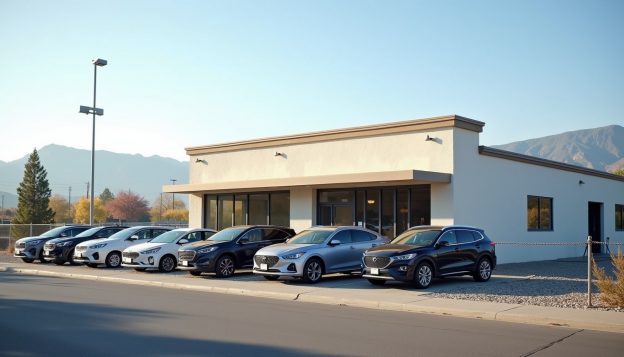
Utah dealer license requirements are set by Utah Code Title 41, Chapter 3, and enforced by the Motor Vehicle Enforcement Division. You need a qualifying principal place of business, a corporate surety bond of $10,000 to $75,000 depending on license class, a Utah sales tax license, a completed application, and a clean enough record that none of the statutory grounds for denial apply to you, your partners, your officers, or your directors.
Last updated: October 2026
Key Takeaways
- You are a dealer under Utah law if your business in whole or in part involves selling motor vehicles and you sell, display for sale, or offer for sale three or more vehicles in any 12-month period. Both parts must be true.
- The principal place of business requirement is specific and physical. The site must be devoted exclusively to the licensed business, marked or bounded, large enough to display three or more vehicles with public parking, and contain a permanent enclosed building for the office and records.
- Bond amounts are $75,000 for a motor vehicle dealer or special equipment dealer, $10,000 for a motorcycle, off-highway vehicle, or small trailer dealer or crusher, and $20,000 for a body shop.
- Two conditions suspend a license automatically with no hearing: losing possession of the bond, and losing possession of the principal place of business.
- Grounds for denial reach your partners, officers, and directors, not just the applicant, and include charges that have merely been filed.
- Licenses expire June 30 every year regardless of when you were licensed.
Do You Actually Need a Utah Dealer License?
Start with the definition, because it decides everything else. Utah Code Section 41-3-102 defines a dealer as a person for which the business in whole or in part involves selling new, used, or new and used motor vehicles or off-highway vehicles, and that sells, displays for sale, or offers for sale or exchange three or more new or used motor vehicles or off-highway vehicles in any 12-month period. A dealer also includes a representative or consignee of any dealer.
Two things in that definition catch people. First, it is conjunctive. Both the business-purpose element and the three-vehicle element have to be present. Second, the counting element is broader than sales. Displaying for sale and offering for sale or exchange both count, so you can reach the threshold without completing three transactions.
Section 41-3-103 then carves out exceptions. A person who sells or exchanges only motor vehicles the person has owned for over 12 months is not considered a dealer. Insurance companies, banks, finance companies, registered title lenders, check cashers and deferred deposit lenders, public utilities, commission impound yards, and government agencies that come into possession of a vehicle incident to their regular business are not dealers when they sell under their contractual rights. Leasing companies do not come into possession incident to their regular business. Pawnbrokers do, and the statute says they must be licensed as used motor vehicle dealers.
The Thirteen License Categories
Section 41-3-201 says a person may not act as any of the following without a license issued by the administrator: dealer, salvage vehicle buyer, salesperson, manufacturer, transporter, dismantler, distributor, factory branch and representative, distributor branch and representative, crusher, remanufacturer, body shop, or motor vehicle auction.
Most applicants need more than one. A dealership needs the dealer license, and every individual selling for it needs a salesperson’s license. If you plan to buy salvage at auction, that is a separate salvage vehicle buyer license, and Section 41-3-201 restricts who may bid on or purchase a vehicle carrying a nonrepairable or salvage certificate.
The Principal Place of Business Requirement
This is where most first applications fail, because the statutory definition is more demanding than a commercial address. Section 41-3-102 defines a principal place of business as a site or location in Utah that meets three tests:
- Exclusive use. Devoted exclusively to the business for which the applicant is licensed, plus businesses incidental to it.
- Definite boundary and display capacity. Sufficiently bounded by fence, chain, posts, or otherwise marked to definitely indicate the boundary and permit a definite description, with space adequate to display three or more motor vehicles and sufficient parking for the public.
- A permanent building. A permanent enclosed building or structure large enough to accommodate the office and provide a safe place to keep the books and records, at which the principal portion of the business is conducted.
Section 41-3-204 makes this a prerequisite rather than a preference. Dealers, special equipment dealers, manufacturers, transporters, remanufacturers, dismantlers, crushers, body shops, and in-state distributors must all maintain a principal place of business, and the administrator may not issue a license to an applicant who does not have one.
If a licensee loses possession of a principal place of business, the license is automatically suspended and he shall immediately notify the administrator and upon demand by the administrator deliver the license, pocket cards, special plates, and temporary permits to the administrator.
That is worth planning your lease around. A landlord dispute, a lease expiration you did not renew in time, or a forced relocation is not merely an operational problem. It suspends the license by operation of statute. If you are moving on purpose, the process is friendlier: notify the administrator immediately and the administrator issues a new license for the unexpired portion of the term at no additional fee.
Bond Requirements by License Class
Section 41-3-205 requires a corporate surety bond before a dealer, special equipment dealer, crusher, or body shop license issues. The surety must be licensed to do business in Utah and carry a rating of at least B+ from the A.M. Best Company, and the form of the bond must be approved by the attorney general.
| License class | Bond amount | Notes |
|---|---|---|
| Motor vehicle dealer | $75,000 | Amount in effect since July 1, 2006 |
| Special equipment dealer | $75,000 | Amount in effect since July 1, 2006 |
| Motorcycle, off-highway vehicle, or small trailer dealer | $10,000 | Same figure applies to a crusher license |
| Body shop | $20,000 |
The bond is conditioned on conducting business without fraud, without fraudulent representation, without violating the certificate of title delivery requirement in Section 41-3-301(1), and without violating the trade-in lien payoff requirement in Section 41-3-402(1). Total aggregate liability to all claimants may not exceed the bond amount no matter how many claimants there are or how many years the bond stays in force. A representative or consignee of a dealer does not have to file a separate bond if the dealer fully complies with the chapter.
As with the principal place of business, loss of the bond triggers automatic suspension under Section 41-3-205, and all licenses, pocket cards, temporary permits, and special plates must be returned immediately.
What Else the Application Requires
Beyond the bond and the location, the statutory grounds for denial in Section 41-3-209 tell you what the division is verifying. Assembling proof of each of these before you apply is faster than responding to a denial afterward.
- A Utah sales tax license under Title 59, Chapter 12. Lack of one is an enumerated ground for denial, suspension, or revocation.
- A bond in effect, not merely applied for.
- Payment of all required fees. Fees are set by Section 41-3-601.
- Accurate statements. A false statement on any license or special plate application is independent grounds for action, which matters because applications ask about prior licensing history in other states.
- Clean licensing history. A current dealer, dismantler, auction, or salesperson license suspension or revocation in another state is grounds for denial, as is having had a Utah license under the chapter revoked within the previous five years.
- Background of the whole ownership group. The grounds apply to the applicant and to any of the applicant’s partners, officers, or directors. Section 41-3-205.5 separately requires a criminal background check on salesperson’s licenses.
If the administrator finds an applicant is not qualified, Section 41-3-209 requires written notice of the reason for the denial. That notice is what any challenge is built on, and the deadlines that follow are covered in our guide to a Utah dealer license suspension and revocation hearing.
The Charges-Filed Ground Applicants Underestimate
One ground for denial operates differently from the others. Section 41-3-209 lists charges filed with a county attorney, district attorney, or United States attorney for a violation of any state or federal law involving motor vehicles as reasonable cause. Not a conviction. And the statute provides that action taken on that basis remains in effect until a final resolution is reached by the court or the charges are dropped.
Because the grounds reach partners, officers, and directors, an unresolved case involving one member of an ownership group can hold up the entire application. Where an ownership group has that exposure, the structure of the entity and who sits as an officer are worth settling before the application goes in rather than after.
After Approval: The Dates That Matter
Section 41-3-206 sets a fixed annual cycle. Every license issued under the chapter expires on June 30 of each year and may be renewed on application and payment of the fee, provided the license has not been suspended or revoked. That date does not move to match when you were first licensed.
Renewal is conditioned on education. The division may not renew a new or used motor vehicle dealer’s license, a direct-sale manufacturer’s license, a new or used motorcycle dealer’s license, or a small trailer dealer’s license unless the renewal applicant completes a three-hour division-approved class covering new motor vehicle laws and rules. The applicant pays the approved cost, and the class may be completed by the applicant or by a designated representative of the renewal applicant dealer.
A salesperson’s license works differently. It expires on the same annual date or when the salesperson terminates employment with the dealer they are licensed under, whichever comes first.
Setting Up the Business Before You Apply
The order of operations matters. Entity formation, the lease, the sales tax license, and the bond all have to be in place before the dealer application is complete, and each one has its own lead time. Utah’s limited liability company provisions moved into Title 16, Chapter 20 effective October 1, 2026, and the registered agent provisions moved to Title 16, Chapter 1a, Part 4, which matters here because the division needs a registered agent on file for the entity that holds the license.
For the entity, lease, and licensing sequence in the order that avoids rework, see our broader resources for dealership owners, including our overview for an attorney for car dealerships in Utah and the national explainer on car dealership law. The Motor Vehicle Enforcement Division publishes current forms and fee amounts on its own site at dmv.utah.gov/mved.
Frequently Asked Questions
How many cars can I sell in Utah before I need a dealer license?
The threshold is three or more vehicles sold, displayed for sale, or offered for sale or exchange in any 12-month period, combined with a business that in whole or in part involves selling vehicles. Selling only vehicles you have owned for more than 12 months does not make you a dealer.
How much is the Utah dealer bond?
$75,000 for a motor vehicle dealer or special equipment dealer license, $10,000 for a motorcycle, off-highway vehicle, or small trailer dealer or a crusher, and $20,000 for a body shop. The surety must be licensed in Utah and rated at least B+ by A.M. Best.
Can I run a Utah dealership from my home?
Not under the principal place of business definition. The site must be devoted exclusively to the licensed business, bounded or marked to show a definite boundary, able to display three or more vehicles with public parking, and include a permanent enclosed building housing the office and records.
When does a Utah dealer license expire?
June 30 of each year, under Section 41-3-206, regardless of when the license was originally issued. Renewal for most dealer classes also requires a three-hour division-approved class on motor vehicle laws and rules.
What happens if I move my dealership to a new location?
Notify the administrator immediately. The administrator issues a new license for the unexpired portion of the term at no additional fee. If you lose possession of the principal place of business rather than relocating, the license is automatically suspended.
Do my salespeople need their own licenses?
Yes. Salesperson is one of the thirteen categories in Section 41-3-201, a criminal background check is required under Section 41-3-205.5, and the license ends when employment with that dealer ends.
Can a criminal charge stop my application if I have not been convicted?
Yes. Charges filed for a violation of state or federal law involving motor vehicles are reasonable cause for denial under Section 41-3-209, and that action remains in effect until the court reaches a final resolution or the charges are dropped. The grounds also reach partners, officers, and directors.
Getting the entity, the lease, the bond, and the application in the right order is cheaper than fixing a denial. We advise Utah dealership owners on licensing and compliance.
Schedule a consultation or call (801) 613-1472.
This article is general information, not legal advice. Reading it does not create an attorney-client relationship. Citations are to Utah Code Title 41, Chapter 3 as published by the Utah Legislature and current as of October 2026. Fee amounts and forms change, so confirm current requirements with the Motor Vehicle Enforcement Division before applying.