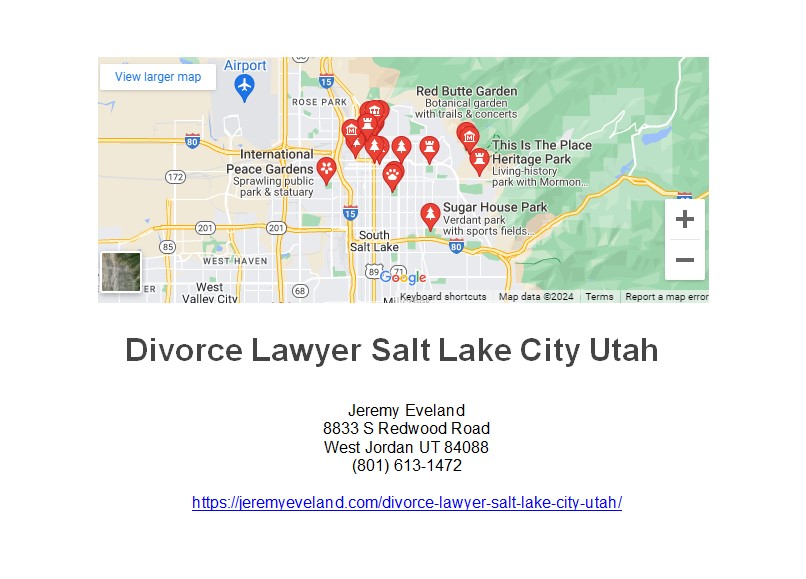
Divorce Lawyer Salt Lake City Utah

Salt Lake City Divorce Lawyer Jeremy Eveland

Divorce Lawyer Salt Lake City Utah

Are you going through a difficult divorce and in need of legal help? Look no further than our team of dedicated divorce lawyers in Salt Lake City, Utah. With years of experience and a deep understanding of family law, we are here to provide you with the support and reassurance you need during this challenging time. From child custody and alimony to property division and legal separation, we will address your common concerns directly, offering guidance and assistance every step of the way. Our goal is to create an emotional connection with our clients, providing them with the peace of mind they deserve. So don’t hesitate to reach out to us today and take the next step in seeking the help you need. Call our office now to schedule a consultation with one of our experienced divorce lawyers. We’re here for you.

What is Divorce?

Divorce is the legal termination of a marriage, where both parties go their separate ways and are no longer legally bound to each other. It marks the end of a marital relationship and involves a series of legal processes to resolve various issues such as child custody, division of assets, and spousal support. Whether you’re contemplating filing for divorce or going through one, it’s important to have a clear understanding of the different aspects involved in the process to ensure your rights and interests are protected.

If you are ready to move forward with your divorce, please fill out an intake form:

Click here for the Divorce Intake Form for Divorce in Utah with No Children.

Click Here

Definition of Divorce

Divorce is a legal process that dissolves a marriage, granting each spouse the freedom to live independently and make decisions without the involvement of the other party. It legally ends the marital relationship, dividing responsibilities, assets, and debts between the spouses. In addition, divorce can address matters related to child custody, support, and alimony, providing a framework for establishing and enforcing these obligations.

Types of Divorce

There are various types of divorce that spouses can choose based on their unique circumstances and the level of conflict between them. Some of the common types of divorce include:

  1. Contested Divorce: This type of divorce occurs when the spouses are unable to reach an agreement on issues such as child custody, property division, or financial matters. It often involves litigation and requires the intervention of the court to make decisions on behalf of the parties.
  2. Uncontested Divorce: In an uncontested divorce, both parties are able to reach a mutual agreement on all the relevant issues without going to trial. This type of divorce is generally quicker, less expensive, and less emotionally draining than a contested divorce.
  3. Collaborative Divorce: Collaborative divorce involves the spouses working together, alongside their respective attorneys, to negotiate and settle all issues relating to their divorce. It promotes open communication and cooperation, aiming to minimize conflict and prioritize the best interests of both parties.
  4. Mediated Divorce: In a mediated divorce, a neutral third-party mediator helps the spouses reach a resolution on their divorce issues through facilitated negotiation. The mediator does not make decisions but assists in finding common ground and encourages cooperation between the spouses.

Why Hire a Divorce Lawyer

While it is possible to navigate the divorce process without legal representation, hiring a divorce lawyer can provide significant benefits and ensure that your rights are protected throughout the proceedings. Here are some reasons why it is advisable to hire a divorce lawyer:

  1. Legal Knowledge and Expertise: Divorce lawyers specialize in family law and have a deep understanding of the legal complexities involved in divorce cases. They can guide you through the process, explain your rights and responsibilities, and provide personalized advice based on your specific situation.
  2. Objective and Emotionally Supportive: Going through a divorce can be emotionally overwhelming. A divorce lawyer can provide you with valuable support, serving as a trusted ally who will advocate for your best interests while maintaining objectivity and ensuring that decisions are not clouded by emotions.
  3. Navigating the Legal System: The divorce process involves a multitude of legal requirements, paperwork, and court filings. A divorce lawyer can navigate these complexities on your behalf, ensuring that all necessary documents are properly prepared and submitted within the required timelines.
  4. Negotiation and Settlement: Divorce lawyers are skilled negotiators who can help you achieve a fair and equitable settlement. They can analyze your assets, debts, and other relevant factors to ensure that you receive what you are entitled to in the division of property, spousal support, and child custody matters.
  5. Avoiding Costly Mistakes: Without the guidance of a divorce lawyer, you may inadvertently make mistakes that could have long-lasting consequences. A divorce lawyer can help you avoid common pitfalls and ensure that your interests are protected throughout the process.

Related Posts About Divorce

Divorce and Alimony Legal Rights And Obligations

High Asset Divorce

Fruit Heights UT Family Law Attorney

Prenuptial Agreement How To

Prenup Lawyer Herriman Utah

Estate Planning for Children

Alimony Lawyer

Choosing a Divorce Lawyer

One of the most crucial decisions you will make during the divorce process is choosing the right divorce lawyer to represent you. Your lawyer will be your advocate, advisor, and confidant throughout the proceedings, so it’s important to select someone who is experienced, trustworthy, and who understands your specific needs. Here are some considerations to keep in mind when choosing a divorce lawyer:

Considerations for Choosing a Divorce Lawyer

  1. Experience and Expertise: Look for a divorce lawyer who specializes in family law and has extensive experience handling divorce cases. Familiarity with the local courts and judges can also be an advantage, as it can help your case proceed smoothly.
  2. Reputation and Track Record: Do your research to find a lawyer with a solid reputation and a track record of success in handling divorce cases. Online reviews and testimonials from past clients can be valuable sources of information.
  3. Communication and Accessibility: It’s important to have open and effective communication with your divorce lawyer. Find an attorney who listens attentively to your concerns, responds promptly to your queries, and keeps you informed about the progress of your case.
  4. Compatibility: Divorce proceedings can be lengthy and emotionally challenging, so it’s crucial to choose a lawyer with whom you feel comfortable and compatible. Trust your instincts and select someone who understands your goals and values.
  5. Fee Structure: Discuss the lawyer’s fee structure during the initial consultation. Some lawyers charge an hourly rate, while others may work on a flat fee or offer a combination of both. Understand the payment terms and ensure they align with your budget.

Salt Lake City Divorce Lawyer Jeremy Eveland

Click Here to Learn More

Questions to Ask a Divorce Lawyer

Before hiring a divorce lawyer, it’s important to schedule an initial consultation to discuss your case and ensure that they are the right fit for your needs. Here are some questions you can ask during this meeting:

  1. How long have you been practicing family law and handling divorce cases?
  2. Do you have experience with cases similar to mine?
  3. What is your approach to divorce settlements?
  4. How do you communicate with your clients?
  5. Will you be handling my case personally or delegating it to another attorney or paralegal?
  6. What are your fees, and how are they structured?
  7. What is your assessment of my case and the likely outcomes?
  8. How do you handle conflicts or disagreements between spouses during the divorce process?
  9. Will you encourage mediation or collaborative divorce if it is suitable for my situation?
  10. Can you provide references from past clients?

Researching Divorce Lawyers in Salt Lake City, Utah

If you’re searching for a divorce lawyer in Salt Lake City, Utah, it’s important to conduct thorough research to find the best attorney for your needs. Here are some steps you can take to find a reputable and experienced divorce lawyer in the area:

  1. Seek Recommendations: Ask friends, family, or colleagues who have gone through a divorce for recommendations. They can provide valuable insights based on their personal experiences.
  2. Online Research: Utilize online directories and search engines to find divorce lawyers in Salt Lake City. Visit their websites to learn more about their areas of expertise, experience, and client testimonials.
  3. Read Reviews: Check online review platforms and legal directories to read reviews from past clients. Pay attention to both positive and negative feedback to get a comprehensive understanding of the lawyer’s reputation.
  4. Contact Local Bar Associations: Reach out to the Salt Lake City Bar Association or the Utah State Bar Association for recommendations. These professional organizations can provide a list of qualified divorce lawyers in the area.
  5. Schedule Consultations: Once you have identified potential divorce lawyers, schedule initial consultations to discuss your case and evaluate the lawyer’s suitability for your needs. Use this opportunity to ask questions, gauge their communication style, and assess their expertise.

The Divorce Process and Filing for Divorce

When you have made the difficult decision to pursue a divorce, the first step is to file a divorce petition with the appropriate court. This document outlines the grounds for divorce, provides information about the marriage, and lists your requests regarding child custody, support, property division, and other related matters. It’s important to ensure that the divorce petition is completed accurately and comprehensively, as any omissions or errors could lead to delays or complications in the process.

Serving Divorce Papers

After filing the divorce petition, it is necessary to serve the papers on your spouse. This involves formally delivering a copy of the divorce petition and any accompanying documents to your spouse, ensuring that they are aware of the divorce proceedings. Depending on the jurisdiction, there are specific rules and procedures governing how divorce papers can be served. It is crucial to follow these guidelines to ensure that the service is legally valid.

Negotiating a Divorce Settlement

Many divorces can be resolved through negotiation and settlement outside of court. This involves working with your spouse and their attorney to reach agreements on various issues such as child custody, visitation schedules, division of assets, and spousal support. Negotiating a settlement can save time, money, and emotional distress for both parties involved. It allows you to have more control over the outcome of your divorce and promotes amicable resolutions.

Going to Divorce Court

If you and your spouse are unable to reach an agreement on the terms of your divorce, the case may proceed to court. This typically happens when the issues at hand are complex or when there is a high degree of conflict between the spouses. In court, both parties present their arguments and evidence, and a judge makes decisions regarding child custody, support, property division, and other relevant matters. Going to court can be an emotionally challenging process, and it is crucial to have a skilled divorce lawyer representing your interests and presenting your case effectively.

Child Custody and Support in Utah

Child custody is one of the most critical and emotionally charged aspects of a divorce involving children. In Utah, child custody is determined based on the best interests of the child and aims to ensure their safety, well-being, and involvement with both parents whenever possible. The court considers various factors, including the child’s wishes, the parents’ ability to provide for the child’s needs, and the relationship between the child and each parent when making custody determinations.

Determining Child Custody in Utah

There are two primary types of child custody in Utah: legal custody and physical custody. Legal custody refers to the authority to make major decisions regarding the child’s upbringing, education, healthcare, and religious affiliation. Physical custody, on the other hand, refers to where the child will reside and spend time on a day-to-day basis. Custody arrangements can vary widely, ranging from sole custody to joint custody, depending on the specific circumstances of the case.

Salt Lake City Divorce Lawyer Jeremy Eveland

Child Support Obligations

In Utah, both parents have a legal obligation to financially support their children, even after divorce. The amount of child support is determined based on established guidelines, which take into account factors such as the income of both parents, the number of children, and the parenting time arrangement. Child support is intended to cover the child’s basic needs, including food, clothing, housing, education, and healthcare expenses. It is crucial to ensure that child support calculations are accurate and fair, and a divorce lawyer can help you navigate this process.

Division of Assets

Utah is an equitable distribution state, which means that marital property is divided fairly, but not necessarily equally, during a divorce. In contrast, community property states require an equal split of all marital assets. In an equitable distribution system, a judge considers various factors to determine how to divide assets and debts, including the length of the marriage, each spouse’s contribution to the acquisition of assets, and the financial needs of each party post-divorce.

Identifying Marital Assets

Marital assets typically include any property or assets acquired during the marriage, regardless of title or ownership. This can include the family home, cars, investments, retirement accounts, businesses, and personal belongings. It’s important to identify and list all marital assets accurately to ensure a fair division during the divorce process. A divorce lawyer can assist in properly valuing and categorizing assets, and in some cases, may recommend hiring financial experts to ensure an accurate assessment.

Valuing and Dividing Marital Assets

Valuing and dividing marital assets can be a complex process. Certain assets, such as bank accounts or stock portfolios, may have a clear monetary value. However, other assets, such as real estate or a family business, may require professional appraisals to determine their worth. Once the assets are valued, they can be divided between the spouses. Depending on the circumstances, this can be done through negotiation, settlement, or, if necessary, by a judge’s ruling. The goal is to ensure an equitable division that takes into account the unique circumstances of the marriage and the financial needs of each party.

Alimony and Spousal Support

Salt Lake City Divorce Lawyer Jeremy Eveland

Eligibility for Alimony

Alimony, also known as spousal support, is financial assistance provided by one spouse to the other following a divorce. In Utah, eligibility for alimony is determined based on factors such as the duration of the marriage, the financial needs and earning capacity of each spouse, and the contributions made to the marriage. Alimony can be temporary or permanent, and it aims to provide support to a spouse who may have a lower income or reduced earning potential after the divorce.

Modifying or Terminating Alimony

In certain circumstances, the court may allow for the modification or termination of alimony orders. If there is a significant change in circumstances, such as a change in either party’s financial situation or a change in the recipient’s remarriage or cohabitation, it may be possible to modify or terminate alimony payments. However, these modifications require a formal request to the court and must meet specific legal criteria. A divorce lawyer can guide you through the process of seeking a modification or termination of alimony if it becomes necessary.

Mediation and Collaborative Divorce

Mediation and collaborative divorce are alternative dispute resolution methods that promote cooperation, open communication, and a focus on reaching mutually beneficial solutions. Both approaches offer several benefits over traditional litigation, including:

  1. Privacy: Mediation and collaborative divorce proceedings are confidential and typically take place behind closed doors, sparing the parties from the public nature of the courtroom.
  2. Control: Mediation and collaborative divorce give the parties more control over the outcome, allowing them to actively participate in the decision-making process.
  3. Reduced Conflict: By fostering open communication and cooperation, these approaches can help minimize conflict and preserve relationships, which is particularly important when children are involved.
  4. Cost-Effectiveness: Mediation and collaborative divorce can be more cost-effective than litigation since they often require fewer court appearances and less time spent in the legal process.
  5. Efficiency: These methods generally have shorter time frames than litigation, allowing couples to reach resolutions and move forward with their lives more quickly.

Divorce Mediation Process

Mediation involves the assistance of a neutral third-party mediator who facilitates communication and negotiation between the divorcing parties. The mediator does not make decisions but helps the parties explore options, identify common ground, and work toward mutually acceptable agreements. The mediator guides the discussions, ensures that both parties have a voice, and helps address any power imbalances. Mediation can be particularly beneficial when the spouses are willing to cooperate and maintain a level of respect and communication.

The Collaborative Divorce Process

Collaborative divorce is a process that involves the spouses and their respective attorneys engaging in a series of meetings to negotiate and settle the terms of their divorce. Unlike mediation, collaborative divorce generally does not involve a third-party mediator. Instead, the parties work together, often with the assistance of other professionals such as financial experts, child specialists, or therapists, to address the various issues at hand. Collaborative divorce promotes open communication, problem-solving, and creative solutions, aiming to achieve a mutually satisfactory outcome for both parties.

Recognizing Domestic Violence in Divorce

Domestic violence is a serious issue that can have a significant impact on divorce cases. It involves any form of physical, emotional, sexual, or economic abuse between intimate partners or family members. It’s important to recognize the signs of domestic violence, which can include physical injuries, emotional manipulation, financial control, isolation from friends and family, and other abusive behaviors. If you are experiencing domestic violence, it is crucial to prioritize your safety and seek legal protection.

Obtaining a Restraining Order

A restraining order, also known as an order of protection, is a legal document issued by the court that restricts the abuser’s contact with the victim and provides legal protection against further abusive behavior. To obtain a restraining order, you must file a petition with the court, detailing the incidents of domestic violence and the need for protection. The court will review the petition and, if granted, issue a restraining order that outlines the specific terms and conditions, such as establishing a safe distance between the parties or prohibiting contact altogether.

Violation of Restraining Orders

Violating a restraining order is a serious offense and can result in criminal consequences for the abuser. If your abuser violates a restraining order, it’s important to document the violation, notify law enforcement immediately, and seek legal assistance. Violation of a restraining order can impact the outcome of the divorce case, and a divorce lawyer can help ensure that the necessary legal measures are taken to protect your safety and rights.

Modifying Child Custody or Support Orders

Life circumstances can change after a divorce, necessitating modifications to child custody or support orders. If there has been a significant change in circumstances, such as a parent’s relocation, a change in income, or a change in the child’s needs, it may be possible to modify the existing child custody or support orders. However, modifying these orders requires going back to court and demonstrating that the requested changes are in the best interests of the child. A divorce lawyer can guide you through the process of seeking modifications and present compelling arguments to support your case.

Requesting Spousal Support Modifications

Similar to child custody and support, spousal support orders can also be modified under certain circumstances. If there has been a substantial change in the financial situation of either party, such as a significant increase or decrease in income, loss of employment, or retirement, it may be possible to request a modification of spousal support. The court will assess the circumstances and determine whether a modification is warranted. A divorce lawyer can help you navigate this process and present the necessary evidence to support your request.

Divorce Frequently Asked Questions

How long does the divorce process typically take?

The duration of the divorce process can vary significantly depending on various factors, such as the complexity of the issues involved, the level of conflict between the spouses, and the court’s availability. On average, uncontested divorces that do not involve substantial disagreements can be finalized in a few months. However, contested divorces or those with complex financial matters or child custody disputes can take significantly longer, sometimes stretching into several months or even years.

How is child custody determined in Utah?

In Utah, child custody is determined based on the best interests of the child. The court considers various factors, including the child’s wishes (if they are of sufficient age and maturity), the parents’ ability to provide for the child’s physical and emotional needs, the child’s relationship with each parent, and any history of abuse or domestic violence. The court may order joint legal and physical custody or award sole custody to one parent, depending on the circumstances of the case.

Can I get a divorce without hiring a lawyer?

While it’s possible to go through a divorce without hiring a lawyer, it is generally not advisable, especially if the divorce involves complex issues such as child custody, support, or significant assets. Divorce laws can be intricate, and a divorce lawyer can provide crucial guidance throughout the process, ensuring that your rights are protected and that your interests are advocated for. Hiring a divorce lawyer can also reduce stress and uncertainty, allowing you to focus on moving forward with your life.

Learn More

Areas We Serve in Utah

We serve individuals and businesses in the following Utah locations:

Salt Lake City Utah
West Valley City Utah
Provo Utah
West Jordan Utah
Orem Utah
Sandy Utah
Ogden Utah
St. George Utah
Layton Utah
South Jordan Utah
Lehi Utah
Millcreek Utah
Taylorsville Utah
Logan Utah
Murray Utah
Draper Utah
Bountiful Utah
Riverton Utah
Herriman Utah
Spanish Fork Utah
Roy Utah
Pleasant Grove Utah
Kearns Utah
Tooele Utah
Cottonwood Heights Utah
Midvale Utah
Springville Utah
Eagle Mountain Utah
Cedar City Utah
Kaysville Utah
Clearfield Utah
Holladay Utah
American Fork Utah
Syracuse Utah
Saratoga Springs Utah
Magna Utah
Washington Utah
South Salt Lake Utah
Farmington Utah
Clinton Utah
North Salt Lake Utah
Payson Utah
North Ogden Utah
Brigham City Utah
Highland Utah
Centerville Utah
Hurricane Utah
South Ogden Utah
Heber Utah
West Haven Utah
Bluffdale Utah
Santaquin Utah
Smithfield Utah
Woods Cross Utah
Grantsville Utah
Lindon Utah
North Logan Utah
West Point Utah
Vernal Utah
Alpine Utah
Cedar Hills Utah
Pleasant View Utah
Mapleton Utah
Stansbury Par Utah
Washington Terrace Utah
Riverdale Utah
Hooper Utah
Tremonton Utah
Ivins Utah
Park City Utah
Price Utah
Hyrum Utah
Summit Park Utah
Salem Utah
Richfield Utah
Santa Clara Utah
Providence Utah
South Weber Utah
Vineyard Utah
Ephraim Utah
Roosevelt Utah
Farr West Utah
Plain City Utah
Nibley Utah
Enoch Utah
Harrisville Utah
Snyderville Utah
Fruit Heights Utah
Nephi Utah
White City Utah
West Bountiful Utah
Sunset Utah
Moab Utah
Midway Utah
Perry Utah
Kanab Utah
Hyde Park Utah
Silver Summit Utah
La Verkin Utah
Morgan Utah

Utah Divorce Lawyer Consultation

When you need help from a Utah divorce lawyer, call Jeremy D. Eveland, MBA, JD (801) 613-1472 for a consultation.

Jeremy Eveland
17 North State Street
Lindon UT 84042
(801) 613-1472

Home

Estate Administration Syracuse Utah

If you’re dealing with the complex and emotional process of estate administration in Syracuse, Utah, we understand that you may have many questions and concerns. That’s why we’re here to provide you with the reassurance and guidance you need during this time. Our experienced attorney is just a phone call away, ready to offer you personalized assistance and help you navigate through the legal aspects of estate administration. We’ve designed this blog post to address common concerns directly, providing you with valuable information and creating an emotional connection as we guide you through the process. So don’t wait, call us today and take the next step in seeking the prompt assistance you deserve.

What is Estate Administration?

Click Here

Understanding the process

Estate administration refers to the legal process of managing and distributing the assets and liabilities of a deceased individual. It involves collecting all the necessary documents, identifying and valuing the assets, paying off debts and taxes, and finally distributing the assets to the rightful beneficiaries.

Role of an estate administrator

An estate administrator, also known as a personal representative or executor, is responsible for carrying out the estate administration process. Their primary role is to ensure that the deceased’s wishes, as outlined in their will or estate plan, are followed. They are responsible for managing and protecting the assets, paying off any debts or taxes owed, and ultimately distributing the assets to the beneficiaries.

Importance of Estate Administration

Protecting the deceased’s assets

One of the crucial aspects of estate administration is protecting the assets of the deceased individual. Without proper administration, there is a risk of valuable assets being lost, mismanaged, or even taken by individuals who are not entitled to them. Through estate administration, the assets are preserved and safeguarded for their intended beneficiaries.

Ensuring proper distribution

Another important role of estate administration is to ensure the proper distribution of the deceased’s assets. By following the instructions outlined in their will or estate plan, the estate administrator ensures that each beneficiary receives their rightful share. This helps avoid disputes and conflicts among family members and loved ones, promoting a fair and orderly distribution process.

Estate Administration Syracuse Utah

Click Here to Learn More

Resolving conflicts and disputes

Estate administration plays a crucial role in resolving any conflicts or disputes that may arise among beneficiaries or other interested parties. The estate administrator serves as a neutral party, ensuring that the interests of all parties involved are protected. They work to mediate and find resolutions to any issues that may arise, promoting a harmonious distribution of assets.

Steps in Estate Administration

1. Gathering necessary documents

The first step in estate administration is to gather all the necessary documents related to the deceased individual’s assets, debts, and liabilities. This may include their will, bank statements, property deeds, life insurance policies, and any outstanding debts or tax obligations. These documents provide the necessary information for the subsequent steps in the administration process.

2. Identifying and valuing assets

Once all the necessary documents have been gathered, the estate administrator needs to identify and value the assets of the deceased individual. This includes determining the value of properties, financial accounts, investments, personal belongings, and any other assets. Proper valuation is essential for accurate distribution and tax purposes.

3. Paying off debts and taxes

Next, the estate administrator is responsible for paying off any outstanding debts and taxes owed by the deceased individual. This may involve working with creditors, filing tax returns, and settling any financial obligations. It is important to ensure that all debts and taxes are properly addressed before proceeding with the distribution of assets.

Estate Administration Syracuse Utah

4. Distributing assets to beneficiaries

Once all debts and taxes have been settled, the estate administrator can proceed with the distribution of assets to the beneficiaries. This involves following the instructions outlined in the deceased individual’s will or estate plan and ensuring that each beneficiary receives their rightful share. The assets may be distributed in the form of monetary value or physical property.

5. Closing the estate

The final step in the estate administration process is to officially close the estate. This involves filing the necessary paperwork with the appropriate court, providing an account of the administration process, and obtaining any required approvals or orders. Once the estate is closed, the administration process is complete, and the assets have been successfully distributed to the beneficiaries.

Working with an Estate Administrator

Hiring an estate administrator

Hiring an estate administrator is an important decision that should be made carefully. It is advisable to choose an individual or professional who has adequate experience and knowledge in estate administration. They should have a clear understanding of the legal requirements and be able to fulfill their responsibilities effectively.

Choosing the right attorney

When selecting an estate administrator, it is often beneficial to work with an experienced estate planning and administration attorney. An attorney can provide valuable guidance throughout the process, ensuring that all legal requirements are met and protecting the interests of the beneficiaries. They can also handle any complex legal issues that may arise during estate administration.

Understanding the costs involved

It is important to have a clear understanding of the costs involved when working with an estate administrator or attorney. The fees for estate administration services can vary depending on the complexity of the estate and the specific services required. It is advisable to discuss the fees and payment structure with the estate administrator or attorney upfront to avoid any misunderstandings.

Common Challenges in Estate Administration

Handling complex estates

Estate administration can become more challenging when dealing with complex estates. This may include situations where the deceased individual owned multiple properties, had significant financial investments, or had a complicated business structure. In such cases, it is crucial to work with an experienced estate administrator or attorney who can navigate the complexities and ensure a smooth administration process.

Dealing with family disputes

Family disputes can often arise during the estate administration process, especially when there are disagreements among the beneficiaries or other interested parties. These disputes can cause delays and create significant emotional stress for all parties involved. An estate administrator plays a critical role in mediating and finding resolutions to these disputes, ensuring a fair and peaceful distribution of assets.

Navigating legal requirements

Estate administration involves complying with various legal requirements and regulations. This can include filing court documents, obtaining necessary approvals, and adhering to tax laws. Navigating these legal requirements can be complex and time-consuming, especially for individuals who are not familiar with the legal system. Working with an estate administrator or attorney who has expertise in this area can help ensure compliance with all legal obligations.

Estate Planning Vs. Estate Administration

Estate Administration Syracuse Utah

Differences between planning and administration

Estate planning refers to the process of creating a comprehensive plan for the management and distribution of one’s assets after death. It involves drafting a will or establishing a trust, appointing guardians for minor children, and making decisions regarding healthcare and finances. Estate administration, on the other hand, is the process of carrying out the wishes outlined in the estate plan after the individual’s death.

How they complement each other

While estate planning focuses on preparing for the future, estate administration is the practical implementation of those plans. Estate planning lays the foundation for a smooth administration process by clearly outlining the individual’s intentions and wishes. By engaging in both estate planning and administration, individuals can ensure that their assets are protected and distributed in accordance with their wishes.

Legal Requirements in Syracuse, Utah

State-specific laws and regulations

Estate administration is governed by state-specific laws and regulations. In Syracuse, Utah, there are specific legal requirements that must be met when administering an estate. These requirements may include filing appropriate documents with the court, obtaining necessary approvals, and complying with local probate laws. It is important to work with an estate attorney who is familiar with the legal requirements in Syracuse, Utah.

Probate process in Syracuse

The probate process in Syracuse, Utah involves the court overseeing the administration of a deceased individual’s estate. It includes validating the deceased’s will, appointing an estate administrator, and ensuring that all debts and taxes are paid. The probate process can vary depending on the complexity of the estate and the specific circumstances. An experienced estate attorney can guide individuals through the probate process in Syracuse.

Benefits of Hiring an Estate Attorney

Expertise in estate administration

Estate attorneys specialize in the field of estate planning and administration, and they have in-depth knowledge and expertise in this area. By working with an estate attorney, individuals can benefit from their experience in handling estate administration cases and ensuring that all legal requirements are met.

Navigating legal complexities

Estate administration can involve complex legal issues, such as disputes among beneficiaries, tax implications, and challenges related to business assets. An estate attorney can navigate these complexities, providing guidance and legal advice to ensure a smooth administration process.

Assistance with tax planning

Estate administration often involves tax implications, including estate taxes and income taxes. An estate attorney can provide valuable assistance with tax planning, helping individuals minimize their tax liabilities and maximize the value of their estate. They can also ensure that all necessary tax filings and payments are made in compliance with the law.

Choosing a Reputable Estate Attorney in Syracuse, Utah

Researching and evaluating attorneys

When choosing an estate attorney in Syracuse, Utah, it is important to conduct thorough research and evaluation. This can include reviewing their qualifications, experience, and track record in handling estate administration cases. It is also beneficial to seek recommendations from trusted sources, such as friends or family members who have worked with estate attorneys before.

Considering experience and specialization

Experience and specialization in estate administration are key factors to consider when choosing an estate attorney. It is advisable to select an attorney who has a proven track record in handling similar cases and has a deep understanding of estate planning and administration laws in Syracuse, Utah.

Reading client testimonials

Reading client testimonials and reviews can provide valuable insights into an estate attorney’s professionalism, expertise, and client satisfaction. It is helpful to assess the experiences of previous clients and determine if the attorney is a good fit for one’s specific needs and requirements.

Frequently Asked Questions

Can I administer an estate without an attorney?

Yes, it is possible to administer an estate without an attorney, especially for simple estates with minimal assets and no complex legal issues. However, working with an estate attorney can provide valuable guidance, ensure compliance with legal requirements, and help navigate any potential challenges or disputes that may arise during the administration process.

What is the role of a personal representative?

A personal representative, also known as an estate administrator or executor, is responsible for managing and administering the estate of a deceased individual. Their role includes gathering necessary documents, identifying and valuing assets, paying off debts and taxes, distributing assets to beneficiaries, and closing the estate. They act as a fiduciary, ensuring that the deceased’s wishes, as outlined in their will or estate plan, are followed.

What happens if there is no estate plan in place?

If there is no estate plan in place, the deceased individual’s assets will be distributed according to the intestate laws of the state. These laws determine the distribution of assets among the surviving family members based on their relationship to the deceased. Without an estate plan, there is a risk of assets being distributed in a manner that does not align with the individual’s wishes. It is advisable to consult with an estate attorney to create an estate plan and avoid potential complications.

Learn More

Termination Of Construction Contracts

Are you facing concerns about terminating a construction contract? Worried about the legal implications and seeking guidance? Look no further. In this article, we will address common legal concerns directly, instilling reassurance and providing guidance on the termination of construction contracts. Our aim is to create an emotional connection, offering valuable information that will empower you to make informed decisions. If you require immediate assistance or want to delve deeper into this subject, don’t hesitate to call the attorney listed on our website. Remember, prompt action is key in seeking the help you need.

Termination of Construction Contracts

Terminating a construction contract can be a complex and delicate process that requires careful consideration of legal obligations and consequences. Whether you are a contractor or an owner, understanding the various aspects of contract termination is crucial to protecting your interests. In this article, we will explore the contract termination process, the different types of termination, applicable clauses, and the impact of termination. We will also discuss legal remedies available in case of termination disputes and provide a handy termination checklist for your reference. So, let’s dive in!

Learn More

Contract Termination Process

The contract termination process involves formally ending the contractual relationship between the parties involved in a construction project. It is essential to follow the prescribed steps to ensure compliance with legal requirements and protect yourself from potential liabilities. Typically, the termination process involves notifying the other party, assessing the validity of termination, and addressing any necessary legal obligations and remedies.

Termination for Convenience

Termination for convenience, also known as termination without cause, allows either party to terminate the contract without having to prove a breach of contract or any wrongdoing. This type of termination is typically included in construction contracts to provide flexibility and protect the parties’ interests in unforeseen circumstances. However, it is important to review the contract language and any applicable laws before exercising this right to avoid any potential disputes or legal challenges.

Termination Of Construction Contracts

Click Here

Termination for Default

Termination for default, also known as termination for cause, occurs when one party fails to fulfill their contractual obligations or breaches the terms of the agreement. This type of termination is typically utilized when a party’s actions or inactions significantly impact the project’s progress, safety, or overall success. However, before invoking termination for default, it is crucial to carefully review the contract provisions, follow any notice requirements, and provide an opportunity for the defaulting party to cure the breach, if possible.

Termination Clauses

Termination clauses are provisions included in construction contracts that outline the conditions, rights, and remedies related to contract termination. These clauses are crucial as they define the parties’ rights and obligations in the event of termination. It is essential to carefully review and negotiate termination clauses to ensure they align with your specific needs and protect your interests. Common termination clauses address termination for convenience, termination for default, notice requirements, termination fees, and dispute resolution mechanisms.

Notice of Termination

Regardless of the type of termination, providing proper notice is critical to maintaining legal compliance and mitigating potential disputes. The contract should specify the required notice period and the method of delivery for the notice of termination. It is essential to strictly adhere to these requirements to prevent any challenges to the validity of your termination. Consider consulting with legal counsel to ensure your notice of termination fully complies with the contract terms and applicable laws.

Possibility of Termination

Although terminating a construction contract might be a difficult decision, it is crucial to understand that it is a legal option available to protect your interests. Before making a decision, thoroughly assess the circumstances, review the contract terms, and consider the impact of termination on the project and the parties involved. Carefully weigh the potential risks and benefits and consult with legal professionals who can provide guidance based on your specific situation.

Termination Of Construction Contracts

Impact of Termination

The termination of a construction contract can have significant consequences on both parties involved. Terminating a contract might result in delays, financial losses, damage to reputation, and potential legal liabilities. It is important to evaluate the potential impact before proceeding with termination. Assessing the contract provisions related to termination fees, warranties, insurance, and dispute resolution can help in understanding the potential financial and legal ramifications. Legal counsel should be sought to fully understand the impact of termination and the steps needed to minimize any adverse effects.

Legal Remedies for Termination

In cases where termination disputes arise, legal remedies are available to address potential breaches of contract or to seek compensation for damages incurred. Depending on the specific circumstances, parties may pursue remedies such as seeking monetary damages, arbitration or mediation, specific performance, or equitable remedies. Engaging the services of experienced legal professionals specializing in construction law is crucial to ensure the proper evaluation of your options and the pursuit of the most favorable remedy available.

Termination Of Construction Contracts

Contract Termination Disputes

Contract termination disputes can be complex and contentious, often leading to protracted legal battles and significant financial implications. Whether you are the terminating party or the party facing termination, it is essential to approach these disputes with a calm and strategic mindset. Attempting to resolve disputes amicably through negotiation, alternative dispute resolution methods, such as mediation or arbitration, is often more cost-effective and less time-consuming than resorting to litigation. However, if resolution attempts are unsuccessful, engaging skilled construction litigators becomes crucial to protect your rights and achieve a favorable outcome.

Termination Checklist

To assist you in navigating the termination process effectively, we have compiled a comprehensive termination checklist. This checklist outlines the key steps involved in terminating a construction contract, including reviewing contract provisions, assessing the reasons for termination, providing proper notice, considering the impact of termination, and seeking legal advice. Following this checklist can help ensure that your termination is conducted in compliance with legal requirements and minimize potential disputes and liabilities.

In conclusion, terminating a construction contract is a significant decision that should not be taken lightly. It is crucial to understand the contract termination process, the different types of termination, and the impact and legal remedies associated with termination. By following proper procedures, adhering to contract provisions, seeking legal advice when necessary, and attempting amicable resolutions, you can navigate contract terminations effectively and protect your interests in construction projects. Remember, seeking professional legal assistance is always advisable to ensure compliance with the law and secure the best possible outcome.

Additional Information

Probate Vs Non-Probate Assets

In the realm of estate planning, the division of assets can often be a complex and intricate process. It is crucial to be well-informed about the distinction between probate and non-probate assets, as this knowledge can significantly impact the distribution of one’s estate after they pass away. This article aims to shed light on the key differences between these two types of assets, providing you with a comprehensive understanding of the subject. By examining this fundamental aspect of estate planning, you will be equipped to make informed decisions and seek reputable legal guidance when it comes to the protection and distribution of your assets.

Probate Vs Non-Probate Assets

Purchase Now

What are Probate Assets?

Probate assets are those assets that are subject to probate, a legal process through which the court determines the validity of a will, settles debts and taxes, and oversees the distribution of assets to beneficiaries. These assets typically include real estate, bank accounts, investments, and personal property, such as vehicles or jewelry, that are solely owned by the deceased individual.

What are Non-Probate Assets?

Non-probate assets, on the other hand, are assets that pass outside of the probate process and directly to designated beneficiaries. These assets include life insurance policies, retirement accounts with named beneficiaries, jointly owned property with rights of survivorship, payable-on-death bank accounts, and assets held in a living trust.

Buy Now

Differences between Probate and Non-Probate Assets

Ownership

In terms of ownership, probate assets are solely owned by the deceased individual. This means that these assets cannot be transferred without going through the probate process. Non-probate assets, on the other hand, may have joint owners or named beneficiaries who automatically assume ownership or receive the assets upon the owner’s death.

Transfer upon Death

Probate assets require the court’s intervention and the administration of the decedent’s will or, in the absence of a will, the laws of intestacy, in order to transfer them to the intended beneficiaries. This process can be time-consuming and expensive. Non-probate assets, however, bypass the probate process entirely and pass directly to the named beneficiaries, avoiding the delays and costs associated with probate.

Distribution

The distribution of probate assets is determined by the court, based on the decedent’s will or the laws of intestacy if no will exists. This can result in disputes among family members and potential delays in the final distribution of assets. In contrast, the distribution of non-probate assets is governed by beneficiary designations or the terms of a living trust, providing a clear and predetermined process for asset distribution.

Costs and Time

The probate process is widely known for its expenses and time-consuming nature. The court fees, attorney fees, executor fees, and other administrative costs associated with probating assets can significantly diminish the value of the estate. Additionally, probate can take several months or even years to complete. Conversely, non-probate assets generally require minimal or no court involvement, reducing costs and allowing for faster distribution to beneficiaries.

Privacy and Public Record

Probate assets are subject to public record, meaning that the details of the estate, including its assets, debts, and beneficiaries, become part of the public domain. This lack of privacy can be a concern for many individuals and families. Non-probate assets, however, remain private and confidential, as they do not go through the probate process and are not a matter of public record.

Court Intervention

In the case of probate assets, the court’s involvement is necessary to oversee the administration process, ensure the validity of the will, and resolve any disputes that may arise among beneficiaries. This requires legal representation and can lead to a longer and more complex process. Non-probate assets, on the other hand, generally do not require court intervention, simplifying the distribution process and minimizing the need for legal assistance.

Ownership

Probate assets, as mentioned earlier, are solely owned by the deceased individual. This means that upon their death, these assets cannot be transferred to beneficiaries without undergoing the probate process. Non-probate assets, on the other hand, may have joint ownership or named beneficiaries who automatically assume ownership or receive the assets upon the owner’s death. This difference in ownership affects how the assets are transferred and distributed.

Transfer upon Death

Probate assets require the court’s intervention to transfer them to the intended beneficiaries. The court oversees the administration process, validates the will, pays off debts and taxes, and ultimately distributes the assets according to the decedent’s wishes or the laws of intestacy. This transfer can be a lengthy and costly process, often requiring the assistance of an attorney. Non-probate assets, on the other hand, bypass the probate process entirely and pass directly to the named beneficiaries or joint owners upon the owner’s death. This direct transfer allows for a faster and more efficient distribution of assets.

Distribution

The distribution of probate assets is determined by the court, based on the provisions of the decedent’s will or the laws of intestacy if no will exists. This can lead to disputes among family members, potential challenges to the will’s validity, and delays in the final distribution of assets. In contrast, the distribution of non-probate assets is governed by beneficiary designations or the terms of a living trust. These predetermined instructions provide clarity and ensure a smoother distribution process, reducing the likelihood of conflicts among beneficiaries.

Probate Vs Non-Probate Assets

Costs and Time

One of the major drawbacks of the probate process is its associated costs and time requirements. Probate assets are subject to court fees, attorney fees, executor fees, and other administrative costs, which can significantly decrease the overall value of the estate. Furthermore, the probate process can take several months or even years to complete, causing delays in asset distribution. Non-probate assets, on the other hand, generally do not require court involvement, resulting in lower costs and faster distribution to beneficiaries.

Privacy and Public Record

Another significant difference between probate and non-probate assets is the level of privacy and public record. Probate assets are subject to public record, which means that the details of the estate, including its assets, liabilities, and beneficiaries, are accessible to the public. This lack of privacy can be a concern for many individuals and families who value their confidentiality. Non-probate assets, however, are not subject to the probate process and remain private and confidential. The distribution of these assets occurs outside of the public domain, providing a higher level of privacy.

Probate Vs Non-Probate Assets

Court Intervention

Probate assets require court intervention in order to oversee the administration process, validate the will, resolve disputes among beneficiaries, and ensure the proper distribution of assets. This involvement often necessitates legal representation and can lead to a longer and more complex process. Non-probate assets, on the other hand, generally do not require court intervention, making the distribution process more straightforward and reducing the need for legal assistance.

Planning for the Distribution of Assets

Given the differences between probate and non-probate assets, it is important to carefully plan for the distribution of assets to ensure a smooth and efficient process. Several estate planning tools can help individuals minimize probate, protect their assets, and provide for their loved ones:

Will

Creating a comprehensive will is essential for individuals who have probate assets and wish to have control over asset distribution. A will allows you to designate how your assets will be divided among your beneficiaries, appoint an executor to oversee the probate process, and potentially minimize estate taxes.

Trust

Establishing a revocable living trust can effectively bypass probate for certain assets. By transferring assets into the trust during your lifetime and designating a successor trustee, you can ensure that the assets held in the trust will pass directly to the beneficiaries upon your death, avoiding the probate process altogether. Trusts can also provide additional benefits, such as asset protection and incapacity planning.

Beneficiary Designations

For non-probate assets, it is crucial to regularly review and update beneficiary designations. Life insurance policies, retirement accounts, and payable-on-death bank accounts all allow individuals to designate specific beneficiaries who will automatically receive the assets upon the owner’s death. Keeping beneficiary designations current can help ensure that the intended beneficiaries receive these assets promptly.

Joint Ownership

Jointly owning property with rights of survivorship can facilitate the transfer of assets without probate. In this arrangement, when one owner passes away, the surviving owner automatically assumes full ownership of the property. Joint ownership can be established for real estate, bank accounts, and other types of property, providing a straightforward method of asset transfer.

In conclusion, understanding the differences between probate and non-probate assets is crucial for individuals and families who want to plan their estates effectively. While probate assets require court intervention, undergo public record scrutiny, and can incur substantial costs and time delays, non-probate assets bypass the probate process, provide privacy, and allow for a faster distribution of assets to named beneficiaries. By engaging in careful estate planning, including the creation of a will, establishment of trusts, updating beneficiary designations, and considering joint ownership, individuals can minimize the impact of probate and ensure that their assets are distributed according to their wishes. Consulting with an experienced attorney can help navigate the complex legalities surrounding probate and non-probate assets, ensuring that your estate planning goals are met efficiently and effectively.

Get Your Copy

Offer Acceptance And Consideration

Imagine this scenario: you’ve received an enticing job offer, one that seems too good to pass up. But before you accept, you need to understand the concept of offer acceptance and consideration. These two elements play a crucial role in the formation of a legally binding contract. In this article, we’ll demystify these terms and explore their significance in the world of law. By the end, you’ll have a clear understanding of what it means to accept an offer and why consideration is a vital component. So let’s dive in and uncover the key aspects of offer acceptance and consideration together.

Offer Acceptance And Consideration

Click Here

The Importance of Offer Acceptance and Consideration

In the world of contract law, offer acceptance and consideration play a crucial role in the formation and enforceability of agreements. Understanding these concepts is essential to ensure that legal agreements are valid and binding. This article will delve into the basics of offer acceptance and consideration, exploring their key elements and significance in contract law. We will also discuss common issues and pitfalls to avoid, as well as the legal consequences of invalid offer acceptance. Lastly, we will touch upon negotiation, modification, enforcement, and breach of contracts.

Understanding the Basics

Definition of Offer Acceptance and Consideration

Offer acceptance refers to the act of agreeing to the terms and conditions proposed by another party, thereby forming a legally binding agreement. Consideration, on the other hand, refers to the exchange of something of value (such as money, goods, or services) between the parties involved in a contract.

Purpose of Offer Acceptance and Consideration

The purpose of offer acceptance is to establish mutual assent and ensure that both parties are in agreement with the terms and conditions of the contract. Consideration, on the other hand, serves to provide evidence of the parties’ intent to be bound by the agreement and adds an element of fairness and exchange to the contract.

Role of Offer Acceptance and Consideration in Contract Law

Offer acceptance and consideration are fundamental elements of contract law. They establish the essential components necessary for the formation of a valid and enforceable agreement. Without offer acceptance and consideration, a contract may lack the required elements to be legally binding.

Click Here to Learn More

Key Elements of a Valid Offer

Clear and Definite Terms

For an offer to be valid, it must have clear and definite terms. This means that the terms of the offer must be specific, leaving no ambiguity or room for misinterpretation. Clarity in the terms is crucial to ensure that both parties are fully aware of their rights and obligations under the contract.

Intent to Contract

An offer must demonstrate the intent to create a legal relationship between the parties involved. It should be clear that the offeror intends to be bound by the terms of the offer if the offeree accepts them. Without the intent to contract, the offer may be considered a mere invitation to negotiate rather than a legally binding agreement.

Communication of Offer

For an offer to be valid, it must be communicated to the offeree. The offeree must be aware of the existence and terms of the offer in order to consider it and potentially accept it. Without proper communication of the offer, there can be no valid acceptance.

No Vague or Uncertain Conditions

An offer must not contain vague or uncertain conditions. The terms of the offer should be clear and specific, leaving no room for doubt or ambiguity. If the conditions of the offer are uncertain or impossible to determine, the offer may be deemed invalid.

Invitation to Acceptance

An offer should be an open invitation to the offeree to accept the terms and conditions proposed by the offeror. The language and tone of the offer should indicate that acceptance is welcomed, encouraging the offeree to consider the offer seriously.

Acceptance and Its Role

Defining Acceptance in Contract Law

Acceptance is the expression of agreement by the offeree to the terms and conditions of the offer. It indicates the offeree’s willingness to be bound by the terms set forth by the offeror. Acceptance is a crucial step in the formation of a contract, as it completes the process of mutual assent between the parties.

Methods of Acceptance

Acceptance can be communicated through various methods, including oral, written, or even by conduct. It can also be expressed explicitly or implied from the offeree’s behavior or actions. The method of acceptance must be in line with the terms set forth in the offer.

Timeframe for Acceptance

The offeror may specify a timeframe within which the offeree must accept the offer. If no timeframe is specified, it is generally understood that the offeree should accept within a reasonable time. Failure to accept within the specified timeframe or a reasonable time may result in the offer lapsing or becoming invalid.

Acceptance by Silence

In certain situations, acceptance by silence may be deemed valid. This typically occurs when there is an established course of dealing between the parties or if the offeree’s silence can reasonably be interpreted as acceptance. However, acceptance by silence is generally not favored and may require additional elements to support its validity.

Conditional and Unconditional Acceptance

Acceptance may be conditional or unconditional. Conditional acceptance means that the offeree accepts the offer but includes additional terms or conditions. Unconditional acceptance, on the other hand, means that the offeree accepts the offer without any modifications or conditions. The acceptance must align with the terms of the offer for it to be considered valid.

What Is Consideration?

Definition of Consideration in Contract Law

Consideration is the exchange of something of value between the parties involved in a contract. It can take various forms, such as money, goods, services, promises, or even refraining from doing something. Consideration demonstrates that both parties are giving up something to enter into the contract, creating a sense of fairness and mutual obligation.

Types of Consideration

Consideration can be categorized into two types: executory consideration and executed consideration. Executory consideration refers to a promise to perform a certain act in the future, while executed consideration refers to an act that has already been performed. Both types of consideration are valid as long as they meet the requirements of legal sufficiency.

Legal Sufficiency of Consideration

For consideration to be legally sufficient, it must possess some value. The value can be monetary or non-monetary, as long as it is deemed to have some worth. Consideration cannot be illusory, which means it must involve a real detriment or benefit to the parties involved.

Past Consideration

Past consideration refers to a promise made in return for something that has already been performed. Generally, past consideration is not considered valid consideration, as it lacks the element of bargained-for exchange. However, there are exceptions to the rule, such as when the past consideration was requested by the offeror or if it was based on a prior implied promise.

Pre-Existing Duty Rule

The pre-existing duty rule states that performing or promising to perform a duty that a party is already obligated to do is not considered valid consideration. This rule prevents parties from trying to enforce promises for actions they are already legally required to take. However, there are exceptions to this rule, such as when there is a modification of an existing contract or if there is consideration provided outside the existing duty.

The Significance of Consideration in a Contract

Exchange of Value

Consideration ensures that both parties are giving up something of value in the contract. This exchange of value creates a sense of fairness and equity, as it shows that both parties have made sacrifices to enter into the agreement. Without consideration, a contract may lack the essential element of exchange.

Evidence of Mutual Assent

The presence of consideration in a contract serves as evidence of the parties’ mutual assent and their intent to be bound by the agreement. It demonstrates that both parties have entered into the contract willingly and with an understanding of the obligations and benefits involved.

Enhances the Enforceability of Contracts

Consideration enhances the enforceability of contracts by providing a legal basis for the parties to enforce their rights and obligations. It acts as a form of consideration that the court can acknowledge as a valid exchange, making it more likely for the contract to be enforced in case of a dispute.

Valid Consideration vs. Illusory Promises

To be legally enforceable, consideration must be valid and not illusory. Illusory promises are promises that do not bind the promisor to provide anything or perform any act. They lack mutuality and therefore cannot serve as valid consideration. Valid consideration, on the other hand, involves a real value exchange, making the contract enforceable.

Offer Acceptance And Consideration

Essential Factors to Consider in Offer Acceptance

Meeting the Terms of the Offer

For offer acceptance to be valid, the offeree must accept the terms of the offer as they were originally proposed by the offeror. Any modifications or changes to the terms may be considered a counteroffer, which the offeror can accept or reject.

Communication of Acceptance

Acceptance must be communicated to the offeror to be considered valid. The offeree must express their agreement to the terms either orally, in writing, or through conduct. It is essential to ensure that the acceptance is clear and properly communicated to avoid any misunderstandings regarding the formation of the contract.

Mode and Timing of Acceptance

The method of acceptance should align with the terms set forth in the offer. If the offeror specifies a particular mode of acceptance, the offeree must adhere to that requirement. Additionally, acceptance must occur within the timeframe specified in the offer or within a reasonable time, depending on the circumstances.

Mirror Image Rule

The mirror image rule states that acceptance must mirror the terms of the offer precisely. Any deviation or modification to the terms may be considered a counteroffer. If the offeree’s acceptance does not match the terms of the offer, the original offer may no longer be valid.

Revocation of Offer

An offer can be revoked at any time before it is accepted, unless the offeror has provided a firm commitment to keep the offer open for a specified period. Revocation of an offer must be communicated to the offeree to be effective. Once an offer is revoked, it is no longer valid, and acceptance after revocation will not create a legally binding contract.

Counteroffers

A counteroffer is a rejection of the original offer and the simultaneous submission of a new offer. When a counteroffer is made, the original offer is terminated, and the roles of offeror and offeree are reversed. It is essential for both parties to be aware that a counteroffer may nullify the initial offer and potentially create a new basis for negotiation.

Common Issues and Pitfalls to Avoid in Offer Acceptance and Consideration

Misunderstandings of Offer Acceptance

Misunderstandings regarding offer acceptance can lead to disputes and potential legal issues. It is crucial for both parties to have a clear understanding of the terms and conditions of the offer and ensure that acceptance is properly communicated. Clear and open communication can help prevent misunderstandings and facilitate the formation of a valid contract.

Ambiguity in Contract Terms

Contract terms that are vague or uncertain can create confusion and potentially render the contract unenforceable. To avoid ambiguity, it is important for the offeror to draft clear and specific terms, leaving no room for misinterpretation. The offeree should also seek clarification if any terms are unclear before accepting the offer.

Failure to Provide Consideration

Without valid consideration, a contract may lack the necessary elements to be legally enforceable. It is essential for both parties to ensure that there is an exchange of something of value in order to establish a valid and binding contract. Failure to provide consideration may result in the contract being deemed unenforceable.

Coercion and Duress

Offer acceptance obtained through coercion or duress is not considered valid. Coercion refers to the use of force or threats to obtain acceptance, while duress involves situations where one party is compelled to enter into a contract due to the wrongful acts or undue influence of the other party. Both coercion and duress undermine the voluntary nature of offer acceptance and render the contract vulnerable to being invalidated.

Unenforceable Agreements

Certain agreements may be unenforceable due to public policy or legal restrictions. For example, agreements to commit illegal acts, agreements against public policy, or agreements that violate statutory requirements may be deemed unenforceable by the courts. It is essential to ensure that the subject matter and terms of the contract comply with applicable laws and regulations to avoid entering into unenforceable agreements.

Offer Acceptance And Consideration

Legal Consequences of Invalid Offer Acceptance

No Valid Contract Formation

If offer acceptance is invalid, the contract may not be formed, and the parties may not be legally bound by the terms and conditions initially proposed. Without a valid contract, the parties may not have the legal recourse to enforce their rights or seek remedies for breach of contract.

Remedies for Breach of Contract

If a contract is indeed formed but one party fails to fulfill their obligations, the other party may seek remedies for breach of contract. These remedies may include specific performance, where the court orders the breaching party to fulfill their obligations, or damages, where the non-breaching party is awarded monetary compensation for the losses suffered as a result of the breach.

Restitution and Damages

In cases where a contract is deemed invalid due to invalid offer acceptance or other reasons, the courts may order restitution to restore the parties to their original positions before the contract was entered into. Damages may also be awarded if one party has suffered losses as a result of their reliance on the contract.

Enforcement and Breach of Contracts

Enforcement Options for Breached Contracts

If a party breaches a contract, the non-breaching party may seek enforcement through various legal options. These options may include litigation, mediation, or arbitration, depending on the terms of the contract and the applicable laws. The goal of enforcement is to ensure that the breaching party fulfills their obligations or compensates the non-breaching party for the losses suffered as a result of the breach.

Specific Performance

Specific performance is a legal remedy where the court orders the breaching party to fulfill the specific terms of the contract as originally agreed upon. This remedy is typically sought when monetary damages would not adequately compensate the non-breaching party or when the subject of the contract is unique or of significant value.

Rescission and Restitution

Rescission is the cancellation or termination of a contract due to a material breach or other factors that render the contract unenforceable. If a contract is rescinded, the parties are released from their contractual obligations, and any consideration exchanged must be returned. Restitution, on the other hand, involves returning the parties to their original positions before the contract was formed.

Damages and Liquidated Damages

Damages refer to the monetary compensation awarded to the non-breaching party for the losses suffered as a result of the breach. The aim of damages is to restore the non-breaching party to the position they would have been in if the contract had been properly performed. In some cases, contracts may include liquidated damages clauses, where the parties agree in advance on the amount of damages to be awarded in case of breach.

Non-Breach of Contract Cases

Not all contract disputes involve a breach of contract. Sometimes, parties may seek legal assistance to interpret the terms of the contract, resolve disputes, or clarify rights and obligations. Non-breach of contract cases may involve issues such as performance disputes, contract termination, or modification of contract terms.

In conclusion, understanding offer acceptance and consideration is essential to navigate the complex world of contract law. The presence of clear and definite terms, communication of the offer and acceptance, and the exchange of valid consideration are vital elements for a contract to be valid and enforceable. By avoiding common issues and pitfalls, parties can ensure that their agreements are legally binding and protected. In case of disputes or breaches, enforcement options and remedies are available to seek resolution and provide justice. It is crucial to consult with legal professionals to ensure compliance with applicable laws and to receive guidance in negotiating, modifying, enforcing, or resolving conflicts related to contracts. Remember, with a clear understanding of offer acceptance and consideration, you can confidently enter into contracts knowing your rights and obligations.

Learn More

Real Estate Lawyer South Jordan Utah

Looking for a reliable and experienced real estate lawyer in South Jordan, Utah? Look no further! In this article, you will discover everything you need to know about finding the right legal representation for your real estate needs. Whether you are buying, selling, or investing in property, having a knowledgeable lawyer by your side can make a world of difference. From navigating complex contracts to ensuring a smooth transaction, a real estate lawyer will guide you through every step of the process. Read on to learn more about the benefits of working with a real estate lawyer in South Jordan, Utah.

Real Estate Lawyer South Jordan Utah

Learn More Here

What is a Real Estate Lawyer?

A real estate lawyer is a legal professional who specializes in matters related to buying, selling, and transferring real estate properties. They are experts in the laws and regulations that govern real estate transactions and can provide valuable guidance and support throughout the process. Whether you are a buyer, seller, or investor, having a real estate lawyer by your side can help ensure that your interests are protected and that the transaction is handled smoothly.

Why Do You Need a Real Estate Lawyer?

You may wonder why you need a real estate lawyer, especially if you are familiar with the legal aspects of buying or selling a property. While it is true that some real estate transactions can be straightforward, others can involve complex legal issues that require expert knowledge and experience. A real estate lawyer can help you navigate through these complexities and ensure that your rights and interests are safeguarded.

One of the main reasons to hire a real estate lawyer is to ensure that the transaction is legally binding and enforceable. They will review all the legal documents involved in the transaction, such as purchase agreements, contracts, and titles, to ensure that they comply with the law and protect your interests. They can also help you understand the terms and conditions of the agreement and advise you on any potential risks or pitfalls.

Another reason to hire a real estate lawyer is to handle any disputes or legal issues that may arise during the transaction process. For example, if there is a disagreement between the buyer and seller regarding the terms of the sale, a real estate lawyer can help negotiate a resolution or represent you in court if necessary. They can also assist in resolving any title issues, such as liens or encumbrances, which could potentially affect the ownership rights of the property.

Click Here For More Information

The Role of a Real Estate Lawyer

The role of a real estate lawyer is multifaceted and extends beyond just reviewing legal documents. They serve as your legal advisor and advocate throughout the entire real estate transaction process. Here are some of the key responsibilities and roles that a real estate lawyer fulfills:

  • Title Examination: A real estate lawyer will conduct a thorough examination of the property’s title to ensure that there are no liens, encumbrances, or other title issues that could jeopardize your ownership rights. They will also verify that the seller has the legal right to sell the property.

  • Contract Review: Your real estate lawyer will review all the contracts and agreements related to the transaction, including purchase agreements, mortgage documents, and closing statements, to ensure that they are accurate, fair, and protect your interests.

  • Negotiation and Dispute Resolution: If any disputes or disagreements arise during the transaction process, your real estate lawyer will act as a mediator or negotiator to help resolve them amicably. If necessary, they can represent you in court or arbitration proceedings.

  • Due Diligence: A real estate lawyer will conduct thorough due diligence on the property, which may include reviewing zoning regulations, surveying the land, and assessing any potential environmental issues. This is essential to ensure that you are making an informed decision and that the property is suitable for your intended use.

  • Closing and Documentation: Your real estate lawyer will oversee the closing process and ensure that all the necessary documentation is properly prepared, signed, and submitted. They will also guide you through the various steps involved in transferring ownership of the property.

Services Provided by Real Estate Lawyers

Real estate lawyers offer a wide range of services to meet the needs of buyers, sellers, investors, and developers. Some of the services they provide include:

  • Residential and Commercial Transactions: Whether you are buying or selling a residential property, such as a house or condominium, or a commercial property, such as an office building or retail space, a real estate lawyer can help facilitate the transaction and ensure that your interests are protected.

  • Lease Agreements: If you are a landlord or tenant involved in a lease agreement, a real estate lawyer can review and negotiate the terms of the lease to ensure that they are fair and legally binding.

  • Land Use and Zoning: Real estate lawyers can help navigate the complexities of land use and zoning regulations to ensure that your property is used in accordance with local laws and regulations.

  • Real Estate Development: If you are a developer involved in a real estate project, a real estate lawyer can provide guidance and support throughout the development process, including drafting and negotiating contracts, obtaining permits and approvals, and resolving any legal issues that may arise.

  • Litigation and Dispute Resolution: In the event of a real estate dispute or litigation, a real estate lawyer can represent you in court or help negotiate a favorable settlement.

Real Estate Lawyer South Jordan Utah

How to Find a Reliable Real Estate Lawyer

Finding a reliable real estate lawyer is crucial to ensuring a smooth and successful real estate transaction. Here are some tips on how to find a reliable real estate lawyer:

  1. Ask for recommendations: Seek recommendations from friends, family, or colleagues who have recently worked with a real estate lawyer. Their personal experiences can give you valuable insights into the lawyer’s professionalism, competence, and level of service.

  2. Research online: Utilize online resources such as legal directories, client reviews, and ratings to gather information about real estate lawyers in your area. Look for lawyers with expertise in real estate law and positive reviews from clients.

  3. Check credentials and experience: Verify the lawyer’s credentials, including their education, certifications, and any specialized training in real estate law. It is also important to consider their experience and track record in handling similar real estate transactions.

  4. Schedule consultations: Once you have shortlisted a few potential real estate lawyers, schedule consultations to discuss your specific needs and objectives. During the consultation, assess their communication skills, responsiveness, and their ability to understand and address your concerns.

  5. Fee structure: Clarify the lawyer’s fee structure and ensure that it aligns with your budget and expectations. Some lawyers charge an hourly fee, while others may offer a flat fee or contingency-based fee arrangement. Make sure you understand the terms and conditions of the fee agreement before moving forward.

  6. Trust your instincts: Ultimately, trust your instincts and choose a real estate lawyer with whom you feel comfortable and confident. A good lawyer-client relationship is built on trust, open communication, and mutual respect.

Questions to Ask a Real Estate Lawyer

When meeting with a potential real estate lawyer, it is important to ask the right questions to assess their suitability for your needs. Here are some questions you can ask during the consultation:

  • How long have you been practicing real estate law?
  • Have you handled similar real estate transactions in the past?
  • What is your strategy for negotiating a fair and favorable agreement?
  • How will you ensure that all the necessary legal documents are accurately prepared and submitted?
  • Can you provide references from past clients?
  • What is your fee structure and how do you bill for your services?
  • How accessible will you be during the transaction process?
  • What is your approach to resolving disputes or legal issues that may arise?
  • Are you familiar with the local real estate laws and regulations in the area where the property is located?

Asking these questions will help you gauge the lawyer’s expertise, experience, and alignment with your goals and expectations.

Real Estate Lawyer Fees

Real estate lawyer fees can vary depending on various factors such as the complexity of the transaction, the amount of time and effort required, the lawyer’s experience and reputation, and the geographic location. It is important to discuss the fee structure and payment terms with the lawyer upfront to avoid any surprises.

Some common fee structures used by real estate lawyers include:

  • Hourly rates: The lawyer charges an hourly rate for their services, with the fee based on the actual time spent working on your case. The rate may vary depending on the lawyer’s experience and the complexity of the transaction.

  • Flat fees: The lawyer offers a flat fee for specific services, such as reviewing and preparing documents, attending the closing, or handling a specific aspect of the transaction. This provides you with clarity and predictability regarding the total cost of the legal services.

  • Contingency fees: In certain real estate cases, such as disputes or litigation, the lawyer may agree to work on a contingency basis. This means that the lawyer’s fee is contingent upon the successful resolution of the case, typically a percentage of the amount recovered.

It is important to carefully review and understand the fee agreement before engaging the services of a real estate lawyer to ensure that it aligns with your budget and expectations.

Common Real Estate Issues

Real estate transactions can be complex and involve various legal issues. Here are some of the common real estate issues that a real estate lawyer can help you navigate:

  • Title Issues: Disputes or discrepancies regarding ownership rights, liens, encumbrances, or other title-related issues can cause significant delays and complications in a real estate transaction. A real estate lawyer can conduct a thorough title search and resolve any title issues to ensure a smooth transfer of ownership.

  • Contract Disputes: Disputes may arise regarding the terms and conditions of the purchase agreement, such as the price, contingencies, or timelines. A real estate lawyer can help negotiate and resolve these disputes, protecting your interests and ensuring a fair and mutually satisfactory agreement.

  • Zoning and Land Use Regulations: Local zoning laws and land use regulations can impose restrictions and requirements on how a property can be used. A real estate lawyer can help you navigate these regulations, obtain the necessary permits and approvals, and ensure that your intended use of the property complies with the law.

  • Financing and Mortgage Issues: Real estate transactions often involve securing financing or obtaining a mortgage. A real estate lawyer can review the terms and conditions of the financing or mortgage agreement, ensure that they are fair and favorable, and protect your interests throughout the process.

  • Construction and Development Disputes: In real estate development projects, disputes may arise with contractors, subcontractors, or other parties involved in the construction process. A real estate lawyer can help negotiate and resolve these disputes, ensuring that the project proceeds smoothly and according to plan.

Real Estate Lawyer South Jordan Utah

Benefits of Hiring a Real Estate Lawyer

There are numerous benefits to hiring a real estate lawyer when buying, selling, or investing in real estate. Here are some of the key advantages:

  • Expertise and Guidance: Real estate lawyers have extensive knowledge and expertise in the laws and regulations that govern real estate transactions. They can provide you with valuable guidance and advice, ensuring that you make informed decisions and avoid costly mistakes.

  • Legal Protection: A real estate lawyer will review all the legal documents involved in the transaction to ensure that they are accurate, fair, and legally binding. They will also help identify and address any potential risks or issues that could threaten your rights or interests.

  • Mitigation of Disputes: Real estate transactions can be contentious and may involve disputes or conflicts. A real estate lawyer can act as a mediator, negotiator, or advocate, helping you resolve any issues that may arise and ensuring a smooth and amicable transaction.

  • Peace of Mind: By hiring a real estate lawyer, you can have peace of mind knowing that your interests are being protected and that the transaction is being handled by a professional who has your best interests at heart.

Conclusion and Final Thoughts

A real estate lawyer plays a vital role in ensuring a smooth and successful real estate transaction. Whether you are buying, selling, or investing in real estate, having a reliable and experienced lawyer by your side can provide you with the guidance, protection, and peace of mind you need throughout the process. From reviewing legal documents to resolving disputes and ensuring compliance with local laws, a real estate lawyer can help you navigate the complexities of real estate transactions with confidence and ease. So, before embarking on your next real estate venture, consider the benefits of hiring a real estate lawyer to make your journey a seamless and rewarding one.

Learn More

Estate Planning Lawyer Sandy Utah

In need of an estate planning lawyer in Sandy, Utah? Look no further! This article aims to provide you with valuable information regarding estate planning and the importance of seeking legal guidance. Whether you’re an individual or a couple, it’s crucial to plan for the future and ensure your assets are protected. Our experienced attorney is ready to assist you, so don’t hesitate to give us a call. Let us help you navigate the complexities of estate planning and ensure peace of mind for you and your loved ones. Take the next step and reach out to us today!

Learn More

What is Estate Planning?

Estate planning is a process of organizing and arranging your assets and affairs to ensure that they are managed and distributed according to your wishes after your passing. It involves making legal arrangements for the transfer of your property, appointing guardians for minor children, and planning for healthcare decisions if you become incapacitated. Estate planning is not just for the wealthy; it is essential for people of all income levels to protect their assets and provide for their loved ones.

Definition of Estate Planning

Estate planning encompasses various legal documents and strategies that are tailored to meet your specific needs and goals. It typically involves creating a will, establishing trusts, designating beneficiaries, and preparing for healthcare decisions. Through estate planning, you can ensure that your assets are distributed as you want, minimize taxes, avoid family disputes, and protect your loved ones’ financial well-being.

Importance of Estate Planning

Estate planning is crucial for several reasons. First and foremost, it allows you to have control over how your assets are distributed after your passing. By creating a comprehensive estate plan, you can ensure that your loved ones receive their inheritances and that any specific wishes or instructions are followed. Estate planning also helps minimize estate taxes and other financial burdens that may be placed on your beneficiaries. Furthermore, it can provide for the care of your minor children and designate guardians who will take care of them in your absence. Overall, estate planning offers peace of mind by allowing you to dictate the future of your assets and secure your family’s financial stability.

Common Goals of Estate Planning

The primary goals of estate planning are to preserve and protect your assets, provide for your loved ones, and minimize taxes and expenses. Estate planning allows you to determine who will inherit your property, whether it’s family members, friends, or charitable organizations. It also ensures that your assets are distributed efficiently, avoiding unnecessary delays and legal complications. Additionally, estate planning can help minimize the financial impact of estate taxes, which can be a significant burden on your beneficiaries. By establishing trusts and utilizing other estate planning tools, you can control how and when your assets are distributed and protect them from creditors or other potential risks.

When Should You Consider Estate Planning?

Deciding when to start estate planning is an important consideration. Although it may be easy to put it off, there are specific life events and circumstances that should prompt you to take action and start the estate planning process.

Life Events That Trigger Estate Planning

Some significant life events that should signal the need for estate planning include getting married, having children, divorcing or remarrying, purchasing property or assets, and reaching retirement age. These events can have a profound impact on your financial situation and your family dynamic, making it essential to have a well-thought-out estate plan in place. It is also crucial to review and update your estate plan periodically to ensure that it reflects any changes in your life, such as the birth of grandchildren or the death of a family member.

Benefits of Planning Early

Planning early for your estate provides numerous benefits. It allows you to have more time to consider your options, make informed decisions, and explore different strategies. By starting early, you can take advantage of tax-saving opportunities and ensure that your estate is properly protected. Early estate planning also gives you the opportunity to communicate your wishes to your loved ones and address any potential conflicts or concerns. Moreover, it provides financial security for your family in case of unexpected events or untimely passing.

Factors to Consider Before Estate Planning

Before beginning the estate planning process, there are several factors to consider. First, take inventory of your assets and determine their value. This includes both tangible assets, such as real estate and personal belongings, and intangible assets, such as investments and retirement accounts. Next, consider who you would like to inherit your assets and how you would like them to be distributed. It is also essential to think about whether there are any specific instructions or conditions you would like to include in your estate plan. Lastly, consider who you would like to appoint as guardians for your minor children and who you would empower to make healthcare decisions on your behalf if you become incapacitated.

Estate Planning Lawyer Sandy Utah

Click Here For More Information

Understanding the Role of an Estate Planning Lawyer

Estate planning can be complex, involving intricate laws and numerous legal documents. Hiring an estate planning lawyer is crucial to ensure that your wishes are properly and legally documented and that your estate plan is tailored to your unique circumstances.

Responsibilities and Expertise of Estate Planning Lawyers

Estate planning lawyers specialize in helping individuals and families create comprehensive estate plans. They have in-depth knowledge of estate planning laws and keep up to date with any changes or new regulations. Estate planning attorneys provide personalized advice and guidance based on their clients’ specific situations and goals. They assist in creating wills, trusts, and other legal documents, taking into account tax implications, asset protection, and family dynamics. Estate planning lawyers also handle the administration of estates, including probate and trust administration.

Why Hiring an Estate Planning Lawyer is Essential

While it is possible to create a basic estate plan without a lawyer, it is highly advisable to seek professional assistance. Estate planning involves complex legal matters, and a small mistake could have significant consequences for your loved ones or result in your wishes not being fulfilled. An experienced estate planning lawyer can ensure that all legal requirements are met, help you navigate through complicated tax laws, and provide guidance on intricate matters such as asset protection and charitable giving. By hiring an estate planning lawyer, you can have peace of mind knowing that your estate plan is legally sound and properly organized.

Key Services Provided by Estate Planning Lawyers

Estate planning lawyers offer a range of services to assist individuals in creating comprehensive estate plans. Some key services provided by estate planning lawyers include:

  1. Creating Wills: A will is a legal document that expresses your wishes regarding the distribution of your assets after your passing. An estate planning lawyer can help you draft a will that is clear, legally valid, and reflects your intentions.

  2. Establishing Trusts: Trusts are an essential tool in estate planning, allowing for more control over the distribution of assets. Estate planning lawyers can help establish different types of trusts, such as revocable living trusts and irrevocable trusts, depending on your specific goals and needs.

  3. Designating Beneficiaries: Designating beneficiaries is a crucial aspect of estate planning. An estate planning lawyer can guide you in determining the best way to designate beneficiaries for your various assets, such as life insurance policies, retirement accounts, and investments.

  4. Creating a Power of Attorney: A power of attorney is a legal document that grants someone else the authority to make financial and legal decisions on your behalf if you become incapacitated. Estate planning lawyers can help you create a power of attorney and ensure that it is valid and enforceable.

  5. Planning for Healthcare Decisions: Estate planning includes preparing for potential healthcare decisions in case you are unable to make them yourself. Estate planning lawyers can help you create advance healthcare directives, such as a living will or a healthcare power of attorney, to ensure that your wishes regarding medical treatment are followed.

Steps Involved in Estate Planning

Estate planning consists of several essential steps that work together to create a comprehensive and effective plan for your assets and affairs.

Gathering Relevant Information

The first step in estate planning is to gather all the relevant information about your assets, beneficiaries, and potential guardians. This information includes a detailed inventory of your assets, such as bank accounts, investments, real estate, and valuable possessions. Additionally, you need to identify the individuals or organizations you wish to designate as beneficiaries and potential guardians for minor children.

Setting Objectives and Priorities

Once you have gathered the necessary information, the next step is to determine your objectives and priorities. Estate planning is highly individualized, and your goals may differ from those of others. Some common objectives include providing for your loved ones, minimizing taxes, and ensuring the smooth transfer of assets. By setting clear objectives and priorities, you can tailor your estate plan to meet your specific needs.

Drafting a Will

Creating a will is one of the fundamental components of estate planning. A will is a legal document that outlines how you want your assets to be distributed after your passing. It allows you to name beneficiaries, designate guardians for minor children, and appoint an executor to handle the administration of your estate. An estate planning lawyer can assist you in drafting a will that clearly expresses your wishes and complies with all legal requirements.

Establishing Trusts

Trusts are powerful estate planning tools that provide enhanced control over the distribution of assets. They can be used to reduce estate taxes, avoid probate, and protect assets from creditors or spendthrift beneficiaries. An estate planning lawyer can help you determine if a trust is suitable for your situation and assist you in creating and funding the trust.

Designating Beneficiaries

Part of estate planning involves designating beneficiaries for your various assets outside of a will, such as life insurance policies, retirement accounts, and investment accounts. This ensures that these assets are transferred directly to the designated beneficiaries upon your passing, bypassing the probate process. An estate planning lawyer can provide guidance on the best options for designating beneficiaries to maximize the benefits and minimize taxes.

Creating a Power of Attorney

Planning for potential incapacity is a crucial aspect of estate planning. By creating a power of attorney, you can appoint someone you trust to make financial and legal decisions on your behalf if you become unable to do so. An estate planning lawyer can help you create a power of attorney that meets your specific requirements and complies with applicable laws.

Planning for Healthcare Decisions

Preparing for potential healthcare decisions is an essential part of estate planning. You can create advance healthcare directives, such as a living will or a healthcare power of attorney, which outline your wishes regarding medical treatment and designate someone to make healthcare decisions on your behalf. An estate planning lawyer can guide you through the process of creating these documents and ensure that your wishes are legally enforceable.

Common Estate Planning Mistakes to Avoid

While estate planning is crucial, there are some common mistakes that people make. By being aware of these mistakes, you can avoid them and ensure that your estate plan is effective and accurately represents your wishes.

Failing to Update Estate Plans Regularly

One of the most common estate planning mistakes is not regularly updating your estate plan. Life circumstances change, and your estate plan should reflect these changes. Births, deaths, marriages, divorces, and changes in financial circumstances can all necessitate updates to your estate plan. It is essential to review and update your estate plan periodically, ideally every few years or whenever a significant life event occurs.

Not Considering Tax Implications

Failing to consider tax implications can result in unnecessary tax burdens for your beneficiaries. Estate taxes, gift taxes, and generation-skipping transfer taxes are essential factors to consider when creating an estate plan. An experienced estate planning lawyer can help you navigate through the complex tax laws and minimize the tax consequences for your estate.

Overlooking the Importance of Health Care Directives

Many people focus solely on the distribution of assets in their estate plan and overlook the importance of healthcare directives. Planning for potential incapacity and outlining your wishes regarding medical treatment is crucial. Ensure that you create advance healthcare directives, such as a living will and a healthcare power of attorney, to protect your healthcare decisions and make them legally binding.

Neglecting to Name Contingent Beneficiaries

Naming contingent beneficiaries is often overlooked but is a vital aspect of estate planning. Contingent beneficiaries are individuals or organizations who will inherit your assets if the primary beneficiaries are unable to do so. Failing to designate contingent beneficiaries can lead to disputes, delays, and unintended consequences. It is essential to review and update beneficiary designations regularly to ensure they align with your wishes.

Ignoring the need for Guardianship Designations

For families with minor children, it is crucial to designate guardians who will care for them in the event of your untimely passing. Ignoring the need for guardianship designations can leave your children in a vulnerable position and potentially lead to family conflicts. Discussing guardianship with your chosen individuals and legally designating them in your estate plan provides clarity and security for your children’s welfare.

Choosing an Estate Planning Lawyer

Selecting the right estate planning lawyer is an important decision that can greatly impact the effectiveness and success of your estate plan. Consider the following factors when choosing an estate planning lawyer.

Factors to Consider When Selecting a Lawyer

When selecting an estate planning lawyer, consider their expertise, experience, and reputation. Look for a lawyer who specializes in estate planning and has substantial experience in the field. It is also crucial to consider their reputation and track record. Look for testimonials or reviews from previous clients to determine their level of satisfaction with the lawyer’s services. Additionally, consider the lawyer’s communication style and whether they make you feel comfortable and confident in their abilities.

Questions to Ask Potential Estate Planning Lawyers

To ensure that you choose the right estate planning lawyer, ask them pertinent questions during your initial consultation. Some questions to consider asking include:

  1. How long have you been practicing estate planning law?
  2. What is your approach to estate planning and how do you tailor plans to meet clients’ needs?
  3. Have you handled similar cases or situations to mine?
  4. How do you stay up to date with changes in estate planning laws and regulations?
  5. Can you provide references from previous clients?

Reviewing Credentials and Experience

Before finalizing your decision, review the credentials and experience of potential estate planning lawyers. Look for credentials such as certifications in estate planning law, memberships in professional organizations, and participation in continuing education programs. Consider the lawyer’s experience in handling complex estate planning matters and whether they have a proven track record of success.

Seeking Recommendations and References

Seeking recommendations and references from friends, family, or trusted professionals can be helpful in finding a reputable estate planning lawyer. Personal recommendations can provide valuable insights into the lawyer’s professionalism, expertise, and overall satisfaction of previous clients. Additionally, consider seeking references directly from the lawyer if they have not already been provided.

Understanding Fee Structures

Estate planning lawyers have different fee structures, and it is important to understand how they charge for their services. Some lawyers may charge an hourly fee, while others may offer flat fees for specific services. Clarify the fee structure and any additional costs or expenses associated with the estate planning process. Ensure that the fee structure is clearly stated in writing and that you have a clear understanding of what is covered.

Estate Planning Lawyer Sandy Utah

Benefits of Hiring an Estate Planning Lawyer

While it is possible to attempt estate planning without a lawyer, hiring an estate planning lawyer offers several significant advantages.

Expertise in Estate Planning Laws

Estate planning laws are complex and constantly evolving. By hiring an estate planning lawyer, you can benefit from their in-depth knowledge and understanding of the intricacies of estate planning laws. They stay up to date with any changes or new regulations, ensuring that your estate plan is compliant and effective.

Ensuring Document Validity and Compliance

Creating legally valid and enforceable estate planning documents requires precision and attention to detail. Estate planning lawyers are well-versed in the legal formalities and requirements for different documents, such as wills, trusts, and powers of attorney. They ensure that all legal requirements are met, reducing the risk of challenges or disputes.

Tailored Solutions for Unique Situations

Every individual’s situation is unique, and a one-size-fits-all approach does not work for estate planning. Estate planning lawyers provide personalized strategies that address your specific goals and concerns. They take the time to understand your unique circumstances and devise tailored solutions to meet your needs and protect your interests.

Minimizing Estate Taxes

Estate taxes can significantly impact the value of your estate and reduce the assets available to your beneficiaries. Estate planning lawyers have expertise in minimizing estate taxes through various strategies and techniques. They can guide you in utilizing tax-saving opportunities, such as lifetime gifting, charitable giving, and establishment of trusts.

Avoiding Family Disputes and Legal Challenges

Clear and well-drafted estate planning documents can help prevent family disputes and legal challenges. Estate planning lawyers ensure that your wishes are clearly expressed and that potential issues or ambiguities are addressed in your estate plan. By hiring an estate planning lawyer, you minimize the risk of family conflicts and legal battles between your loved ones.

Estate Planning for Business Owners

Business owners have unique considerations when it comes to estate planning. Properly planning for the transfer of business assets and ensuring business continuity is essential to protect the future of the business and the financial well-being of the owner’s family.

Considerations for Small Business Owners

Small business owners face specific challenges when it comes to estate planning. They must consider the management and ownership transfer of their business in the event of their passing or incapacity. It is essential to have a succession plan in place that outlines who will take over the business and how it will be managed. Small business owners should also consider the potential impact of estate taxes on the value of their business and explore strategies to minimize these taxes.

Succession Planning

Succession planning is a critical aspect of estate planning for business owners. It involves identifying and preparing successors who will take over the business in the event of the owner’s retirement, incapacitation, or passing. Succession planning ensures a smooth transition and minimizes disruption to the business and its operations. An estate planning lawyer can assist business owners in creating a comprehensive succession plan that addresses the unique challenges and goals of the business.

Protecting Business Assets

Business assets are often a significant part of an owner’s estate. It is essential to take measures to protect these assets and ensure their proper distribution. Estate planning lawyers can help business owners establish trusts or other legal structures to shield business assets from creditors or potential risks. They can also provide guidance on how to minimize the impact of estate taxes on business assets.

Minimizing Business Disruption

Effective estate planning for business owners aims to minimize business disruption in the event of the owner’s passing or incapacity. Planning for the seamless transition of business operations, determining who will assume key roles, and addressing potential challenges can help ensure the continued success and viability of the business. Estate planning lawyers can provide strategic advice and assistance in creating comprehensive plans that address these concerns.

Estate Planning Lawyer Sandy Utah

Updating and Reviewing Your Estate Plan

Creating an estate plan is not a one-time event; it requires regular updating and reviewing to ensure that it remains up to date and reflects your current circumstances and wishes.

When Should You Update Your Estate Plan?

Certain life events should trigger a review and update of your estate plan. These events include getting married or divorced, having children or grandchildren, buying or selling significant assets, starting a business, changes in financial circumstances, and if any of your named beneficiaries pass away. Additionally, changes in estate planning laws or tax regulations may necessitate updates to your plan.

Benefits of Regularly Reviewing Your Plan

Regularly reviewing your estate plan ensures that it remains current and aligned with your goals. By conducting periodic reviews, you can identify any necessary changes or updates, such as modifying beneficiary designations, updating asset information, or adjusting your wishes regarding healthcare decisions. Regular reviews also provide an opportunity to address any changes in family dynamics or personal circumstances that may impact your estate plan.

Life Events That May Require Estate Plan Updates

Various life events may necessitate updates to your estate plan. These events include marriage or divorce, the birth or adoption of children or grandchildren, the death of a beneficiary or executor, changes in financial circumstances, purchasing or selling significant assets, starting a business or selling a business, and moving to a different state or country. It is important to consult with an estate planning lawyer whenever these life events occur to ensure that your estate plan remains current and effective.

Working with Your Estate Planning Lawyer

Your estate planning lawyer should be your trusted advisor throughout the estate planning process, including updating and reviewing your plan. Contact your lawyer whenever you experience significant life events or if you have any questions or concerns regarding your estate plan. They can guide you in making necessary updates and help ensure that your estate plan continues to meet your goals and protect your assets.

Estate Planning Laws in Sandy, Utah

Understanding the estate planning laws in your specific jurisdiction is crucial to ensuring that your estate plan is legally valid and compliant. Here’s an overview of the estate planning laws in Sandy, Utah.

Overview of Estate Planning Laws in Sandy

Sandy, Utah follows the estate planning laws set forth by the state of Utah. The state has specific laws regarding wills, trusts, powers of attorney, healthcare directives, and other estate planning documents. It is essential to comply with these laws to ensure that your estate plan is enforceable and legally valid.

Specific Considerations for Utah Residents

Utah residents should be aware of specific considerations when creating their estate plans. For example, Utah does not have an estate or inheritance tax, which can be advantageous for estate planning purposes. However, it is important to stay up to date with any changes in state laws or regulations that may impact your estate plan.

Important Legal Requirements and Guidelines

When creating an estate plan in Sandy, Utah, you must comply with certain legal requirements and guidelines. For example, wills must be in writing, signed by the testator (the person creating the will), and witnessed by at least two individuals who are not beneficiaries of the will. Trusts must be properly drafted, executed, and funded according to state laws. Powers of attorney and healthcare directives must meet specific formalities to be legally valid.

To ensure that your estate plan adheres to the legal requirements and guidelines in Sandy, Utah, it is crucial to work with an experienced estate planning lawyer who is familiar with state-specific laws and regulations.

In conclusion, estate planning is a vital step to protect your assets, provide for your loved ones, and ensure your wishes are carried out. It involves several key steps, such as gathering relevant information, setting objectives, drafting legal documents, and planning for healthcare decisions. By hiring an estate planning lawyer, you can ensure that your estate plan is legally valid, tailored to your unique circumstances, and compliant with applicable laws. Avoiding common estate planning mistakes and regularly updating your plan are essential to maintaining its effectiveness. Whether you are a business owner or an individual, the benefits of proper estate planning extend beyond your lifetime, providing security and peace of mind for you and your loved ones.

More Information Here

Marital Debt

Are you feeling overwhelmed by the burden of marital debt? It’s not uncommon for couples to find themselves in this situation, and it can be a daunting and stressful experience. But fear not, because help is just a phone call away. Our team of experienced attorneys is here to provide you with the guidance and reassurance you need during this challenging time. From addressing common legal concerns to creating emotional connections, our goal is to empower you to take the next step and seek assistance promptly. Don’t let marital debt weigh you down any longer – reach out to us today and let us help you find a way forward.

Click Here

Understanding Marital Debt

Marital debt refers to the financial obligations that are acquired during a marriage. When two individuals enter into a marriage, they not only share their lives but also intertwine their finances. This means that any debts incurred by either spouse during the marriage can be considered marital debt, regardless of whose name is on the account or who was responsible for the purchase.

Definition of marital debt

Marital debt can encompass a wide range of financial obligations, including credit card debt, mortgage loans, car loans, personal loans, student loans, and even medical bills. Essentially, any debt that is acquired for the benefit of the marital union can be classified as marital debt.

Types of marital debt

There are two main types of marital debt: community property debt and equitable distribution debt. The classification of debt depends on the state in which you reside, as each state has its own laws regarding property division during divorce.

In community property states, such as California, Texas, and Arizona, all assets and debts acquired during the marriage are considered community property and are divided equally between the spouses upon divorce. This means that both spouses are equally responsible for the repayment of marital debts, regardless of who incurred the debt or whose name is on the account.

On the other hand, in equitable distribution states, which include the majority of states in the United States, debts acquired during the marriage are divided in a fair and equitable manner. This doesn’t necessarily mean an equal division, as the court will take into consideration various factors, such as each spouse’s financial contributions and earning potential, when determining the distribution of marital debt.

Filing for divorce and marital debt

When filing for divorce, it’s important to address the issue of marital debt early on. Many couples choose to negotiate and come to an agreement on how to divide their debts outside of court. This can be done through mediation or with the assistance of their respective attorneys.

If an agreement cannot be reached, the court will step in and make a determination on how to divide the marital debt. The court will consider factors such as each spouse’s financial situation, earning capacity, the length of the marriage, and whether there are any minor children involved.

It’s essential to consult with a divorce attorney who can guide you through the process of dividing marital debt and ensure that your rights and interests are protected.

Legal Implications of Marital Debt

The legal implications of marital debt vary depending on the state in which you reside and the classification of the debt as community property or equitable distribution. Understanding these legal implications is crucial when navigating the division of marital debt during divorce.

Community property states and marital debt

In community property states, both spouses are considered equal owners of all assets and debts acquired during the marriage. Therefore, each spouse is equally responsible for the repayment of marital debts, regardless of whose name is on the account. This includes debts incurred by one spouse without the knowledge or consent of the other spouse.

In the event of divorce, the court will typically divide the marital debt equally between the spouses, unless there are compelling reasons to deviate from an equal distribution. It’s important to note that even if a spouse agrees to assume responsibility for a specific marital debt, creditors can still pursue the other spouse for payment if the debt remains unpaid.

Equitable distribution states and marital debt

In equitable distribution states, the court will divide marital debts in a fair and equitable manner, taking into consideration various factors such as each spouse’s financial situation, earning capacity, and the length of the marriage.

In these states, the court will aim to divide the debts in a way that is reasonable and provides a measure of financial stability for both parties. This means that the spouse with a higher income or greater financial resources may be required to assume a larger portion of the marital debt.

Joint liability and individual liability

It’s essential to understand that even if a court assigns certain debts to one spouse in the divorce decree, creditors are not bound by this decision. If both spouses are listed as joint account holders or co-signers on a debt, creditors can pursue either spouse for the full repayment of the debt.

Therefore, it’s crucial to work out an agreement with your spouse regarding the division of debts and to close or refinance joint accounts wherever possible to protect your individual liability.

Marital Debt

Click Here to Learn More

Dividing Marital Debt

Dividing marital debt can be a complex and challenging process, but with careful consideration and negotiation, it can be accomplished fairly. Here are some steps to help guide you through the division of marital debt.

Identifying marital debt

The first step in dividing marital debt is to create a comprehensive list of all debts accumulated during the marriage. This includes credit card statements, loan documents, and any other financial obligations. It’s important to gather all relevant information to ensure nothing is overlooked during the division process.

Evaluating financial contributions

When dividing marital debt, it’s important to consider each spouse’s financial contributions to the marriage. This includes both financial contributions, such as income earned and assets brought into the marriage, as well as non-financial contributions, such as taking care of the household or raising children.

The court will consider these factors when determining the equitable division of marital debt. It’s important to gather evidence of your financial contributions to present to the court, such as pay stubs, bank statements, and tax returns.

Negotiating debt division

Once you have identified your marital debts and evaluated your financial contributions, it’s time to negotiate the division of debt with your spouse. This can be done through informal discussions, mediation, or with the assistance of your respective attorneys.

During these negotiations, it’s crucial to consider your long-term financial stability and to prioritize debts that may have a more significant impact on your credit or financial future. It may be beneficial to consult with a financial advisor or credit counselor who can provide guidance on the best approach to debt division.

Protecting Yourself from Marital Debt

While it’s impossible to predict the future, there are preventive measures you can take to protect yourself from potential marital debt issues. By implementing these strategies, you can safeguard your financial well-being and minimize the risk of being burdened with excessive debt in the event of a divorce.

Preventive measures before marriage

Before getting married, it’s important to have open and honest discussions about money with your partner. This includes sharing information about your financial history, debts, and credit scores. Understanding each other’s financial situation can help set realistic expectations and prevent future disputes.

It may also be beneficial to create a budget and financial plan together as a couple. This can help you establish shared financial goals and manage your money as a team. By being proactive and transparent about your financial situation, you can mitigate the risk of accumulating excessive marital debt.

Prenuptial agreements and marital debt

A prenuptial agreement, also known as a prenup, is a legal contract entered into before marriage that outlines each spouse’s rights and responsibilities in the event of a divorce. Prenups can include provisions regarding the division of marital assets and debts, as well as spousal support and other financial matters.

Including provisions related to marital debt in a prenuptial agreement can provide clarity and protection in the event of a divorce. It can outline which spouse is responsible for specific debts, how the debts will be divided, and whether either spouse will be held liable for the other’s debts.

Postnuptial agreements and marital debt

Similar to a prenuptial agreement, a postnuptial agreement is a legal contract that outlines the division of assets and debts in the event of a divorce. The main difference is that a postnuptial agreement is entered into after marriage, rather than before.

Postnuptial agreements can be a useful tool for couples who want to address marital debts that have already been incurred or to revise their existing financial arrangements. By clearly defining each spouse’s responsibility for specific debts, a postnuptial agreement can help avoid disputes and potential financial hardship in the event of a divorce.

Marital Debt

Effects of Marital Debt on Credit

Marital debt can have a significant impact on your credit score and overall creditworthiness. It’s important to understand how marital debt affects your credit and to take steps to protect and rebuild your credit after a divorce.

How marital debt affects credit scores

When you marry someone with existing debt or incur joint debt during the marriage, it can affect your credit score. Your creditworthiness is determined by factors such as payment history, debt-to-income ratio, and the length of your credit history.

If your spouse fails to make timely payments on joint debts, it can negatively impact your credit score. Even if you are not legally responsible for the debt, late or missed payments can still be reported on your credit report if your name is associated with the account.

Creditors’ rights and marital debt

Creditors are primarily concerned with receiving payment for the debt owed to them. They are not bound by the terms of your divorce decree and can continue to pursue both spouses for the repayment of a joint debt, regardless of the division of responsibility outlined in the divorce agreement.

This means that if your spouse fails to make payments on a joint debt, creditors can come after you for payment, even if you were not responsible for the debt according to the divorce decree. It’s crucial to monitor your credit report regularly and take immediate action if any joint debts are in arrears.

Rebuilding credit after divorce

Divorce can take a toll on your credit score, but with time and diligent effort, you can rebuild your credit. Here are some steps to help you get back on track:

  1. Review your credit report: Obtain a copy of your credit report from each of the three major credit bureaus—Equifax, Experian, and TransUnion—and review it for any errors or inaccuracies. Dispute any incorrect information to ensure that your credit report is up-to-date and accurate.

  2. Pay all bills on time: Make a concerted effort to pay all of your bills on time, including credit card payments, utility bills, and loans. Payment history is a significant factor in determining your credit score, so consistently making timely payments can help improve your creditworthiness.

  3. Reduce your debt: Focus on paying down your existing debts. Consider creating a budget and cutting back on non-essential expenses to free up additional funds for debt repayment. The less debt you have, the better your credit utilization ratio, which can positively impact your credit score.

  4. Establish new credit: If you don’t have any individual credit accounts, consider opening a new credit card or applying for a small loan to start building your credit history. Just be sure to use credit responsibly and make timely payments to avoid further debt.

  5. Monitor your credit: Stay vigilant and monitor your credit report regularly to ensure that all debts are being reported accurately. Set up alerts or subscribe to a credit monitoring service to receive notifications of any changes or potential fraud.

Remember, rebuilding your credit takes time, so be patient and persistent. With consistent responsible financial habits, you can gradually improve your credit and achieve a healthier financial future.

Dealing with Marital Debt during Separation

During the separation period before a divorce is finalized, financial matters can become even more complicated. Determining which spouse is responsible for ongoing marital debt and how to manage these obligations can be challenging. However, there are steps you can take to navigate this process more effectively.

Responsibility for ongoing marital debt

The responsibility for ongoing marital debt can vary depending on the circumstances and the laws of your state. In some cases, spouses may agree to continue dividing expenses and debt payments as they did during the marriage. However, in other situations, one spouse may assume sole responsibility for specific debts as part of a temporary separation agreement.

It’s crucial to take steps to protect your individual liability during this time. Close joint accounts if possible or remove your name from joint accounts to avoid being held responsible for any additional debt incurred by your spouse.

Temporary court orders and marital debt

In some cases, couples may seek temporary court orders during the separation period to establish guidelines for financial responsibilities. These orders can address issues such as child support, spousal support, and the division of ongoing marital debt.

A temporary court order can provide clarity and structure during this challenging time, ensuring that both parties fulfill their financial obligations. It’s important to consult with an attorney to understand the options available to you and to ensure that your rights and interests are protected.

Communication with creditors

During the separation period, it’s essential to communicate with your creditors to inform them of your change in marital status and to update your contact information. This can help ensure that you receive important notifications and statements regarding your debts.

If you and your spouse have joint debts, it may be necessary to notify your creditors of your impending divorce and discuss potential options for dividing or restructuring the debt. Creditors may be willing to work with you to modify payment terms or transfer the debt into the responsible party’s name.

Maintaining open lines of communication with your creditors can help prevent any surprises or negative consequences related to marital debt during the separation period.

Bankruptcy and Marital Debt

When faced with overwhelming marital debt, bankruptcy may be a viable option to obtain a fresh financial start. Bankruptcy allows individuals to discharge or reorganize their debts under court supervision. Here’s an overview of bankruptcy options for dealing with marital debt.

Bankruptcy options for dealing with marital debt

There are two primary types of bankruptcy for individuals—Chapter 7 bankruptcy and Chapter 13 bankruptcy.

Chapter 7 bankruptcy, also known as liquidation bankruptcy, allows individuals to eliminate most of their unsecured debts, such as credit card debt and medical bills. However, certain types of debts, such as child support, alimony, student loans, and recent taxes, cannot be discharged through Chapter 7 bankruptcy.

Chapter 13 bankruptcy, also known as reorganization bankruptcy, involves creating a repayment plan to repay a portion of the debts over a period of three to five years. This can be a beneficial option for individuals who have a regular income and want to protect their assets from liquidation.

Chapter 7 bankruptcy and marital debt

When filing for Chapter 7 bankruptcy, both you and your spouse can choose to file jointly or individually. If you decide to file jointly, all of your joint debts will be discharged, and you will each receive a fresh financial start. However, it’s important to be aware that if one spouse files for bankruptcy individually, the other spouse may still be responsible for the joint debts.

Marital debt is typically considered community property in community property states, which means that both spouses share equal responsibility for the debts. In equitable distribution states, the court will take into account the division of marital debts outlined in the divorce decree when deciding how to treat the debt in bankruptcy.

Chapter 13 bankruptcy and marital debt

Chapter 13 bankruptcy involves creating a repayment plan to repay a portion of your debts over a period of three to five years. This can be particularly helpful for couples who want to protect certain assets, such as a home or a vehicle, from being liquidated in Chapter 7 bankruptcy.

In Chapter 13 bankruptcy, the court will determine the monthly repayment amount based on your disposable income and allowable expenses. Marital debts will be included in the repayment plan, and each spouse’s responsibility for the debt will be based on the division outlined in the divorce decree.

Bankruptcy can be a complex legal process, and it’s important to consult with a bankruptcy attorney to understand your options and determine the best course of action for your specific situation.

Legal Assistance for Marital Debt

When dealing with marital debt, it’s crucial to seek legal assistance from a knowledgeable and experienced divorce attorney. An attorney can guide you through the complex legal process, protect your rights and interests, and ensure that you make informed decisions regarding the division of marital debt.

Importance of consulting with a divorce attorney

A divorce attorney can provide valuable legal advice and representation throughout the divorce process, including the division of marital debt. They can help you understand your rights and responsibilities, explain the laws specific to your state, and negotiate on your behalf for a fair debt division agreement.

An attorney will also ensure that all necessary legal documents are properly prepared and filed, and that your interests are protected during any court proceedings. They can provide guidance on how to address any unexpected issues that may arise during the division of marital debt, such as disputes over responsibility or hidden assets.

Documents needed for marital debt disputes

To effectively address and resolve marital debt disputes, it’s important to gather and organize all relevant financial documents. These documents may include:

  • Bank statements
  • Credit card statements
  • Loan agreements
  • Tax returns
  • Employment records
  • Retirement account statements
  • Real estate documents
  • Business financial records (if applicable)
  • Prenuptial or postnuptial agreements (if applicable)

Having these documents readily available will help your attorney accurately assess your financial situation, evaluate your contributions to the marriage, and advocate for a fair division of marital debt.

Settlement negotiation strategies

During the settlement negotiation process, it’s important to approach the division of marital debt with a clear and strategic mindset. Here are some negotiation strategies that can help you achieve a favorable outcome:

  1. Prepare a comprehensive debt inventory: Create a detailed list of all debts, including the amount owed, the creditor’s information, and any joint or individual liability. Having a comprehensive overview of your marital debt will help you negotiate effectively.

  2. Consider your long-term financial goals: Think about your financial goals post-divorce and how the division of debt will impact your ability to achieve those goals. Prioritize debts that may have a more significant impact on your credit or financial well-being.

  3. Be willing to compromise: Negotiation often requires some give and take from both parties. Be open to compromise and consider alternative solutions that may benefit both you and your spouse. This can help facilitate a more amicable resolution and minimize ongoing disputes.

  4. Seek professional guidance: Consult with a divorce attorney who specializes in family law and has experience dealing with marital debt. They can provide expert advice, anticipate potential challenges, and offer practical solutions based on your specific circumstances.

Negotiating the division of marital debt can be emotionally charged, but with the right strategy and legal guidance, it’s possible to reach a fair agreement that protects your financial interests.

Marital Debt

Emotional and Financial Impact of Marital Debt

Marital debt can have a profound impact on your emotional well-being and financial stability. It’s important to acknowledge and address these effects to promote healing and set the foundation for a brighter future.

Effects of marital debt on mental health

The stress and pressure of dealing with marital debt can take a toll on your mental health. Constant worry about repayment, disputes with creditors, and the fear of financial instability can lead to anxiety, depression, and other mental health issues.

It’s crucial to seek emotional support during this challenging time. Lean on family, friends, or support groups who can offer understanding and guidance. Consider seeking professional help from a therapist or counselor who can provide strategies for managing stress and emotional well-being during the divorce process.

Financial recovery after divorce

Recovering financially after a divorce and marital debt can be a gradual process, but it’s important to take proactive steps towards your financial recovery. Consider the following strategies:

  1. Create a post-divorce budget: Develop a budget that reflects your new financial reality post-divorce. This will help you manage your expenses, prioritize debt repayment, and establish financial goals for the future.

  2. Establish an emergency fund: Save money in an emergency fund to cover unexpected expenses or emergencies. Having a financial safety net can provide peace of mind and help prevent the accumulation of additional debt.

  3. Focus on rebuilding your credit: Take steps to rebuild your credit by making timely payments on all financial obligations and monitoring your credit report regularly. Gradually, your credit score will improve, opening up opportunities for better financial terms and options.

  4. Consider financial counseling: If you are struggling to regain control of your finances, consider working with a certified financial counselor who can provide guidance and help you develop a personalized plan to achieve your financial goals.

Support systems for managing marital debt

Building a support system is essential to help you navigate the emotional and financial challenges associated with marital debt. Reach out to friends and family who can provide emotional support, guidance, and encouragement during this difficult time.

Additionally, consider joining support groups or seeking professional assistance from therapists, counselors, or divorce recovery programs. These resources can provide you with a safe space to share your experiences and gain insights from others who have gone through similar situations.

Remember, you are not alone in your journey. Building a strong support system can make a significant difference in your ability to manage and overcome the challenges of marital debt.

Conclusion

Marital debt is a common concern for couples facing divorce, and it’s important to understand the legal implications, division process, and long-term effects of such debt. Seeking professional legal advice from a divorce attorney who specializes in family law will ensure that your rights and interests are protected throughout the process.

By taking control of your marital debt, you can significantly minimize its impact on your financial well-being and credit. Whether through negotiation, bankruptcy, or other legal strategies, there are various options available to help you navigate the complexity of marital debt and move forward towards a brighter and more stable financial future. Seek professional guidance, take proactive steps, and remember that with time and perseverance, you can overcome the challenges of marital debt and emerge stronger and more resilient.

Learn More

Making A Positive Difference In Divorce

Divorce can be an incredibly difficult and distressing experience for everyone involved. From legal concerns to emotional turmoil, it’s important to have the right support and guidance during this challenging time. If you’re looking for assistance and reassurance, you’ve come to the right place. With our experienced team of attorneys, we are dedicated to making a positive difference in divorce cases. Our goal is to provide you with the information, guidance, and emotional support you need to navigate this process successfully. So, let us help you take the next step towards a brighter future. Pick up the phone and call us today to speak with one of our knowledgeable attorneys.

Making A Positive Difference In Divorce

Click Here

Understanding the Challenges of Divorce

Divorce is a significant life event that can bring about a range of challenges. It is important to recognize and understand these challenges in order to navigate through the process with clarity and confidence. There are several key areas that require attention during a divorce, including the emotional toll, financial considerations, and custody battles. By having a comprehensive understanding of each of these aspects, you can approach divorce in a way that promotes positive resolutions and minimizes conflict.

The Emotional Toll of Divorce

Divorce can have a profound emotional impact on both individuals involved. It is natural to experience a wide range of emotions such as sadness, anger, and fear during this process. It is crucial to allow yourself time and space to grieve the loss while seeking support from loved ones, friends, or professionals who can provide guidance and understanding. Remember that it is okay to seek help and prioritize your emotional well-being during this challenging time.

Financial Considerations

Another significant challenge in divorce is the financial aspect. It is important to carefully review your assets, debts, and financial obligations in order to determine a fair division of property. Seek the advice of a trusted financial advisor or divorce attorney who can guide you through the process and help you understand the potential impact on your financial future. By being proactive in addressing financial concerns, you can avoid potential pitfalls and secure a stable financial footing post-divorce.

Custody Battles and Parenting Issues

For couples with children, custody battles and parenting issues can be one of the most difficult aspects of divorce. It is essential to prioritize the best interests of the children and focus on creating a healthy co-parenting relationship. Developing effective parenting plans that take into consideration the child’s needs and maintaining open and respectful communication with your ex-spouse can go a long way in fostering positive outcomes. Remember, the wellbeing of your children should always be the primary concern.

The Importance of a Positive Approach

Approaching divorce with a positive mindset can make a significant difference in the outcome and overall experience. Instead of viewing divorce as an end, consider reframing it as a new beginning. Embrace the opportunity for personal growth and change that divorce presents. By focusing on the positive aspects of this transition, you can cultivate resilience and optimism during a challenging time.

Reframing Divorce as a New Beginning

Divorce may mark the end of a marriage, but it can also signify the start of a new chapter in your life. Embrace this chance to rediscover yourself, pursue new interests, and build a fulfilling future. By reframing divorce as a new beginning, you can approach the process with a sense of hope and excitement for what lies ahead.

Focusing on the Best Interests of Children

When children are involved in divorce, it is crucial to prioritize their well-being above all else. Instead of allowing conflict to dominate your interactions, shift the focus towards finding common ground and working together to create a healthy co-parenting relationship. By placing the best interests of your children at the forefront, you can create a stable and nurturing environment for them to thrive in.

Promoting a Healthy Co-Parenting Relationship

Maintaining a healthy co-parenting relationship is essential for the long-term well-being of both you and your children. This involves effective communication, mutual respect, and a willingness to collaborate on important decisions regarding the upbringing of your children. By setting aside personal differences and focusing on the shared goal of raising happy and healthy children, you can significantly reduce conflict and create a positive co-parenting dynamic.

Click Here to Learn More

Utilizing Mediation and Collaborative Law

When seeking a more peaceful alternative to litigation, mediation and collaborative law can be valuable tools in reaching amicable resolutions. These approaches prioritize open communication and negotiation, allowing couples to actively participate in the decision-making process and maintain control over the outcome.

Explaining Mediation as a Peaceful Alternative

Mediation is a process in which a neutral third party, the mediator, assists the couple in reaching mutually agreeable solutions. The mediator facilitates communication and helps the couple explore various options in a non-adversarial setting. This approach allows for a more peaceful and cooperative environment, fostering positive resolutions and minimizing conflict.

Benefits of Collaborative Law

Collaborative law is another alternative to traditional litigation that encourages cooperation and settlement negotiation. In a collaborative divorce, each party is represented by their own attorney, and all commit to resolving disputes through negotiation rather than litigation. This cooperative approach promotes constructive problem-solving and allows couples to maintain control over the outcome, all while reducing the emotional and financial costs associated with courtroom battles.

How Mediation and Collaborative Law Promote Positive Resolutions

Both mediation and collaborative law encourage open communication, respect, and a focus on finding common ground. By engaging in these alternative dispute resolution processes, couples have the opportunity to actively participate in decision-making, resulting in resolutions that are tailored to their unique circumstances. These approaches promote positive outcomes by emphasizing cooperation and fostering mutual understanding.

Providing Supportive Legal Guidance

During the divorce process, it is important to have the support and guidance of an experienced divorce attorney who can ensure that your rights are protected and that the legal procedures are navigated effectively. A knowledgeable attorney can provide you with the information and resources you need to make well-informed decisions and work towards fair settlements.

The Role of an Experienced Divorce Attorney

An experienced divorce attorney plays a crucial role in advocating for your rights and guiding you through the complex legal landscape of divorce. They can provide you with personalized advice tailored to your specific situation, helping you understand the legal implications of your choices and navigate any challenges that may arise.

Navigating Divorce Laws and Procedures

Divorce laws and procedures can vary significantly from state to state. An attorney who specializes in family law will have a deep understanding of the local laws and regulations, ensuring that your divorce proceeds smoothly and in accordance with the applicable legal framework. They can guide you through each step of the process, ensuring that all necessary documentation is prepared and filed correctly.

Working Towards Fair Settlements

One of the primary goals of your divorce attorney is to work towards fair settlements that protect your interests. They will advocate for your rights during negotiations, ensuring that your financial resources, assets, and parenting arrangements are given due consideration. With their expertise, you can navigate the complexities of property division, spousal support, and child custody, reaching resolutions that are fair and equitable.

Addressing Financial Concerns

Divorce has significant financial implications for both parties involved. It is important to address financial concerns proactively, protecting your financial interests and securing a stable future. Understanding asset division, spousal support, and the overall financial impact of divorce is crucial in making informed decisions.

Protecting Your Financial Interests

During a divorce, it is important to protect your financial interests by carefully reviewing your assets, debts, and financial obligations. This includes obtaining a thorough understanding of your marital property, such as real estate, vehicles, investments, and bank accounts. Consulting with a financial advisor or divorce lawyer who specializes in complex financial issues can help ensure that your economic well-being is safeguarded throughout the process.

Understanding Asset Division

Asset division is a critical aspect of divorce, and the approach may vary depending on the jurisdiction in which you reside. It is important to understand the applicable laws regarding community property or equitable distribution to ensure a fair division of assets. Consulting with an attorney who specializes in family law can provide you with the necessary guidance and expertise to navigate these complexities.

Spousal Support and Alimony

Spousal support, also known as alimony, may be a consideration in divorce cases where one spouse has a significantly higher income or financial resources than the other. The duration and amount of spousal support can vary based on numerous factors, including the length of the marriage, the earning capacity of each spouse, and the standard of living established during the marriage. Understanding the factors involved in determining spousal support can help you make informed decisions and seek fair arrangements.

Prioritizing Children’s Well-being

Divorce can be especially challenging for children, as they navigate their way through an emotionally charged and often uncertain period. It is crucial to prioritize their well-being throughout the process and ensure that their needs are met both during and after the divorce.

Putting Children First

When going through a divorce, it is essential to put the needs of your children first. This means shielding them from conflict, maintaining stability, and fostering open lines of communication. Consistency, routine, and reassurance can go a long way in helping children adjust to new circumstances and minimize the negative impact of the divorce.

Creating Effective Parenting Plans

Crafting effective parenting plans is crucial for co-parenting success. A parenting plan outlines how decisions will be made regarding the children’s upbringing, including issues such as custody, visitation schedules, and major life decisions. By working collaboratively with your ex-spouse and keeping the children’s best interests at heart, you can create a plan that promotes stability and provides a roadmap for shared parenting responsibilities.

Supporting Children Emotionally

Divorce can have a profound emotional impact on children, and it is important to provide them with the necessary support during this time. Encourage open communication, create a safe space for them to share their feelings, and consider professional counseling or therapy if needed. By prioritizing their emotional well-being, you can help your children navigate the challenges of divorce in a healthy and resilient manner.

Making A Positive Difference In Divorce

Maintaining Healthy Communication

Effective and healthy communication is essential in any co-parenting relationship. By improving communication skills and managing conflict constructively, you can foster a respectful and cooperative co-parenting dynamic that benefits both you and your children.

Effective Strategies for Co-Parenting Communication

Co-parenting communication can be challenging, but there are strategies that can help improve the process. Actively listen to your ex-spouse, choose your words carefully, and aim to communicate in a calm and respectful manner. Consider utilizing tools such as email or text messaging to keep communication clear and documented. By focusing on effective communication, you can reduce misunderstandings and promote productive co-parenting.

Managing Conflict Constructively

Conflict is inevitable in any divorce, but it is crucial to manage it constructively, especially when children are involved. Set ground rules for communication, such as refraining from derogatory or inflammatory language, and prioritize finding common ground. Consider utilizing the services of a mediator or therapist to assist in resolving conflicts and finding mutually beneficial solutions. By managing conflict constructively, you can minimize the negative impact on your children and foster a healthier post-divorce relationship.

Seeking Professional Help when Needed

Divorce can be emotionally challenging, and sometimes professional help is necessary. If you find that communication with your ex-spouse is consistently difficult or if conflicts escalate, consider seeking the assistance of a therapist or counselor who specializes in divorce and co-parenting issues. Their guidance can help you navigate the complexities of divorce and provide you with the necessary tools to maintain healthy communication moving forward.

Promoting Healthy Coping Mechanisms

Divorce can be an emotionally and mentally draining experience, and it is important to prioritize self-care and seek support during this time. By implementing healthy coping mechanisms and utilizing the support of friends, family, and professionals, you can work through the challenges of divorce in a positive and resilient manner.

Self-Care during Divorce Process

Self-care is crucial during the divorce process. Make time for activities that bring you joy and relaxation, such as exercising, practicing mindfulness, or participating in hobbies. Nurturing your emotional and physical well-being can provide you with the strength and resilience needed to navigate through the challenges of divorce.

Building a Strong Support Network

A strong support network is invaluable during divorce. Surround yourself with friends, family, or support groups who can provide understanding, empathy, and guidance. Having a network of individuals who have your best interests at heart can help alleviate feelings of isolation and provide the emotional support necessary to overcome challenges.

Therapeutic Approaches to Healing

Therapeutic approaches can be highly beneficial during the divorce process. Consider seeking therapy or counseling to help you navigate the emotional and mental aspects of divorce. A trained professional can assist in processing grief, managing stress, and developing coping strategies, ultimately leading to healing and personal growth.

Making A Positive Difference In Divorce

Finding Closure and Moving Forward

After the divorce is finalized, finding closure and embracing the future is essential in moving forward with your life. By accepting change, setting new goals, and seeking professional guidance when needed, you can create a brighter and more fulfilling post-divorce future.

Embracing Change and Acceptance

Divorce brings significant change, and it is important to embrace it as an opportunity for growth and personal development. Acknowledge and accept the changes that have occurred, both internally and externally, and work towards finding peace and contentment within this new chapter of your life.

Setting New Goals and Aspirations

Divorce provides a clean slate to set new goals and aspirations for your future. Take the time to reflect on what you want to achieve and map out a plan to attain those goals. Whether it involves personal growth, career advancement, or new experiences, setting new goals can provide you with a sense of purpose and direction moving forward.

Seeking Professional Guidance for Closure

Finding closure after divorce can be a complex process, and for some individuals, professional guidance may be necessary. Consider seeking the assistance of a therapist, counselor, or life coach who specializes in helping individuals navigate the emotional aspects of divorce. They can provide the necessary tools and support to help you find closure and move forward with confidence and optimism.

FAQs

What are the grounds for divorce?

The grounds for divorce vary depending on the jurisdiction. In many jurisdictions, “no-fault” divorce is recognized, allowing couples to divorce without having to prove fault or wrongdoing. Common reasons for divorce include irreconcilable differences, separation, or breakdown of the marriage.

How long does it take to get a divorce?

The duration of a divorce can vary significantly depending on various factors, such as the complexity of financial issues, the presence of children, and the level of conflict between the parties involved. A simple uncontested divorce can be finalized within a few months, while a contested divorce involving complex issues can take significantly longer.

Can I modify child custody agreements?

Child custody agreements can be modified if there has been a significant change in circumstances since the initial agreement was made. Factors such as relocation, changes in parental fitness, or the child’s best interests may warrant a modification. It is important to consult with an attorney who specializes in family law to determine if a modification is appropriate in your specific situation.

Learn More

Premarital Law Firm

Are you considering getting married but want to protect your assets and ensure a smooth transition into married life? Look no further than the Premarital Law Firm, where we specialize in drafting prenuptial agreements tailored to your specific needs. Our team of experienced attorneys is here to guide you through the legal process, addressing your concerns and providing reassurance every step of the way. In each blog post, we will delve into common legal concerns, offering valuable information and emotional connections to help you make informed decisions. With our clear call-to-action, we encourage you to reach out to our lawyers for prompt assistance. Trust the Premarital Law Firm to protect your future and secure your peace of mind.

Premarital Law Firm

Click Here

Premarital Law Firm

Welcome to the comprehensive guide on premarital law firms! If you’re considering getting married or are currently engaged, consulting a premarital law firm can provide you with valuable legal guidance and protection. In this article, we will explore what premarital law firms are, why you should consider consulting one, the services they offer, how to choose the right firm for your needs, the benefits of hiring a premarital law firm, factors to consider before signing a prenuptial agreement, common misconceptions about prenuptial agreements, the legal process of creating a prenuptial agreement, and what to expect during your first consultation with a premarital law firm. Let’s dive in!

What is a Premarital Law Firm?

Definition of a Premarital Law Firm

A premarital law firm specializes in providing legal expertise and guidance to individuals who are getting married or planning to enter into a prenuptial agreement. These firms have a team of experienced lawyers who are well-versed in the laws and regulations surrounding prenuptial agreements and can offer invaluable advice tailored to your specific needs.

Key Roles and Responsibilities

The primary role of a premarital law firm is to assist clients in drafting, reviewing, and negotiating prenuptial agreements. They ensure that the agreements are legally binding, comprehensive, and tailored to the unique circumstances of each couple. Additionally, premarital law firms provide legal advice, guidance, and representation in cases of enforcement and modification of prenuptial agreements and collaborative divorce processes.

Legal Expertise in Prenuptial Agreements

Premarital law firms have extensive knowledge and expertise in prenuptial agreements, also known as premarital agreements or “prenups.” These legal documents outline the financial rights and obligations of each party in the event of a divorce or separation. They can address various aspects, including property division, spousal support, debt management, and inheritance rights. By consulting a premarital law firm, you can ensure that your prenuptial agreement is comprehensive, legally sound, and protects your interests.

Click Here to Learn More

Why Should You Consider Consulting a Premarital Law Firm?

Protection of Assets

Consulting a premarital law firm allows you to protect your assets and preserve your financial well-being. A thorough prenuptial agreement can outline how your assets will be divided in the event of a divorce, ensuring that you retain what is rightfully yours. Whether you have significant financial assets, own a business, or have future inheritances, a prenuptial agreement can safeguard your interests.

Clarity of Financial Rights and Obligations

One of the main benefits of consulting a premarital law firm is the clarity it provides regarding your financial rights and obligations within the marriage. By clearly defining these through a prenuptial agreement, potential disputes and conflicts can be minimized. This clarity can alleviate stress and uncertainty, allowing you and your partner to focus on building a strong and harmonious relationship.

Preservation of Family and Business Interests

If you have children from a previous relationship or own a business, a prenuptial agreement can safeguard these interests. By setting forth provisions regarding child custody, support, and visitation, a prenuptial agreement can protect the best interests of your children. For business owners, a prenuptial agreement can establish how the business will be managed and distributed in the event of a divorce, ensuring its continuity and success.

Avoiding Potential Conflicts and Disputes

A prenuptial agreement can help avoid potential conflicts and disputes that may arise during a divorce or separation. By clearly outlining the terms and conditions of property division, spousal support, and other financial matters, a prenuptial agreement sets expectations and can save both parties from lengthy and costly legal battles. Consulting a premarital law firm can help you navigate these potential conflicts and protect your interests.

Services Offered by a Premarital Law Firm

Prenuptial Agreement Drafting

A premarital law firm can assist you in drafting a thorough and legally binding prenuptial agreement. They will gather relevant information about your financial situation, assets, and liabilities, and work with you to create an agreement that meets your needs and protects your interests. With their legal expertise, they ensure that the prenuptial agreement complies with applicable laws and covers all necessary aspects.

Review and Negotiation of Prenuptial Agreements

If you’ve already been presented with a prenuptial agreement by your partner, a premarital law firm can review the document on your behalf. They will carefully analyze the agreement, ensuring that it is fair, reasonable, and in your best interest. If necessary, they can negotiate with your partner’s legal representation to make amendments or additions that better address your needs.

Legal Advice and Guidance for Clients

Premarital law firms provide legal advice and guidance throughout the entire process of creating a prenuptial agreement. They can answer any questions you have, explain the legal implications of different clauses, and ensure that you fully understand the agreement before signing it. Their expertise allows them to provide tailored advice based on your unique circumstances and goals.

Enforcement and Modification of Prenuptial Agreements

In the event of a divorce or separation, a premarital law firm can assist in enforcing the provisions outlined in the prenuptial agreement. If one party fails to comply with the agreement, the firm can take legal action to ensure that its terms are upheld. Additionally, if circumstances change after the agreement is signed, such as a significant increase in assets or changes in child custody arrangements, a premarital law firm can help modify the agreement to reflect these changes.

Collaborative Divorce Processes

In cases where divorce is unavoidable, premarital law firms can facilitate the collaborative divorce process. They can work with you and your partner’s legal representation to find mutually beneficial solutions and negotiate settlements outside of court. This approach promotes a cooperative and amicable resolution, minimizing the emotional and financial toll of a traditional litigated divorce.

Premarital Law Firm

How to Choose the Right Premarital Law Firm

Experience and Expertise

When choosing a premarital law firm, it’s important to consider their experience and expertise in handling prenuptial agreements. Look for firms that specialize in family law and have a track record of successfully drafting and negotiating prenuptial agreements. Experienced firms will be familiar with the specific laws and requirements of your state and can provide valuable insights tailored to your situation.

Reputation and Client Testimonials

Research the reputation of the premarital law firms you are considering by reading client testimonials and reviews. Look for firms with positive feedback and satisfied clients who have had successful experiences with their prenuptial agreements. Trusted recommendations from friends, family, or other professionals can also help you make an informed decision.

Cost and Billing Structure

Discuss the cost and billing structure with the premarital law firms you are considering. Generally, law firms charge an hourly rate or a fixed fee for their services. Ensure that you have a clear understanding of the costs involved and any additional fees that may arise during the process. It’s important to find a firm that fits within your budget and provides transparent pricing information.

Availability and Accessibility

Consider the availability and accessibility of the premarital law firms you are considering. It’s essential to work with a firm that is responsive to your inquiries and able to accommodate your schedule. Quick and effective communication is crucial during the process of creating a prenuptial agreement, so ensure that the firm can provide the level of attention and availability you require.

Compatibility and Trust

Trust and compatibility are key when working with a premarital law firm. The lawyers representing you should be someone you feel comfortable discussing personal and financial matters with. Arrange a consultation or initial meeting with each firm to assess their communication style, professionalism, and ability to understand your needs. Choose a firm that you feel confident will prioritize your best interests throughout the entire process.

Benefits of Hiring a Premarital Law Firm

Legal Knowledge and Expertise

Hiring a premarital law firm ensures that you have access to legal professionals with extensive knowledge and expertise in prenuptial agreements. They are familiar with the nuances of the law, state-specific requirements, and can guide you in making informed decisions. Their expertise ensures that your prenuptial agreement is comprehensive, legally binding, and protects your interests.

Customized and Comprehensive Agreements

Premarital law firms understand the importance of tailoring prenuptial agreements to the unique needs and circumstances of each couple. They work closely with you to gather relevant information and create a customized agreement that addresses your specific concerns. By considering various scenarios and potential future events, they can draft a comprehensive agreement that minimizes uncertainties and potential conflicts.

Objective and Impartial Guidance

When emotions are involved, it can be difficult to make objective decisions. Premarital law firms provide impartial guidance based on legal expertise and experience. They can offer a fresh perspective, helping you and your partner navigate sensitive topics and reach mutually beneficial solutions. This objectivity ensures that the final prenuptial agreement is fair, reasonable, and stands up to legal scrutiny.

Conflict Resolution and Mediation

In the event of disputes or conflicts during the negotiation process, premarital law firms can serve as mediators and help facilitate resolution. Their expertise in conflict resolution and negotiation techniques can help promote open communication and find compromise. Resolving conflicts early on can save time, money, and emotional distress, allowing you to start your marriage on a positive note.

Protection of Client Interests

Above all, hiring a premarital law firm ensures the protection of your interests. They have the legal knowledge and experience to identify potential pitfalls or loopholes in a prenuptial agreement and safeguard your rights. By enlisting their help, you can have peace of mind knowing that your financial well-being is secure and that your assets are protected in the event of a divorce or separation.

Factors to Consider Before Signing a Prenuptial Agreement

Individual Financial Situation

Before signing a prenuptial agreement, it’s crucial to assess your individual financial situation. Consider your assets, liabilities, and any potential future income. This evaluation helps determine what provisions should be included in the agreement to protect your financial interests. Consulting a financial advisor alongside a premarital law firm can provide further insights into your specific financial circumstances.

Full Disclosure of Assets and Debts

To ensure the validity and enforceability of a prenuptial agreement, full disclosure of assets and debts is essential. Both parties should provide a comprehensive overview of their financial situation, including bank accounts, investments, properties, and any outstanding debts. This disclosure promotes transparency and helps create a fair agreement that accurately reflects the financial realities of both individuals.

Negotiating Fair and Reasonable Terms

Negotiating fair and reasonable terms is crucial when creating a prenuptial agreement. Both parties should have the opportunity to express their needs and concerns. It’s important to approach negotiations with open communication, a willingness to compromise, and the guidance of a premarital law firm. A balanced agreement that considers the interests of both parties is more likely to be upheld in court if challenged.

Potential Impact on Future Relationships

Consider how signing a prenuptial agreement may impact your future relationships, both with your partner and with potential family members. While a prenuptial agreement can protect your assets, it’s important to approach the conversation in a sensitive and compassionate manner. Openly discussing the reasons behind the agreement and involving your partner in the process can help build trust and ensure a solid foundation for your relationship.

Review with Independent Legal Counsel

Both parties involved in a prenuptial agreement should have their own independent legal counsel review the document before signing. This ensures that each party fully understands the terms and implications of the agreement. Independent legal counsel can provide unbiased advice and guidance, ensuring that the agreement is fair and legally binding. Consulting separate lawyers promotes transparent negotiations and helps protect the interests of both individuals.

Common Misconceptions About Prenuptial Agreements

Prenuptial Agreements are Only for the Rich

Contrary to popular belief, prenuptial agreements are not solely for the wealthy. While high-net-worth individuals may have more complex financial situations to address, prenuptial agreements can benefit couples of all income levels. From protecting personal assets to addressing potential future debts, a well-drafted prenuptial agreement can provide financial security for individuals from all walks of life.

Prenuptial Agreements Indicate a Lack of Trust

Signing a prenuptial agreement is not a reflection of a lack of trust in your partner. Instead, it is a practical and responsible step towards protecting your assets and securing your financial future. A prenuptial agreement can foster open and honest communication about financial matters and ensure that both parties are aware of their rights and obligations within the marriage.

Prenuptial Agreements Encourage Divorce

Another common misconception is that prenuptial agreements encourage divorce. In reality, a prenuptial agreement can promote stability and peace of mind within a marriage. By establishing clear financial expectations and addressing potential conflicts, a well-crafted prenuptial agreement can actually strengthen a relationship. It provides a roadmap for how financial matters will be handled throughout the marriage, reducing uncertainty and potential sources of conflict.

Prenuptial Agreements are Set in Stone

Prenuptial agreements are not set in stone; they can be modified or revoked under certain circumstances. Life events such as the birth of a child, significant changes in income, or changes in state laws may necessitate revisiting and amending the agreement. A premarital law firm can guide you through the process of modifying or revoking an existing prenuptial agreement to reflect these changes.

Premarital Law Firm

Understanding the Legal Process of Creating a Prenuptial Agreement

State-specific Laws and Requirements

Each state has its own laws and requirements regarding prenuptial agreements. It’s essential to work with a premarital law firm that is familiar with the laws of your state. They will guide you through the specific legal requirements, such as mandatory waiting periods or the inclusion of certain provisions. Adhering to these laws ensures that your prenuptial agreement is valid and enforceable.

Full Financial Disclosure

A crucial step in creating a prenuptial agreement is full financial disclosure by both parties. This involves providing complete and accurate information about your assets, liabilities, income, and any potential future inheritances or business interests. Failure to disclose all relevant financial information may render the agreement invalid, so it’s important to be transparent and forthcoming.

Negotiation and Drafting of Agreement Terms

With the guidance of a premarital law firm, both parties will negotiate and agree upon the terms of the prenuptial agreement. This includes discussions about property division, spousal support, inheritance rights, and other relevant financial matters. The lawyers will draft the agreement, ensuring that the terms are clear, concise, and legally sound.

Independent Legal Representation

To ensure fairness and protect both parties’ interests, each individual should seek independent legal representation throughout the process. Independent lawyers will review the agreement, provide advice, and ensure that each party understands the terms and implications. This step promotes transparency and avoids potential conflicts of interest.

Execution and Notarization

Once the prenuptial agreement is finalized, both parties will sign the document, and it will need to be properly executed and notarized. This involves signing in the presence of a notary public, who will verify the identities of the signatories and affirm the legality of the agreement. Proper execution and notarization ensure the validity of the prenuptial agreement.

What to Expect During Your First Consultation with a Premarital Law Firm

During your first consultation with a premarital law firm, you can expect to discuss your specific needs, concerns, and goals regarding the prenuptial agreement. The lawyer will ask questions about your financial situation, assets, debts, and any potential future changes that may impact the agreement. They will provide an overview of the legal process, state-specific requirements, and answer any initial questions you may have. This consultation is an opportunity for both parties to assess compatibility and trust, ensuring a successful working relationship moving forward.

Frequently Asked Questions

What is a premarital agreement?

A premarital agreement, also known as a prenuptial agreement or prenup, is a legal document that outlines the financial rights and obligations of each party in the event of a divorce or separation. It addresses matters such as property division, spousal support, and debt management. The agreement is created and agreed upon by both parties before entering into a marriage or civil partnership.

Do you need a lawyer to create a premarital agreement?

While it’s not legally required to have a lawyer to create a premarital agreement, it is highly recommended. A premarital law firm can provide valuable legal guidance, ensure that the agreement complies with applicable laws, and protect your interests. Lawyers have the expertise to identify potential pitfalls and can draft a comprehensive agreement that accounts for your specific needs, increasing the likelihood of its enforceability.

Can a premarital agreement be changed or revoked?

Yes, a premarital agreement can be changed or revoked under certain circumstances. If there are significant changes in circumstances, such as the birth of a child, a substantial increase or decrease in income, or changes in state laws, it may be necessary to modify or revoke the agreement. By consulting a premarital law firm, you can navigate the legal process of making these changes and ensure that the modifications are legally valid.

In conclusion, consulting a premarital law firm can provide you with invaluable legal advice and guidance when entering into a prenuptial agreement. These firms specialize in protecting your assets, ensuring clarity of financial rights and obligations, and preserving your family and business interests. By choosing the right premarital law firm, you can benefit from their legal knowledge and expertise, receive customized and comprehensive agreements, and have peace of mind knowing that your interests are protected. Remember to consider the factors discussed before signing a prenuptial agreement, address common misconceptions, understand the legal process, and be prepared for your first consultation with a premarital law firm. With the services of a premarital law firm, you can enter into your marriage with confidence and security.

Disclaimer: This article is for informational purposes only and does not constitute legal advice. Consult with a qualified attorney for personalized legal advice regarding your specific situation.

Learn More