Do I Need an LLC or a PLLC in Utah?
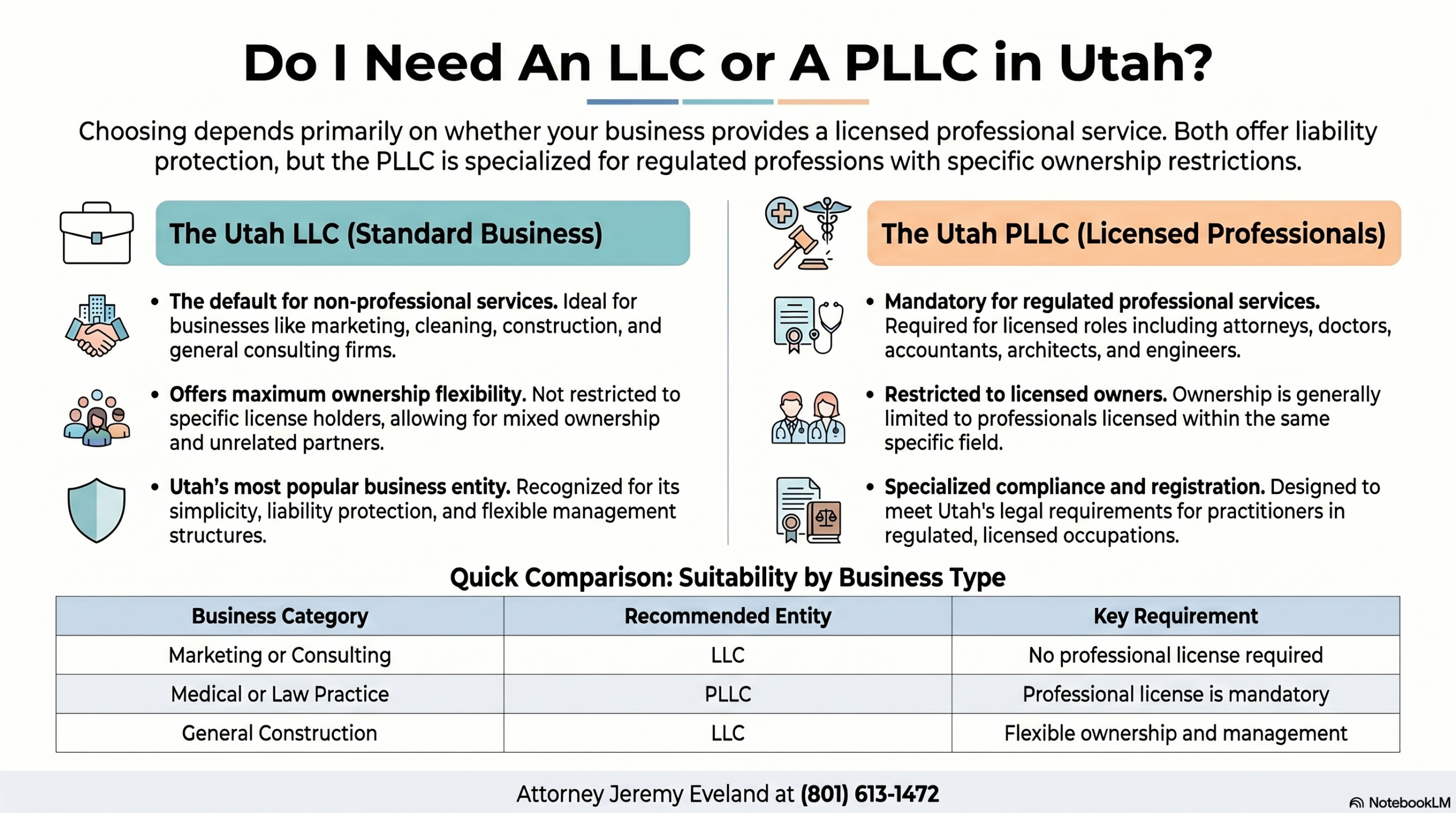
This guide covers Do I Need and what you need to know. If you are starting a business in Utah, one of the first and most important questions you will face is: should I form a standard LLC or a Professional Limited Liability Company (PLLC)? The answer depends on whether your profession requires a state-issued license. Under Utah Code Title 48, Chapter 3a, licensed professionals such as attorneys, physicians, dentists, engineers, and accountants are required to form a PLLC rather than a standard LLC when they practice their licensed profession through a business entity. Both structures offer liability protection and pass-through taxation, but PLLCs carry additional requirements tied directly to professional licensing laws. For a full overview of your options under Utah business law, see our business law practice page.
This article will walk you through the key differences between an LLC and a PLLC in Utah, who qualifies and who is required to use each structure, the real costs of getting this decision wrong, common mistakes to avoid, and answers to over 25 frequently asked questions. Whether you are a first-time business owner or a seasoned professional reconsidering your structure, understanding the LLC vs. PLLC distinction in Utah is essential. When the decision feels complex, attorney Jeremy Eveland (801) 613-1472 is available to provide personalized guidance for Utah professionals.
LLC vs. PLLC in Utah: Quick Comparison
Before diving into the details, here is a side-by-side comparison of the two structures to help you quickly identify which one applies to your situation:
| Feature | Standard LLC | PLLC (Professional LLC) |
|---|---|---|
| Who can form it? | Anyone for any lawful business | Licensed professionals only |
| Member licensing required? | No | Yes — all members must be licensed |
| Single service restriction? | No | Yes — one professional service type only |
| Name requirement | Must include “LLC” | Must include “PLLC” or “P.L.L.C.” |
| Liability protection | Protects members from business debts | Same, plus cross-member malpractice protection |
| Tax treatment | Pass-through by default | Pass-through by default (same as LLC) |
| Non-licensed partners allowed? | Yes | No |
| State filing fee | $54 | $54 |
| Governing statute | Utah Code Title 48, Chapter 3a | Utah Code §§ 48-3a-1101 through 48-3a-1110 |
| Annual renewal required? | Yes | Yes |
What Is the Difference Between an LLC and a PLLC in Utah?
A Limited Liability Company (LLC) is a flexible business structure available to almost any person or group in Utah. It combines the liability protection of a corporation with the tax simplicity of a partnership. Members of an LLC are generally not personally responsible for the debts or legal judgments of the business itself. If you are looking at the LLC formation process in Utah, that resource walks through the Certificate of Organization filing step by step.
A Professional Limited Liability Company (PLLC) is a specialized form of LLC designed specifically for people who hold a state-issued professional license. In Utah, a PLLC is governed by Utah Code § 48-3a-1101 through § 48-3a-1110, which sets out who may form one, how it must be named, and what services it may provide.
Key Governing Rules in Utah
- An LLC is formed by filing a Certificate of Organization with the Utah Division of Corporations and Commercial Code.
- A PLLC requires the same filing, but all members must hold an active, valid Utah professional license in the specific service the PLLC will provide.
- Under Utah Code § 48-3a-1106, a Utah PLLC is limited to providing only one type of professional service.
- Under Utah Code § 48-3a-1105, every member of the PLLC must be licensed in Utah for the service the company offers.
The practical difference comes down to this: if your work requires a license in Utah, you likely need a PLLC, not a standard LLC.
9 Key Things to Know About LLC vs. PLLC in Utah
1. Who Is Required to Form a PLLC in Utah?
Utah’s PLLC statute applies to any profession that requires a license, certificate, or other legal authorization before services can be rendered. The list of professions specifically identified under Utah Code § 48-3a-1101 includes:
- Appraisers
- Architects
- Attorneys
- Chiropractors
- Dentists
- Engineers
- Medical physicians, surgeons, and doctors
- Naturopaths
- Nurses
- Optometrists
- Osteopaths
- Pharmacists
- Physician assistants
- Physical therapists
- Podiatrists
- Psychologists
- Public accountants
- Real estate brokers and sales agents
- Social workers
- Therapists
- Veterinarians
If you are in one of these professions and you want to run your practice through a business entity, Utah law requires you to use a PLLC, not a standard LLC. Forming a regular LLC in this situation could expose you to compliance issues with your licensing board and potentially with the Utah Division of Corporations. For example, dentists and dental practice owners should also review Utah’s dental practice laws and regulations, which impose additional requirements beyond the PLLC statute itself. Similarly, accountants should be aware of the specific regulations governing accounting firms in Utah.
2. All PLLC Members Must Be Licensed
One of the most critical restrictions in Utah’s PLLC law is that every single member of a PLLC must hold an active, valid professional license for the service the company provides. You cannot bring in a non-licensed business partner as a PLLC member, even if that partner will only handle administrative or financial matters. If a member’s license expires or is revoked, that creates a compliance problem for the entire PLLC. This rule is stricter than what applies to a standard LLC, where there are no licensing requirements for membership at all.
This matters enormously in Salt Lake City and throughout Utah, because many professionals want to bring in a business partner who handles operations while they handle the licensed work. Under a PLLC structure, that arrangement is not permitted for the licensed entity itself.
3. A Utah PLLC Can Only Offer One Type of Professional Service
Under Utah Code § 48-3a-1106, a Utah PLLC is restricted to providing a single type of professional service. You cannot combine a legal practice and an accounting practice under one PLLC, for example. If you want to offer multiple licensed professional services, you will need to form two separate PLLCs. This is a common source of confusion for multi-discipline professionals in Utah, particularly in healthcare and consulting.
If you are looking to build a diversified professional services firm, a holding company structure with separate PLLCs beneath it may be an approach worth discussing with a knowledgeable Utah business lawyer like Jeremy Eveland (801) 613-1472.
4. Naming Rules for a Utah PLLC Are Stricter
A standard Utah LLC has relatively flexible naming rules, as long as the name is distinguishable from other entities already registered in Utah and includes a proper identifier like “LLC” or “Limited Liability Company”. A PLLC, however, must include the words “professional limited liability company” or the abbreviation “PLLC” or “P.L.L.C.” in its name. The name also cannot suggest the PLLC is organized for any practice other than what is stated in its Certificate of Organization, and it must comply with the naming rules of the relevant professional licensing board. Violating these naming rules can result in rejected filings and delays in getting your business off the ground.
5. Liability Protection Works Differently in a PLLC
Both an LLC and a PLLC protect members from the personal debts and general liabilities of the business. However, a PLLC provides one notable additional layer of protection: if one member is sued for professional malpractice, the other members of the PLLC are not automatically held personally liable for that specific malpractice claim. This is significant for group medical practices, law firms, and accounting firms in Utah, where multiple licensed professionals work together.
The critical caveat is that each member remains personally liable for their own professional negligence. The PLLC does not shield an individual from the consequences of their own malpractice. This is why professional liability insurance remains essential even when operating through a PLLC.
6. Formation Process and Costs
Forming a standard LLC in Utah involves filing a Certificate of Organization with the Utah Division of Corporations and Commercial Code, designating a registered agent with a physical Utah address, and paying a filing fee. The process is relatively straightforward. See our guide on how to form an LLC in Utah for a step-by-step walkthrough of the process.
Forming a Utah PLLC follows the same basic steps but adds requirements:
- Verify that all members hold current, valid Utah professional licenses
- File a PLLC Certificate of Organization (a different form than a standard LLC filing)
- Include names and addresses of all members or managers
- Specify the professional service the PLLC will provide
- Comply with any naming requirements set by the relevant licensing board
The filing fee for a Utah PLLC Certificate of Organization is $54, with an optional 48-hour expedited processing fee of an additional $75. Standard online filing is processed within 24 hours, while paper and fax filings take approximately 5 to 7 days.
7. Annual Renewal Requirements
Both LLCs and PLLCs in Utah are required to file annual reports with the Utah Division of Corporations and Commercial Code to maintain their good standing. Failure to renew on time can result in administrative dissolution, which strips the entity of its legal protections. For a PLLC, dissolution could also trigger issues with the relevant professional licensing board, since operating a professional practice through a dissolved entity may violate licensing rules.
8. Tax Treatment: LLC vs. PLLC
From the IRS’s perspective, a PLLC is taxed the same way as a standard LLC by default. A single-member PLLC is taxed as a sole proprietorship (disregarded entity). A multi-member PLLC is taxed as a partnership. Either can elect to be taxed as an S-corporation or C-corporation if it meets the requirements. The professional designation does not create a separate federal tax category. However, the way you structure your compensation and the entity’s income can have real tax implications. A Utah business attorney or CPA can help you evaluate which approach reduces your overall tax burden.
9. Converting from an LLC to a PLLC (or Vice Versa)
If you initially formed a standard LLC but later realize you should have formed a PLLC (or you became licensed after forming your LLC), the Utah Division of Corporations does allow conversion filings. This is not automatic and requires proper paperwork, including a conversion filing and verification that all members meet the licensing requirements. Getting the conversion wrong or delaying it can create gaps in legal compliance that expose you and your fellow members to liability.
The Real Cost of Getting This Wrong in Utah
Choosing the wrong entity structure in Utah is not just a paperwork inconvenience. The financial, professional, and legal costs can be substantial.
- Licensing board discipline: Operating a licensed professional service through an improperly structured entity (such as a standard LLC when a PLLC is required) can trigger disciplinary action from your Utah licensing board, including fines, suspension, or license revocation.
- Loss of liability protection: If your entity is not properly formed, a court may pierce the corporate veil and hold members personally liable for business debts and judgments.
- Tax penalties: Choosing the wrong structure can result in suboptimal tax treatment, causing you to pay more in self-employment tax or miss out on legitimate deductions.
- Dissolution and restart costs: If your entity is administratively dissolved or voided due to non-compliance, you may need to start the formation process over, paying new fees and potentially losing your business name.
- Client and contract issues: Some contracts and professional relationships require proof of proper licensure and entity structure. An improperly formed entity can jeopardize contracts, hospital credentialing, insurance panels, and government contracts.
Most of these costs are entirely avoidable with proper upfront planning and guidance from an experienced business formation attorney in Salt Lake City.
How an Experienced Attorney Helps You Succeed
Navigating the LLC vs. PLLC decision in Utah involves more than just reading a statute. An experienced attorney can help you with every step, from determining whether your profession legally requires a PLLC to structuring your operating agreement in a way that protects all members.
Attorney Jeremy Eveland (801) 613-1472 serves clients in Salt Lake City and throughout Utah, providing guidance on business formation, PLLC compliance, operating agreements, and ongoing regulatory requirements. A qualified Utah business attorney can:
- Confirm whether your specific profession falls under the Utah PLLC statutes
- Prepare and file your Certificate of Organization correctly the first time
- Draft a customized operating agreement that addresses ownership transfers, member departures, and malpractice allocation
- Advise on the tax election that best suits your practice’s financial structure
- Help you maintain compliance with annual renewal requirements and licensing board rules
- Assist with converting an existing LLC to a PLLC if your circumstances have changed
- Identify risk management strategies specific to your profession in Utah
Attempting to navigate these requirements without professional guidance often leads to costly errors that are far more expensive to fix than they were to prevent.
LLC and PLLC Alternatives and Related Structures in Utah
Professional Corporation (PC)
A Professional Corporation functions similarly to a PLLC in that it is restricted to licensed professionals, but it is organized as a corporation rather than an LLC. PCs have shareholders, a board of directors, and corporate-level formalities. They are generally more complex and costly to operate than PLLCs. Some professionals prefer a PC if they anticipate significant retained earnings or want a structure more familiar to investors. Under Utah Code § 16-11-6, Professional Corporations in Utah are subject to the same single-discipline and licensed-ownership requirements that apply to PLLCs.
Professional Limited Liability Partnership (PLLP or LLP)
Utah also permits Professional Limited Liability Partnerships for certain licensed services, governed by Utah Code § 48-1d-1305 and § 48-1d-1308. All partners in a PLLP must hold appropriate licenses, and the entity is restricted to a single type of professional service — the same restriction that applies to PLLCs. PLLPs are less commonly used than PLLCs but may be appropriate for certain established professional practices transitioning from a general partnership.
Sole Proprietorship
If you are a sole licensed professional just starting out and not yet ready to share ownership with others, operating as a sole proprietor (without any entity) is technically an option. However, it provides zero liability protection. Even a small malpractice claim could result in personal financial devastation. Forming a single-member PLLC provides the same simplicity as a sole proprietorship while adding the liability shield that every licensed professional in Utah needs.
Holding Company Structure
Some Utah professionals with multiple business lines set up a non-professional LLC or corporation as a holding entity to manage administrative and investment activities, with one or more PLLCs underneath handling the licensed professional services. This structure is more complex and requires careful legal planning to comply with Utah’s single-discipline PLLC rules, but it can provide significant flexibility for professionals who want to diversify their business activities. Careful drafting of a business partnership agreement is especially important in multi-entity professional structures.
Understanding Utah LLC Laws for Professionals
Utah’s LLC statutes provide the foundation for both standard LLCs and PLLCs. The Utah LLC laws that govern formation, management, and dissolution apply to both entity types, with additional PLLC-specific requirements layered on top under Part 11 of the statute. Understanding how these rules interact is critical before you file any formation documents.
Key provisions every Utah professional should know include:
- Operating agreement requirements: While not legally mandated, a written operating agreement is essential for both LLCs and PLLCs. It governs how the entity is managed, how profits are distributed, and what happens when a member leaves, loses their license, or dies.
- Registered agent requirement: Both LLCs and PLLCs must continuously maintain a registered agent with a physical Utah address. Failure to maintain a registered agent can result in the entity being administratively dissolved.
- Annual report filing: Utah requires annual reports to be filed to keep the entity in good standing. The report confirms the entity’s registered agent, principal address, and other key information.
- Member governance: Unless the operating agreement specifies otherwise, LLC and PLLC governance defaults to Utah’s statutory rules, which may not match what members intend.
What to Do If You Are Currently Dealing With This Issue in Utah
If you are a licensed professional in Utah who is currently operating without the correct entity structure, or who is in the process of starting a new professional practice, here is a practical checklist:
- Confirm whether your profession requires a PLLC by reviewing Utah Code § 48-3a-1101 and consulting your licensing board.
- Verify that all proposed members hold active Utah professional licenses in the specific service your entity will provide.
- Choose a compliant business name that includes “PLLC” or “Professional Limited Liability Company” and satisfies your licensing board’s naming rules.
- Appoint a registered agent with a physical Utah address who is available during business hours.
- File a PLLC Certificate of Organization through the Utah Division of Corporations and Commercial Code either online (processed within 24 hours) or by mail/fax.
- Draft a written operating agreement addressing member responsibilities, ownership percentages, profit distribution, and what happens if a member loses their license.
- Obtain an EIN from the IRS for banking and tax purposes.
- Evaluate your tax election (default partnership/disregarded entity vs. S-corp election) with a CPA or attorney.
- Set a calendar reminder for annual renewal to avoid administrative dissolution.
- Contact attorney Jeremy Eveland (801) 613-1472 to review your entire formation plan before filing, or to correct an existing entity structure.
How to Choose the Right Attorney for LLC and PLLC Matters in Utah
When selecting a business attorney to help you form or correct your entity structure in Utah, look for the following:
- Specific experience with Utah LLC and PLLC law, including familiarity with Utah Code Title 48, Chapter 3a
- Knowledge of your professional licensing board’s rules, since different professions have different naming and compliance requirements
- Familiarity with the Utah Division of Corporations and Commercial Code and its filing processes and timelines
- Experience drafting operating agreements that address the unique risks of professional practices, including malpractice allocation clauses
- Clear, plain-English communication so you understand exactly what you are signing and why
- Availability and responsiveness, especially during the formation phase when timing matters
- A comprehensive approach that covers both immediate formation needs and long-term compliance planning
- Willingness to coordinate with your CPA or financial advisor on the tax structure of your entity
Attorney Jeremy Eveland (801) 613-1472 provides guidance on LLC and PLLC formation matters for clients in Salt Lake City and throughout Utah, offering the kind of comprehensive, accessible legal support that licensed professionals need when making these foundational decisions.
Common Mistakes People Make With LLC and PLLC Decisions in Utah
Mistake 1: Forming a Standard LLC When a PLLC Is Required
This is the most common error. Many licensed professionals in Utah file a standard LLC because the process is simpler and more widely advertised, without realizing that their profession legally requires a PLLC. This can result in disciplinary action from the licensing board and potential loss of liability protection.
Mistake 2: Including a Non-Licensed Member in a PLLC
Professionals sometimes want to bring in a business-savvy partner who handles operations, marketing, or finances. Under Utah’s PLLC statutes, all members must be licensed. Including a non-licensed individual as a PLLC member violates the statute and can invalidate the entity.
Mistake 3: Trying to Run Multiple Professional Services Under One PLLC
Utah prohibits a single PLLC from offering more than one type of professional service. A physician who also holds a real estate license cannot run both practices under one PLLC. Two separate PLLCs are required.
Mistake 4: Skipping the Operating Agreement
Utah does not legally require a written operating agreement, but failing to create one is a serious mistake. Without one, disputes between members are governed by default statutory rules that may not reflect what the parties actually intended. An operating agreement is especially important in a PLLC because it should address what happens when a member’s license is revoked or suspended.
Mistake 5: Letting the Annual Renewal Lapse
Utah requires annual renewal to keep an LLC or PLLC in good standing. Many professionals forget this requirement, resulting in administrative dissolution. A dissolved PLLC offers no liability protection, and operating under a dissolved entity may violate licensing rules.
Mistake 6: Assuming Personal Liability Is Fully Eliminated
Some professionals believe that forming a PLLC completely eliminates personal liability for malpractice claims. It does not. Each member remains personally liable for their own professional negligence. Professional liability insurance is still essential.
Mistake 7: Using an Online Formation Service Without Legal Review
Many online services will file your PLLC documents for a low fee, but they will not advise you on whether a PLLC is the right structure, whether your operating agreement is appropriate, or whether your entity complies with your licensing board’s rules. The filing is the easy part. The legal strategy behind it is where professional guidance provides real value.
Frequently Asked Questions
What is the main difference between an LLC and a PLLC in Utah?
The main difference is who can own them and what services they can provide. Any person can form a standard LLC for any lawful business purpose. A PLLC is restricted to licensed professionals providing the specific service for which they are licensed, and all members must be licensed.
Do I need a PLLC if I am a licensed attorney in Utah?
Yes. Attorneys in Utah who want to practice through a business entity are required to use a PLLC, not a standard LLC, under Utah Code § 48-3a-1101.
Do I need a PLLC if I am a licensed real estate agent in Utah?
Yes. Real estate brokers and sales agents are specifically listed under Utah’s professional services statute, which means they must use a PLLC when practicing through a business entity.
Can I form an LLC and then convert it to a PLLC in Utah?
Yes. The Utah Division of Corporations allows conversion filings. However, the conversion requires all members to be properly licensed, and the filing must comply with all PLLC requirements.
How much does it cost to form a PLLC in Utah?
The state filing fee is $54. Expedited 48-hour processing costs an additional $75.
How long does it take to form a PLLC in Utah?
Online filings are typically processed within 24 hours. Mail and fax filings take approximately 5 to 7 days, or 48 hours with the expedited option.
Where do I file a PLLC in Utah?
You file with the Utah Division of Corporations and Commercial Code, either online through OneStop Online Business Registration, by mail to P.O. Box 146705, Salt Lake City, UT 84114-6705, in person at 160 E. 300 S, 1st Floor, Salt Lake City, UT 84111, or by fax to (801) 530-6438.
Can a non-licensed person be a member of a Utah PLLC?
No. Under Utah Code § 48-3a-1105, every member of a PLLC must hold an active Utah professional license in the service the PLLC provides.
Can a Utah PLLC provide more than one type of professional service?
No. Utah Code § 48-3a-1106 restricts a PLLC to a single type of professional service. If you want to offer two types of licensed services, you need two separate PLLCs.
Does a PLLC protect me from personal malpractice liability in Utah?
No. A PLLC protects members from the malpractice liability of other members, but each member remains personally liable for their own professional negligence. You still need professional liability insurance.
Is a written operating agreement required for a Utah PLLC?
It is not legally required, but it is strongly recommended. Without one, disputes and management questions are governed by default Utah LLC rules, which may not match the members’ intentions.
Does a Utah PLLC need a registered agent?
Yes. All LLCs and PLLCs in Utah must designate a registered agent with a physical Utah address who is available during business hours.
What name must a Utah PLLC use?
The name must include “professional limited liability company,” “PLLC,” or “P.L.L.C.” and must comply with the naming rules of the relevant professional licensing board.
What is the annual renewal requirement for a Utah PLLC?
Utah PLLCs must file annual reports with the Division of Corporations and Commercial Code to maintain good standing. Failure to renew can result in administrative dissolution.
What happens if a PLLC member loses their professional license?
The PLLC is no longer in compliance with Utah Code § 48-3a-1105. This could trigger dissolution proceedings or disciplinary action from the licensing board. The operating agreement should address this scenario in advance.
Can a Utah PLLC elect S-corporation tax treatment?
Yes, if it meets IRS eligibility requirements, a Utah PLLC can elect to be taxed as an S-corporation, which can reduce self-employment taxes for active members.
How does a PLLC differ from a Professional Corporation (PC) in Utah?
Both are restricted to licensed professionals, but a PC is organized like a corporation, with shareholders, a board of directors, and corporate formalities. A PLLC offers more operational flexibility and simpler governance.
Can a Utah PLLC have only one member?
Yes. Utah permits single-member PLLCs, provided that sole member holds the required professional license.
What professions are required to form a PLLC in Utah?
The list includes attorneys, physicians, dentists, nurses, pharmacists, engineers, architects, accountants, psychologists, social workers, physical therapists, chiropractors, optometrists, veterinarians, real estate brokers, appraisers, and others listed under Utah Code § 48-3a-1101.
Is a Utah PLLC required to carry professional liability insurance?
Utah law does not impose a universal insurance mandate for PLLCs, but individual licensing boards may require it, and some professional contracts and credentialing bodies require it as well.
Can I add a new member to my Utah PLLC after formation?
Yes, but the new member must hold an active Utah professional license in the same service the PLLC provides. An amendment to the Certificate of Organization may also be required.
What is the difference between a PLLC and a sole proprietorship in Utah?
A sole proprietorship provides no liability protection whatsoever. A PLLC provides a legal liability shield between the business and the members’ personal assets, as well as cross-member malpractice protection.
Can I operate a professional practice in Utah without any entity at all?
Yes, as a sole proprietor or general partnership, but doing so exposes you to unlimited personal liability. Most licensed professionals in Utah benefit significantly from the protection provided by a properly formed PLLC.
What is the Utah Division of Corporations and Commercial Code?
It is the state agency that administers business entity registrations in Utah, including LLCs and PLLCs. It operates under the Utah Department of Commerce and is the official body for filing, renewing, and amending business entities.
Can a foreign professional licensed in another state be a member of a Utah PLLC?
Utah Code § 48-3a-1105 requires members to be professionally licensed in Utah for the service the company will offer. A professional licensed only in another state would generally need to obtain a Utah license before becoming a PLLC member.
What is the governing statute for Utah PLLCs?
Utah Code Title 48, Chapter 3a, Part 11 (Utah Code §§ 48-3a-1101 through 48-3a-1110) governs Professional Services Limited Liability Companies in Utah.
How do I know if my profession requires a license in Utah?
You can check with the Utah Division of Occupational and Professional Licensing (DOPL) or consult with a Utah business attorney who can confirm whether your specific work falls under the PLLC statute.
Key Laws and Standards You Should Know
Utah Code § 48-3a-1101 — Definition of Professional Services
This statute defines a “professional service” as any service that requires a license, certificate, or other legal authorization before it can be rendered in Utah. It also provides the list of qualifying licensed professions.
Utah Code § 48-3a-1105 — Membership Requirements
Requires that all members of a Utah PLLC hold a valid Utah professional license for the service the company provides. This is the core rule that distinguishes a PLLC from a standard LLC in Utah.
Utah Code § 48-3a-1106 — Single-Service Restriction
Limits each Utah PLLC to providing only one type of professional service and requires that all owners be licensed in the same field.
Utah Code § 48-3a-1104 — Naming Requirements
Governs how a Utah PLLC must designate itself in its business name, requiring use of “PLLC,” “P.L.L.C.,” or “professional limited liability company.”
Utah Revised Uniform Limited Liability Company Act — Utah Code Title 48, Chapter 3a
The broader framework governing all LLCs in Utah, including standard LLCs and PLLCs, covering formation, governance, operating agreements, dissolution, and more.
Utah Code § 16-11-6 — Professional Corporations
Governs Professional Corporations in Utah, which operate under similar licensing and single-discipline restrictions as PLLCs but are organized as corporations.
Next Steps
Deciding between an LLC and a PLLC in Utah is one of the most consequential early decisions you will make as a licensed professional or aspiring business owner. The right choice protects your license, your personal assets, and your professional reputation. The wrong choice can lead to licensing board discipline, personal liability exposure, invalid contracts, and costly corrective filings.
The good news is that with proper planning and legal guidance, these problems are entirely avoidable. Utah’s PLLC framework is well-established, and the formation process is straightforward when approached correctly from the start. Whether you are opening a new medical practice in Salt Lake City, setting up a law firm in Utah County, or restructuring an existing professional practice anywhere in the state, the most important step you can take is to consult with an experienced Utah business attorney before you file anything.
For personalized guidance on LLC and PLLC formation in Utah, contact attorney Jeremy Eveland at (801) 613-1472. Whether you are just getting started or correcting a prior filing, expert legal support makes all the difference.
Jeremy Eveland
8833 S Redwood Road
West Jordan UT 84088
(801) 613-1472
For legal assistance, contact Jeremy Eveland, Attorney at Law — 8833 S Redwood Rd #A, West Jordan, UT 84088 · (801) 613-1472.