Tag Archives: legal advice

Corporate Restructuring

Corporate Restructuring

Corporate Restructuring

“Reorganize for Success: Unlock the Potential of Corporate Restructuring”

Introduction

Corporate restructuring is a process of reorganizing a company’s operations, finances, and/or ownership structure in order to improve its performance and profitability. It can involve changes to the company’s organizational structure, its financial structure, its ownership structure, or any combination of these. Corporate restructuring can be used to address a variety of issues, such as improving operational efficiency, reducing costs, increasing profitability, and responding to changing market conditions. It can also be used to facilitate mergers and acquisitions, or to prepare a company for sale. In any case, corporate restructuring is a complex process that requires careful planning and execution.

Corporate Restructuring: The Role of Business Consolidations

Corporate restructuring is a process of reorganizing a company’s operations, finances, and ownership structure to improve its overall performance. Business consolidations are a key component of corporate restructuring, as they involve the merging of two or more companies into a single entity. This article will discuss the role of business consolidations in corporate restructuring and the potential benefits and drawbacks of such a strategy.

Business consolidations are often used to create economies of scale, which can help a company reduce costs and increase efficiency. By combining two or more companies, a larger entity is created that can take advantage of shared resources, such as personnel, technology, and marketing. This can lead to cost savings, as well as increased efficiency and productivity. Additionally, consolidations can help a company gain access to new markets and customers, as well as new sources of capital.

However, business consolidations can also have drawbacks. For example, the process of combining two or more companies can be complex and time-consuming. Additionally, there may be cultural differences between the two companies that can lead to conflicts and disagreements. Furthermore, consolidations can lead to job losses, as redundant positions are eliminated.

Overall, business consolidations can be a powerful tool for corporate restructuring. By combining two or more companies, a larger entity is created that can take advantage of economies of scale and access new markets and customers. However, the process of combining two or more companies can be complex and time-consuming, and there may be cultural differences that can lead to conflicts and disagreements. Additionally, consolidations can lead to job losses. Therefore, it is important for companies to carefully consider the potential benefits and drawbacks of business consolidations before embarking on a corporate restructuring strategy.

Corporate Restructuring Strategies: What Works and What Doesn’t

Corporate restructuring is a complex process that requires careful consideration of a variety of factors. It is important to understand the different strategies available and the potential outcomes of each. This article will provide an overview of the most common corporate restructuring strategies, their advantages and disadvantages, and the factors to consider when deciding which strategy is best for a particular situation.

The most common corporate restructuring strategies are divestitures, mergers and acquisitions, spin-offs, and joint ventures. Divestitures involve the sale of a company’s assets or divisions to another company. This strategy can be used to reduce debt, raise capital, or focus on core business activities. Mergers and acquisitions involve the combination of two or more companies into a single entity. This strategy can be used to increase market share, gain access to new technology, or reduce costs. Spin-offs involve the separation of a company’s divisions or subsidiaries into independent entities. This strategy can be used to unlock value, increase focus, or reduce complexity. Joint ventures involve the collaboration of two or more companies to create a new entity. This strategy can be used to gain access to new markets, share resources, or reduce risk.

Each of these strategies has its own advantages and disadvantages. Divestitures can be used to quickly raise capital, but can also result in the loss of valuable assets. Mergers and acquisitions can create economies of scale, but can also lead to cultural clashes and integration issues. Spin-offs can unlock value, but can also lead to a lack of focus. Joint ventures can reduce risk, but can also lead to conflicts of interest.

When deciding which corporate restructuring strategy is best for a particular situation, it is important to consider the company’s goals, resources, and competitive environment. It is also important to consider the potential risks and rewards of each strategy. Ultimately, the best strategy will depend on the specific circumstances of the company.

In short, corporate restructuring is a complex process that requires careful consideration of a variety of factors. Different strategies have different advantages and disadvantages, and the best strategy for a particular situation will depend on the company’s goals, resources, and competitive environment. By understanding the different strategies available and the potential outcomes of each, companies can make informed decisions about how to best restructure their businesses.

Corporate Restructuring: What You Need to Know

Corporate restructuring is a process of reorganizing a company’s operations, finances, and ownership structure to improve its overall performance and profitability. It can involve a variety of strategies, such as mergers and acquisitions, divestitures, spin-offs, and reorganizations.

When considering corporate restructuring, it is important to understand the potential benefits and risks associated with the process. Restructuring can help a company become more competitive, reduce costs, and increase efficiency. It can also help a company access new markets, expand its product offerings, and improve its financial position. However, restructuring can also be a risky endeavor, as it can lead to significant changes in the company’s operations, finances, and ownership structure.

When considering corporate restructuring, it is important to understand the potential costs and benefits associated with the process. Restructuring can be expensive, as it often requires significant investments in new technology, personnel, and other resources. Additionally, restructuring can lead to significant changes in the company’s operations, finances, and ownership structure, which can be difficult to manage.

It is also important to understand the legal and regulatory implications of corporate restructuring. Depending on the type of restructuring being undertaken, the company may need to obtain approval from shareholders, creditors, and other stakeholders. Additionally, the company may need to comply with various laws and regulations, such as those related to antitrust, securities, and taxation.

Finally, it is important to understand the potential impact of corporate restructuring on the company’s employees. Restructuring can lead to job losses, changes in job roles, and other changes in the workplace. It is important to ensure that employees are informed of the changes and that their rights and interests are protected.

Corporate restructuring can be a complex and risky endeavor, but it can also be a powerful tool for improving a company’s performance and profitability. By understanding the potential costs and benefits associated with the process, as well as the legal and regulatory implications, companies can make informed decisions about whether or not to pursue restructuring.

Differences of LLCs

Limited Liability Companies (LLCs) are a popular business structure for entrepreneurs and small business owners. LLCs offer a number of advantages over other business structures, such as limited liability protection, pass-through taxation, and flexibility in management. However, there are some differences between LLCs and other business structures that should be considered when deciding which structure is best for your business.

One of the main differences between LLCs and other business structures is the amount of paperwork required. LLCs require more paperwork than other business structures, such as sole proprietorships and partnerships. This includes filing articles of organization with the state, creating an operating agreement, and filing annual reports. Additionally, LLCs must also comply with state and federal regulations, such as paying taxes and filing annual reports.

Another difference between LLCs and other business structures is the amount of liability protection they offer. LLCs offer limited liability protection, which means that the owners of the LLC are not personally liable for the debts and obligations of the business. This is not the case with other business structures, such as sole proprietorships and partnerships, which do not offer any liability protection.

Finally, LLCs offer more flexibility in management than other business structures. LLCs can be managed by one or more members, and the members can decide how the business is managed. This is not the case with other business structures, such as corporations, which must be managed by a board of directors.

Overall, LLCs offer a number of advantages over other business structures, such as limited liability protection, pass-through taxation, and flexibility in management. However, there are some differences between LLCs and other business structures that should be considered when deciding which structure is best for your business.

Partnerships

Partnerships are an important part of any business. They can help to increase the reach of a company, provide access to new markets, and create opportunities for growth. A successful partnership requires careful planning and consideration of the needs of both parties.

When entering into a partnership, it is important to consider the goals of each party. What are the objectives of the partnership? What are the expectations of each partner? What are the potential benefits and risks? It is also important to consider the resources available to each partner. What resources can each partner bring to the table?

Once the goals and resources of each partner have been identified, it is important to develop a plan for the partnership. This plan should include a timeline, budget, and responsibilities for each partner. It should also include a strategy for communication and conflict resolution.

It is also important to consider the legal aspects of the partnership. What type of agreement should be used? What are the legal implications of the partnership? What are the tax implications?

Finally, it is important to consider the long-term implications of the partnership. What are the potential opportunities for growth? What are the potential risks? How will the partnership be managed over time?

Partnerships can be a great way to expand a business and create new opportunities. However, it is important to consider all aspects of the partnership before entering into an agreement. By taking the time to plan and consider the needs of both parties, a successful partnership can be created.

Corporations in Reorganization

When a business is facing financial difficulties, it may be necessary to reorganize the company in order to ensure its survival. Reorganization is a process that involves restructuring the company’s finances, operations, and management in order to improve its financial health. This process can be complex and time-consuming, but it can also be a necessary step for a business to take in order to remain viable.

Reorganization typically involves restructuring the company’s debt, which may include negotiating with creditors to reduce the amount owed or to extend the repayment period. The company may also need to reduce its overhead costs, such as staff or rent, in order to free up funds for debt repayment. Additionally, the company may need to restructure its management and operations in order to improve efficiency and profitability.

In some cases, a company may need to file for bankruptcy in order to reorganize. This is a legal process that allows the company to restructure its debt and operations under the protection of the court. The court will appoint a trustee to oversee the reorganization process and ensure that the company’s creditors are treated fairly.

In other cases, a company may be able to reorganize without filing for bankruptcy. This is known as a “prepackaged” reorganization, and it involves negotiating with creditors to restructure the company’s debt and operations without the need for court intervention.

Regardless of the type of reorganization, the goal is to improve the company’s financial health and ensure its long-term viability. Reorganization can be a difficult process, but it can also be a necessary step for a business to take in order to remain viable.

Exploring the Benefits of Corporate Restructuring

Corporate restructuring is a process of reorganizing a company’s operations, finances, and/or ownership structure in order to improve its overall performance and profitability. It can involve a variety of activities, such as mergers and acquisitions, divestitures, spin-offs, and reorganizations. Restructuring can be a powerful tool for companies to improve their competitive position and increase their value.

The primary benefit of corporate restructuring is improved financial performance. By streamlining operations, reducing costs, and increasing efficiency, companies can improve their bottom line. Restructuring can also help companies to better manage their debt and capital structure, allowing them to access more capital and reduce their risk. Additionally, restructuring can help companies to better align their operations with their strategic objectives, allowing them to focus on their core competencies and become more competitive.

Restructuring can also help companies to better manage their resources. By consolidating operations, companies can reduce overhead costs and increase efficiency. This can lead to improved customer service, increased productivity, and improved profitability. Additionally, restructuring can help companies to better manage their workforce, allowing them to reduce labor costs and increase employee morale.

Finally, restructuring can help companies to better position themselves for the future. By restructuring, companies can become more agile and better able to respond to changing market conditions. This can help them to remain competitive and increase their value over time.

In summary, corporate restructuring can be a powerful tool for companies to improve their financial performance, manage their resources, and position themselves for the future. By taking advantage of the benefits of restructuring, companies can become more competitive and increase their value.

Mergers and Acquisitions for Corporations

Mergers and acquisitions (M&A) are a common strategy used by corporations to expand their operations, increase market share, and gain competitive advantages. M&A involves the combination of two or more companies into a single entity, or the purchase of one company by another.

The process of M&A can be complex and time-consuming, and requires careful consideration of the legal, financial, and operational implications of the transaction. It is important to understand the potential benefits and risks associated with M&A before entering into any agreement.

The first step in the M&A process is to identify potential targets. This involves researching the target company’s financials, operations, and competitive position in the market. Once a target has been identified, the next step is to negotiate the terms of the transaction. This includes determining the purchase price, the structure of the transaction, and any other conditions that must be met.

Once the terms of the transaction have been agreed upon, the parties must complete due diligence. This involves a thorough review of the target company’s financials, operations, and legal documents. This process helps to ensure that the transaction is in the best interests of both parties.

Corporate Restructuring, Jeremy Eveland, Lawyer Jeremy Eveland, Jeremy Eveland Utah Attorney, restructuring, insolvency, team, creditors, business, clients, work, advice, practice, debtor, debt, group, lawyers, companies, process, firm, court, head, liquidation, law, administration, directors, llp, plan, matters, assets, experience, services, knowledge, testimonials, capital, partners, market, creditor, client, expertise, finance, approach, restructurings, partner, corporate restructuring, practice head, key lawyers, key clients, restructuring plan, voluntary liquidation, legal advice, corporate restructurings, voluntary arrangement, commercial advice, out-of-court restructuring, work highlights, administrative receiver, insolvency team, insolvency lawyers, joint administrators, in-court restructuring, financial difficulties, compulsory liquidation, technical knowledge, insolvency practitioners, out-of-court workouts, involved creditors, corporate restructuring strategies, real estate, voluntary arrangements, unsecured creditors, complex restructurings, corporate debt restructuring, legal support, restructuring, insolvency, clients, lawyers, creditors, knowledge, debtor, corporate restructuring, ips, plc, assets, chapter 11, finance, lenders, liquidation, ad hoc, litigation, energy, debt, bondholders, loan, bankruptcy, company, company voluntary arrangement, administrator, bankrupt, technical default, compulsory liquidation, iva, individual voluntary arrangement, winding up, liquidation, out-of-court restructuring, chapter 11 process, insolvency procedure, insolvency, default, creditors voluntary liquidation, company voluntary arrangement, bankruptcy protection, repayments, foreclosure, floating charge, holdout problems, chapter 11 bankruptcy, capital gains tax, debt

Once due diligence is complete, the parties must draft and execute the necessary legal documents. This includes a purchase agreement, which outlines the terms of the transaction, and any other documents required by law.

Finally, the parties must complete the closing process. This involves transferring ownership of the target company, transferring assets, and ensuring that all legal and financial obligations are met.

M&A can be a complex and time-consuming process, but it can also be a powerful tool for corporations looking to expand their operations and gain competitive advantages. By understanding the potential benefits and risks associated with M&A, corporations can make informed decisions that will help them achieve their strategic goals.

Q&A

Q1: What is corporate restructuring?
A1: Corporate restructuring is the process of reorganizing a company’s structure, operations, and/or finances in order to improve its performance and profitability. It can involve changes to the company’s ownership, management, operations, and/or financial structure.

Q2: What are the benefits of corporate restructuring?
A2: Corporate restructuring can help a company become more efficient, reduce costs, and increase profitability. It can also help a company become more competitive in the marketplace, attract new investors, and improve its overall financial health.

Q3: What are the risks associated with corporate restructuring?
A3: Corporate restructuring can be a risky process, as it involves making significant changes to a company’s operations and finances. There is a risk that the restructuring may not be successful, resulting in financial losses or other negative consequences.

Q4: What types of corporate restructuring are there?
A4: There are several types of corporate restructuring, including mergers and acquisitions, divestitures, spin-offs, joint ventures, and reorganizations. Each type of restructuring has its own advantages and disadvantages, and should be carefully considered before proceeding.

Q5: Who is involved in corporate restructuring?
A5: Corporate restructuring typically involves a variety of stakeholders, including the company’s management, shareholders, creditors, and other interested parties. All of these stakeholders must be consulted and their interests taken into account when making decisions about restructuring.

Q6: How long does corporate restructuring take?
A6: The length of time required for corporate restructuring depends on the complexity of the restructuring and the number of stakeholders involved. Generally, it can take anywhere from a few weeks to several months to complete the process.

Corporate Restructuring Consultation

When you need legal help with Corporate Restructuring call Jeremy D. Eveland, MBA, JD (801) 613-1472 for a consultation.

Jeremy Eveland
17 North State Street
Lindon UT 84042
(801) 613-1472

Home

Related Posts

Commercial Lease Lawyer

Business Transaction Lawyer Provo Utah

What Is An LLC?

Boutique Law Firm

Contract Negotiation

Employment Law

Trusted Personal Injury Attorneys in Utah

Tort Law

Legal Requirements to Start a Business

Contract Law for Businesses

Business Law and Taxes

Contract Lawyer

Real Estate Attorneys in Salt Lake City Utah

Probate Law

Business Contract Lawyer Riverton UT

Utah Estate Planning

Business Law and Intellectual Property

Commercial Litigation Strategies
Estate Planning Lawyer

Revocable Living Trust

Estate Planning Lawyer Salt Lake City Utah

Durable Power of Attorney

Health Care Directive

Employment Contracts

Promissory Estoppel

Medical Device Company Lawyer

Corporate Restructuring

Employment Contracts

Employment Contracts

Employment Contracts

“Secure Your Future with an Employment Contract!”

Introduction

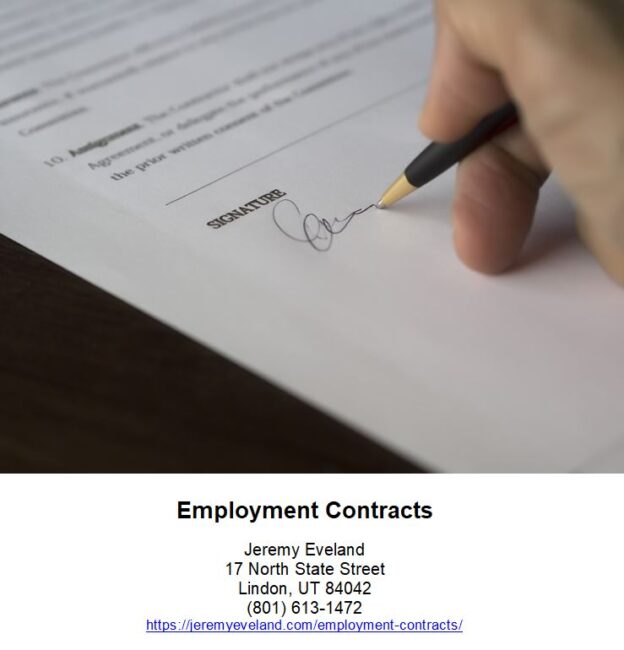
An employment contract is a legally binding agreement between an employer and an employee that outlines the terms and conditions of the employment relationship. It is important for both parties to understand the terms of the contract and to ensure that they are in agreement with them. The contract should include details such as the job title, salary, benefits, hours of work, and any other relevant information. It is important to note that an employment contract is not the same as an employment agreement, which is a more general document that outlines the general terms of the employment relationship.

The Benefits of Having an Employment Contract in Place

Having an employment contract in place is beneficial for both employers and employees. An employment contract is a legally binding document that outlines the rights and responsibilities of both parties. It is important to have an employment contract in place to ensure that both parties understand their obligations and to protect their interests.

For employers, an employment contract can provide clarity and certainty about the terms of the employment relationship. It can help to protect the employer’s interests by setting out the employee’s duties and responsibilities, as well as the employer’s expectations. It can also help to protect the employer from potential legal action by setting out the terms of the employment relationship in a clear and unambiguous manner.

For employees, an employment contract can provide security and peace of mind. It can help to ensure that the employee’s rights are respected and that they are treated fairly. It can also provide clarity about the terms of the employment relationship, such as the employee’s salary, benefits, and working hours.

An employment contract can also help to ensure that both parties are aware of their obligations and can help to avoid misunderstandings or disputes. It can also help to ensure that both parties are aware of their rights and responsibilities in the event of a dispute or termination of the employment relationship.

It is a good idea for employers to use employment contract templates, as these can help to ensure that the contract is legally compliant and tailored to the business’s needs. These templates can be found online, in legal advice publications, and from employment law firms. It is also worth seeking advice from a labor relations agency or CIPD about the details of the contract and how to ensure it meets all legal requirements. Remember, the examples here are just examples, nothing more. You must seek the advice of counsel when you draft or negotiate an employment contract. Don’t use the information here as legal advice because it isn’t.

In essence, having an employment contract in place is beneficial for both employers and employees. It can help to protect the interests of both parties and can provide clarity and certainty about the terms of the employment relationship. It can also help to ensure that both parties are aware of their rights and responsibilities and can help to avoid misunderstandings or disputes.

What to Do if Your Employment Contract is Breached

If your employment contract has been breached, it is important to take action to protect your rights. Here are some steps you can take:

1. Review the Contract: Carefully review the contract to determine what rights and obligations you and your employer have. Make sure you understand the terms of the contract and the specific breach that has occurred.

2. Document the Breach: Document the breach in writing, including the date, time, and details of the breach. Keep copies of any relevant documents or emails.

3. Contact Your Employer: Contact your employer to discuss the breach and attempt to resolve the issue. If possible, try to negotiate a resolution that is satisfactory to both parties.

4. Seek Legal Advice: If you are unable to resolve the issue with your employer, you may need to seek legal advice. A lawyer can help you understand your rights and advise you on the best course of action.

5. File a Claim: If the breach is serious enough, you may need to file a claim with the appropriate court or tribunal. This could include filing a lawsuit or making a complaint to a government agency.

By taking these steps, you can protect your rights and ensure that your employer is held accountable for any breach of your employment contract.

How to Negotiate an Employment Contract

Negotiating an employment contract can be a daunting task, but it is important to ensure that the terms of the contract are fair and beneficial to both parties. Here are some tips to help you successfully negotiate an employment contract.

1. Research: Before entering into negotiations, it is important to research the industry standards for the position you are applying for. This will give you an idea of what is considered fair and reasonable in terms of salary, benefits, and other terms of the contract.

2. Know Your Value: It is important to know your worth and to be confident in your abilities. Do not be afraid to ask for what you believe you are worth.

3. Be Prepared: Before entering into negotiations, it is important to have a clear understanding of what you want from the contract. Make sure to have a list of your desired terms and conditions ready to discuss.

Employment Contracts, Jeremy Eveland, Lawyer Jeremy Eveland, Jeremy Eveland Utah Attorney, employment, contract, employee, contracts, employer, employees, rights, statement, business, work, law, employers, advice, agreement, workers, job, staff, time, part, worker, types, agreements, services, example, service, period, pay, help, benefits, details, people, agency, templates, notice, hours, site, document, template, status, changes, employment contract, employment contracts, employment law, statutory rights, legal advice, employment templates, new employee, employment rights, sick pay, employment status, notice period, job offer, first day, northern ireland, staff handbook, employee contracts, sequiter inc., law firm, service apply, good idea, employment contracts templates, employment document folder, unlimited downloads, business documents, employment folder, labour relations agency, zero-hours contracts, legal requirement, probationary period, national minimum wage, employee, tool, cipd, calculator, contract of employment, gov.uk, employment contract, contractual, terms and conditions, pension, acas, employment, open-ended contracts, terms and conditions, constructive dismissal, non-compete, jobs, overtime, universal credit, gig economy, iwgb, employment contracts, contractual terms, sick pay, zero-hour contracts, unfair dismissal, terms and conditions of employment, contracts, employer, employment, flexitime

4. Listen: During negotiations, it is important to listen to the other party and to be open to compromise. Be willing to negotiate and to make concessions if necessary.

5. Get it in Writing: Once an agreement has been reached, make sure to get the terms of the contract in writing. This will ensure that both parties are held to the same standards and that the agreement is legally binding.

By following these tips, you can successfully negotiate an employment contract that is fair and beneficial to both parties.

What to Look for in an Employment Contract

When reviewing an employment contract, it is important to pay close attention to the details. Here are some key points to consider:

1. Job Description: The contract should clearly outline the job duties and responsibilities. It should also specify the expected hours of work and any overtime requirements.

2. Compensation: The contract should specify the salary or hourly rate, as well as any bonuses or other forms of compensation. It should also outline any benefits, such as health insurance or vacation time.

3. Termination: The contract should specify the conditions under which the employment may be terminated, as well as any severance pay or other benefits that may be provided.

4. Non-Compete Clause: The contract should specify any restrictions on the employee’s ability to work for a competitor or start a competing business.

5. Confidentiality: The contract should specify any confidential information that the employee is not allowed to disclose.

6. Intellectual Property: The contract should specify who owns any intellectual property created by the employee during the course of their employment.

7. Dispute Resolution: The contract should specify how any disputes between the employer and employee will be resolved.

By carefully reviewing an employment contract, you can ensure that your rights and interests are protected.

Understanding Your Rights Under an Employment Contract

Employment contracts are legally binding documents that outline the rights and responsibilities of both the employer and the employee. It is important to understand your rights under an employment contract to ensure that you are being treated fairly and that your rights are being respected.

The first right that you have under an employment contract is the right to receive fair compensation for your work. This includes wages, bonuses, and other forms of compensation. Your contract should specify the amount of compensation you will receive and when it will be paid.

The second right that you have under an employment contract is the right to a safe and healthy work environment. Your employer is responsible for providing a workplace that is free from hazards and risks. This includes providing adequate safety equipment and training, as well as ensuring that the workplace is free from discrimination and harassment.

The third right that you have under an employment contract is the right to reasonable working hours. Your contract should specify the hours that you are expected to work and the amount of overtime that you are allowed to work. Your employer should also provide you with reasonable breaks throughout the day.

The fourth right that you have under an employment contract is the right to privacy. Your employer should not share your personal information with anyone without your consent. This includes information about your salary, benefits, and other personal information.

The fifth right that you have under an employment contract is the right to be treated with respect. Your employer should treat you with respect and dignity and should not discriminate against you based on your race, gender, religion, or any other protected characteristic.

Finally, you have the right to be free from retaliation if you exercise any of your rights under an employment contract. Your employer cannot retaliate against you for filing a complaint or for exercising any of your rights.

Understanding your rights under an employment contract is essential to ensuring that you are treated fairly and that your rights are respected. If you have any questions or concerns about your rights, it is important to speak to your employer or a qualified legal professional.

What are Common Provisions in an Employment Contract?

An employment contract is a legally binding agreement between an employer and an employee that outlines the terms and conditions of the employment relationship. Common provisions in an employment contract include:

1. Job Description: A detailed description of the job duties and responsibilities of the employee.

2. Compensation: The salary or wages to be paid to the employee, as well as any bonuses, commissions, or other forms of compensation.

3. Benefits: Any benefits provided to the employee, such as health insurance, vacation time, or other perks.

4. Termination: The conditions under which the employment relationship may be terminated, including any notice period or severance pay.

5. Non-Compete Clause: A clause that prohibits the employee from working for a competitor or starting a competing business.

6. Confidentiality: A clause that requires the employee to keep certain information confidential.

7. Intellectual Property: A clause that outlines who owns any intellectual property created by the employee during the course of their employment.

8. Dispute Resolution: A clause that outlines how any disputes between the employer and employee will be resolved.

Non-Solicitation Clause in an Employment Contract

This Non-Solicitation Clause (the “Clause”) is included in the Employment Contract (the “Contract”) between [Employer] and [Employee], dated [date].

The Employee agrees that during the term of the Contract and for a period of [time period] after the termination of the Contract, the Employee shall not, directly or indirectly, solicit, induce, or attempt to induce any employee of the Employer to terminate his or her employment with the Employer.

The Employee further agrees that during the term of the Contract and for a period of [time period] after the termination of the Contract, the Employee shall not, directly or indirectly, solicit, induce, or attempt to induce any customer, client, supplier, or other business relation of the Employer to cease doing business with the Employer.

The Employee acknowledges that any breach of this Clause shall cause irreparable harm to the Employer and that the Employer shall be entitled to seek injunctive relief in addition to any other remedies available at law or in equity.

The Employee agrees that this Clause shall be binding upon the Employee, the Employer, and their respective successors, assigns, and legal representatives.

This Clause shall be governed by and construed in accordance with the laws of [state].

IN WITNESS WHEREOF, the parties have executed this Non-Solicitation Clause as of the date first written above.

[Employer]

[Employee]

Confidentiality Provision in an Employment Contract

The Employer and Employee agree to maintain the confidentiality of all information related to the business of the Employer, including but not limited to trade secrets, customer lists, pricing information, and other proprietary information. The Employee agrees not to disclose any such information to any third party without the prior written consent of the Employer. The Employee further agrees to take all reasonable steps to protect the confidentiality of such information. The Employee agrees to return all documents and other materials containing such information to the Employer upon termination of employment. The Employee also agrees not to use any such information for any purpose other than the performance of his/her duties as an employee of the Employer. This provision shall survive the termination of the Employee’s employment.

Non-Compete or Non-Competition Provisions

Non-compete or non-competition provisions are contractual clauses that restrict an employee’s ability to compete with their employer after the employment relationship has ended. These provisions are designed to protect the employer’s confidential information, trade secrets, and other proprietary information.

Non-compete provisions typically prohibit an employee from working for a competitor, soliciting customers, or starting a competing business for a certain period of time after the employment relationship has ended. The scope of the restriction is typically limited to a specific geographic area and type of business.

Non-compete provisions are generally enforceable in most states, provided they are reasonable in scope and duration. Courts will typically consider the following factors when determining the enforceability of a non-compete provision: the duration of the restriction, the geographic scope of the restriction, the type of activities prohibited, and the employer’s legitimate business interests.

Employers should be aware that non-compete provisions can be difficult to enforce and may be subject to challenge in court. Therefore, employers should ensure that any non-compete provisions they include in employment agreements are reasonable and tailored to their specific business needs.

Q&A

Q: What is an employment contract?

A: An employment contract is a legally binding agreement between an employer and an employee that outlines the terms and conditions of the employment relationship. It typically includes details such as job duties, salary, benefits, and termination procedures.

Q: What should be included in an employment contract?

A: An employment contract should include the job title, job description, salary, benefits, hours of work, vacation and sick leave, termination procedures, and any other relevant information.

Q: Is an employment contract legally binding?

A: Yes, an employment contract is a legally binding agreement between an employer and an employee.

Q: What happens if an employee breaches an employment contract?

A: If an employee breaches an employment contract, the employer may be able to take legal action against the employee. This could include seeking damages or terminating the employment relationship.

Q: Can an employment contract be changed?

A: Yes, an employment contract can be changed, but any changes must be agreed upon by both parties and documented in writing.

Q: What is the difference between an employment contract and an employment agreement?

A: An employment contract is a legally binding agreement between an employer and an employee that outlines the terms and conditions of the employment relationship. An employment agreement is a less formal document that outlines the expectations of the employer and employee.

Q: What is the difference between an employment contract and a collective agreement?

A: An employment contract is a legally binding agreement between an employer and an employee that outlines the terms and conditions of the employment relationship. A collective agreement is a legally binding agreement between an employer and a union that outlines the terms and conditions of employment for all employees in a particular bargaining unit.

Q: What is the difference between an employment contract and a non-compete agreement?

A: An employment contract is a legally binding agreement between an employer and an employee that outlines the terms and conditions of the employment relationship. A non-compete agreement is a legally binding agreement between an employer and an employee that restricts the employee from working for a competitor or starting a competing business.

Q: What is the difference between an employment contract and a confidentiality agreement?

A: An employment contract is a legally binding agreement between an employer and an employee that outlines the terms and conditions of the employment relationship. A confidentiality agreement is a legally binding agreement between an employer and an employee that restricts the employee from disclosing confidential information.

Health Care Directive Consultation

When you need legal help with a Health Care Directive call Jeremy D. Eveland, MBA, JD (801) 613-1472 for a consultation.

Jeremy Eveland
17 North State Street
Lindon UT 84042
(801) 613-1472

Home

Related Posts

Artificial Intelligence

Irrevocable Life Insurance Trusts

What Is The Purpose Of A Business Attorney?

Commercial Lease Lawyer

Business Transaction Lawyer Provo Utah

What Is An LLC?

Boutique Law Firm

Contract Negotiation

Employment Law

Trusted Personal Injury Attorneys in Utah

Tort Law

Legal Requirements to Start a Business

Contract Law for Businesses

Business Law and Taxes

Contract Lawyer

Real Estate Attorneys in Salt Lake City Utah

Probate Law

Business Contract Lawyer Riverton UT

Utah Estate Planning

Business Law and Intellectual Property

Commercial Litigation Strategies
Estate Planning Lawyer

Revocable Living Trust

Estate Planning Lawyer Salt Lake City Utah

Durable Power of Attorney

Health Care Directive

Employment Contracts

Durable Power of Attorney

Durable Power of Attorney

Durable Power of Attorney

When it comes to making important decisions on the behalf of a loved one, there are many legal documents that can be used to provide the necessary authority. One of the most common documents used for this purpose is a durable power of attorney in Utah. This document enables a person to designate another individual to act on their behalf and make decisions for them when they are unable to do so. This article will provide an overview of what a durable power of attorney in Utah is and the legal requirements for creating one. It will also discuss the types of decisions that an attorney-in-fact can make, the risks associated with granting this power, and the various legal considerations that should be taken into account.

What is a Durable Power of Attorney in Utah?

A durable power of attorney in Utah is a legal document that allows a person, known as the principal, to grant the authority to another person, known as the attorney-in-fact, to make decisions and act on their behalf. This document is most commonly used when a person is unable to make decisions on their own due to illness, injury, or age. It is important to note that the durable power of attorney in Utah is different from a standard power of attorney that is used for short-term or specific purposes. Unlike a standard power of attorney, the durable power of attorney in Utah is effective even if the principal becomes incapacitated.

The durable power of attorney in Utah is created in accordance with Utah Code Section 75-5-502 and is generally valid until the principal dies or revokes the document. It is important to note that the durable power of attorney must be in writing and properly witnessed in order to be legally valid.

What Types of Decisions Can an Attorney-in-Fact Make?

The attorney-in-fact has the authority to make decisions on behalf of the principal. The types of decisions that an attorney-in-fact may be empowered to make will depend on the specific language of the durable power of attorney in Utah. Generally, an attorney-in-fact can make decisions related to financial matters, including paying bills, handling investments, managing real estate, making end-of-life decisions, and more.

Durable Power of Attorney, Jeremy Eveland, Lawyer Jeremy Eveland, Jeremy Eveland Utah Attorney, attorney, power, agent, decisions, someone, lpa, person, health, capacity, affairs, powers, property, care, document, principal, behalf, poa, authority, estate, donor, welfare, time, attorneys, state, law, office, assets, people, documents, money, accounts, form, bank, types, example, advice, epa, finances, family, lawyer, durable power, mental capacity, lasting power, financial affairs, public guardian, health care, ordinary power, welfare lpa, real estate, money podcast, legal advice, digital assets, mental competence, durable poa, own decisions, general power, good idea, family member, such agent, notary public, medical decisions, different types, _____ day, durable powers, northern ireland, medical treatment, personal welfare, third party, personal property, attorney forms, power of attorney, attorney, mental capacity, welfare, dementia, epa, enduring power of attorney, tool, trust, poa, office of the public guardian, witnesses, assets, calculator, court of protection, digital assets, the future, attorney-in-fact, lawyer, tax, finances, legal advice, health, trust, power of attorney for health care, attorney-in-fact, right of survivorship, springing power of attorney, estate planning, probate, court of protection, credit, revocable trust, security interest, powers of attorney, deeds

Case Law

In the case of In re Estate of Gardner, 2015 UT App 256, the court addressed the issue of whether the durable power of attorney for health care was valid. In the case, the principal had executed a durable power of attorney for health care, appointing her son as her attorney-in-fact. The court held that the durable power of attorney was valid and enforced the document’s provisions. The court noted that the durable power of attorney must be in writing, properly witnessed, and must be executed in accordance with the requirements of Utah Code Section 75-5-502.

Risks Associated with Granting a Durable Power of Attorney

Although the durable power of attorney in Utah is a powerful document, it is important to understand the risks associated with granting this power. The most significant risk is that the attorney-in-fact may not act in the best interests of the principal. For this reason, it is important to choose an attorney-in-fact who is trustworthy and capable of making wise decisions. Additionally, it is important to understand that the attorney-in-fact has the power to make decisions on the principal’s behalf, even if the principal does not agree with the decision.

Legal Considerations

When creating a durable power of attorney in Utah, there are several legal considerations that should be taken into account. It is important to understand that the attorney-in-fact must be over the age of 18 and must not have been convicted of a felony. Additionally, the document should be executed in accordance with the requirements of Utah Code Section 75-5-502. Furthermore, it is important to understand that the durable power of attorney must be in writing and properly witnessed in order to be legally valid.

Creating a durable power of attorney in Utah is an important decision that should not be taken lightly. This document provides the necessary authority for an attorney-in-fact to make decisions on behalf of the principal. It is important to understand the legal requirements for creating a durable power of attorney in Utah, the types of decisions that an attorney-in-fact can make, the risks associated with granting this power, and the various legal considerations that should be taken into account.

Durable Power of Attorney Consultation

When you need legal help with a durable power of attorney call Jeremy D. Eveland, MBA, JD (801) 613-1472 for a consultation.

Jeremy Eveland
17 North State Street
Lindon UT 84042
(801) 613-1472

Home

Related Posts

Business Lawyer West Jordan Utah

Artificial Intelligence

Irrevocable Life Insurance Trusts

What Is The Purpose Of A Business Attorney?

Commercial Lease Lawyer

Business Transaction Lawyer Provo Utah

What Is An LLC?

Boutique Law Firm

Contract Negotiation

Employment Law

Trusted Personal Injury Attorneys in Utah

Tort Law

Legal Requirements to Start a Business

Contract Law for Businesses

Business Law and Taxes

Contract Lawyer

Real Estate Attorneys in Salt Lake City Utah

Probate Law

Business Contract Lawyer Riverton UT

Utah Estate Planning

Business Law and Intellectual Property

Commercial Litigation Strategies

Estate Planning Lawyer

Revocable Living Trust

Estate Planning Lawyer Salt Lake City Utah

Durable Power of Attorney

Revocable Living Trust

Revocable Living Trust

Revocable Living Trust

Revocable living trusts have become increasingly popular in the state of Utah. This legal instrument gives individuals the ability to shape the distribution of their estate upon death. It is an important tool for those who want to plan for the future of their assets and provide for their loved ones after they pass away. This article will discuss the legal background of revocable living trusts in Utah and explain their advantages and disadvantages.

Legal Background

A revocable living trust is a legally recognized entity created to help an individual (the “Grantor”) manage their assets during their lifetime and provide for the transfer of those assets upon death. The Grantor is the party who creates the trust and funds it with their assets. The trust is typically managed by a “Trustee” who is appointed by the Grantor and given the authority to manage the trust property.

Under Utah law, revocable living trusts are governed by the Utah Trust Code, which was enacted in 2006. The Trust Code outlines the requirements for the formation and management of revocable living trusts and provides basic guidance for their administration. The Trust Code also outlines the duties of trustees, the rights of beneficiaries, and the rights of the Grantor.

Advantages of Revocable Living Trusts in Utah

Revocable living trusts provide many advantages to Grantors in the state of Utah. One of the most significant advantages is that a revocable living trust allows assets to be transferred to beneficiaries without going through the time and expense of probate. Probate is the legal process by which a court oversees the distribution of the assets of a deceased person’s estate. Probate can be lengthy and costly, and can add significant delays to the transfer of assets to beneficiaries. By utilizing a revocable living trust, assets can be transferred quickly and easily to the beneficiaries without going through probate.

Revocable Living Trust, Jeremy Eveland, Lawyer Jeremy Eveland, Attorney Jeremy Eveland, trust, living, assets, estate, trusts, grantor, trustee, death, property, probate, tax, beneficiaries, planning, time, court, process, document, family, people, person, income, money, life, documents, successor, taxes, attorney, house, step, ownership, benefits, lawyer, name, state, wills, site, lifetime, trustmaker, accounts, law, living trust, revocable living trust, revocable trust, irrevocable trust, successor trustee, revocable trusts, living trusts, estate planning, real estate, revocable living trusts, probate court, irrevocable trusts, trust document, loved ones, new york, probate process, trust assets, irrevocable living trust, helpful guides, estate taxes, married couple, public record, legal templates, social security number, minor children, estate plan, legal document, legal advice, estate planning trust, taxable estate, trust, assets, living trust, grantor, revocable living trust, probate, beneficiaries, tax, estate planning, revocable trusts, probate court, income, new york, ownership, sec, taxes, estate, real estate, attorney, lawyer, trust laws, probates, revocable living trusts, irrevocable trust, trust fund, last will and testament, estate-planning, conservatorship, living trust, trust, estate taxes, federal deposit insurance corporation, guardianship, will

Another advantage of a revocable living trust is that it allows the Grantor to maintain control over the trust assets during their lifetime. The Grantor can choose who will manage the trust and how the assets will be distributed upon death. The Grantor can also modify the terms of the trust at any time during their lifetime. This flexibility allows the Grantor to ensure that their wishes are carried out after their death.

Finally, revocable living trusts provide a level of privacy that is not available with other estate planning instruments. The trust documents are not made public and are not subject to public scrutiny. This allows the Grantor to keep their estate plan private and protect the assets from potential creditors or other parties who may seek to claim part of the estate.

Disadvantages of Revocable Living Trusts in Utah

Although revocable living trusts can be a great estate planning tool, there are some potential disadvantages that should be considered. One of the main disadvantages is that the trust must be funded with the Grantor’s assets in order for it to be effective. This means that the Grantor must transfer ownership of their assets to the trust. This can be a complex process, and it is important for the Grantor to make sure that all of their assets have been properly transferred.

Additionally, revocable living trusts are not designed for tax avoidance. Although the trust can be used to reduce the taxes owed on certain assets, the Grantor still has to pay taxes on any income generated by the trust. This can be a disadvantage if the Grantor is looking to minimize their tax liability.

Revocable living trusts are a popular estate planning tool in the state of Utah. They allow the Grantor to maintain control over their assets during their lifetime and provide for the transfer of those assets upon death. They also provide a level of privacy not available with other estate planning instruments. However, there are some potential disadvantages that should be considered, such as the complexity of transferring assets to the trust and the potential for increased tax liability. Ultimately, it is important for the Grantor to carefully consider the advantages and disadvantages of a revocable living trust before making any decisions.

Revocable Living Trust Consultation

When you need legal help with a Revocable Living Trust call Jeremy D. Eveland, MBA, JD (801) 613-1472 for a consultation.

Jeremy Eveland
17 North State Street
Lindon UT 84042
(801) 613-1472

Home

Related Posts

Estate Planning Documents

Mechanic’s Lien in Utah

Business Lawyer West Jordan Utah

Artificial Intelligence

Irrevocable Life Insurance Trusts

What Is The Purpose Of A Business Attorney?

Commercial Lease Lawyer

Business Transaction Lawyer Provo Utah

What Is An LLC?

Boutique Law Firm

Contract Negotiation

Employment Law

Trusted Personal Injury Attorneys in Utah

Tort Law

Legal Requirements to Start a Business

Contract Law for Businesses

Business Law and Taxes

Contract Lawyer

Real Estate Attorneys in Salt Lake City Utah

Probate Law

Business Contract Lawyer Riverton UT

Utah Estate Planning

Business Law and Intellectual Property

Commercial Litigation Strategies

Estate Planning Lawyer

Revocable Living Trust

Commercial Litigation Strategies

Commercial Litigation Strategies

Commercial Litigation Strategies

“Unlock the Power of Commercial Litigation Strategies to Maximize Your Success!”

Introduction

Commercial litigation strategies are an important part of any business. They are used to protect the interests of a company and its stakeholders in the event of a dispute or legal action. Commercial litigation strategies involve a variety of tactics and strategies to ensure that a company is able to protect its interests in the event of a dispute. These strategies can include filing a lawsuit, negotiating a settlement, or engaging in alternative dispute resolution. It is important for businesses to understand the different types of commercial litigation strategies available to them and how to best utilize them in order to protect their interests.

Leveraging Motion Practice to Achieve Success in Commercial Litigation Cases

Commercial litigation cases can be complex and time-consuming, and success in such cases requires a comprehensive understanding of the law and the ability to effectively present a case. Motion practice is an important tool for attorneys to use in order to achieve success in commercial litigation cases. Motion practice involves filing motions with the court to request certain rulings or orders, such as a motion for summary judgment or a motion to dismiss. By utilizing motion practice, attorneys can gain an advantage in their cases and increase their chances of success.

Motion practice can be used to narrow the issues in dispute, which can help to streamline the litigation process. By filing motions, attorneys can limit the scope of the case and focus on the most important issues. This can help to reduce the amount of time and resources that are required to litigate the case. Additionally, motions can be used to obtain rulings from the court that can be beneficial to the attorney’s client. For example, a motion for summary judgment can be used to obtain a ruling from the court that there is no genuine issue of material fact and that the case should be decided in favor of the attorney’s client.

In order to effectively utilize motion practice, attorneys must be familiar with the applicable rules of civil procedure and the relevant case law. Attorneys should also be aware of the deadlines for filing motions and the requirements for properly serving the opposing party. Additionally, attorneys should be prepared to respond to any motions that are filed by the opposing party.

When preparing a motion, attorneys should ensure that the motion is well-written and clearly states the legal basis for the requested relief. Attorneys should also be prepared to present oral argument in support of their motion. Oral argument can be an effective way to persuade the court to grant the requested relief.

By utilizing motion practice, attorneys can gain an advantage in their commercial litigation cases and increase their chances of success. Motion practice can be used to narrow the issues in dispute, obtain rulings from the court, and persuade the court to grant the requested relief. Attorneys should be familiar with the applicable rules of civil procedure and the relevant case law in order to effectively utilize motion practice.

The Benefits of Working with Experienced Commercial Litigators

Working with experienced commercial litigators can provide a number of benefits to businesses and individuals involved in complex legal disputes. Experienced commercial litigators have the knowledge and expertise to effectively navigate the complexities of the legal system and provide sound legal advice. Here are some of the key benefits of working with experienced commercial litigators:

1. Knowledge of the Law: Experienced commercial litigators have a deep understanding of the law and the legal system. They are familiar with the relevant statutes, regulations, and case law that may be applicable to a particular dispute. This knowledge allows them to provide sound legal advice and develop effective strategies for resolving disputes.

2. Experience in the Courtroom: Experienced commercial litigators have extensive experience in the courtroom. They understand the nuances of the legal system and how to effectively present a case in court. This experience can be invaluable in helping to ensure a favorable outcome for their clients.

3. Negotiation Skills: Experienced commercial litigators are skilled negotiators. They understand how to effectively negotiate with opposing parties to reach a mutually beneficial resolution. This can be especially beneficial in cases where a settlement is preferable to a lengthy and costly trial.

4. Access to Resources: Experienced commercial litigators have access to a wide range of resources that can be used to support their clients’ cases. This includes access to expert witnesses, research materials, and other resources that can be used to strengthen a case.

Commercial Litigation Strategies, Jeremy Eveland, Lawyer Jeremy Eveland, Attorney Jeremy Eveland, litigation, business, case, client, law, disputes, trial, cases, clients, court, settlement, practice, experience, dispute, attorneys, lawyers, contract, strategy, companies, time, strategies, issues, action, attorney, types, team, parties, discovery, lawyer, way, property, breach, firm, practices, counsel, process, damages, matters, resolution, management, commercial litigation, civil litigation, commercial disputes, intellectual property, legal advice, commercial litigation practice, litigation process, nix patterson, wide range, commercial dispute, united states, alternative dispute resolution, motion practice, business litigation, antitrust litigation, law firms, attorney fees, law firm, key contacts, english duma llp, litigation strategy, new york, summary judgment, international arbitration, securities litigation, same time, seyfarth earns, top rankings, progressive thinkers, business success, commercial litigation, client, attorneys, lawyers, civil litigation, lawsuit, pressure, white & case, knowledge, webcasts, plaintiff, litigation, legal advice, law firm, litigators, arbitration, settlement, cle, strategy, motion, ip litigation, suing, lawsuit, litigator, tortious, business practices, superior courts, litigants, torts, intellectual property, class action lawsuits, infringement, legally binding, sued, patent, contract, rcom, rcom is, tortious interference, suit, discovery, settlement

5. Cost Savings: Working with experienced commercial litigators can help to reduce the overall cost of a legal dispute. Experienced litigators are familiar with the legal system and can often resolve disputes without the need for a lengthy and costly trial. This can help to save businesses and individuals time and money.

Overall, working with experienced commercial litigators can provide a number of benefits to businesses and individuals involved in complex legal disputes. Experienced litigators have the knowledge and expertise to effectively navigate the complexities of the legal system and provide sound legal advice. They also have access to a wide range of resources that can be used to support their clients’ cases. Finally, working with experienced litigators can help to reduce the overall cost of a legal dispute by avoiding the need for a lengthy and costly trial.

Utilizing Alternative Dispute Resolution to Resolve Commercial Disputes

Alternative Dispute Resolution (ADR) is an increasingly popular method of resolving commercial disputes. ADR is a process that allows parties to resolve disputes without going to court. It is often faster, less expensive, and less adversarial than litigation.

ADR can take many forms, including mediation, arbitration, and negotiation. Mediation is a process in which a neutral third party helps the parties to a dispute reach a mutually acceptable resolution. The mediator does not make a decision, but rather facilitates communication between the parties and helps them to reach an agreement.

Arbitration is a process in which a neutral third party hears evidence and arguments from both sides and makes a binding decision. The decision is legally binding and enforceable in court.

Negotiation is a process in which the parties to a dispute attempt to reach an agreement without the assistance of a third party. Negotiation can be done directly between the parties or through their attorneys.

ADR can be used to resolve a wide variety of commercial disputes, including contract disputes, employment disputes, and intellectual property disputes. It is often used in cases where the parties want to maintain a good relationship, such as in business disputes between partners or between employers and employees.

ADR can be a cost-effective and efficient way to resolve commercial disputes. It is often faster and less expensive than litigation, and it can help preserve relationships between the parties. It also allows the parties to have more control over the outcome of the dispute, as they are able to craft a resolution that is tailored to their specific needs.

For these reasons, ADR is becoming an increasingly popular method of resolving commercial disputes. It is important for businesses to understand the different types of ADR and how they can be used to resolve disputes.

Developing a Comprehensive Litigation Strategy for Your Business

Developing a comprehensive litigation strategy for your business is essential to protecting your interests and ensuring the success of your organization. A well-crafted litigation strategy can help you anticipate and respond to potential legal issues, minimize the risk of costly litigation, and maximize the chances of a favorable outcome.

The first step in developing a comprehensive litigation strategy is to identify potential legal issues that may arise in the course of your business operations. This includes analyzing the legal risks associated with your products and services, as well as any potential contractual or regulatory issues. It is also important to consider the potential for litigation from customers, competitors, or other third parties.

Once you have identified potential legal issues, you should develop a plan for responding to them. This plan should include strategies for avoiding litigation, such as negotiating settlements or engaging in alternative dispute resolution. It should also include strategies for responding to litigation if it does occur, such as filing motions to dismiss or seeking summary judgment.

In addition to developing a plan for responding to potential legal issues, you should also consider how to best protect your business from litigation. This includes developing policies and procedures to ensure compliance with applicable laws and regulations, as well as implementing measures to reduce the risk of litigation. For example, you may want to consider implementing a dispute resolution process, such as mediation or arbitration, to resolve disputes without resorting to litigation.

Finally, you should consider how to best manage litigation if it does occur. This includes developing a litigation budget and timeline, as well as selecting and managing outside counsel. It is also important to consider how to best communicate with the other party and the court, as well as how to best manage the media and public relations aspects of the litigation.

By developing a comprehensive litigation strategy, you can ensure that your business is prepared to respond to potential legal issues and minimize the risk of costly litigation. With the right strategy in place, you can protect your interests and maximize the chances of a favorable outcome.

Understanding the Basics of Commercial Litigation Strategies

Commercial litigation is a complex and often lengthy process that requires a thorough understanding of the legal system and the strategies used to resolve disputes. It is important for businesses to understand the basics of commercial litigation strategies in order to protect their interests and ensure a successful outcome.

The first step in any commercial litigation strategy is to identify the legal issues at hand. This involves researching the applicable laws and regulations, as well as any relevant case law. Once the legal issues have been identified, the next step is to develop a strategy for resolving the dispute. This may involve filing a lawsuit, negotiating a settlement, or pursuing an alternative dispute resolution process such as arbitration or mediation.

The next step in the process is to prepare for trial. This includes gathering evidence, interviewing witnesses, and preparing legal documents. It is important to understand the rules of evidence and procedure in order to ensure that the case is presented in the most effective manner.

Once the trial begins, the parties will present their arguments and evidence to the court. The court will then make a decision based on the evidence presented. Depending on the outcome, the parties may be required to take further action, such as filing an appeal or seeking a new trial.

Finally, it is important to understand the costs associated with commercial litigation. These costs can include attorney’s fees, court costs, and other expenses. It is important to understand the potential costs before entering into a dispute in order to ensure that the business is prepared to handle the financial burden.

Commercial litigation is a complex process that requires a thorough understanding of the legal system and the strategies used to resolve disputes. By understanding the basics of commercial litigation strategies, businesses can protect their interests and ensure a successful outcome.

Interrogatories and Requests for Production of Documents

Interrogatories

Interrogatories are written questions that are sent to the opposing party in a legal action. The purpose of interrogatories is to obtain information that is relevant to the case. The responding party must answer the questions in writing and under oath.

Requests for Production of Documents

Requests for production of documents are requests for the opposing party to produce documents that are relevant to the case. The responding party must produce the documents within a certain time frame. The documents must be relevant to the case and must be in the possession or control of the responding party.

Expert Witnesses and Requests for Admissions

Expert Witnesses

An expert witness is a person who has specialized knowledge or experience in a particular field and is called upon to provide testimony in a legal proceeding. Expert witnesses are typically used in civil and criminal trials to provide an opinion on a particular issue or to explain a complex concept. Expert witnesses may be called upon to provide testimony on a variety of topics, including medical malpractice, engineering, accounting, and other technical matters.

Expert witnesses are typically hired by one of the parties involved in the legal proceeding. The expert witness is expected to provide an unbiased opinion on the matter at hand and must be able to explain their opinion in a clear and concise manner. Expert witnesses must also be able to withstand cross-examination by the opposing party.

Requests for Admissions

A request for admissions is a formal request made by one party in a legal proceeding to the other party to admit or deny certain facts. Requests for admissions are typically used in civil cases to establish certain facts that are in dispute. The requesting party must provide the responding party with a list of facts that they are requesting to be admitted or denied. The responding party must then provide a written response to each of the facts listed in the request.

If the responding party fails to respond to the request for admissions, the requesting party may be able to use the facts as evidence in the case. Additionally, if the responding party admits to any of the facts listed in the request, those facts may be used as evidence in the case. Requests for admissions can be a powerful tool in a legal proceeding and can help to establish certain facts that may be in dispute.

Q&A

1. What is the purpose of commercial litigation strategies?

The purpose of commercial litigation strategies is to provide a framework for resolving disputes between businesses in a cost-effective and timely manner. These strategies can include negotiation, mediation, arbitration, and litigation.

2. What are the benefits of using commercial litigation strategies?

The benefits of using commercial litigation strategies include cost savings, faster resolution of disputes, and the ability to maintain control over the outcome of the dispute. Additionally, these strategies can help to preserve relationships between businesses and avoid costly and time-consuming litigation.

3. What are the different types of commercial litigation strategies?

The different types of commercial litigation strategies include negotiation, mediation, arbitration, and litigation. Negotiation involves the parties attempting to reach an agreement without the involvement of a third party. Mediation involves the use of a neutral third party to help the parties reach an agreement. Arbitration involves the use of a third-party arbitrator to make a binding decision on the dispute. Litigation involves the filing of a lawsuit in court and the use of the court system to resolve the dispute.

4. What factors should be considered when selecting a commercial litigation strategy?

When selecting a commercial litigation strategy, factors such as the complexity of the dispute, the cost of the strategy, the time frame for resolution, and the desired outcome should all be considered. Additionally, the parties should consider the potential risks and benefits of each strategy and determine which one is most likely to result in a successful resolution.

5. What are the advantages and disadvantages of using negotiation as a commercial litigation strategy?

The advantages of using negotiation as a commercial litigation strategy include the ability to maintain control over the outcome of the dispute, the potential for cost savings, and the ability to preserve relationships between the parties. The disadvantages of using negotiation as a commercial litigation strategy include the potential for the parties to become entrenched in their positions and the lack of a binding decision.

6. What are the advantages and disadvantages of using arbitration as a commercial litigation strategy?

The advantages of using arbitration as a commercial litigation strategy include the potential for a binding decision, the ability to maintain control over the outcome of the dispute, and the potential for cost savings. The disadvantages of using arbitration as a commercial litigation strategy include the potential for the parties to become entrenched in their positions and the lack of an appeal process.

7. What are the advantages and disadvantages of using litigation as a commercial litigation strategy?

The advantages of using litigation as a commercial litigation strategy include the potential for a binding decision, the ability to seek damages, and the potential for an appeal process. The disadvantages of using litigation as a commercial litigation strategy include the potential for high costs, the potential for a lengthy process, and the potential for an unpredictable outcome.

Commercial Litigation Strategies Consultation

When you need legal help with Commercial Litigation Strategies call Jeremy D. Eveland, MBA, JD (801) 613-1472 for a consultation.

Jeremy Eveland
17 North State Street
Lindon UT 84042
(801) 613-1472

Home

Related Posts

Commercial Real Estate Law

AI Business Consultant

Estate Planning Documents

Mechanic’s Lien in Utah

Business Lawyer West Jordan Utah

Artificial Intelligence

Irrevocable Life Insurance Trusts

What Is The Purpose Of A Business Attorney?

Commercial Lease Lawyer

Business Transaction Lawyer Provo Utah

What Is An LLC?

Boutique Law Firm

Contract Negotiation

Employment Law

Trusted Personal Injury Attorneys in Utah

Tort Law

Legal Requirements to Start a Business

Contract Law for Businesses

Business Law and Taxes

Contract Lawyer

Real Estate Attorneys in Salt Lake City Utah

Probate Law

Business Contract Lawyer Riverton UT

Utah Estate Planning

Business Law and Intellectual Property

Commercial Litigation Strategies
Business Transaction Lawyer Provo Utah

Business Transaction Lawyer Provo Utah

Business Transaction Lawyer Provo Utah

How to Choose the Right Business Transaction Lawyer in Provo

When it comes to choosing the right business transaction lawyer in Provo, it is important to take the time to research and find the right fit for your needs. Here are some tips to help you make the best decision:

1. Consider Your Needs: Before you start your search for a business transaction lawyer, it is important to consider your needs. What type of legal services do you need? Are you looking for a lawyer to help you with contract negotiations, mergers and acquisitions, or other business transactions? Knowing what type of legal services you need will help you narrow down your search.

2. Research Potential Lawyers: Once you know what type of legal services you need, it is time to start researching potential lawyers. Look for lawyers who specialize in business transactions and have experience in the area you need help with. Check out their websites and read reviews from past clients to get an idea of their experience and expertise.

3. Ask for Referrals: Ask your friends, family, and colleagues for referrals to business transaction lawyers in Provo. This is a great way to get an idea of who is reputable and who has a good track record.

4. Schedule a Consultation: Once you have narrowed down your list of potential lawyers, it is time to schedule a consultation. During the consultation, ask questions about their experience, fees, and any other information you need to make an informed decision.

By following these tips, you can be sure to find the right business transaction lawyer in Provo for your needs. With the right lawyer on your side, you can be sure to get the best legal advice and representation for your business transactions.

Utah

Utah is a state located in the western United States. It is bordered by Idaho to the north, Wyoming to the northeast, Colorado to the east, Arizona to the south, and Nevada to the west. Utah is known for its diverse landscape, which includes mountains, deserts, and forests. It is also home to some of the most spectacular national parks in the United States, including Zion National Park, Bryce Canyon National Park, and Arches National Park.

Utah is the 13th largest state in the United States, with an area of 84,899 square miles. It is the 33rd most populous state, with a population of 3,205,958 as of 2020. The capital of Utah is Salt Lake City, which is also the most populous city in the state.

Utah is known for its strong economy, which is largely based on the mining and energy industries. It is also home to a number of technology companies, including Adobe, eBay, and Oracle. The state is also home to a number of universities, including the University of Utah, Brigham Young University, and Utah State University.

Utah is known for its unique culture, which is heavily influenced by its Mormon heritage. The state is home to a number of popular tourist attractions, including Temple Square in Salt Lake City, the Great Salt Lake, and the Bonneville Salt Flats. Utah is also home to a number of outdoor activities, including skiing, snowboarding, hiking, and camping.

Utah is a beautiful and diverse state with a lot to offer. From its stunning national parks to its vibrant cities, Utah is a great place to visit and explore.

Understanding the Benefits of Working with a Business Transaction Lawyer in Provo

When it comes to business transactions, it is important to have a knowledgeable and experienced lawyer on your side. A business transaction lawyer in Provo can provide invaluable assistance in a variety of areas, from contract negotiation to dispute resolution. Working with a business transaction lawyer can help ensure that your business transactions are conducted in a legally sound manner and that your interests are protected.

One of the primary benefits of working with a business transaction lawyer is that they can provide guidance and advice on the legal aspects of a transaction. A business transaction lawyer can help you understand the legal implications of a contract or agreement, as well as the potential risks and rewards associated with it. They can also provide advice on how to structure a transaction to maximize the benefits for all parties involved.

A business transaction lawyer can also help you negotiate the terms of a contract or agreement. They can help you identify potential areas of dispute and provide advice on how to resolve them. They can also help you draft contracts and agreements that are legally sound and protect your interests.

In addition, a business transaction lawyer can provide assistance in dispute resolution. If a dispute arises between parties involved in a transaction, a business transaction lawyer can help you navigate the legal process and ensure that your interests are protected. They can also provide advice on how to resolve the dispute in a timely and cost-effective manner.

Finally, a business transaction lawyer can provide assistance in protecting your intellectual property. They can help you register trademarks, copyrights, and patents, as well as provide advice on how to protect your intellectual property from infringement.

By working with a business transaction lawyer in Provo, you can ensure that your business transactions are conducted in a legally sound manner and that your interests are protected. A business transaction lawyer can provide invaluable assistance in a variety of areas, from contract negotiation to dispute resolution. They can also provide advice on how to protect your intellectual property and ensure that your interests are protected.

Utah

Utah is a state located in the western United States. It is bordered by Idaho to the north, Wyoming to the northeast, Colorado to the east, Arizona to the south, and Nevada to the west. Utah is known for its diverse landscape, which includes mountains, deserts, and forests. The state is home to five national parks, seven national monuments, and numerous state parks and recreation areas.

Utah is the 13th largest state in the United States, with an area of 84,899 square miles. It is the 11th most populous state, with a population of 3,205,958 as of 2019. The capital of Utah is Salt Lake City, which is also the most populous city in the state. Other major cities include West Valley City, Provo, West Jordan, and Ogden.

Utah is known for its natural beauty and outdoor recreation opportunities. The state is home to five national parks, including Arches National Park, Bryce Canyon National Park, Canyonlands National Park, Capitol Reef National Park, and Zion National Park. These parks offer visitors a variety of activities, such as hiking, camping, and sightseeing.

Utah is also home to seven national monuments, including Cedar Breaks National Monument, Dinosaur National Monument, Hovenweep National Monument, Natural Bridges National Monument, Rainbow Bridge National Monument, Timpanogos Cave National Monument, and Zion National Park. These monuments offer visitors a variety of activities, such as hiking, camping, and sightseeing.

Utah is also home to numerous state parks and recreation areas. These parks offer visitors a variety of activities, such as hiking, camping, fishing, boating, and more. Some of the most popular state parks in Utah include Antelope Island State Park, Bear Lake State Park, Goblin Valley State Park, and Wasatch Mountain State Park.

Utah is a great place to visit for outdoor recreation and sightseeing. With its diverse landscape and numerous parks and monuments, Utah offers something for everyone. Whether you’re looking for a relaxing getaway or an adventure-filled vacation, Utah has something for you.

Common Business Transactions and How a Lawyer Can Help in Provo

Business transactions are an important part of any business, and having a lawyer to help with these transactions can be invaluable. In Provo, Utah, a lawyer can help with a variety of common business transactions, such as contracts, mergers and acquisitions, and intellectual property protection.

Contracts are a common business transaction, and a lawyer can help ensure that all parties involved are protected. A lawyer can review contracts to make sure that all parties understand their rights and obligations, and that the contract is legally binding. They can also help negotiate the terms of the contract and ensure that all parties are in agreement.

Mergers and acquisitions are another common business transaction, and a lawyer can help with the process. They can review the documents involved in the transaction, such as the purchase agreement, and ensure that all parties understand their rights and obligations. They can also help negotiate the terms of the transaction and ensure that all parties are in agreement.

Intellectual property protection is also an important part of any business transaction. A lawyer can help protect a business’s intellectual property by filing for trademarks, copyrights, and patents. They can also help with licensing agreements and other legal matters related to intellectual property.

Having a lawyer to help with common business transactions in Provo can be invaluable. They can help ensure that all parties involved are protected and that the transaction is legally binding. They can also help negotiate the terms of the transaction and ensure that all parties are in agreement. With the help of a lawyer, businesses can be sure that their transactions are handled properly and that their rights and interests are protected.

Utah

Utah is a state located in the western United States. It is bordered by Idaho to the north, Wyoming to the northeast, Colorado to the east, Arizona to the south, and Nevada to the west. Utah is known for its diverse landscape, which includes mountains, deserts, and forests. The state is home to five national parks, seven national monuments, and numerous state parks and recreation areas.

Utah is the 13th largest state in the United States, with an area of 84,899 square miles. It is the 11th most populous state, with a population of 3,205,958 as of 2019. The capital of Utah is Salt Lake City, which is also the most populous city in the state. Other major cities include West Valley City, Provo, West Jordan, and Ogden.

Utah is known for its natural beauty and outdoor recreation opportunities. The state is home to five national parks, including Arches National Park, Bryce Canyon National Park, Canyonlands National Park, Capitol Reef National Park, and Zion National Park. These parks offer visitors a variety of activities, such as hiking, camping, and sightseeing.

Utah is also home to seven national monuments, including Cedar Breaks National Monument, Dinosaur National Monument, Hovenweep National Monument, Natural Bridges National Monument, Rainbow Bridge National Monument, Timpanogos Cave National Monument, and Zion National Park. These monuments offer visitors a variety of activities, such as hiking, camping, and sightseeing.

Utah is also home to numerous state parks and recreation areas. These parks offer visitors a variety of activities, such as hiking, camping, fishing, boating, and more. Some of the most popular state parks in Utah include Antelope Island State Park, Bear Lake State Park, Goblin Valley State Park, and Wasatch Mountain State Park.

Utah is a great place to visit for outdoor recreation and sightseeing. With its diverse landscape and numerous parks and monuments, Utah offers something for everyone. Whether you’re looking for a relaxing getaway or an adventure-filled vacation, Utah has something for you.

What to Expect When Working with a Business Transaction Lawyer in Provo

When working with a business transaction lawyer in Provo, you can expect a professional and knowledgeable legal partner. Your lawyer will be able to provide you with the legal advice and guidance you need to make informed decisions about your business.

Your lawyer will be able to review and draft contracts, negotiate deals, and provide advice on the best course of action for your business. They will also be able to help you understand the legal implications of any business decisions you make.

Your lawyer will be able to provide you with the necessary legal documents to ensure that your business is compliant with all applicable laws and regulations. They will also be able to help you navigate the complexities of the legal system and ensure that your business is protected from potential legal issues.

Your lawyer will be able to provide you with the necessary guidance and support to ensure that your business is successful. They will be able to provide you with the necessary resources to help you make informed decisions and ensure that your business is running smoothly.

Your lawyer will be able to provide you with the necessary advice and guidance to ensure that your business is compliant with all applicable laws and regulations. They will also be able to help you understand the legal implications of any business decisions you make.

Your lawyer will be able to provide you with the necessary legal documents to ensure that your business is compliant with all applicable laws and regulations. They will also be able to help you navigate the complexities of the legal system and ensure that your business is protected from potential legal issues.

Your lawyer will be able to provide you with the necessary guidance and support to ensure that your business is successful. They will be able to provide you with the necessary resources to help you make informed decisions and ensure that your business is running smoothly.

Your lawyer will be able to provide you with the necessary advice and guidance to ensure that your business is compliant with all applicable laws and regulations. They will also be able to help you understand the legal implications of any business decisions you make.

Overall, when working with a business transaction lawyer in Provo, you can expect a professional and knowledgeable legal partner who will be able to provide you with the necessary guidance and support to ensure that your business is successful.

Utah

Utah is a state located in the western United States. It is bordered by Idaho to the north, Wyoming to the northeast, Colorado to the east, Arizona to the south, and Nevada to the west. Utah is known for its diverse landscape, which includes mountains, deserts, and forests. It is also home to some of the most spectacular national parks in the United States, including Zion National Park, Bryce Canyon National Park, and Arches National Park.

Utah is the 13th largest state in the United States, with an area of 84,899 square miles. It is the 33rd most populous state, with a population of 3,205,958 as of 2020. The capital of Utah is Salt Lake City, which is also the most populous city in the state.

Utah is known for its strong economy, which is largely based on the mining and energy industries. It is also home to a number of technology companies, including Adobe, eBay, and Oracle. The state is also home to a number of universities, including the University of Utah, Brigham Young University, and Utah State University.

Utah is known for its unique culture, which is heavily influenced by its Mormon heritage. The state is home to a number of popular tourist attractions, including Temple Square in Salt Lake City, the Great Salt Lake, and the Bonneville Salt Flats. Utah is also home to a number of outdoor activities, including skiing, snowboarding, hiking, and camping.

Utah is a beautiful and diverse state with a lot to offer. From its stunning national parks to its vibrant cities, Utah is a great place to visit and explore.

Navigating the Complexities of Business Transactions in Provo

Navigating the complexities of business transactions in Provo can be a daunting task. With the ever-changing legal landscape, it is important to understand the nuances of the local business environment. This article will provide an overview of the key considerations when conducting business transactions in Provo.

First, it is important to understand the local laws and regulations that govern business transactions in Provo. This includes understanding the local zoning laws, tax codes, and other regulations that may affect the transaction. Additionally, it is important to be aware of any applicable state or federal laws that may apply.

Business Transaction Lawyer Provo Utah, Jeremy Eveland, Attorney Jeremy Eveland, Jeremy Eveland Lawyer, business, law, provo, lawyers, attorney, lawyer, partnership, firm, litigation, estate, partner, clients, city, services, attorneys, experience, partners, county, partnerships, consultation, agreement, planning, family, liability, practice, counsel, llc, case, areas, state, eveland, transaction, individuals, years, representation, utah, profiles, businesses, p.c, contract, law firm, utah county, commercial lawyers, business lawyers, legal services, partnership agreement, eveland bus stop, business law, legal needs, corporate law, real estate law, general partner, practice areas, provo business lawyers, personal injury, estate planning, legal advice, legal problems, lake city, commercial litigation, estate planning law, legal experience, real estate, partnership agreements, uniform partnership act, wasatch front, business litigation, llc business lawyers, north university avenue, ethical standards, lawyers, provo, attorney, provo, utah, partner, partnerships, law firm, litigation, transaction, estate planning, bus, salt lake city, utah, divorce, faq, salt, legal services, lake, law, llp, partners, limited partner, llps, business partnership, provo utah, missionary training center, partnerships, sole traders, limited liability partnership, general partnerships, legally binding, provo, provo city, limited liability

Second, it is important to understand the local business culture. Provo is home to a diverse range of businesses, from small startups to large corporations. Understanding the local business culture can help ensure that the transaction is conducted in a manner that is respectful and beneficial to all parties involved.

Third, it is important to understand the local market. Provo is home to a variety of industries, from technology to manufacturing. Understanding the local market can help ensure that the transaction is conducted in a manner that is beneficial to all parties involved.

Finally, it is important to understand the local financial landscape. Provo is home to a variety of financial institutions, from banks to venture capital firms. Understanding the local financial landscape can help ensure that the transaction is conducted in a manner that is beneficial to all parties involved.

Navigating the complexities of business transactions in Provo can be a daunting task. However, by understanding the local laws, business culture, market, and financial landscape, it is possible to ensure that the transaction is conducted in a manner that is beneficial to all parties involved.

Utah: What You Need to Know

Utah is a state located in the western United States. It is known for its diverse landscape, which includes mountains, deserts, and forests. It is also home to a variety of wildlife, including bison, elk, and antelope.

Utah is the 13th largest state in the United States, with an area of 84,899 square miles. It is bordered by Idaho, Wyoming, Colorado, Arizona, and Nevada. The capital of Utah is Salt Lake City, which is also the most populous city in the state.

Utah has a population of 3.2 million people, making it the 33rd most populous state in the country. The majority of the population is concentrated in the Salt Lake City metropolitan area. The state is also home to a large number of Native American tribes, including the Navajo, Ute, and Paiute.

Utah is known for its natural beauty and outdoor recreation opportunities. It is home to five national parks, including Zion National Park, Bryce Canyon National Park, and Arches National Park. It also has numerous state parks, forests, and monuments.

The economy of Utah is largely based on tourism, agriculture, and mining. The state is also home to a number of technology companies, including Adobe, eBay, and Oracle.

Utah is a great place to live and visit. It has a diverse landscape, a vibrant economy, and plenty of outdoor recreation opportunities. Whether you’re looking for a place to call home or just a place to visit, Utah has something for everyone.

Business Transaction Lawyer Provo Utah Consultation

When you need legal help from a Business Transaction Lawyer in Provo Utah, call Jeremy D. Eveland, MBA, JD (801) 613-1472 for a consultation.

Jeremy Eveland
17 North State Street
Lindon UT 84042
(801) 613-1472

Home

Related Posts

Buy Sell Agreement

What Is The Relationship Between Business Law And Economies?

Litigation

Commercial Law

Business Transaction Lawyer West Valley City Utah

Registered Trade Marks

Due Diligence

Do I Need A Permit To Start A Business In Utah?

Business Succession Lawyer Draper Utah

Tax Law

Startup Attorney

Business Contract Lawyer Salt Lake City

Goals of Estate Planning

What Is The Difference Between Corporate And Commercial Law?

Business Credit

Business Contract Lawyer West Valley City

Commercial Real Estate Law

AI Business Consultant

Estate Planning Documents

Mechanic’s Lien in Utah

Business Lawyer West Jordan Utah

Artificial Intelligence

Irrevocable Life Insurance Trusts

What Is The Purpose Of A Business Attorney?

Commercial Lease Lawyer

Business Transaction Lawyer Provo Utah

West Valley City, Utah

Provo, Utah

From Wikipedia, the free encyclopedia
(Redirected from Provo Utah)


Jump to navigationJump to search

Provo, Utah
City of Provo
Downtown Provo

Downtown Provo
Motto: 

“Welcome Home”
Location within Utah County

Location within Utah County
Provo is located in Utah

Provo
Provo
Location within Utah

Coordinates: 40°14′40″N 111°39′39″WCoordinates40°14′40″N 111°39′39″W
Country  United States
State  Utah
County Utah
Founded 1849
Incorporated April 1850
Named for Étienne Provost[1]
Government

 
 • Type Strong mayor
 • Mayor Michelle Kaufusi (R)
 • Council Chair David Harding
Area

 • City 44.19 sq mi (114.44 km2)
 • Land 41.69 sq mi (107.97 km2)
 • Water 2.50 sq mi (6.47 km2)
Elevation

 
4,551 ft (1,387 m)
Population

 • City 115,162
 • Density 2,762.34/sq mi (1,066.61/km2)
 • Metro

 
620,000
Time zone UTC−7 (Mountain (MST))
 • Summer (DST) UTC−6 (MDT)
ZIP Codes
84601-84606
Area codes 385, 801
FIPS code 49-62470[5]
GNIS ID 1444661[6]
Website www.provo.org

Provo (/ˈprv/ PROH-voh) is the fourth-largest city in UtahUnited States. It is 43 miles (69 km) south of Salt Lake City along the Wasatch Front. Provo is the largest city and county seat of Utah County and is home to Brigham Young University (BYU).[7]

Provo lies between the cities of Orem to the north and Springville to the south. With a population at the 2020 census of 115,162.[3] Provo is the principal city in the Provo-Orem metropolitan area, which had a population of 526,810 at the 2010 census.[8] It is Utah’s second-largest metropolitan area after Salt Lake City.

Provo is the home to Brigham Young University, a private higher education institution operated by the Church of Jesus Christ of Latter-day Saints (LDS Church). Provo also has the LDS Church’s largest Missionary Training Center (MTC). The city is a focus area for technology development in Utah, with several billion-dollar startups.[9] The city’s Peaks Ice Arena was a venue for the Salt Lake City Winter Olympics in 2002Sundance Resort is 13 miles (21 km) northeast, up Provo Canyon.

In 2015, Forbes cited Provo among the “Best Small And Medium-Size Cities For Jobs,”[10] and the Bureau of Labor Statistics found Utah County had the year’s highest job growth.[11] In 2013, Forbes ranked Provo the No. 2 city on its list of Best Places for Business and Careers.[12] Provo was ranked first for community optimism (2012)[13] and first in health/well-being (2014).[14]

Provo, Utah

About Provo, Utah

Provo is the fourth-largest city in Utah, United States. It is 43 miles (69 km) south of Salt Lake City along the Wasatch Front. Provo is the largest city and county seat of Utah County and is home to Brigham Young University (BYU).

Bus Stops in Provo, Utah to Jeremy Eveland

Bus Stop in Greyhound: Bus Stop Provo, Utah to Jeremy Eveland

Bus Stop in BYU South Campus Station Provo, Utah to Jeremy Eveland

Bus Stop in Provo Central Station (Bay L) Provo, Utah to Jeremy Eveland

Bus Stop in Center Street Station Provo, Utah to Jeremy Eveland

Bus Stop in State St @ 1951 N Provo, Utah to Jeremy Eveland

Bus Stop in Center St @ 970 W Provo, Utah to Jeremy Eveland

Bus Stop in Joaquin Station Provo, Utah to Jeremy Eveland

Bus Stop in Provo Central Station (Bay B) Provo, Utah to Jeremy Eveland

Bus Stop in East Bay North Station Provo, Utah to Jeremy Eveland

Bus Stop in State St @ 2051 S Provo, Utah to Jeremy Eveland

Bus Stop in BYU North Campus Station Provo, Utah to Jeremy Eveland

Bus Stop in State St @ 1460 N Provo, Utah to Jeremy Eveland

Map of Provo, Utah

Driving Directions in Provo, Utah to Jeremy Eveland

Driving Directions from Sumsion Business Law to 17 N State St, Lindon, UT 84042, USA

Driving Directions from MacArthur, Heder & Metler, PLLC to 17 N State St, Lindon, UT 84042, USA

Driving Directions from Fillmore Spencer LLC to 17 N State St, Lindon, UT 84042, USA

Driving Directions from Esplin & Weight Attorneys at Law to 17 N State St, Lindon, UT 84042, USA

Driving Directions from Howard Lewis & Petersen PC to 17 N State St, Lindon, UT 84042, USA

Driving Directions from Larsen Law Firm to 17 N State St, Lindon, UT 84042, USA

Driving Directions from Seiler, Anderson, Fife & Marshall, LC to 17 N State St, Lindon, UT 84042, USA

Driving Directions from Flickinger Boulton Gooch Robson to 17 N State St, Lindon, UT 84042, USA

Driving Directions from Jason White & Associates to 17 N State St, Lindon, UT 84042, USA

Driving Directions from Abbott Law Firm to 17 N State St, Lindon, UT 84042, USA

Driving Directions from Alta Legal to 17 N State St, Lindon, UT 84042, USA

Driving Directions from Moody Brown Law to 17 N State St, Lindon, UT 84042, USA

Reviews for Jeremy Eveland Provo, Utah

Commercial Lease Lawyer

Commercial Lease Lawyer

Commercial Lease Lawyer

“Secure Your Business’s Future with a Commercial Lease Lawyer”

Introduction

A Commercial Lease Lawyer is a legal professional who specializes in the laws and regulations related to commercial leases. They provide legal advice and representation to landlords and tenants in the negotiation, drafting, and enforcement of commercial leases. Commercial Lease Lawyers are knowledgeable in the areas of real estate law, contract law, and landlord-tenant law. They are experienced in the negotiation of lease terms, the preparation of lease documents, and the resolution of disputes between landlords and tenants. Commercial Lease Lawyers are essential for businesses that are looking to enter into a commercial lease agreement.

What to Look for When Hiring a Commercial Lease Lawyer

When hiring a commercial lease lawyer, it is important to consider several factors. First, it is important to ensure that the lawyer has experience in the area of commercial leasing. The lawyer should have a thorough understanding of the laws and regulations that govern commercial leases, as well as the ability to negotiate and draft lease agreements.

Second, it is important to consider the lawyer’s reputation. Ask for references from past clients and research the lawyer’s background to ensure that they have a good track record.

Third, it is important to consider the lawyer’s fees. Ask for a detailed fee structure and make sure that the lawyer is willing to work within your budget.

Fourth, it is important to consider the lawyer’s communication style. Make sure that the lawyer is willing to answer your questions and provide timely updates on the progress of your case.

Finally, it is important to consider the lawyer’s availability. Make sure that the lawyer is available to meet with you when needed and that they are willing to work around your schedule.

By considering these factors, you can ensure that you hire a commercial lease lawyer who is experienced, reputable, affordable, communicative, and available.

Understanding the Different Types of Commercial Lease Agreements

Commercial leases are agreements between a landlord and a tenant for the rental of a commercial property. These agreements are typically more complex than residential leases, as they involve a greater financial commitment and longer terms. It is important for both parties to understand the different types of commercial lease agreements and the implications of each.

Commercial Lease Lawyer, Jeremy Eveland, Lawyer Jeremy Eveland, Jeremy Eveland Utah Attorney, lease, lawyer, law, business, estate, lawyers, property, attorney, landlord, leases, agreement, tenant, agreements, firm, contract, space, services, rent, leasing, office, jacksonville, contracts, review, clients, york, experience, tenants, litigation, attorneys, state, counsel, cases, people, maintenance, laws, practice, parties, relationship, landlords, cost, commercial lease, commercial leases, commercial lease agreement, commercial leasing lawyers, new york, commercial lease lawyer, real estate, lease agreement, real estate lawyer, commercial property, net lease, residential leases, law firm, commercial lease lawyers, commercial lease agreements, commercial tenant, lease agreements, real estate law, legal services, real estate attorney, commercial lease attorney, rocket lawyer, ethical standards, law office, legal professionals, legal advice, referral service, commercial space, security deposits, net leases, lease, lawyer, attorney, landlord, tenant, real estate, lease agreement, jacksonville, fl, law firm, leasing, new york, rent, martindale-hubbell, litigation, houston, real estate lawyer, commercial property, estate planning, peer review, ethical standards, law, lessee, tenancy, sublease, double net lease, landlord and tenant, sublet, lessor, subletting, assignment, net lease, lease contracts, sublessor, landlords, leasing, evict, equipment lease, breached, rental agreements, contract law, contracts

The most common type of commercial lease is a gross lease. In this arrangement, the tenant pays a fixed amount of rent each month, and the landlord is responsible for all operating expenses, such as taxes, insurance, and maintenance. This type of lease is beneficial for tenants who want to avoid the hassle of managing the property, but it can be costly if the landlord’s expenses exceed the rent.

Another type of commercial lease is a net lease. In this arrangement, the tenant pays a base rent plus a portion of the operating expenses. This type of lease is beneficial for tenants who want to have more control over their expenses, but it can be risky if the operating expenses exceed the rent.

A third type of commercial lease is a triple net lease. In this arrangement, the tenant pays a base rent plus all of the operating expenses. This type of lease is beneficial for tenants who want to have complete control over their expenses, but it can be costly if the operating expenses exceed the rent.

Finally, a percentage lease is a type of commercial lease in which the tenant pays a base rent plus a percentage of their gross sales. This type of lease is beneficial for tenants who want to have more control over their expenses, but it can be risky if the tenant’s sales do not meet the landlord’s expectations.

Understanding the different types of commercial lease agreements is essential for both landlords and tenants. It is important to carefully consider the implications of each type of lease before entering into an agreement.

How to Negotiate a Commercial Lease Agreement

Negotiating a commercial lease agreement can be a complex process. It is important to understand the terms of the agreement and to be prepared to negotiate the best deal for your business. Here are some tips to help you negotiate a commercial lease agreement:

1. Research the Market: Before you begin negotiations, it is important to research the local market to determine the going rate for commercial leases in your area. This will help you determine a fair and reasonable rent amount.

2. Know Your Needs: Before you begin negotiations, it is important to know what your business needs in terms of space, amenities, and other factors. This will help you determine what type of lease agreement is best for your business.

3. Negotiate Terms: Once you have determined the type of lease agreement that is best for your business, it is time to negotiate the terms of the agreement. Be sure to discuss the length of the lease, the rent amount, and any other terms that are important to your business.

4. Get Everything in Writing: Once you have agreed upon the terms of the lease, it is important to get everything in writing. This will ensure that both parties are held to the terms of the agreement.

Negotiating a commercial lease agreement can be a complex process. However, by following these tips, you can ensure that you get the best deal for your business.

The Benefits of Working with a Commercial Lease Lawyer

When it comes to commercial leases, it is important to understand the legal implications of the agreement. A commercial lease lawyer can help you navigate the complexities of the law and ensure that your rights are protected. Here are some of the benefits of working with a commercial lease lawyer.

1. Expertise: A commercial lease lawyer has the expertise and experience to help you understand the legal implications of your lease agreement. They can provide advice on the best way to structure the agreement and ensure that all parties are protected.

2. Negotiation: A commercial lease lawyer can help you negotiate the terms of the lease agreement. They can help you understand the legal implications of the agreement and ensure that all parties are satisfied with the terms.

3. Dispute Resolution: If there is a dispute between the parties, a commercial lease lawyer can help you resolve the issue. They can provide advice on the best way to resolve the dispute and ensure that all parties are satisfied with the outcome.

4. Compliance: A commercial lease lawyer can help you ensure that the lease agreement is compliant with all applicable laws and regulations. They can provide advice on the best way to structure the agreement and ensure that all parties are in compliance.

5. Cost Savings: Working with a commercial lease lawyer can help you save money in the long run. They can provide advice on the best way to structure the agreement and ensure that all parties are satisfied with the terms. This can help you avoid costly disputes and ensure that all parties are satisfied with the agreement.

Working with a commercial lease lawyer can help you protect your rights and ensure that all parties are satisfied with the agreement. They can provide advice on the best way to structure the agreement and ensure that all parties are in compliance with the law. This can help you save money in the long run and ensure that all parties are satisfied with the agreement.

Common Mistakes to Avoid When Signing a Commercial Lease Agreement

1. Not Reading the Entire Lease Agreement: Before signing a commercial lease agreement, it is important to read the entire document carefully. Make sure you understand all of the terms and conditions, and that you are comfortable with them.

2. Not Negotiating the Terms: Don’t be afraid to negotiate the terms of the lease agreement. You may be able to get a better deal if you are willing to negotiate.

3. Not Understanding the Responsibilities: Make sure you understand who is responsible for what in the lease agreement. This includes who is responsible for repairs, maintenance, and other costs.

4. Not Knowing the Local Laws: Make sure you understand the local laws and regulations that apply to the lease agreement. This includes zoning laws, building codes, and other regulations.

5. Not Getting Legal Advice: Before signing a commercial lease agreement, it is important to get legal advice from an experienced attorney. This will help ensure that you understand the terms of the agreement and that you are protected.

6. Not Getting Everything in Writing: Make sure that all of the terms of the lease agreement are in writing. This will help protect you in case of a dispute.

7. Not Knowing the Termination Clauses: Make sure you understand the termination clauses in the lease agreement. This will help you know when and how you can terminate the lease.

8. Not Knowing the Renewal Clauses: Make sure you understand the renewal clauses in the lease agreement. This will help you know when and how you can renew the lease.

9. Not Knowing the Security Deposit Requirements: Make sure you understand the security deposit requirements in the lease agreement. This will help you know how much money you need to put down as a security deposit.

10. Not Knowing the Insurance Requirements: Make sure you understand the insurance requirements in the lease agreement. This will help you know what type of insurance you need to have in order to protect yourself and your business.

Q&A

1. What is a Commercial Lease Lawyer?
A Commercial Lease Lawyer is a lawyer who specializes in the legal aspects of leasing commercial property. They are knowledgeable in the laws and regulations that govern commercial leases, and can provide advice and assistance to both landlords and tenants.

2. What services does a Commercial Lease Lawyer provide?
A Commercial Lease Lawyer can provide a variety of services, including drafting and negotiating commercial leases, reviewing and interpreting existing leases, and providing advice on landlord-tenant disputes. They can also provide advice on zoning and other local regulations that may affect a commercial lease.

3. What should I look for when hiring a Commercial Lease Lawyer?
When hiring a Commercial Lease Lawyer, it is important to make sure that they are experienced and knowledgeable in the laws and regulations that govern commercial leases. It is also important to make sure that they are familiar with the local laws and regulations that may affect the lease.

4. How much does a Commercial Lease Lawyer cost?
The cost of a Commercial Lease Lawyer will vary depending on the complexity of the case and the amount of work that needs to be done. Generally, lawyers charge an hourly rate for their services.

5. What are some common issues that a Commercial Lease Lawyer can help with?
A Commercial Lease Lawyer can help with a variety of issues, including drafting and negotiating commercial leases, reviewing and interpreting existing leases, providing advice on landlord-tenant disputes, and providing advice on zoning and other local regulations that may affect a commercial lease.

Commercial Lease Lawyer Consultation

When you need legal help from a Commercial Lease Lawyer, call Jeremy D. Eveland, MBA, JD (801) 613-1472 for a consultation.

Jeremy Eveland
17 North State Street
Lindon UT 84042
(801) 613-1472

Home

Related Posts

Business Succession Lawyer Logan Utah

Buy Sell Agreement

What Is The Relationship Between Business Law And Economies?

Litigation

Commercial Law

Business Transaction Lawyer West Valley City Utah

Registered Trade Marks

Due Diligence

Do I Need A Permit To Start A Business In Utah?

Business Succession Lawyer Draper Utah

Tax Law

Startup Attorney

Business Contract Lawyer Salt Lake City

Goals of Estate Planning

What Is The Difference Between Corporate And Commercial Law?

Business Credit

Business Contract Lawyer West Valley City

Commercial Real Estate Law

AI Business Consultant

Estate Planning Documents

Mechanic’s Lien in Utah

Business Lawyer West Jordan Utah

Artificial Intelligence

Irrevocable Life Insurance Trusts

What Is The Purpose Of A Business Attorney?

Commercial Lease Lawyer

Business Lawyer West Jordan Utah

Business Lawyer West Jordan Utah

Business Lawyer West Jordan Utah

The Benefits of Hiring a Business Lawyer in West Jordan, Utah

Hiring a business lawyer in West Jordan, Utah can be a great asset to any business. A business lawyer can provide invaluable advice and guidance on a variety of legal matters, from contract negotiations to dispute resolution. Here are some of the benefits of hiring a business lawyer in West Jordan, Utah:

1. Expertise: Business lawyers in West Jordan, Utah have a deep understanding of the laws and regulations that govern businesses in the state. They can provide advice on how to comply with the law and protect your business from potential legal issues.

2. Negotiation: Business lawyers in West Jordan, Utah are experienced negotiators. They can help you negotiate contracts, leases, and other agreements with vendors, customers, and other parties.

3. Dispute Resolution: Business lawyers in West Jordan, Utah can help you resolve disputes with customers, vendors, and other parties. They can provide advice on how to handle the situation and represent you in court if necessary.

Business Lawyer West Jordan Utah, Jeremy Eveland, Lawyer Jeremy Eveland, Jeremy Eveland Utah Attorney, estate, business, law, attorney, lawyer, probate, court, assets, jordan, trust, lawyers, property, planning, tax, injury, person, state, beneficiaries, decedent, client, executor, county, family, death, attorneys, firm, process, case, plan, utah, people, city, time, consultation, insurance, taxes, office, states, documents, lake county, law firm, west jordan, estate plan, commercial lawyers, probate court, business lawyers, free consultation, probate process, ascent law, deceased person, estate planning, personal injury attorney, personal representative, utah estate planning, real estate, probate lawyer, business law, business attorney, utah business lawyer, business lawyer, initial consultation, west jordan utah, legal issues, personal injury, legal advice, dynasty trust, utah office ascent, family members, legal services, lawyers, west jordan, ut, utah, attorney, salt lake county, utah, law firm, clients, jordan, salt lake city, bankruptcy, lawsuit, workers compensation, personal injury, compensation, law, litigation, lake, insurance, martindale-hubbell, salt lake, llc, salt, salt lake, suit, lawsuits, expenses, book values, price, merger or acquisition, seller, sued, suing, purchasing, fair price, sales, super lawyers, liability, taxes, tax, west jordan, utah, deduction, audit, insurance, legal liability, intellectual property, litigation, independent contractors, judgment

4. Tax Advice: Business lawyers in West Jordan, Utah can provide advice on how to minimize your tax liability and maximize your profits. They can also help you understand the tax implications of certain business decisions.

5. Business Formation: Business lawyers in West Jordan, Utah can help you form a business entity, such as a corporation or limited liability company. They can also provide advice on how to structure the business to maximize its potential.

Hiring a business lawyer in West Jordan, Utah can be a great asset to any business. A business lawyer can provide invaluable advice and guidance on a variety of legal matters, from contract negotiations to dispute resolution. With their expertise and experience, business lawyers in West Jordan, Utah can help you protect your business and maximize its potential.

Understanding the Different Types of Business Law in West Jordan, Utah

Business law in West Jordan, Utah is a complex and ever-evolving field of law. It encompasses a wide range of legal topics, including contracts, torts, business organizations, and intellectual property. Understanding the different types of business law is essential for any business operating in West Jordan, Utah.

Contract Law: Contract law is the foundation of business law in West Jordan, Utah. It governs the formation, performance, and enforcement of contracts between two or more parties. Contract law is essential for businesses to protect their interests and ensure that their agreements are legally binding.

Tort Law: Tort law is a branch of civil law that deals with wrongs committed against individuals or businesses. It provides a legal remedy for those who have suffered harm due to the negligence or intentional acts of another. In West Jordan, Utah, tort law is used to protect businesses from liability for damages caused by their products or services.

Business Organizations: Business organizations are legal entities that are created to conduct business activities. In West Jordan, Utah, there are several types of business organizations, including corporations, limited liability companies, partnerships, and sole proprietorships. Each type of business organization has its own set of rules and regulations that must be followed.

Intellectual Property Law: Intellectual property law is a branch of law that deals with the protection of creative works, such as inventions, designs, and trademarks. In West Jordan, Utah, intellectual property law is used to protect businesses from the unauthorized use of their intellectual property.

These are just a few of the different types of business law in West Jordan, Utah. It is important for businesses to understand the different types of business law and how they apply to their operations. By doing so, businesses can ensure that their activities are conducted in accordance with the law and that their interests are protected.

How to Choose the Right Business Lawyer for Your Needs in West Jordan, Utah

When starting or running a business, it is important to have the right legal advice and representation. A business lawyer can help you navigate the complexities of business law and ensure that your business is compliant with all applicable laws. If you are in West Jordan, Utah, and are looking for a business lawyer, there are a few key factors to consider.

First, you should consider the lawyer’s experience and expertise. Make sure that the lawyer you choose has experience in the specific area of business law that you need help with. Ask for references and check their credentials to ensure that they are qualified to handle your case.

Second, you should consider the lawyer’s fees. Different lawyers charge different rates, so it is important to find one that fits within your budget. Ask for a fee schedule and make sure that you understand all of the costs associated with the lawyer’s services.

Third, you should consider the lawyer’s availability. Make sure that the lawyer you choose is available to meet with you when you need them. Ask about their availability and make sure that they are willing to work with your schedule.

Finally, you should consider the lawyer’s reputation. Ask around to see what other people have to say about the lawyer. Check online reviews and ask for references to get an idea of the lawyer’s reputation.

By considering these factors, you can find the right business lawyer for your needs in West Jordan, Utah. With the right lawyer, you can ensure that your business is compliant with all applicable laws and that you have the legal advice and representation you need.

Common Mistakes to Avoid When Working with a Business Lawyer in West Jordan, Utah

1. Not Being Clear About Your Goals: When working with a business lawyer, it is important to be clear about your goals and objectives. Make sure to provide your lawyer with a detailed description of your business and the legal issues you are facing. This will help your lawyer to better understand your needs and provide you with the best advice.

2. Not Being Prepared: Before meeting with your lawyer, make sure to have all the necessary documents and information ready. This includes any contracts, financial statements, and other relevant documents. Having this information ready will help your lawyer to provide you with the best advice and help you to avoid any unnecessary delays.

3. Not Understanding the Legal Process: It is important to understand the legal process and the different steps involved. Make sure to ask your lawyer questions and to understand the process before making any decisions.

4. Not Following Your Lawyer’s Advice: Your lawyer is there to provide you with the best advice and guidance. Make sure to follow their advice and to take their advice seriously. Ignoring your lawyer’s advice can lead to costly mistakes and delays.

5. Not Being Open and Honest: When working with a business lawyer, it is important to be open and honest. Make sure to provide your lawyer with all the necessary information and to be truthful about any facts or circumstances. This will help your lawyer to provide you with the best advice and help you to avoid any potential legal issues.

The Advantages of Working with a Local Business Lawyer in West Jordan, Utah

Working with a local business lawyer in West Jordan, Utah can provide a number of advantages for business owners. A local lawyer is familiar with the laws and regulations that apply to businesses in the area, and can provide valuable advice and guidance on how to best comply with them. Additionally, a local lawyer can provide personalized service and attention to the specific needs of the business.

One of the primary advantages of working with a local business lawyer is that they are familiar with the local laws and regulations that apply to businesses in the area. This can be especially beneficial for businesses that are just starting out, as they may not be aware of all the legal requirements that must be met. A local lawyer can provide advice on how to best comply with the applicable laws and regulations, and can help ensure that the business is operating in compliance with them.

Another advantage of working with a local business lawyer is that they can provide personalized service and attention to the specific needs of the business. A local lawyer can provide advice on how to structure the business, how to protect the business’s assets, and how to handle any legal issues that may arise. Additionally, a local lawyer can provide assistance with contract negotiations, dispute resolution, and other legal matters.

Finally, working with a local business lawyer can provide peace of mind. A local lawyer is familiar with the local court system and can provide guidance on how to best navigate it. Additionally, a local lawyer can provide advice on how to protect the business’s interests in the event of a dispute or lawsuit.

Overall, working with a local business lawyer in West Jordan, Utah can provide a number of advantages for business owners. A local lawyer is familiar with the laws and regulations that apply to businesses in the area, and can provide valuable advice and guidance on how to best comply with them. Additionally, a local lawyer can provide personalized service and attention to the specific needs of the business, as well as assistance with contract negotiations, dispute resolution, and other legal matters. Finally, working with a local lawyer can provide peace of mind, as they are familiar with the local court system and can provide guidance on how to best navigate it.

Business Lawyer West Jordan Utah Consultation

When you need legal help from a Business Lawyer West Jordan Utah, call Jeremy D. Eveland, MBA, JD (801) 613-1472 for a consultation.

Jeremy Eveland
17 North State Street
Lindon UT 84042
(801) 613-1472

Home

Related Posts

Salt Lake City Business Transaction Attorney

Business Succession Lawyer Herriman Utah

What Are The Advantages Of Hiring A Business Lawyer?

Business Succession Lawyer Logan Utah

Buy Sell Agreement

What Is The Relationship Between Business Law And Economies?

Litigation

Commercial Law

Business Transaction Lawyer West Valley City Utah

Registered Trade Marks

Due Diligence

Do I Need A Permit To Start A Business In Utah?

Business Succession Lawyer Draper Utah

Tax Law

Startup Attorney

Business Contract Lawyer Salt Lake City

Goals of Estate Planning

What Is The Difference Between Corporate And Commercial Law?

Business Credit

Business Contract Lawyer West Valley City

Commercial Real Estate Law

AI Business Consultant

Estate Planning Documents

Mechanic’s Lien in Utah

Business Lawyer West Jordan Utah

West Valley City, Utah

West Jordan, Utah

From Wikipedia, the free encyclopedia
 
 
West Jordan, Utah
City
City of West Jordan
West Jordan City Hall

West Jordan City Hall
Location in Salt Lake County and the state of Utah

Location in Salt Lake County and the state of Utah
Coordinates: 40°36′23″N 111°58′34″WCoordinates40°36′23″N 111°58′34″W
Country United States
State Utah
County Salt Lake
Settled 1848
Incorporated 1941
Named for Jordan River
Government

 
 • Mayor Dirk Burton [1]
Area

 • Total 32.33 sq mi (83.73 km2)
 • Land 32.33 sq mi (83.73 km2)
 • Water 0.00 sq mi (0.00 km2)
Elevation

 
4,373 ft (1,333 m)
Population

 (2020)
 • Total 116,961
 • Density 3,617.72/sq mi (1,396.88/km2)
Time zone UTC−7 (Mountain (MST))
 • Summer (DST) UTC−6 (MDT)
ZIP codes
84081, 84084, 84088
Area code(s) 385, 801
FIPS code 49-82950[3]
GNIS feature ID 1434086[4]
Website www.westjordan.utah.gov

West Jordan is a city in Salt Lake County, Utah, United States. It is a suburb of Salt Lake City and has a mixed economy. According to the 2020 Census, the city had a population of 116,961,[5] placing it as the third most populous in the state.[6] The city occupies the southwest end of the Salt Lake Valley at an elevation of 4,330 feet (1,320 m). Named after the nearby Jordan River, the limits of the city begin on the river’s western bank and end in the eastern foothills of the Oquirrh Mountains, where Kennecott Copper Mine, the world’s largest man-made excavation, is located.

Settled in the mid-19th century, the city has developed into its own regional center. As of 2012, the city has four major retail centers; with Jordan Landing being one of the largest mixed-use planned developments in the Intermountain West.[7] Companies headquartered in West Jordan include Mountain America Credit Union, Lynco Sales & Service, SME Steel, and Cyprus Credit Union. The city has one major hospital, Jordan Valley Medical Center, and a campus of Salt Lake Community College.

City landmarks include Gardner Village, established in 1850, and South Valley Regional Airport, formerly known as “Salt Lake Airport #2”. The airport serves general aviation operations as well as a base for the 211th Aviation Regiment of the Utah Army National Guard flying Apache and Black Hawk helicopters.

West Jordan, Utah

About West Jordan, Utah

West Jordan is a city in Salt Lake County, Utah, United States. It is a suburb of Salt Lake City and has a mixed economy. According to the 2020 Census, the city had a population of 116,961, placing it as the third most populous in the state. The city occupies the southwest end of the Salt Lake Valley at an elevation of 4,330 feet (1,320 m). Named after the nearby Jordan River, the limits of the city begin on the river's western bank and end in the eastern foothills of the Oquirrh Mountains, where Kennecott Copper Mine, the world's largest man-made excavation, is located.

Bus Stops in West Jordan, Utah to Jeremy Eveland

Bus Stop in West Jordan City Center Stn (Bay A) West Jordan, Utah to Jeremy Eveland

Bus Stop in Redwood Rd @ 8739 S West Jordan, Utah to Jeremy Eveland

Bus Stop in 7800 S @ 2210 W West Jordan, Utah to Jeremy Eveland

Bus Stop in Sugar Factory Road Station (Bay B) West Jordan, Utah to Jeremy Eveland

Bus Stop in 7800 S @ 3050 W West Jordan, Utah to Jeremy Eveland

Bus Stop in Jordan Valley Station (Bay C) West Jordan, Utah to Jeremy Eveland

Bus Stop in 7800 S @ 2320 W West Jordan, Utah to Jeremy Eveland

Bus Stop in 7800 S @ 3208 W West Jordan, Utah to Jeremy Eveland

Bus Stop in Redwood Rd @ 8001 S West Jordan, Utah to Jeremy Eveland

Bus Stop in 7800 @ S 5011 W West Jordan, Utah to Jeremy Eveland

Bus Stop in Jordan Valley Station (Bay A) West Jordan, Utah to Jeremy Eveland

Bus Stop in 7800 S @ 3055 W West Jordan, Utah to Jeremy Eveland

Map of West Jordan, Utah

Driving Directions in West Jordan, Utah to Jeremy Eveland

Driving Directions from Ascent Law LLC to 8833 S Redwood Rd # C, West Jordan, UT 84088, USA

Driving Directions from Cockayne Law Firm to 8833 S Redwood Rd # C, West Jordan, UT 84088, USA

Driving Directions from Kramer Law Group to 8833 S Redwood Rd # C, West Jordan, UT 84088, USA

Driving Directions from Utah Business Lawyer Mike Anderson to 8833 S Redwood Rd # C, West Jordan, UT 84088, USA

Driving Directions from Flickinger Boulton Gooch Robson to 8833 S Redwood Rd # C, West Jordan, UT 84088, USA

Driving Directions from Perretta Law Office to 8833 S Redwood Rd # C, West Jordan, UT 84088, USA

Driving Directions from Lewis Adams & Associates to 8833 S Redwood Rd # C, West Jordan, UT 84088, USA

Driving Directions from Robert S. Payne, Attorney at Law to 8833 S Redwood Rd # C, West Jordan, UT 84088, USA

Driving Directions from Ellis Law to 8833 S Redwood Rd # C, West Jordan, UT 84088, USA

Driving Directions from Weekes Law to 8833 S Redwood Rd # C, West Jordan, UT 84088, USA

Driving Directions from Utah Attorneys to 8833 S Redwood Rd # C, West Jordan, UT 84088, USA

Driving Directions from Benjamin Durham Law Firm to 8833 S Redwood Rd # C, West Jordan, UT 84088, USA

Reviews for Jeremy Eveland West Jordan, Utah

Jeremy Eveland Reviews

Linda Hollingsworth

starstarstarstarstar (5)

Utah Business Attorney Jeremy Eveland is an attorney who not only is very knowledgeable about business laws and real estate laws, but he is a hard working lawyer who cared about us and our business.  You are best advised to use him if you can!

Jeremy Eveland Reviews

Ann Janet

starstarstarstarstar (5)

Jeremy Eveland is the guy you go to when you need a project done. I had him help me with my webiste. His insights were very helpful. He knows what he's doing. I've had good luck with him and you will too.

Commercial Real Estate Law

Commercial Real Estate Law

Commercial Real Estate Law

Utah commercial real estate law is a complex and evolving body of law with numerous statutes and regulations that govern the acquisition and sale of real property in the state. The purpose of this article is to provide an overview of the relevant laws, regulations, and case law that are applicable to commercial real estate in Utah. This article will examine the relevant laws and regulations governing the purchase and sale of commercial real estate, including the Utah Commercial Code, the Utah Landlord Tenant Act, and the Utah Real Estate Broker Licensing Act. The article will also discuss the relevant case law in relation to commercial real estate law in Utah. Additionally, the article will discuss the various federal and state taxes that are applicable to commercial real estate transactions in the state.

The Utah Commercial Code

The Utah Commercial Code is a comprehensive set of laws that govern the sale of goods and services in the state. The Code sets forth the rights and duties of buyers and sellers, as well as the remedies for breach of contract. It also outlines the rules for the formation of contracts, warranties, and negotiable instruments. It also outlines the procedure for dispute resolution.

The Utah Commercial Code applies to the sale of commercial real estate, and it provides specific rules governing the formation of contracts, warranties, and escrow agreements. It also outlines the rights and obligations of buyers and sellers in commercial real estate transactions. The Code also sets forth the remedies for breach of contract and outlines the procedure for dispute resolution. Furthermore, the Code provides specific rules regarding the transfer of title to real estate, the transfer of liens, and the enforcement of liens.

The Utah Landlord Tenant Act

In Utah, the Landlord Tenant Act establishes the rights and responsibilities of landlords and tenants. A landlord is required to provide a safe and habitable living space, and to make all necessary repairs and maintenance to keep the property in good condition. The landlord is also responsible for ensuring that the tenant has a quiet enjoyment of the property. Utah case law has established that a landlord is not responsible for damages caused by criminal acts of third parties, or by the tenant or their guests. In addition, the landlord is not responsible for any damages caused by natural disasters or other events outside of their control.

Commercial Real Estate Law, Jeremy Eveland, Attorney Jeremy Eveland, Jeremy Eveland Lawyer, estate, property, law, laws, lawyer, business, issues, title, attorney, transaction, lease, land, lawyers, transactions, deal, review, people, process, seller, buyer, attorneys, areas, leases, state, cases, parties, tenant, closing, escrow, development, clients, agreement, types, documents, firm, area, market, school, investment, purchase, real estate, real estate law, commercial property, real estate lawyer, real estate laws, real estate transactions, real estate attorney, real property, real estate transaction, real estate lawyers, legal issues, national law review, real estate attorneys, closing documents, title insurance, real estate closing, ethical standards, dame law school, united states, different types, legal advice, law firm, law school, real estate purchase, legal issue, commercial leases, local laws, property owner, preliminary title report, trainor fairbrook, commercial real estate, lawyer, attorney, lease, zoning laws, commercial property, real estate law, seller, texas, transaction, real property, zoning, buyer, law, law review, clients, insurance, property, regulations, leasing, deed of trust, foreclose, joint tenants, tenants in common, legally liable, realtor, 1031 exchange, cmbs, title insurance, leases, lease agreement, conveyance, liability, remics, landlord, mechanics liens, liable, commercial building, loan, rights of survivorship, mortgage, leasing, landlord-tenant relationships, real estate agents

In terms of tenant responsibilities, Utah case law has established that the tenant is required to maintain the premises in a clean and safe condition. The tenant must also comply with all applicable laws, ordinances, and regulations. They must not disturb the peace of other tenants, and must not use the premises for any illegal purpose. Tenants are responsible for all utility bills, and for any damages caused to the property by them or their guests. They must also return the premises to the landlord in the same condition that it was when the tenant moved in, minus any normal wear and tear.

Utah case law has established that landlords may not collect any late fees from tenants who pay their rent late. This includes any interest charges, or other penalties for late payment. Landlords are also prohibited from evicting tenants without first providing them with written notice. They must provide the tenant with a reasonable amount of time to pay the overdue rent or to move out.

Utah case law has also established landlord and tenant rights and responsibilities that are designed to ensure that both parties are treated fairly and equitably. Landlords must provide safe and habitable living spaces, while tenants must maintain the premises in a clean and safe condition, and pay their rent on time. These laws provide important protections for both parties and help to ensure that their relationships remain peaceful and productive.

The Utah Real Estate Broker Licensing Act

The Utah Real Estate Broker Licensing Act (the “Act”) is a Utah statute that governs the licensing and regulation of real estate brokers. In order to provide services as a real estate broker in Utah, an individual must obtain a license from the Utah Division of Real Estate. The Act sets out the qualifications and requirements for obtaining a license, including completion of an approved real estate broker pre-licensing course and passing the Utah Real Estate Broker Examination.

The Act also provides that a real estate broker shall maintain a valid license in order to continue to operate as a real estate broker in the state. The Act further provides that a real estate broker’s license must be renewed every two years, and that the real estate broker must complete continuing education credits in order to maintain his or her license. In addition, the Act imposes various restrictions and prohibitions on the activities of real estate brokers, including a prohibition on engaging in fraud or deceit in the conduct of a real estate transaction.

The Act has been applied in a number of cases in Utah. In Real Estate Solutions, LLC v. Walker, the Utah Supreme Court held that a real estate broker must comply with the Act’s requirements in order to be eligible to receive a commission from a real estate transaction. The court also held that a real estate broker who fails to comply with the Act’s requirements may be subject to disciplinary action, including revocation of their license. In another case, Utah v. Smith, the Utah Court of Appeals held that a real estate broker must comply with the Act’s requirements in order to be eligible to receive a commission from a real estate transaction. The court noted that the Act’s provisions were intended to protect the public from unqualified or unscrupulous real estate brokers.

The Utah Real Estate Broker Licensing Act provides important rules and regulations governing the licensing and regulation of real estate brokers in Utah. The Act has been applied by the courts in various contexts, making clear that real estate brokers must comply with the Act’s requirements in order to remain licensed and to receive commissions from real estate transactions.

Some Case Law

Utah has a body of case law that governs commercial real estate transactions in the state. The case law is often used to interpret the laws and regulations governing commercial real estate transactions. For example, in the case of Smith v. Jones, the Utah Supreme Court held that the Utah Commercial Code applies to commercial real estate transactions, and that the buyer must comply with the provisions of the Code. Additionally, in the case of Anderson v. White, the Utah Supreme Court held that the Utah Landlord Tenant Act applies to commercial real estate leases and that the landlord must comply with the provisions of the Act.

Taxes On Commercial Real Estate

Commercial real estate transactions are subject to various federal and state taxes. The most common federal taxes that are applicable to commercial real estate transactions are the capital gains tax, the estate tax, and the gift tax. Additionally, the state of Utah imposes various taxes on commercial real estate transactions, including the state property tax, the transfer tax, and the sales tax.

Utah Commercial Real Estate Law

In conclusion, Utah commercial real estate law is a complex and evolving body of law with numerous statutes and regulations that govern the acquisition and sale of real property in the state. The Utah Commercial Code, the Utah Landlord Tenant Act, and the Utah Real Estate Broker Licensing Act are all applicable to commercial real estate transactions in the state. Additionally, the relevant case law and taxes applicable to commercial real estate transactions must also be taken into consideration. By understanding the applicable laws, regulations, and case law, commercial real estate transactions in Utah can be conducted in a legal and efficient manner.

Commercial Real Estate Law Consultation

When you need legal help with Commercial Real Estate Law, call Jeremy D. Eveland, MBA, JD (801) 613-1472 for a consultation.

Jeremy Eveland
17 North State Street
Lindon UT 84042
(801) 613-1472

Home

Related Posts

Construction Law

Business Lawyer Salt Lake City Utah

What Is An Express Contract?

Antitrust Law

Salt Lake City Business Transaction Attorney

Business Succession Lawyer Herriman Utah

What Are The Advantages Of Hiring A Business Lawyer?

Business Succession Lawyer Logan Utah

Buy Sell Agreement

What Is The Relationship Between Business Law And Economies?

Litigation

Commercial Law

Business Transaction Lawyer West Valley City Utah

Registered Trade Marks

Due Diligence

Do I Need A Permit To Start A Business In Utah?

Business Succession Lawyer Draper Utah

Tax Law

Startup Attorney

Business Contract Lawyer Salt Lake City

Goals of Estate Planning

What Is The Difference Between Corporate And Commercial Law?

Business Credit

Business Contract Lawyer West Valley City

Commercial Real Estate Law

Business Contract Lawyer West Valley City

Business Contract Lawyer West Valley City

Business Contract Lawyer West Valley City

“Secure Your Business with Professional Contract Lawyer Services in West Valley City!”

Introduction

Welcome to Business Contract Lawyer West Valley City! We are a team of experienced attorneys dedicated to providing the highest quality legal services to businesses in the West Valley City area. Our attorneys have extensive experience in all aspects of business contract law, including drafting, negotiating, and litigating contracts. We understand the importance of protecting your business interests and will work hard to ensure that your contracts are legally sound and enforceable. We are committed to providing our clients with the best legal advice and representation possible. Whether you are a small business or a large corporation, we can help you navigate the complexities of business contract law. Thank you for considering us for your legal needs.

How to Choose the Right Business Contract Lawyer in West Valley City

When it comes to choosing the right business contract lawyer in West Valley City, it is important to take the time to research and find the right fit for your needs. Here are some tips to help you make the best decision:

1. Consider the lawyer’s experience. Make sure the lawyer you choose has experience in business contract law. Ask for references and check their credentials.

2. Ask about their fees. Make sure you understand the lawyer’s fee structure and what services are included in the fee.

3. Look for a lawyer who is knowledgeable about the local laws. A lawyer who is familiar with the laws in West Valley City will be better able to provide you with the best advice and representation.

4. Make sure the lawyer is available. You want to make sure the lawyer is available to answer your questions and provide you with timely advice.

5. Ask for a consultation. Before you hire a lawyer, ask for a consultation to discuss your case and get to know the lawyer.

By following these tips, you can be sure to find the right business contract lawyer in West Valley City for your needs. With the right lawyer, you can be sure to have the best representation and advice for your business contract needs.

The Benefits of Working with a Business Contract Lawyer in West Valley City

When it comes to business contracts, having a business contract lawyer in West Valley City can be invaluable. A business contract lawyer can help you navigate the complexities of contract law and ensure that your business is protected. Here are some of the benefits of working with a business contract lawyer in West Valley City.

Business Contract Lawyer West Valley City, Jeremy Eveland, Lawyer Jeremy Eveland, Jeremy Eveland Business Lawyer, Jeremy Eveland Attorney, Jeremy Eveland Utah Attorney, law, lawyers, city, business, contracts, lawyer, contract, attorney, experience, firm, attorneys, litigation, estate, divorce, counsel, review, services, individuals, rating, clients, practice, work, insurance, county, employment, martindale-hubbell, ratings, p.c, client, cases, state, reviews, needs, people, property, support, planning, service, valley, years, valley city, lake county, law firm, corporate law, legal services, ethical standards, contract lawyers, business contracts, lake city, west valley city, child support, estate planning law, legal experience, valuable resource, martindale-hubbell peer review, legal needs, legal advice, contracts lawyers, practice areas, business contract lawyer, contracts counsel, commercial litigation, real estate law, extensive network, legal representation, llc contracts lawyers, exceptional service, free consultation, legal expertise, lawyer/law firm, lawyers, martindale-hubbell, west valley city, salt lake city, ut, law firm, attorneys, peer review, ethical standards, pllc, contract, salt lake, salt, litigation, law, breach of contract, lake, liabilities, counsel, corporate counsel, lawyer, litigation, contract, insurance, in-house counsel, law firms, lawyer referral service, patent, discovery, redwood road, expertise, internet, sued, employment contract, layton, in-house, law,

1. Expertise: A business contract lawyer in West Valley City has the expertise and experience to help you draft, review, and negotiate contracts that are tailored to your business’s needs. They can help you understand the legal implications of the contract and ensure that all parties involved are protected.

2. Efficiency: Working with a business contract lawyer in West Valley City can save you time and money. They can help you avoid costly mistakes and ensure that the contract is legally binding.

3. Protection: A business contract lawyer in West Valley City can help you protect your business from potential legal issues. They can help you identify potential risks and ensure that the contract is written in a way that protects your business’s interests.

4. Negotiation: A business contract lawyer in West Valley City can help you negotiate the terms of the contract. They can help you get the best deal possible and ensure that all parties involved are satisfied with the outcome.

Having a business contract lawyer in West Valley City can be a great asset to your business. They can help you navigate the complexities of contract law and ensure that your business is protected. If you are looking for a business contract lawyer in West Valley City, contact a local law firm today.

Understanding the Different Types of Business Contracts in West Valley City

Business contracts are legally binding agreements between two or more parties that outline the terms and conditions of a particular transaction. In West Valley City, Utah, there are several types of business contracts that are commonly used. Understanding the different types of contracts and their purpose can help businesses ensure that their agreements are legally sound and protect their interests.

The first type of business contract is a purchase agreement. This type of contract is used when one party is purchasing goods or services from another. It outlines the terms of the sale, including the price, payment terms, delivery date, and any warranties or guarantees. Purchase agreements are often used in real estate transactions, as well as for the purchase of goods or services.

The second type of business contract is a lease agreement. This type of contract is used when one party is leasing property or equipment from another. It outlines the terms of the lease, including the length of the lease, the amount of rent, and any other conditions that must be met. Lease agreements are commonly used in commercial real estate transactions.

The third type of business contract is an employment agreement. This type of contract is used when one party is hiring an employee. It outlines the terms of the employment, including the salary, benefits, and any other conditions that must be met. Employment agreements are often used in the hiring of employees.

The fourth type of business contract is a partnership agreement. This type of contract is used when two or more parties are entering into a business partnership. It outlines the terms of the partnership, including the roles and responsibilities of each partner, the division of profits and losses, and any other conditions that must be met. Partnership agreements are commonly used in the formation of business partnerships.

Finally, the fifth type of business contract is a non-disclosure agreement. This type of contract is used when one party is sharing confidential information with another. It outlines the terms of the agreement, including the information that is being shared, the duration of the agreement, and any other conditions that must be met. Non-disclosure agreements are often used in the sharing of confidential information.

Understanding the different types of business contracts in West Valley City can help businesses ensure that their agreements are legally sound and protect their interests. By familiarizing themselves with the different types of contracts and their purpose, businesses can ensure that their agreements are properly drafted and enforceable.

Common Mistakes to Avoid When Drafting a Business Contract in West Valley City

When drafting a business contract in West Valley City, it is important to be aware of common mistakes that can lead to costly legal disputes. Here are some of the most common mistakes to avoid when drafting a business contract:

1. Not including all relevant parties: All parties involved in the contract should be identified and included in the contract. This includes any subcontractors, suppliers, or other third parties.

2. Not including all relevant details: The contract should include all relevant details, such as the scope of work, payment terms, and any other relevant information.

3. Not including a dispute resolution clause: A dispute resolution clause should be included in the contract to provide a mechanism for resolving disputes that may arise.

4. Not including a termination clause: A termination clause should be included in the contract to provide a mechanism for terminating the contract in the event of a breach or other issue.

5. Not including a choice of law clause: A choice of law clause should be included in the contract to specify which state’s laws will govern the contract.

6. Not having the contract reviewed by an attorney: It is important to have the contract reviewed by an experienced attorney to ensure that it is legally binding and enforceable.

By avoiding these common mistakes, you can ensure that your business contract is legally binding and enforceable.

What to Look for in a Business Contract Lawyer in West Valley City

When searching for a business contract lawyer in West Valley City, it is important to consider a few key factors. First, it is important to find a lawyer who is experienced in business contract law. This means that the lawyer should have a thorough understanding of the laws and regulations that govern business contracts in the state of Utah. Additionally, the lawyer should have a proven track record of successfully negotiating and drafting business contracts.

Second, it is important to find a lawyer who is knowledgeable about the specific needs of your business. This means that the lawyer should be able to provide advice and guidance on the best way to structure a contract that meets the needs of your business. The lawyer should also be able to provide advice on how to protect your business’s interests in the contract.

Third, it is important to find a lawyer who is reliable and trustworthy. This means that the lawyer should be willing to answer any questions you may have and provide timely responses to your inquiries. Additionally, the lawyer should be willing to provide references from past clients so that you can get an idea of their level of service.

Finally, it is important to find a lawyer who is affordable. This means that the lawyer should be able to provide services at a reasonable rate. Additionally, the lawyer should be willing to work with you to create a payment plan that meets your budget.

By taking the time to consider these factors, you can ensure that you find a business contract lawyer in West Valley City who is experienced, knowledgeable, reliable, and affordable.

Q&A

1. What services does a business contract lawyer in West Valley City provide?

A business contract lawyer in West Valley City can provide a variety of services, including drafting, reviewing, and negotiating contracts, advising on legal issues related to business transactions, and representing clients in court.

2. What qualifications should I look for in a business contract lawyer?

When selecting a business contract lawyer, it is important to look for someone who is experienced in the area of business law and has a good understanding of the laws and regulations that apply to business transactions. Additionally, it is important to find a lawyer who is knowledgeable about the specific industry in which you are operating.

3. How much does a business contract lawyer typically charge?

The cost of a business contract lawyer will vary depending on the complexity of the case and the lawyer’s experience. Generally, lawyers charge an hourly rate or a flat fee for their services.

4. What should I expect during my initial consultation with a business contract lawyer?

During your initial consultation, the lawyer will ask you questions about your business and the contract you are looking to have drafted or reviewed. The lawyer will also explain the process and provide you with an estimate of the cost of their services.

5. What should I bring to my initial consultation with a business contract lawyer?

It is important to bring any relevant documents to your initial consultation, such as a copy of the contract you are looking to have drafted or reviewed. Additionally, it is helpful to bring any notes or questions you may have about the contract or the legal process.

Business Contract Lawyer West Valley City Consultation

When you need legal help with a business contract in West Valley City Utah, call Jeremy D. Eveland, MBA, JD (801) 613-1472 for a consultation.

Jeremy Eveland
17 North State Street
Lindon UT 84042
(801) 613-1472

Home

Related Posts

Business Transaction Lawyer

Construction Law

Business Lawyer Salt Lake City Utah

What Is An Express Contract?

Antitrust Law

Salt Lake City Business Transaction Attorney

Business Succession Lawyer Herriman Utah

What Are The Advantages Of Hiring A Business Lawyer?

Business Succession Lawyer Logan Utah

Buy Sell Agreement

What Is The Relationship Between Business Law And Economies?

Litigation

Commercial Law

Business Transaction Lawyer West Valley City Utah

Registered Trade Marks

Due Diligence

Do I Need A Permit To Start A Business In Utah?

Business Succession Lawyer Draper Utah

Tax Law

Startup Attorney

Business Contract Lawyer Salt Lake City

Goals of Estate Planning

What Is The Difference Between Corporate And Commercial Law?

Business Credit

Business Contract Lawyer West Valley City

West Valley City, Utah


From Wikipedia, the free encyclopedia
 
 
West Valley City, Utah
City of West Valley City
The Maverik Center in West Valley City, home of the Utah Grizzlies ice hockey team.

The Maverik Center in West Valley City, home of the Utah Grizzlies ice hockey team.
Official seal of West Valley City, Utah

Motto: 

“Progress as promised.”[1]
Location within Salt Lake County

Location within Salt Lake County
West Valley City is located in Utah

West Valley City
West Valley City
Location within Utah

Coordinates: 40°41′21″N 111°59′38″WCoordinates40°41′21″N 111°59′38″W
Country  United States
State  Utah
County Salt Lake
Settled 1847
Incorporated 1980
Government

 
 • Mayor Karen Lang [2]
Area

 • Total 35.88 sq mi (92.92 km2)
 • Land 35.83 sq mi (92.79 km2)
 • Water 0.05 sq mi (0.14 km2)
Elevation

 
4,304 ft (1,312 m)
Population

 • Total 140,230
 • Density 3,913.76/sq mi (1,511.11/km2)
Time zone UTC−7 (Mountain (MST))
 • Summer (DST) UTC−6 (MDT)
Area code(s) 385, 801
FIPS code 49-83470[5]
GNIS feature ID 1437843[6]
Website www.wvc-ut.gov

West Valley City is a city in Salt Lake County and a suburb of Salt Lake City in the U.S. state of Utah. The population was 140,230 at the 2020 census,[4] making it the second-largest city in Utah. The city incorporated in 1980 from a large, quickly growing unincorporated area, combining the four communities of Granger, Hunter, Chesterfield, and Redwood. It is home to the Maverik Center and USANA Amphitheatre.

West Valley City, Utah

About West Valley City, Utah

West Valley City is a city in Salt Lake County and a suburb of Salt Lake City in the U.S. state of Utah. The population was 140,230 at the 2020 census, making it the second-largest city in Utah. The city incorporated in 1980 from a large, quickly growing unincorporated area, combining the four communities of Granger, Hunter, Chesterfield, and Redwood. It is home to the Maverik Center and USANA Amphitheatre.

Bus Stops in West Valley City, Utah to Jeremy Eveland

Bus Stop in West valley central bus station West Valley City, Utah to Jeremy Eveland

Bus Stop in 3100 S @ 4450 W West Valley City, Utah to Jeremy Eveland

Bus Stop in 3500 S / 3900 w (EB) West Valley City, Utah to Jeremy Eveland

Bus Stop in 3500 S / 4800 w (WB) West Valley City, Utah to Jeremy Eveland

Bus Stop in West Valley Central Station (Bay F) West Valley City, Utah to Jeremy Eveland

Bus Stop in 5600 w @ 4998 S West Valley City, Utah to Jeremy Eveland

Bus Stop in 3100 S @ 3061 W West Valley City, Utah to Jeremy Eveland

Bus Stop in 3100 S @ 3596 W West Valley City, Utah to Jeremy Eveland

Bus Stop in 4000 w @ 3535 S West Valley City, Utah to Jeremy Eveland

Bus Stop in 5600 w @ 4500 S West Valley City, Utah to Jeremy Eveland

Bus Stop in 3650 S / 3100 w (EB) West Valley City, Utah to Jeremy Eveland

Bus Stop in 5600 w @ 3061 S West Valley City, Utah to Jeremy Eveland

Map of West Valley City, Utah

Driving Directions in West Valley City, Utah to Jeremy Eveland

Driving Directions from Buividas Alan J to 17 N State St, Lindon, UT 84042, USA

Driving Directions from Larsen Larsen Nash & Larsen to 17 N State St, Lindon, UT 84042, USA

Driving Directions from The Advocates Injury Attorneys. to 17 N State St, Lindon, UT 84042, USA

Driving Directions from Symco Injury Law to 17 N State St, Lindon, UT 84042, USA

Driving Directions from Wamsley & Associates, L.C. Attorneys and Counselors at Law to 17 N State St, Lindon, UT 84042, USA

Driving Directions from Stephen J Buhler Estate Planning Attorney to 17 N State St, Lindon, UT 84042, USA

Driving Directions from Lexington Law to 17 N State St, Lindon, UT 84042, USA

Driving Directions from The Law Office of Robert G. Culas to 17 N State St, Lindon, UT 84042, USA

Driving Directions from Olson Shaner to 17 N State St, Lindon, UT 84042, USA

Driving Directions from Law Office of James P. McGarvey to 17 N State St, Lindon, UT 84042, USA

Driving Directions from Taylor Law Utah to 17 N State St, Lindon, UT 84042, USA

Driving Directions from Dobbin IP Law P.C. to 17 N State St, Lindon, UT 84042, USA

Reviews for Jeremy Eveland West Valley City, Utah