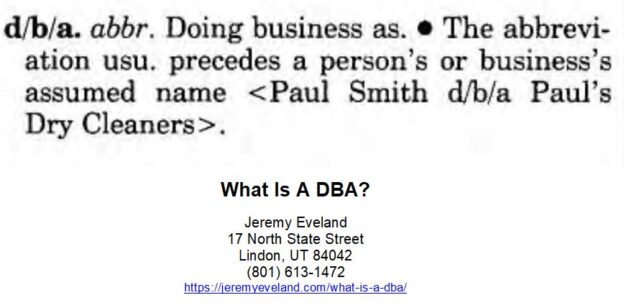
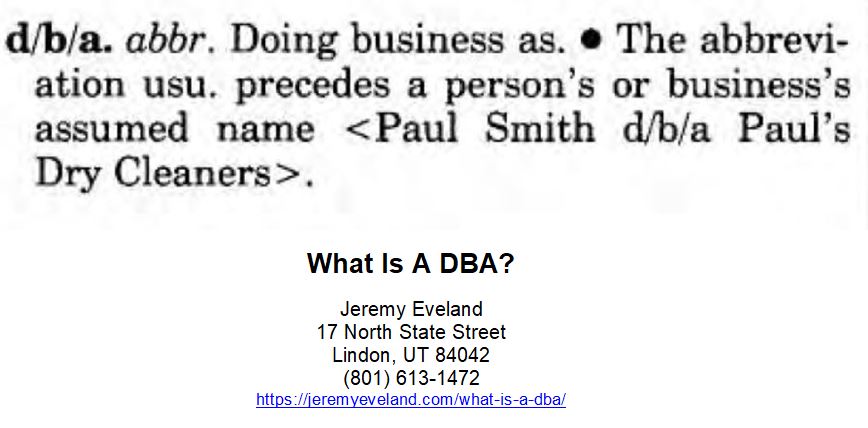
A DBA, or Doing Business As, is a type of business structure that allows an individual or company to operate under a name that is different from their legal name. A DBA is also sometimes referred to as an alias, assumed name, fictitious business name, or trade name. For example, a business owner operating under their own name might file a DBA to do business as “ABC Widgets,” rather than their own name.
When registering a DBA, the business owner is usually required to submit a form to the county or state in which they are doing business. This form typically includes the name of the business, the address of the business, and the name and address of the business owner. Depending on the state, the owner may also be required to publish a notice in a local newspaper or other periodical, alerting the public of the DBA registration.
In most cases, a DBA does not provide the same legal protections as a corporation or limited liability company (LLC). Without registering as a separate business entity, the business owner remains personally liable for any debts and obligations associated with the business. A DBA also does not offer the same tax advantages, as the business is still taxed as a sole proprietorship or partnership
Business Structures in Utah
Business structure is a vital component of any successful organization. It is the way in which the business is set up and maintained, and it can have a significant effect on the company’s ability to operate effectively. In Utah, there are a variety of different business structures available, including sole proprietorships, limited liability companies (LLCs), corporations, and partnerships. Each of these structures offer different levels of protection and exposure to the owners and their businesses.
For example, a sole proprietorship is the simplest type of business structure. This is when one individual owns the business and is solely responsible for its operations. The owner may operate the business under their own name, or they may register a “doing business as” (DBA) name with the state. This DBA name must be unique and should be registered in the state’s database of business names. This will provide a degree of protection for the owner and their business from liability and taxation.
A limited liability company (LLC) is a more complex type of business structure. LLCs are popular in Utah due to their high degree of protection and flexibility when it comes to business operations. LLCs have a number of advantages, including limited liability protection for the owners, reduced filing fees, and the ability to manage the business in a way that suits the owners’ needs. In addition, LLCs provide tax and accounting benefits, such as the ability to pass tax credits onto their owners.
Partnerships are another popular business structure in Utah. This type of business structure is similar to a sole proprietorship in that two or more individuals own the business. However, partnerships offer the advantage of having two or more owners to share the risk of running the business. Partnerships also offer tax advantages, such as the ability to pass profits and losses onto the partners.
Finally, corporations are the most complex type of business structure. Corporations are owned by shareholders and managed by a board of directors. Corporations offer a number of advantages, including limited liability protection for the owners and the ability to raise capital through the sale of stock. However, corporations are subject to a number of regulations and taxes, so it is important to consider all of the options before making a decision.
No matter which type of business structure you choose, it is important to have a clear understanding of the regulations and laws that apply to your business. In Utah, the Division of Corporations and Commercial Code Administration is responsible for registering and managing businesses. It is also important to consider the fees associated with each type of business structure, as well as the time and energy it will take to set up the business. With careful thought and planning, however, the right business structure can provide a strong foundation for success.
Business Formation
Business formation is a critical step for entrepreneurs seeking to establish a business and start generating revenue. In Utah, business formation is typically accomplished by registering a dba name, sole proprietorship, legal name, business name, legal entity, or fictitious name. A dba name is a different name used by an individual or business to identify itself to the public, while a sole proprietorship is a business structure that is owned and operated by a single business owner. For a dba registration, business owners must file an application with their county clerk. Additionally, many states require a business owner to register a fictitious business name with the state.
When forming a sole proprietorship, a business owner typically uses his or her own name as the business name. In some cases, business owners may register a “trade name” which is a name other than their own personal name. This allows them to use a different name for the business that is more descriptive or easier to remember. In addition, many states require business owners to register a dba degree, which is an additional designation that they can use to identify the business.
When forming a legal entity, such as a general partnership or limited liability company, business owners must appoint a business administration to handle business affairs. This includes opening a business bank account, obtaining necessary permits and licenses, and filing all required paperwork with the state. Depending on the business structure, the business owners may be personally liable for any debts or obligations of the business. Therefore, it is important for business owners to understand the legal protections of the particular business structure they choose.
Noise levels and personal assets are two important considerations when selecting a business structure. For example, a sole proprietorship provides the greatest amount of legal protection for the business owner’s personal assets, but there is no limit on the amount of noise associated with the business. On the other hand, a limited liability company offers more legal protections for the business owner’s personal assets, but it also limits the amount of noise generated by the business.
The cost of business formation also varies depending on the type of business structure chosen. For example, the cost of filing a fictitious business name is typically lower than the cost of registering a dba or forming a legal entity such as a general partnership or limited liability company. Additionally, the state fees associated with forming a business may vary from state to state.
In conclusion, business formation is a critical step for entrepreneurs looking to launch a business. There are a variety of factors to consider, including the type of business structure selected, the cost associated with filing a fictitious business name or dba degree, and the legal protections of the particular business structure chosen. Additionally, many states require business owners to register a fictitious business name with the state. It is important for entrepreneurs to understand all of the options available to them when forming a business in order to ensure the most successful business formation.
DBA Lawyer Consultation
When you need legal help from a Business Lawyer about a DBA, call Jeremy D. Eveland, MBA, JD (801) 613-1472 for a consultation.
Jeremy Eveland
17 North State Street
Lindon UT 84042
(801) 613-1472
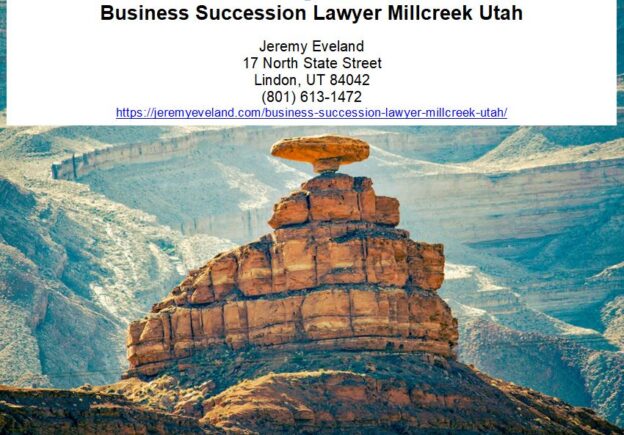
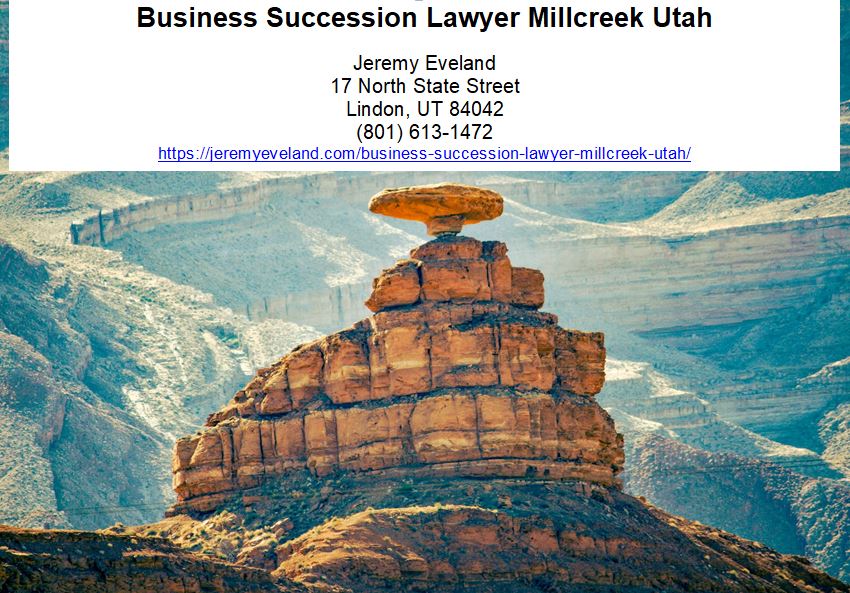
Millcreek, Utah is home to many businesses and entrepreneurs, and they all need the expertise of a business succession lawyer. A business succession lawyer is a legal professional who specializes in the area of business succession law. This type of law covers a variety of topics, including estate planning, business succession planning, transfer of ownership, asset protection, and taxation. A business succession lawyer in Millcreek, Utah can provide legal advice and services to business owners, entrepreneurs, and families in the area.
“Good things happen to those who hustle.” – Anais Nin
Good things (usually) don’t just fall into your lap, and there’s no use waiting around and hoping they will. Want to start a side hustle? Stop thinking and talking about it. Get started today, good things will happen when you work hard for them—and position yourself to identify which opportunities you can take advantage.
“The dream is free. The hustle is sold separately.”
It doesn’t cost you anything to dream—time, money, or hard work. Hustle, on the other hand, costs all of that.
“I am deliberate and afraid of nothing.” – Audre Lorde
Adopt a deliberate mindset, and do not be afraid to take chances. This motivational quote is a reminder that if you want to be successful, you will need to work like your life (style) depends on it.
“I began to realize how important it was to be an enthusiast in life. If you are interested in something, no matter what it is, go at it full speed ahead. Embrace it with both arms, hug it, love it, and above all become passionate about it. Lukewarm is no good. Hot is no good either. White hot and passionate is the only thing to be.” – Roald Dahl
When in doubt, don’t half-ass it. You can’t afford to.
“Remembering that you are going to die is the best way I know to avoid the trap of thinking you have something to lose. You are already naked. There is no reason not to follow your heart.” – Steve Jobs
It’s a bit nihilistic, but it’s also pretty damn motivating. What do you really have to lose in this life? Failure in business won’t kill you, and you’ll be able to get back into the game if you have the drive. Pick yourself up and hustle again.
Business succession lawyers in Millcreek, Utah can provide legal services to business owners, entrepreneurs, and families in the area. They can provide advice on how to structure a business entity, such as a sole proprietorship, partnership, limited liability company (LLC), or corporation. They can also provide advice on how to draft a valid succession plan, which is the document that will outline the ownership and control of the business. They can also provide advice on how to transfer ownership and control of a business in the event of a death or disability.
“You can’t use up creativity. The more you use, the more you have.” – Maya Angelou
The best way to get your side hustle moving is to flex those creative muscles. No matter how small or seemingly insignificant. The act of exercising your creative muscle will help you perfect your craft and become even better. Create. Create. Create.
“I always did something I was a little not ready to do. I think that’s how you grow. When there’s that moment of, ‘Wow, I’m not really sure I can do this,’ and you push through those moments, that’s when you have a breakthrough.” – Marissa Mayer
Never stop challenging yourself. The day you do, you’re falling behind. Do things you’re a little not-ready-to-do yet. That’s how you grow and have breakthroughs.
“Never let go of that fiery sadness called desire.” – Patti Smith
If you lose your ambition, you’ve lost the drive to succeed. Keep that desire to be something greater burning inside of you, and bookmark this motivational quote—it’ll get you through the tough times that lie ahead.
“Challenges are gifts that force us to search for a new center of gravity. Don’t fight them. Just find a new way to stand.” – Oprah Winfrey
If you feel like your side hustle is hitting a roadblock, reframe it: It’s adjusting its center of gravity. This motivational quote is inspiration to constantly adapt in the face of challenges. Any time you feel procrastination creeping in, strive to be aware of it and treat it like a plague—stop procrastinating the moment you realize you’re doing it and find a reward for completion of the milestone.
“What would you do if you weren’t afraid?” – Sheryl Sandberg
Take a minute to think about that one. If truly nothing was stopping you, nothing in your way, nothing to be afraid of, what would you do? This is an inspiration to do exactly that. Right now. What are you waiting for? Should you quit your job to pursue your side project that’s gaining momentum? Well, maybe. You tell me. What are you afraid of?
“It is not true that people stop pursuing dreams because they grow old. They grow old because they stop pursuing dreams.” – Gabriel García Márquez
Your passion for your dream will keep you young and invigorated. This is a reminder not to fall into the trap of contentment, laziness, or stagnation. Find a business idea that helps you achieve your most meaningful goals in life—and keep pushing towards it until you’re there.
Business succession law is an important area of the law that business owners, entrepreneurs, and families should have a basic understanding of. This type of law deals with the transfer of ownership and control of a business from one generation to the next. This law is especially important for businesses that are structured as partnerships or limited liability companies (LLCs). Business succession law also covers estate planning, which is the legal process of managing and protecting the assets of an individual or family.
“I don’t count my sit-ups; I only start counting when it starts hurting because they’re the only ones that count.” – Muhammad Ali
Going through the routine isn’t good enough, and more importantly, it’s not going to keep pushing you to grow. This is a reminder that the only way to get to the zone where you’re growing, and pushing the limits, is to continue to push yourself beyond your comfort zone.
“One, remember to look up at the stars and not down at your feet. Two, never give up work. Work gives you meaning and purpose and life is empty without it. Three, if you are lucky enough to find love, remember it is there and don’t throw it away.” – Stephen Hawking
“Innovation distinguishes between a leader and a follower.” – Steve Jobs
Are you imitating or innovating? Keep asking yourself that as you pursue your work, and use this motivational quote to push yourself in the right direction and strive to be a leader.
“I have not failed. I’ve just found 10,000 ways that won’t work.” – Thomas Edison
No one has ever done anything important (perfectly) on the first try—failing once or even dozens of times—should never mean failing forever. When you fail with a big project, don’t land a new client you’ve been pitching, under-deliver on the results you were expecting, or get down about a cold email that went unanswered, always limit the amount of time you allow for being discouraged, to no more than an afternoon. After that, it’s time to dust yourself off, figure out where you went wrong, and start hustling again.
“Do not go where the path may lead, go instead where there is no path and leave a trail.” – Ralph Waldo Emerson
It’s easier to follow established career paths and societally acceptable professions, but if that’s not going to make you the happiest version of yourself—then it’s your responsibility to deviate from the path. Welcome to entrepreneurship. Leaders carve out their own path instead of following the masses and you should inspire others to follow you. You can’t expect people to flock to your cause; give them a compelling reason that they won’t be able to ignore you any longer.
“You gotta run more than your mouth to escape the treadmill of mediocrity. A true hustler jogs during the day, and sleepwalks at night.” – Jarod Kintz
Basically, put your money where your mouth is. Don’t just tell everyone about that great idea of your, those dreams of owning your own business—this is a reminder to actually make daily progress towards bringing it to life. Learn the skills you’ll need to excel, take the right online business courses to level up your game, network with the right people, find mentors. Don’t make excuses—hustle hard.
“Lift up the weak; inspire the ignorant. Rescue the failures; encourage the deprived! Live to give. Don’t only hustle for survival. Go, and settle for revival!” – Israelmore Ayivor
If you’re doing what you do for just you, you’re probably doing it wrong. Strive to do better, give back, and inspire others. This is a reminder that there’s plenty of room for generosity in the hustle. And when you do pay it forward, the benefits you will experience come back tenfold.
“Hustle until you no longer need to introduce yourself.” – Anonymous
No one asks Bill Gates who he is, use this to achieve greatness—remind yourself of that and you can’t lose in the long run.
“Things work out best for those who make the best of how things work out.” – John Wooden
Success almost never comes in a neat package. This motivational quote will remind you to make the best of what you have, and what happens even if you fail.
“If you are not willing to risk the usual, you will have to settle for the ordinary.” – Jim Rohn
Mediocre is easy. It takes work to become truly great. Learn to love the hustle. If you want mediocrity, invest in a low risk, low return lifestyle.
You want to fulfill your dreams as an entrepreneur? You’re going to have to hustle a lot.
Business Succession Lawyer Millcreek Utah Consultation
To talk through a business succession matter in Millcreek with Jeremy Eveland, get in touch through the contact page or call (801) 613-1472. Consultations are handled statewide.
When you need legal help with a business succession in Millcreek Utah, call Jeremy D. Eveland, MBA, JD (801) 613-1472.
Jeremy Eveland
17 North State Street
Lindon UT 84042
(801) 613-1472
Business transaction lawyers provide a wide range of legal services that focus on the legal needs of businesses and other organizations. A business transaction lawyer is a lawyer that specializes in areas such as corporate law, contracts, finance, property, tax, and employment law. Business transaction lawyers provide legal advice and counsel to their clients in order to ensure that all legal aspects of a business transaction are handled properly. Business transaction lawyers also assist in the resolution of disputes that may arise from business transactions.
Business transaction lawyers may work for a law firm, or they may be employed by a company or other organization. In some cases, business transaction lawyers may work from their own offices. Business transaction lawyers may work in many different sectors and locations, including London, Houston, New Jersey, and other locations in the United States. Business transaction lawyers may practice in many different areas of law, including corporate law, contract law, finance, property, tax, and employment law. When you need a Business Transaction Lawyer in Salt Lake City Utah you should give us a call at (801) 613-1472.
Business transaction lawyers may also provide legal advice and counsel to clients on a variety of matters, including business transactions, contract agreements, and dispute resolution. They may also provide legal advice on the use of technology in business transactions, as well as on estate planning, debt recovery, and capital markets. Business transaction lawyers may also provide counsel on areas such as intellectual property, commercial law, employment law, and data protection.
Business transaction lawyers may specialize in certain sectors, such as banking, healthcare, energy, media, real estate, and life sciences. A business transaction lawyer may also provide legal counsel to clients in other specialist sectors, such as financial institutions, financial services, construction, and dispute resolution. Business transaction lawyers may also provide legal advice for companies and other organizations that are involved in transactional law, such as mergers and acquisitions, corporate restructuring, and franchise agreements.
Business transaction lawyers may also provide legal advice to clients on matters such as limited liability companies, liquidated damages, and contractual agreements. Business transaction lawyers may also provide advice to clients on matters such as sourcing, counsel, and due diligence in business acquisitions. They may also provide legal counsel to clients on matters such as breaching of contracts, remedies, and remedy.
Business transaction lawyers may have offices located in the United Kingdom, the United States, or other countries. Some business transaction lawyers may also have offices located in multiple locations around the world. Business transaction lawyers may also have a head office located in one location, such as London, and then have offices located in other locations, such as Houston, New Jersey, or other countries.
Business transaction lawyers may also provide legal advice to clients on a variety of other matters, such as ESG, legal outlook, private equity, and legal services. Business transaction lawyers additionally implements legal counsel to clients on a variety of other matters, such as business transactions, dispute resolution, transactional law, and legal advice. Business transaction lawyers may also provide legal advice to clients on a variety of other matters, such as transactional lawyers, financial services, and dispute resolution. Business transaction lawyers may also provide legal counsel to clients on a variety of other matters, such as transactional law, corporate law, employment law, and contract law.
In addition to providing legal advice and counsel, business transaction lawyers may also provide clients with a range of other services, such as legal research, drafting of documents, and negotiation of contracts. Business transaction lawyers may also provide clients with a range of other services, such as legal analysis, legal document preparation, and dispute resolution. Business transaction lawyers may also provide clients with a range of other services, such as legal education and training, and legal representation.
Business transaction lawyers may also provide clients with a variety of other services, such as advice on mergers and acquisitions, capital markets, and debt recovery. Business transaction lawyers may also provide clients with a variety of other services, such as advice on corporate restructuring, sourcing, and due diligence. Business transaction lawyers may also provide clients with a variety of other services, such as advice on franchising, liquidated damages, and contractual agreements.
The Law For Businesses
Business law encompasses all of the laws that dictate how to form and run a business. This includes all of the laws that govern how to start, buy, manage and close or sell any type of business. Business laws establish the rules that all businesses should follow. A savvy businessperson will be generally familiar with business laws and know when to seek the advice of a licensed attorney. Business law includes state and federal laws, as well as administrative regulations. Let’s take a look at some of the areas included under the umbrella of business law. Much of business law addresses the different types of business organizations. There are laws regarding how to properly form and run each type. This includes laws about entities such as corporations, partnerships and limited liability companies. There are many laws that concern managing a business because there are many aspects involved in managing. As you can already see, running a business will involve a lot of employment law and contract law.
While Utah has not yet adopted the Uniform Deceptive Trade Practices Act, the state has enacted several statutes within its Consumer Protection and Criminal sections that prohibit sellers from intentionally misleading buyers. These laws prohibit everything from mislabeling food products to altering a used car’s odometer. Utah’s laws prohibiting deceptive trade practices are generally limited to prosecuting scams after they happen. Therefore, consumers must do their best to avoid these swindles before they happen. A state consumer protection office can give you the most up-to-date information on local scams, and receive reports about a person or local business engaging in deceptive business practices. State deceptive trade statutes can be as confusing. If you would like legal assistance regarding a consumer fraud or a possible deceptive trade practices matter, you can consult with a Utah consumer protection attorney. In Utah, pyramid and Ponzi schemes are illegal under the Pyramid Scheme Act. A pyramid scheme is a sales device or plan where a person makes what is essentially a worthless investment that is contingent upon procuring others who must also invest and procure other investors, thereby perpetuating a chain of people. The Beehive State outlaws participating in, organizing, establishing, promoting, or administering a pyramid scheme. Pyramid or Ponzi schemes are also considered deceptive acts or practices prohibited under Utah’s Consumer Sales Practices Act. The following is a quick summary of Utah pyramid and Ponzi scheme laws.
Utah Pyramid and Ponzi Scheme Laws
What is prohibited: Knowingly participating in, organizing, establishing, promoting, or administering a pyramid scheme. Knowingly organizing, establishing, promoting, or administering a pyramid scheme is a third-degree felony punishable by up to 5 years in prison and up to $5,000 in fines. Knowingly participating in a pyramid scheme and receiving compensation for procuring other investors is a Class B misdemeanor punishable by up to 6 months in prison and up to $1,000 in fines. An injured party may file an action to recover damages and the court may also award interest, reasonable attorney’s fees, and costs. A pyramid or Ponzi scheme is also a deceptive act or practice and under the Consumer Sales Practices Act, the Division of Consumer Protection may issue a cease-and-desist order and impose up to $2,500 in administrative fines for each violation. The Division of Consumer Protection may also seek a restraining order or injunction to stop a pyramid or Ponzi scheme. If the injunction is violated, the court may impose up to $5,000 each day in fines for each violation.
Wage and hour laws help ensure that employees are paid a fair wage by providing them with certain rights. The federal wage and hour laws are contained in the Fair Labor Standards Act (FLSA), and provide minimum standards that the state laws may not dip below. States have the power to enact their own wage and hour laws, as long as the state law doesn’t violate the federal FLSA. Utah has chosen to enact its own minimum wage rule, and the following chart provides a brief overview of this law.
Utah’s minimum wage law doesn’t apply to the following workers:
• Any employee entitled to a Federal minimum wage as provided in 29 U.S.C. Sec. 201 et seq. of the FLSA
• Outside sales persons
• Employee who are members of the employer’s immediate family
• Employees who provide companionship services to people who (because of age or infirmity) aren’t able to care for themselves
• Casual and domestic employees
• Seasonal employees of nonprofit camping programs, religious, or recreational programs, and nonprofit or charitable organizations
• Employees of the USA
• Prisoners employed through the prison system
• Agricultural employees who mainly produce livestock, harvest crops on a piece rate basis, worked as an agricultural employee for less than 13 weeks during the previous year, or retired and performs incidental work as a condition of residing on a farm
• Registered apprentices or students employed by their educational institution, or
• Seasonal hourly employees employed by a seasonal amusement park
Employing Minors
A “minor” is any person under 18 years old. In Utah, a minor employee must be paid at least $4.25 per hour for the first 90 days working for a particular employer, and then the minor must be paid a minimum wage of $7.25 per hour.
Tipped Employees
A “tipped employee” is a worker who regularly receives tips from customers. For example, waiters and waitresses are traditionally tipped employees. An employer may credit tips received by tipped employees against the employer’s minimum wage obligation. An employee must receive at least $30.00 in tips per month before the credit is allowed. Tipped employees can be paid as little as $2.13 per hour, so long as this base pay combined with the employee’s tips equals at least $7.25 per hour.
Additional information about tipped employees
• Service charges that are imposed on a customer don’t qualify as tips
• Tip pooling or sharing among employees who regularly receive tips qualifies
• Dishwashers, chefs, cooks, janitors, and other employees who don’t regularly receive tips from customers don’t qualify as tipped employees
Enforcement of the Minimum Wage
If an employer in Utah repeatedly violates the minimum wage law outlined above, that employer has committed a Class B misdemeanor. A Class B misdemeanor is punishable by up to six months in jail, and/or a fine of up to $1,000. An employee can bring a civil action against his employer in order to enforce his rights under Utah’s minimum wage laws. If the employee wins in court then he is entitled to injunctive relief and may recover the difference between the wage paid and the minimum wage, plus interest. If you’re an employee in Utah and feel that your employer has violated Utah’s state labor laws, you can file a claim with the Division of
Antidiscrimination and Labor
• A “workweek” can be any 168 consecutive hours. The FLSA allows employers to set their own workweek. Overtime hours must be paid at a rate of at least 1½ of the employee’s standard pay rate.
Utah Antitrust Laws
As consumers, we’re always wondering what’s going on behind the scenes in the “free market.” Are a few companies conspiring to set an inflated price? Or uniting to artificially control supply? And fellow businesses may wonder if their competitors are colluding in an effort to undercut competition. As long as the battle for sales is open, transparent, and above board, we’re generally okay with it. That’s why the State has strict laws created to make sure pricing is fair and to protect open markets. State antitrust laws prohibit companies gaining an unfair competitive advantage in the consumer market via collusion between companies. These laws will also try to avoid monopolies by blocking certain mergers and acquisitions as well. In order to enforce these provisions, Utah law allows private citizens, as well as the state attorney general, to bring lawsuits against companies for antitrust violations. If successful, a citizen may recover attorneys’ fees and the cost of the lawsuit.
Antitrust Enforcement
Along with Utah’s antitrust statutes, there are numerous additional business regulations designed to protect free trade and commerce. The United States government uses two federal statutes, the Sherman Act and the Clayton Act, to assist states in prosecuting antitrust claims by prohibiting any interference with the ordinary, competitive pricing system, as well as price discrimination, exclusive dealing contracts and mergers that may lessen competition. If you suspect a person or business has committed an antitrust violation, you can report it the Utah Attorney General’s Markets and Financial Fraud Division. As with many statutes covering corporate malfeasance, state antitrust laws can be as complicated as the conspiracies they are intended to prevent. If you would like legal assistance regarding an antitrust matter, or if you are interested in understanding the rules and regulations regarding your business, you can consult with a Utah antitrust attorney in your area.
Interest Rates Laws
States may craft their interest rate laws depending on the type of credit or loan involved. By restricting the amount of interest a creditor can charge, these laws are designed to help consumers avoid crippling debt and deter predatory lenders. Utah’s maximum interest rate is 10% absent a contract, and charging more than the legal rate, (known as “usury”) is a felony. Interest Rates on Judgments Federal post-judgment interest rate as of Jan. 1 of each year plus 2%; judgment on contract shall conform to contract and shall bear interest agreed to by parties The easiest way to prevent the financial pitfalls of high interest rate credit cards is to avoid credit card debt entirely. This is certainly easier said than done, but one of the best strategies for staying out of debt is to use a credit card responsibly and pay off the entire balance quickly — every month, if possible. For those already in significant credit card debt, there could be consumer protections under federal law that can help.
Utah Civil Statute of Limitations Laws
All states have developed laws to regulate the time periods within which a person can bring a civil action against another person or entity. These laws are called the “statutes of limitations.” If you sue after this time limit has run, your claim is barred and the defendant will automatically win. Read on to learn more about Utah’s civil statute of limitations laws. The time period to sue doesn’t start to run until the person knew or should have known they suffered harm and the nature of that harm. For example, a woman takes a fertility medication to have a child. Fifteen years later, she discovers her child has a reproductive system problem that didn’t show up until puberty and it’s discovered that all of the women who took this fertility medication have children with the same defect. She wasn’t warned of this possible problem until the child was older. The child’s time limit to sue for damages didn’t start when her mom first took the medicine, but when she discovered or reasonably should have discovered the related harm to her. However, if the drug company had a national campaign exposing the problem and contacted all former users to inform them of the problem, and the child, now an adult, still waited 15 more years to sue, it would probably be too late. This is called the “discovery of harm rule” and generally doesn’t apply to the most common personal injury claims, like car accidents and slip and falls.
Tolling the Statute of Limitations
The time period to sue can be extended for various reasons, based on the legal concept of “tolling.” Generally, being under the age of majority, 18 years old in Utah, or having a mental disability causes the clock to stop. If someone suffered from severe mental illness for many years and was harmed during this time, it would be unfair to expect him or her to have the mental capacity to sue. Medical Malpractice Two years after discovering or reasonably should have discovered the injury caused by health care provider, but not more than four years from the date of act, omission, neglect, or occurrence
Business transaction lawyers may also provide clients with a variety of other services, such as advice on mergers and acquisitions, corporate restructuring, and dispute resolution. Business transaction lawyers may also provide clients with a variety of other services, such as advice on legal outlook, ESG, and private equity. Business transaction lawyers may also provide clients with a variety of other services, such as legal research and analysis, legal document preparation, and legal representation.
Business Transaction Law
Overall, business transaction lawyers provide clients with a wide range of legal services and advice, such as those related to corporate law, contracts, finance, property, tax, and employment law. Business transaction lawyers may also provide clients with a variety of other services, such as legal analysis, legal document preparation, and dispute resolution. Business transaction lawyers may also provide a range of services related to transactional law, such as mergers and acquisitions, corporate restructuring, and franchising. Business transaction lawyers may also provide a range of services related to intellectual property, commercial law, employment law, and data protection.
Business Transaction Lawyer Consultation
When you need legal help with a business transaction in Utah, call Jeremy D. Eveland, MBA, JD (801) 613-1472.
Jeremy Eveland
17 North State Street
Lindon UT 84042
(801) 613-1472